There are millions of species on Earth, so how do scientists decide whether two organisms belong to the same species, and how are the different species organised? This page covers what a species is, why courtship matters before mating, and how species are classified and named.
Defining a Species
What you need to know (from the AQA specification)
What you need to know (from the AQA specification)
Two organisms belong to the same species if they are able to produce fertile offspring.
Definition: Species
A species is a group of organisms that are able to interbreed and produce fertile offspring.
For example, horses breed with horses and produce fertile offspring. However, if two different species interbreed (e.g. a horse and a donkey produce a mule), the offspring are sterile and cannot reproduce.
Courtship Behaviour
What you need to know (from the AQA specification)
What you need to know (from the AQA specification)
Courtship behaviour as a necessary precursor to successful mating. The role of courtship in species recognition.
Courtship behaviour is a set of actions performed by animals before mating (for humans, this ‘set of actions’ could be described as similar to dating).
It is a necessary precursor to successful mating, and without it mating is unlikely to occur.
Role of Courtship in Species Recognition
Courtship signals allow individuals to identify members of their own species. Only individuals that produce and respond to the correct signals will mate.
This prevents interbreeding between species.
Courtship also helps an animal:
- Find a mate that is sexually mature (able to breed)
- Synchronise mating, so it happens when the female is most likely to be fertile
- Form a pair bond, which in some species helps the parents raise the young together
Examples of courtship behaviour:
- Peacock (male) performs elaborate rituals and dances for the female (called a peahen), fanning out vibrant feathers.
- Frogs use special advertisement calls to attract female frogs.
Why is species recognition through courtship important?
Why is species recognition through courtship important?
If individuals mated with members of a different species, the offspring might be sterile. Courtship signals act as a filter. Individuals respond only to the correct species-specific cues.
Phylogenetic Classification
What you need to know (from the AQA specification)
What you need to know (from the AQA specification)
A phylogenetic classification system attempts to arrange species into groups based on their evolutionary origins and relationships. It uses a hierarchy in which smaller groups are placed within larger groups, with no overlap between groups. Each group is called a taxon (plural taxa).
One hierarchy comprises the taxa: domain, kingdom, phylum, class, order, family, genus and species.
Recall of different taxonomic systems, such as the three domain or five kingdom systems, will not be required.
How are species organised?
Phylogenetic classification organises species according to their evolutionary origins and relationships.
Species that share a more recent common ancestor are grouped more closely together.
Key features of the system:
- Arranged as a hierarchy.
- Groups are nested within larger groups
- No overlap between groups.
- Each organism belongs to exactly one group at each level
- Each group is called a taxon (plural: taxa)
- See these on the diagram below
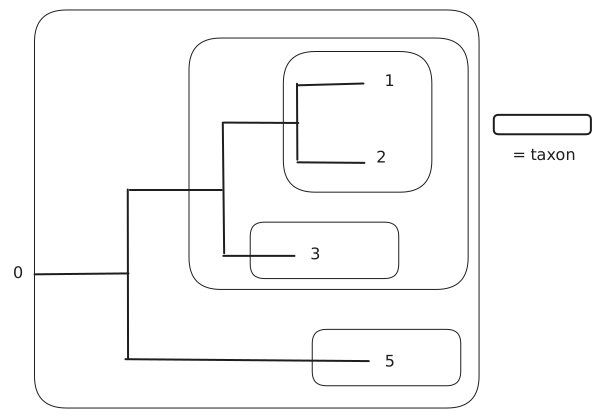
Exam questions often ask you to interpret phylogenetic trees. Try these questions below:
Name the taxa shown in the diagram above.
Name the taxa shown in the diagram above.
The diagram shows 5 taxa (each box is one taxon):
- {1, 2}: species 1 and 2 share the most recent common ancestor
- {3} and {5}: each on its own
- {1, 2, 3}: a larger taxon. Species 1, 2 and 3 all descend from an earlier common ancestor
- {1, 2, 3, 5}: the largest taxon. All the species descend from ancestor 0
The taxa are nested inside each other with no overlap. This is what makes it a hierarchy.
Using the diagram above, which organism is most closely related to organism 1?
Using the diagram above, which organism is most closely related to organism 1?
Organism 2. Species 1 and 2 share the most recent common ancestor: their branches meet at a branch point closer to the tips than any other pair. The more recently two branches meet, the more closely related the organisms are.
Using the diagram above, which organism diverged first from the common ancestor (0)?
Using the diagram above, which organism diverged first from the common ancestor (0)?
Organism 5. Its branch splits off at the first branch point after the common ancestor (0), before any other branching happens. This means 5 diverged earliest and is the most distantly related to all the others.
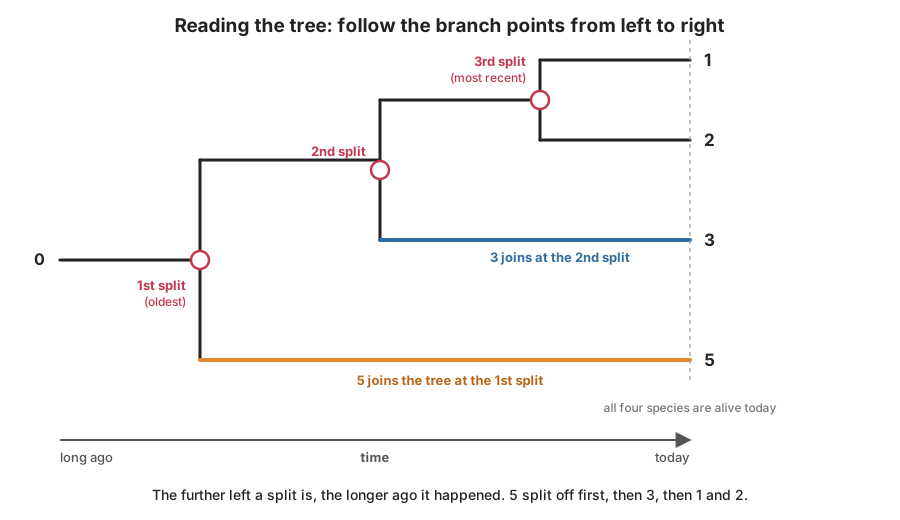
Follow the branch points from left to right, like a timeline: the further left a split is, the longer ago it happened.
The Hierarchy
Phylogenetic classification tells you why organisms are grouped together, because they share a common evolutionary ancestor. The hierarchy of taxa tells you how groups are arranged.
From broadest to most specific:
| Level | Example (humans) |
|---|---|
| Domain | Eukarya |
| Kingdom | Animalia |
| Phylum | Chordata |
| Class | Mammalia |
| Order | Primates |
| Family | Hominidae |
| Genus | Homo |
| Species | sapiens |
You don’t need to learn these example names: they just show how each level works, using humans. What you need to know is the order of the levels.
Mnemonic: Dear King Philip Came Over For Good Soup
What you do NOT need to know
You do not need to recall the three-domain system or the five-kingdom system by name. These will not be tested.
What does it mean for two species to share a more recent common ancestor?
What does it mean for two species to share a more recent common ancestor?
It means they diverged from a shared ancestor more recently in evolutionary time. On a phylogenetic tree, the closer two species’ branches meet (the nearer their shared branch point is to the tips), the more recently they diverged and the more closely related they are.
Binomial Nomenclature
What you need to know (from the AQA specification)
What you need to know (from the AQA specification)
Each species is universally identified by a binomial consisting of the name of its genus and species, eg, Homo sapiens.
Every species is given a unique two-part Latin name:
- First name: the genus (capitalised, e.g. Homo)
- Second name: the species (lower case, e.g. sapiens)
Written in italics (or underlined if handwritten): Homo sapiens
This binomial system is used internationally, so scientists in any country refer to the same organism by the same name, regardless of local common names/differences.
Andrena chlorogaster, Andrena piperi and Peponapis pruinosa are three species of bee. What do their names suggest about how they are related?
Andrena chlorogaster, Andrena piperi and Peponapis pruinosa are three species of bee. What do their names suggest about how they are related?
A. chlorogaster and A. piperi are more closely related to each other than to P. pruinosa, because they’re in the same genus (Andrena). Species in the same genus share a more recent common ancestor.
Make your answer a comparison: “more closely related to each other than to P. pruinosa”.
Investigating Evolutionary Relationships
What you need to know (from the AQA specification)
What you need to know (from the AQA specification)
Students should be able to appreciate that advances in immunology and genome sequencing help to clarify evolutionary relationships between organisms.
Traditional classification relied on comparing observable (phenotypic) characteristics. This is less accurate because:
- Unrelated species can look similar, and closely related species can look very different
- Characteristics are affected by the environment as well as genes (e.g. height, weight)
- It’s subjective, so scientists can disagree about which features matter most
Modern techniques allow more accurate comparison by looking directly at the molecules:
Molecular Comparisons
- DNA base sequence: comparing the base sequences of genes across species
- mRNA base sequence: comparing base sequences of mRNA produced by specific genes
- Amino acid sequence of proteins: comparing the primary structure of proteins coded for by shared genes
Species with more similar sequences share a more recent common ancestor and are more closely related.
Why do we use all three (DNA, mRNA and amino acid sequences)?
Why do we use all three (DNA, mRNA and amino acid sequences)?
They don’t show the same amount of difference:
- DNA shows the most differences, because it includes non-coding DNA (e.g. introns), where changes don’t affect the protein
- mRNA only contains the coding parts (exons), because the introns have been removed
- Amino acid sequences show the fewest differences, because the genetic code is degenerate: a base change may not change the amino acid (see DNA and protein synthesis)
So DNA gives the most detail (useful for very closely related species), while proteins change more slowly (useful for comparing distantly related species).
Why doesn't the mRNA base sequence exactly match the DNA base sequence of the gene it came from?
Why doesn't the mRNA base sequence exactly match the DNA base sequence of the gene it came from?
The DNA gene contains both introns (non-coding) and exons (coding). When the gene is transcribed, the introns are removed during splicing before the mRNA leaves the nucleus. So the mature mRNA only contains the exons, meaning its base sequence doesn’t match the full DNA gene sequence.
Immunological Comparisons
If a protein from one species is put into a different species, the protein acts as an antigen, because the second species’ immune system sees it as foreign. That species then produces antibodies against the protein, which are complementary in shape to it.
Let’s look at an example:
- A protein from human blood (species 1) is injected into a rabbit (species 2), and the rabbit makes antibodies against it
- These antibodies are collected and mixed with the same protein from other species (e.g. a chimpanzee (species 3) and a dog (species 4))
- If the other species’ protein has a similar shape, the antibodies bind to it and form a precipitate (clumps)
The more precipitate forms, the more similar the protein is to the human one, so the more closely related that species is to humans. The chimpanzee’s protein would give lots of precipitate; the dog’s would give much less.
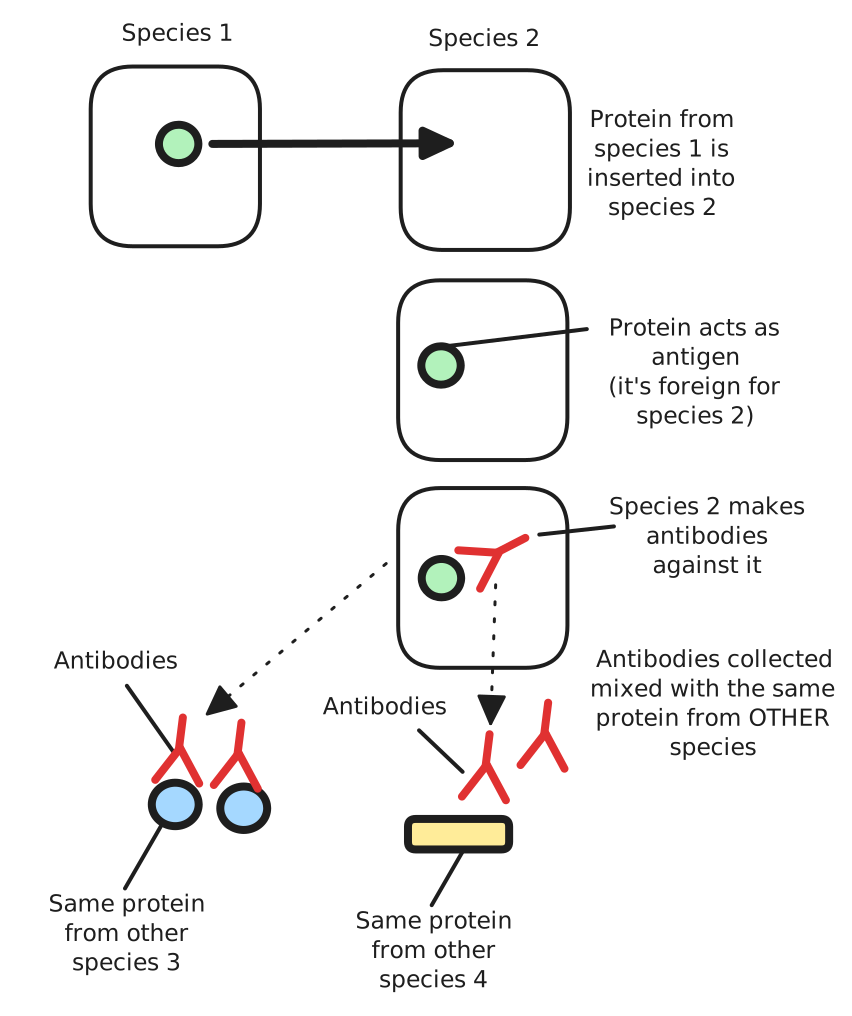
Antibodies against a protein from species 1 were mixed with the same protein from species 3 and species 4. Species 3 formed lots of precipitate; species 4 formed very little. Which species is more closely related to species 1, and why?
Antibodies against a protein from species 1 were mixed with the same protein from species 3 and species 4. Species 3 formed lots of precipitate; species 4 formed very little. Which species is more closely related to species 1, and why?
Species 3. Lots of precipitate means many antibodies bound, so species 3’s protein has a similar shape (a similar amino acid sequence) to species 1’s. Species 3 therefore shares a more recent common ancestor with species 1.
Species 4’s protein has a different shape, so few antibodies bound: it’s more distantly related.
How this topic is tested
This analysis is based on past paper data from 2017 to 2025. It is intended for interest only and is not predictive of what will appear in future papers.
- Tested in 8 of 9 years (2017–2025): 13 question parts worth 21 marks.
- 38th most-examined topic overall by marks, 5th in Unit 4.
Marks by year
Most-tested spec points
- Phylogenetic Classification: tested in 4 parts (7 marks)
- Species & Courtship Behaviour: tested in 3 parts (7 marks)
- The Taxonomic Hierarchy & Binomial Naming: tested in 4 parts (5 marks)
- Immunology & Genome Sequencing in Classification: tested in 1 part (1 marks)
Also links to: Interpreting Sequence Data.
Maths and practical skills
- Percentages, ratios and fractions (MS 0.3): e.g. 2024 P1 Q9.1
Tips from examiner reports
What students commonly get wrong
- Renamed species: new evidence, not new evolutionWatch out: species get renamed because of new evidence, e.g. comparing DNA base sequences, not because they have evolved or mutated. Include the word base: "DNA base sequencing", not just "DNA sequencing". 2023 P1 Q6.3
- Counting genera: look at the first nameWatch out: the first part of a binomial is the genus, so count the different first names, not the number of species. E.g. Chrysolina graminis, Chrysolina herbacea and Gastrophysa viridula are 3 species but only 2 genera (Chrysolina and Gastrophysa). 2025 P3 Q3.1
- Different species: explain the offspringWatch out: don't just say two organisms are different species. Explain why: they can't breed (e.g. their gametes can't fuse), or if they do, the offspring are not fertile. 2019 P1 Q7.3
Exam Question Practice
Courtship behaviour in the frog species, Xenopus laevis, involves male frogs calling to:
- attract sexually active females – these are advertisement calls
- start and continue mating – these are mating calls
- signal when a male is not sexually active – these are rasping calls.
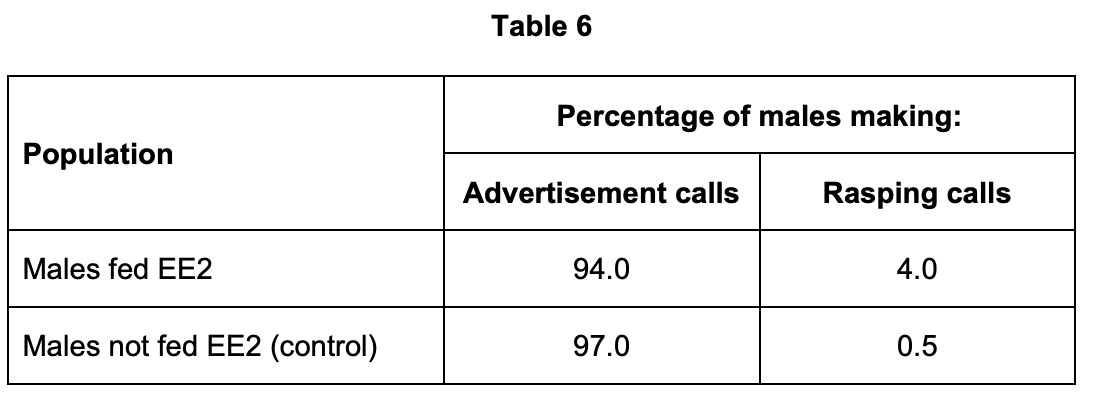
Scientists investigated frog courtship behaviour by feeding a population of sexually active male frogs a diet containing the hormone EE2. The scientists also fed a separate control population of sexually active male frogs a diet without EE2.
They determined the percentage of males making advertisement calls or rasping calls in each population.
Table 6 shows their results.
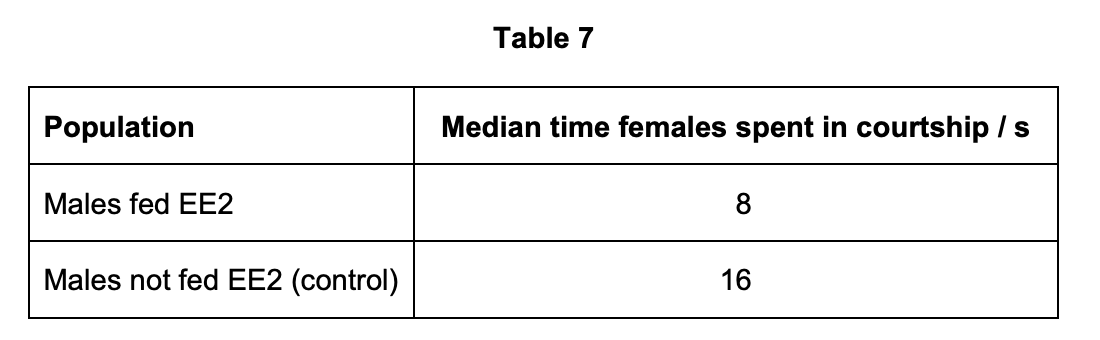
The scientists also investigated the effect on female frog courtship behaviour of feeding EE2 to male frogs.
Table 7 shows their results.
EE2 is contained in human contraceptive pills. Some EE2 is released in human urine and collects in sewage. Untreated sewage pollutes the water in frog habitats.
Suggest and explain the effect EE2 pollution in frog habitats will have on frog breeding.
Use information from Table 6 and Table 7 in your answer.
Effect on frog breeding = ________
Explanation = ________
(4 marks)
Hint
Use BOTH tables. For each call type change, think about its function - what consequence does changing that call have for breeding success?
Mark Scheme
Max 4 marks
(Effect on breeding)
- Less mating/breeding
OR Fewer offspring (1 mark)
(Explanation)
- Fewer advertisement calls, so females not attracted
OR Fewer advertisement calls, so males not located (1 mark) - Fewer mating calls as males less (sexually) active (1 mark)
- More rasping calls as (more) males not (sexually) active (1 mark)
- Less time spent in courtship (1 mark)
Comments from mark scheme
Tips from examiner reports
Tips from the examiner report
- Give the effect first: less mating/breeding, so fewer offspring
- Link each piece of data to its meaning: fewer advertisement calls so fewer females attracted; more rasping calls so more males not sexually active
- Use Table 7 correctly: females spent less time in courtship, not “fewer females”
- Use both tables; don’t just quote figures or describe trends
What earned marks
- Less time spent in courtship leading to fewer offspring
P. vivax evolved from a common ancestor in Africa. As humans migrated around the world, new strains of P. vivax evolved.
P. vivax is now extremely rare in Africa but there are several different strains of P. vivax in other parts of the world.
Figure 3 shows a phylogenetic diagram of the evolution of these different strains.
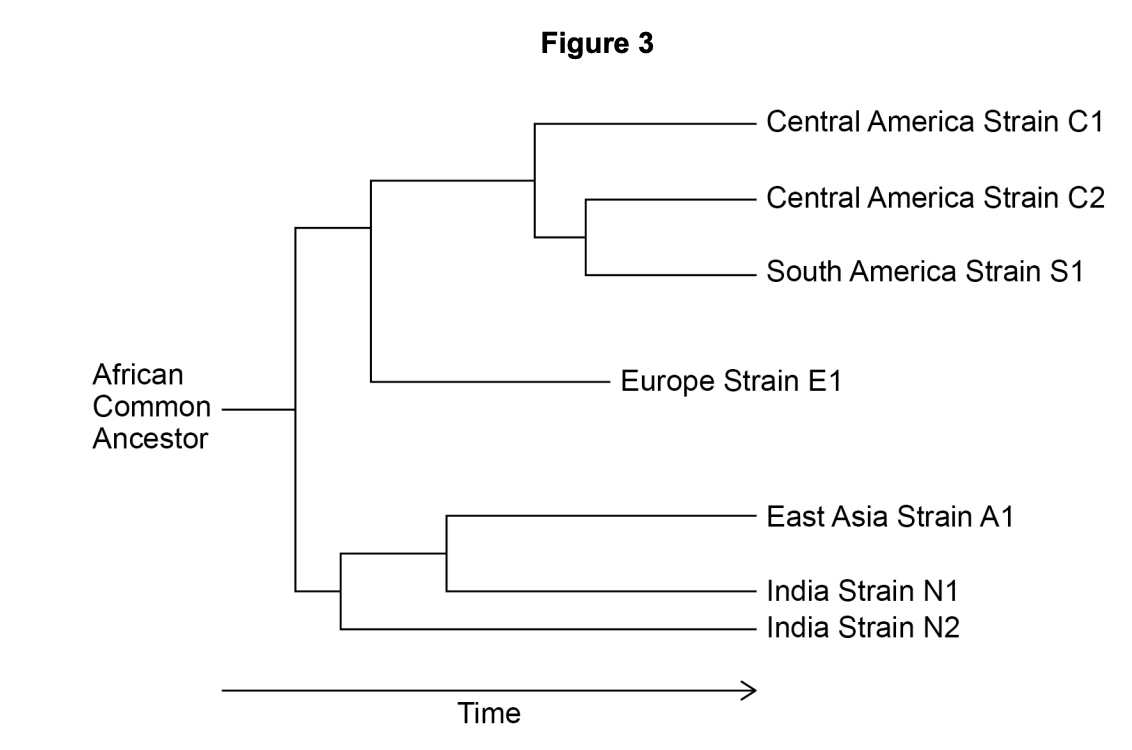
What does Figure 3 suggest is the order of human migration out of Africa?
Tick (✓) one box.
(1 marks)
Hint
Apply your knowledge of cell structures and their functions.
Mark Scheme
Answer key:
India, Europe, East Asia, Central America, South America (1 mark)
Tips from examiner reports
Tips from the examiner report
- Read the phylogenetic diagram from left to right: the earliest branch from the African ancestor is India (N2), then Europe (E1), then East Asia (A1), then Central America (C1), then South America (S1)
Scientists investigated the genetic diversity between several species of sweet potato. They studied non-coding multiple repeats of base sequences.
The percentage similarities in the non-coding multiple repeats of base sequences of four species of sweet potato are shown in Table 3.
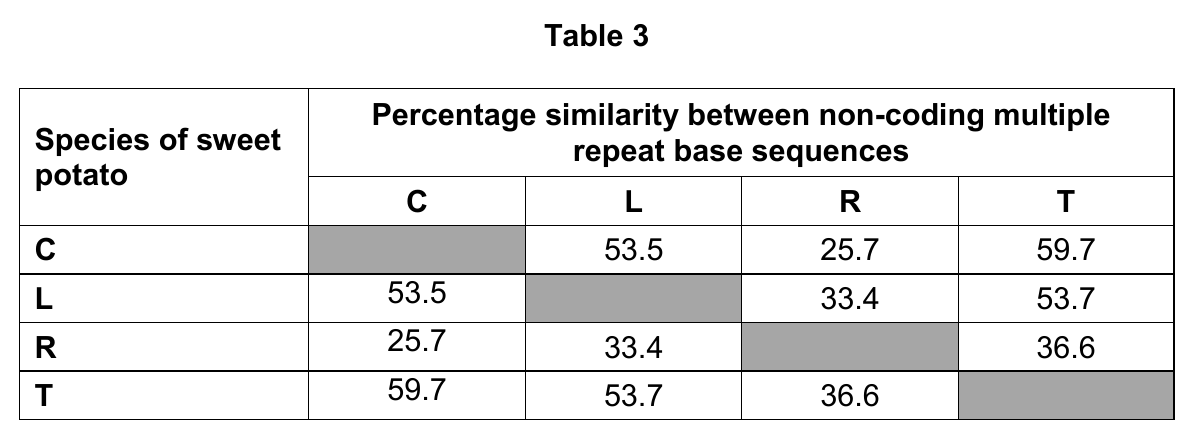
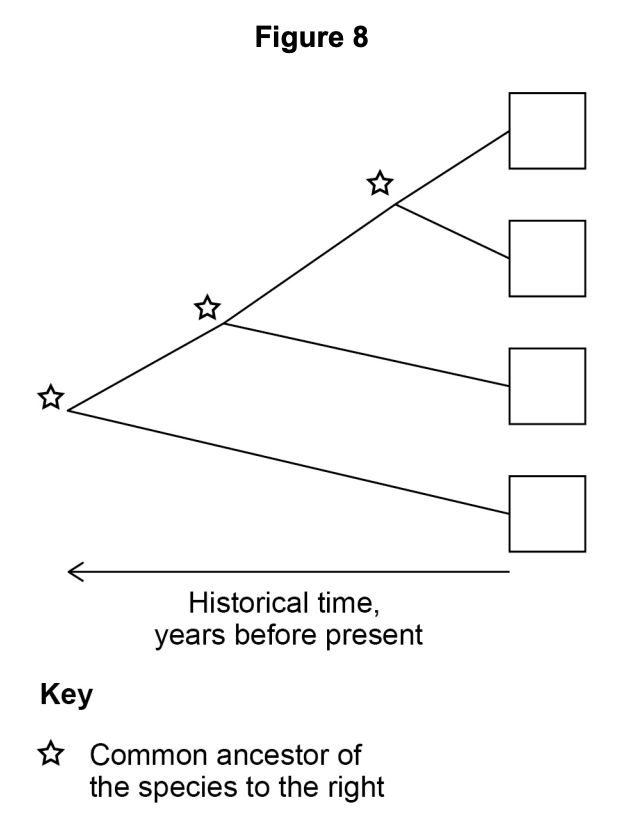
Use the information in Table 3 to complete the phylogenetic tree shown in Figure 8.
Write the letter that represents the correct species into each box.
(1 marks)
Hint
Which two species are most similar in Table 3? Which species is least similar to all the others?
Mark Scheme
Top to bottom C T L R
OR Top to bottom T C L R (1 mark)
Tips from examiner reports
Tips from the examiner report
- The species on a phylogenetic tree evolved from extinct common ancestors (the stars), not from one living species into another
- The two most similar species share the most recent common ancestor
Tansy, Tanacetum vulgare, is a plant that grows in dense patches. The tansy beetle, Chrysolina graminis, feeds on, and completes its life cycle on T. vulgare.
C. graminis is 8–10 mm long and green in colour.
Two other green beetles can also be found in the same habitat.
- The dock beetle, Gastrophysa viridula, which is 4–7 mm long.
- The mint leaf beetle, Chrysolina herbacea, which is 6–10 mm long.
Figure 2 shows the life cycle of C. graminis.
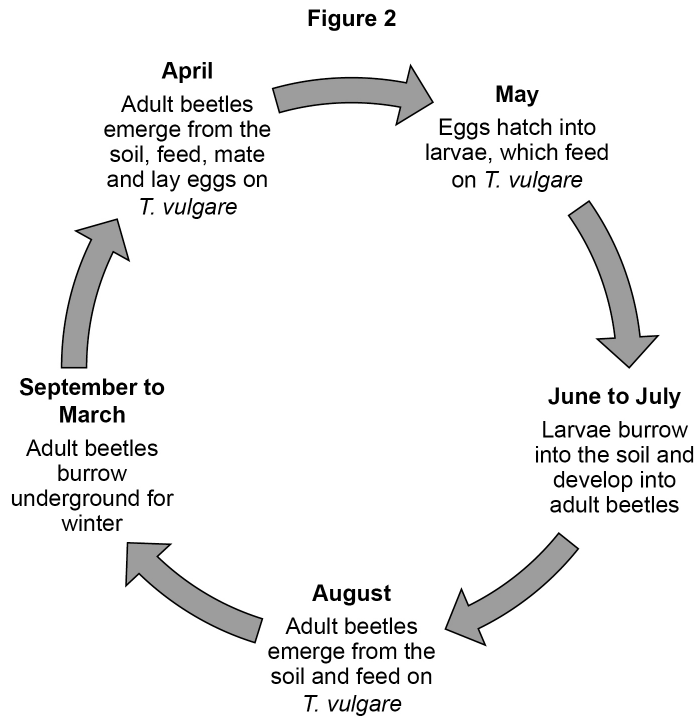
How many different genera of beetles are there in the information provided?
(1 marks)
Hint
The genus is the first word of each scientific name. How many different first words are there among the beetles?
Mark Scheme
- 2/two (1 mark)
Comments from mark scheme
If no number is present, accept Gastrophysa and Chrysolina alone
Tips from examiner reports
Tips from the examiner report
- Count genera, not species: the genus is the first word of the scientific name. Chrysolina appears twice, so there are two genera (Chrysolina and Gastrophysa). 3 (the number of beetle species) and 4 (all species) were common wrong answers
Suggest why several bacterial species have been renamed in recent years.
(1 marks)
Hint
What new molecular techniques allow more accurate classification? Be specific about what is being compared.
Mark Scheme
DNA/mRNA/RNA base sequencing
OR Amino acid sequencing
OR Use of electron microscopes with greater resolution
OR Use of electron microscopes and improved staining/preparation (1 mark)
Comments from mark scheme
Accept genome sequencing
Ignore detail OR magnification for resolution
Accept abbreviations TEM OR SEM in this instance
Tips from examiner reports
Tips from the examiner report
- Name the new evidence: DNA (or RNA) base sequencing, amino acid sequencing, or electron microscopes with greater resolution
- Include the word “base” in base sequencing
- “New technology” is too vague, and the bacteria haven’t evolved or mutated into new species
Maximum 3 marks for MP2 to MP5
4. Accept mature for active