Every species alive today, including humans, evolved from an earlier species. Over many generations, the allele frequencies in a population change, and given enough time, this can lead to new species.
You met natural selection in Unit 4. This page builds on it to explain how new species form.
Variation
What you need to know (from the AQA specification)
What you need to know (from the AQA specification)
Individuals within a population of a species may show a wide range of variation in phenotype. This is due to genetic and environmental factors. The primary source of genetic variation is mutation. Meiosis and the random fertilisation of gametes during sexual reproduction produce further genetic variation.
Students should be able to:
- explain why individuals within a population of a species may show a wide range of variation in phenotype
Individuals in a population can look very different from each other. This variation in phenotype comes from genetic factors, environmental factors, or both.
Genetic variation comes from:
- Mutation: The primary source of genetic variation, because it’s the only way new alleles are made. (The others listed below produce new combinations of alleles that already exist.)
- Meiosis produces new combinations of alleles in the gametes by:
- Random fertilisation:
- Any gamete can fuse with any other gamete, giving even more combinations
Environmental variation comes from:
- Conditions an organism lives in, e.g. diet affects body mass, and light affects how tall a plant grows.
- Two organisms with the same genotype can have different phenotypes due to environmental variation
Why is mutation called the primary source of genetic variation?
Why is mutation called the primary source of genetic variation?
Mutation is the only process that makes new alleles. Meiosis and random fertilisation produce new combinations of the alleles that already exist.
Tip
Mutations happen randomly. The environment doesn’t cause the mutation that later turns out to be useful. It only selects which alleles are passed on.
Natural Selection
What you need to know (from the AQA specification)
What you need to know (from the AQA specification)
Predation, disease and competition for the means of survival result in differential survival and reproduction, ie natural selection.
Those organisms with phenotypes providing selective advantages are likely to produce more offspring and pass on their favourable alleles to the next generation. The effect of this differential reproductive success on the allele frequencies within a gene pool.
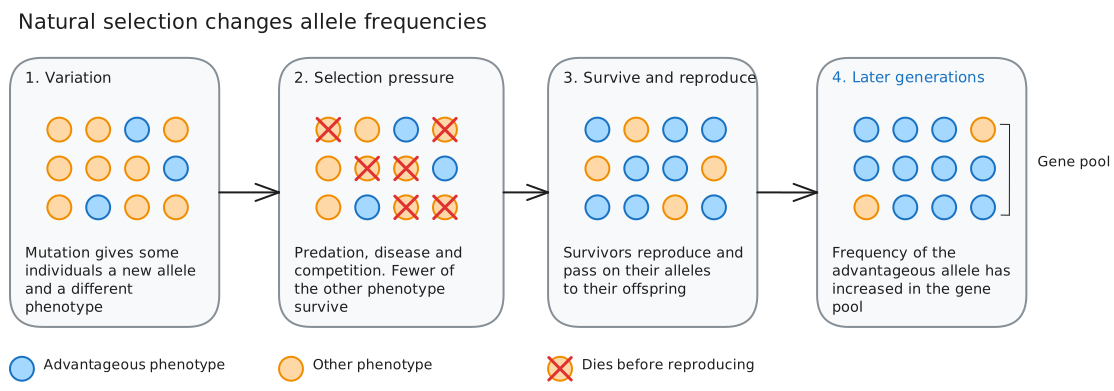
You met natural selection in Unit 4. In this topic, the focus is on what happens to the allele frequencies in the gene pool:
- There is variation in the population. One of the main causes is mutations, which happen randomly.
- Selection pressures such as predation, disease and competition mean that some phenotypes have a selective advantage (i.e. an advantageous phenotype, e.g. camouflage)
- Individuals with the advantageous phenotype are more likely to survive and reproduce. This is called differential survival and reproduction.
- They pass on their favourable alleles to their offspring
- Over many generations, the frequency of the advantageous allele increases in the gene pool
Evolution is a change in the allele frequencies in a population.
Tip
Say alleles, not genes, and “the allele frequency increases”, not “there are more alleles”. It’s the individuals that survive and reproduce, not the alleles.
Types of Selection
What you need to know (from the AQA specification)
What you need to know (from the AQA specification)
The effects of stabilising, directional and disruptive selection.
Evolution as a change in the allele frequencies in a population.
Selection can change a population in three ways. You met directional and stabilising selection in Unit 4. Disruptive selection is new to Unit 7.
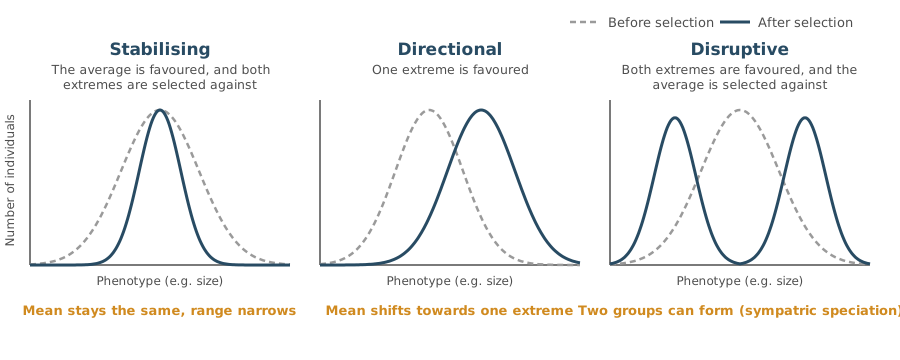
- Stabilising selection:
- The average phenotype is favoured, and both extremes are selected against.
- The mean stays the same, but the range gets narrower.
- This happens when the environment stays the same, e.g. human birth weight
- Directional selection:
- One extreme phenotype is favoured, so the mean shifts in that direction.
- This often happens when the environment changes, e.g. antibiotic resistance in bacteria
- Disruptive selection:
- Both extremes are favoured, and the average is selected against.
- Over time, this can split the population into two groups, e.g. if only very small and very large seeds are available, birds with small or large beaks do better than birds with medium beaks
Which type of selection is most likely to lead to a new species forming? Explain why.
Which type of selection is most likely to lead to a new species forming? Explain why.
Disruptive selection. It favours both extreme phenotypes and selects against the intermediate, so the population can split into two groups. If these groups stop interbreeding, their allele frequencies can keep changing separately until they become different species (see sympatric speciation below). Stabilising and directional selection keep the population as one group, so they are less likely to lead to speciation.
Genetic Drift
What you need to know (from the AQA specification)
What you need to know (from the AQA specification)
The importance of genetic drift in causing changes in allele frequency in small populations.
Students should be able to:
- explain why genetic drift is important only in small populations
Students could apply their knowledge of sampling to the concept of genetic drift.
Students could devise an investigation to mimic the effects of random sampling on allele frequencies in a population.
Students could use computer programs to model the effects of natural selection and of genetic drift.
Definition
Genetic drift is a change in allele frequency caused by chance, not by natural selection.
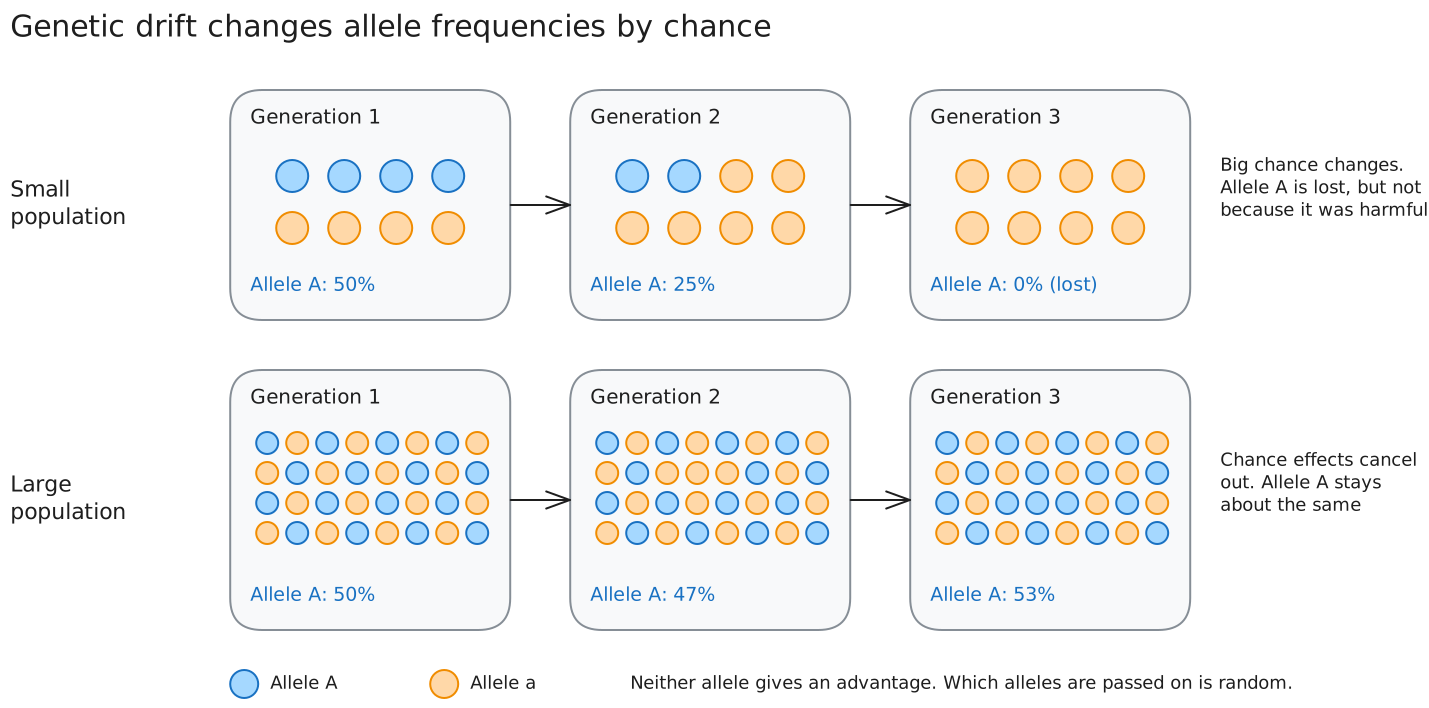
Each new generation only gets a random sample of the alleles from the one before. By chance, some individuals have more offspring than others, so some alleles are passed on more than others.
So allele frequencies can change between generations even when neither allele gives an advantage.
How much difference chance makes depends on population size:
- Large population: Chance effects mostly cancel out, so allele frequencies stay close to what they were in the previous generation
- Small population: A few chance events make a big difference, so allele frequencies can change quickly. An allele can even be lost completely (or become the only one left), whether or not it is advantageous
The image below shows how this works.
Why is genetic drift only important in small populations?
Why is genetic drift only important in small populations?
In a small population, only a few individuals reproduce, so chance decides a large share of which alleles are passed on. This can change allele frequencies a lot in one generation. In a large population, the chance effects even out, so allele frequencies stay much more stable.
Tip
Only use “genetic drift” when you mean a chance change in allele frequency, and say “allele frequencies”, not “gene frequencies”.
Speciation
What you need to know (from the AQA specification)
What you need to know (from the AQA specification)
Reproductive separation of two populations can result in the accumulation of difference in their gene pools. New species arise when these genetic differences lead to an inability of members of the populations to interbreed and produce fertile offspring. In this way, new species arise from existing species.
Allopatric and sympatric speciation.
Students should be able to:
- explain how natural selection and isolation may result in change in the allele and phenotype frequency and lead to the formation of a new species
A species is a group of organisms that can interbreed to produce fertile offspring. Speciation is when a new species forms from an existing one.
Key idea
Speciation depends on reproductive isolation. If two populations stop interbreeding, there is no gene flow between them, so their gene pools stay separate and differences can build up.
Steps of speciation
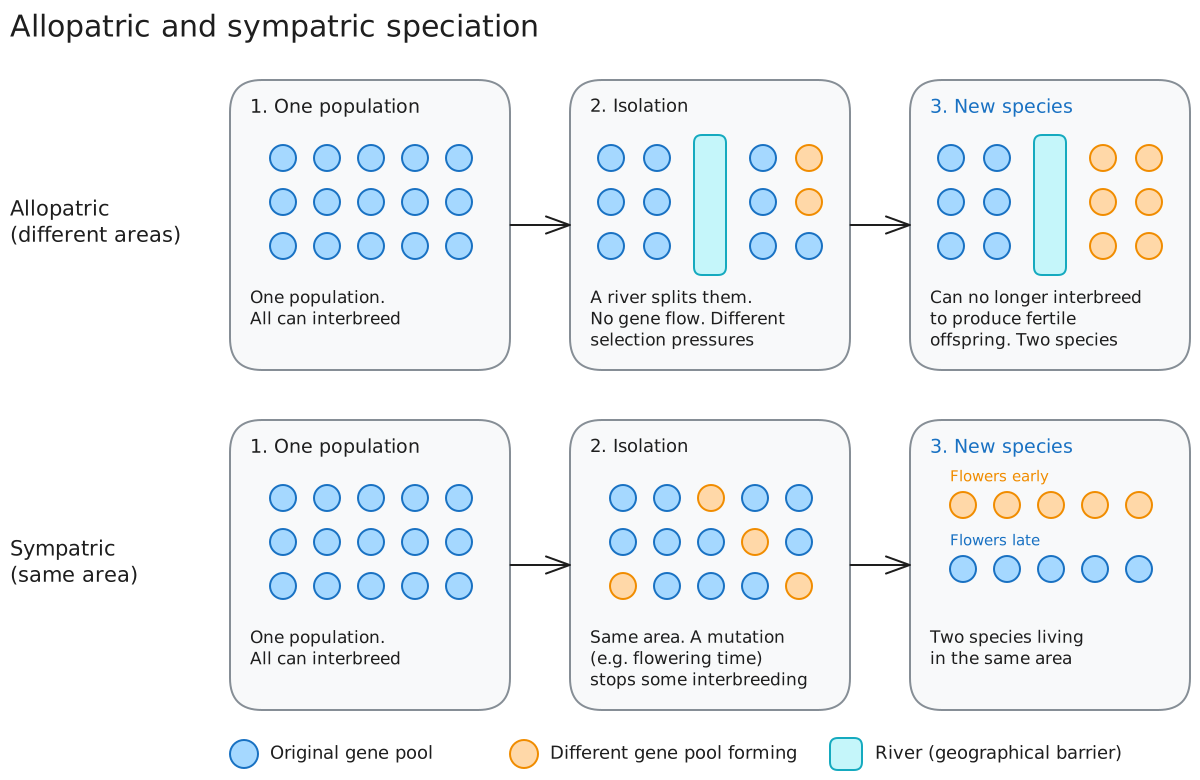
- A population is split into two groups that can’t interbreed (reproductive isolation), so there is no gene flow between them. This can be caused by a geographical barrier (allopatric) or happen in the same area (sympatric). See the two types below
- Mutations happen at random in each group, producing different new alleles
- The groups face different selection pressures (e.g. different climate, food or predators)
- Different alleles are selected in each group, so the allele frequencies change differently (genetic drift can also play a part, especially in small groups)
- Over many generations, the gene pools become so different that the groups can no longer interbreed to produce fertile offspring.
- They are now separate species.
Allopatric speciation
The populations are geographically isolated (physically separated), e.g. by a river, mountain range or sea. Because they live in different places, they often face different selection pressures.
Sympatric speciation
The populations live in the same area, so there is no geographical isolation. Something else stops them interbreeding, e.g.:
- a mutation changes the flowering time of some plants, so they can no longer cross-pollinate with the rest
- different courtship behaviour or mating preferences, so members of each group only mate with each other
- disruptive selection splits the population into two groups with different phenotypes
What's the difference between allopatric and sympatric speciation?
What's the difference between allopatric and sympatric speciation?
In allopatric speciation, the populations are geographically isolated (physically separated). In sympatric speciation, the populations live in the same area, but something else (such as different flowering times or behaviour) stops them interbreeding.
Tip
In an “explain how a new species formed” answer, work through the steps in order and use the context. Say what isolated the populations, then mutation, different selection pressures, the change in allele frequencies, and finish with “can no longer interbreed to produce fertile offspring”. For sympatric speciation, say that the populations are not geographically isolated.
Evolution and the Diversity of Species
What you need to know (from the AQA specification)
What you need to know (from the AQA specification)
Students should be able to:
- explain how evolutionary change over a long period of time has resulted in a great diversity of species.
Speciation has happened again and again over millions of years. Each new species can later split into further species, so one ancestral species can give rise to many. This is why there is such a great diversity of species today, and why closely related species share a recent common ancestor (see phylogenetic classification).
How this topic is tested
This analysis is based on past paper data from 2017 to 2025. It is intended for interest only and is not predictive of what will appear in future papers.
- Tested in 6 of 9 years (2017–2025): 16 question parts worth 49 marks.
- 20th most-examined topic overall by marks, 3rd in Unit 7.
Marks by year
Most-tested spec points
- Stabilising, Directional & Disruptive Selection: tested in 4 parts (18 marks)
- Reproductive Separation & Speciation: tested in 4 parts (17 marks)
- Natural Selection & Allele Frequency: tested in 5 parts (14 marks)
- Explaining Selection, Drift & Speciation: tested in 3 parts (14 marks)
- Genetic Drift: tested in 2 parts (4 marks)
- Sources of Variation in Phenotype: tested in 2 parts (4 marks)
Also links to: Populations, Gene Pools & Allele Frequency, The Process of Meiosis.
Maths and practical skills
- Percentages, ratios and fractions (MS 0.3): e.g. 2024 P3 Q5.2
- Units and standard form (MS 0.1): e.g. 2021 P2 Q10.2
Exam Question Practice
Past paper questions on this topic. Try each one before opening the answer.
Lactose is the main sugar in milk and is hydrolysed by the enzyme lactase. Lactase is essential to newborn mammals as milk is their only source of food. Most mammals stop producing lactase when they start feeding on other food sources. Humans are an exception to this because some continue to produce lactase as adults. The ability to continue producing lactase is known as lactase persistence (LP) and is controlled by a dominant allele. A number of hypotheses based on different selection pressures have been put forward to explain LP in humans.
One hypothesis for LP in humans suggests that the selective pressure was related to some human populations farming cattle as a source of milk.
Describe how farming cattle as a source of milk could have led to an increase in LP.
(4 marks)
Hint
Where did the LP allele first come from? What advantage would it give where milk is available, and what happens to its frequency over generations?
Mark Scheme
Max 4 marks
- LP due to mutation
OR Allele due to mutation (1 mark) - Milk provides named nutrient (1 mark)
- Individuals with LP more likely to survive and reproduce
OR Individuals with advantageous allele more likely to survive and reproduce (1 mark) - Directional selection (1 mark)
- Frequency of allele increases (in the offspring/next generation) (1 mark)
Comments from mark scheme
Tips from examiner reports
Tips from the examiner report
- The LP allele arose by mutation; drinking milk didn’t cause it
- Name a nutrient milk provides, then say people with the allele are more likely to survive and reproduce, so the allele frequency increases (directional selection)
- Say ‘allele’, not ‘gene’; it’s people, not alleles, that survive and reproduce
- LP is in humans, not cattle
Lord Howe Island in the Tasman Sea possesses two species of palm tree which have arisen via sympatric speciation. The two species diverged from each other after the island was formed 6.5 million years ago. The flowering times of the two species are different.
Using this information, suggest how these two species of palm tree arose by sympatric speciation.
(5 marks)
Hint
If the palms live in the same place, what stops them interbreeding? Follow it through to alleles and the definition of a species.
Mark Scheme
Max 5 marks
- Occurs in the same habitat/environment/population (1 mark)
- Mutation/s cause different flowering times (1 mark)
- Reproductive separation/isolation
OR No gene flow
OR Gene pools remain separate (1 mark) - Different allele/s passed on/selected
OR Change in frequency of allele/s (1 mark) - Disruptive (natural) selection (1 mark)
- Eventually different species cannot (inter)breed to produce fertile offspring (1 mark)
Comments from mark scheme
1. Accept: are not geographically isolated /separated.
1. Accept: same place
3. Accept: no interbreeding but must be a separate idea from mark point 6 which relates to definition of a species.
Note: Answers relating only to allopatric speciation = 3 max, mark points 3, 4 and 6.
Tips from examiner reports
Tips from the examiner report
- Describe sympatric speciation, not allopatric: the populations live in the same area; answers about geographical separation are limited to three marks
- Link a mutation to the different flowering times, then reproductive isolation, different alleles passed on (say ‘alleles’, not ‘genes’), and finally no fertile offspring
- The palms don’t switch to reproducing asexually
Variation in flower colour is considered one of the factors involved in the evolution of the following two species of monkeyflower.
- Erythranthe lewisii (Great Purple Monkeyflower), which has pink flowers, is mostly found at higher altitudes (1600 to 3000 metres) and attracts bumblebees.
- Erythranthe cardinalis (Scarlet Monkeyflower), which has red flowers, is mostly found at lower altitudes (up to 2000 metres) and attracts hummingbirds.
Bumblebees and hummingbirds are important in the pollination of flowers. Pollination involves the transfer of male gametes to female gametes.
Explain the different processes that may have been involved in the evolution of these two species of monkeyflower. Use the information provided to justify your answer.
(5 marks)
Hint
Link geographical separation to different selection pressures to reproductive isolation to speciation. Be specific about what causes isolation.
Mark Scheme
Max 5 marks
- Geographical isolation/separation due to elevation/altitude (1 mark)
- Allopatric speciation due to isolation/separation (1 mark)
- Different selection pressures
OR Different environment(s) (1 mark) - (However) some overlap in distribution
OR (Both) plants found in same area/habitat/altitude (1 mark) - So (possibly) sympatric speciation (1 mark)
- (Variation due to) mutation(s) (1 mark)
- Reproductive isolation/separation due to different pollinators/distributions/altitudes
OR Separate gene pools due to different pollinators/distributions/altitudes (1 mark) - Change in allele frequency (in each population)
OR Different allele frequency (in each population) (1 mark) - Different species) can no longer (interbreed to) produce fertile offspring (1 mark)
Comments from mark scheme
3. Accept selection (due to) flower colour.
3. Accept different ‘abiotic conditions/factors’ for ‘different environment(s)’ or different named factor e.g. temperature, humidity but ‘different altitudes’ on its own is not enough.
5. Only awarded if mark point 4 is credited.
6. Reject mutation(s) if context incorrect e.g. ‘mutate to adapt’.
7. Accept ‘no gene flow’ for separate gene pools.
8. Accept ‘increase’ or ‘decrease’ for ‘change’.
Tips from examiner reports
Tips from the examiner report
- Use the information: different altitudes cause geographical isolation (allopatric speciation), but the ranges overlap (1600 to 2000 m), so sympatric speciation is also possible
- Link the isolation to altitude, not to mountains or rivers; for different environments, name a factor such as temperature, as “different altitudes” alone isn’t enough
- Mutations arise randomly; don’t say the environment causes them
- Say the reproductive isolation is due to different pollinators, rather than just repeating the stem
- Finish with a change in allele frequencies until they can no longer interbreed to produce fertile offspring
1. Reject mutation caused by drinking milk.
2. Accept any correct named nutrient e.g. glucose, galactose, protein
2. Ignore ‘sugar’ ‘lactose’ as named nutrient
1. and 3. Reject (LP) gene
3. Accept ‘individuals who produce lactase’ for ‘LP individuals’
3. Accept ‘pass on allele/LP/characteristic’ for reproduce.
5. Accept description of increasing frequency of allele e.g. ‘higher proportion’, ‘more common’ but ignore increase in number of allele