Principles of Gas Exchange
Why do organisms need efficient gas exchange?
- They require oxygen for aerobic respiration to produce ATP (required for nearly all life processes)
- They need to remove carbon dioxide produced by respiration. A build-up of CO₂ would lower the pH of body fluids and disrupt enzyme activity
Three general principles apply across every gas exchange system. Keep these in mind whenever a question asks about adaptations that increase the rate of gas exchange:
Large surface area
- A greater surface area means more molecules can diffuse at once, so the rate of diffusion is faster.
- This can be achieved by highly branched or folded structures (e.g. tracheoles in insects, bronchioles and alveoli in humans, lamellae in fish)
Short diffusion pathway (thin surface)
- The thinner the exchange surface, the faster gases can diffuse across it
- Most exchange surfaces are only one cell thick (e.g. alveolar epithelium, tracheole walls, gill lamellae)
Steep concentration gradient maintained
- The greater the difference in concentration across the surface, the faster the rate of diffusion
- This is maintained by a good blood supply (continuously carrying away absorbed gases) and ventilation (continuously bringing in fresh air/water)
- Examples: fish counter-current system, ventilation of alveoli
Single-celled Organisms
What you need to know (from the AQA specification)
What you need to know (from the AQA specification)
Adaptations of gas exchange surfaces, shown by gas exchange:
- across the body surface of a single-celled organism
A single-celled organism such as an amoeba has a high surface area to volume ratio, so it doesn’t need a specialised gas exchange system. Gases simply diffuse in and out across the cell membrane.
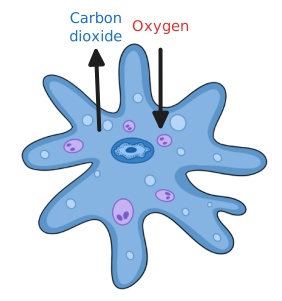
What are the adaptations of an amoeba for efficient gas exchange?
What are the adaptations of an amoeba for efficient gas exchange?
- Large SA:V ratio: enough surface to supply the whole cell with oxygen
- Thin cell membrane: short diffusion pathway, so gases move in and out quickly
- The organism is so small that no part of it is far from the surface, so oxygen can reach every part of the cell by diffusion alone
Insects
What you need to know (from the AQA specification)
What you need to know (from the AQA specification)
Adaptations of gas exchange surfaces, shown by gas exchange:
- in the tracheal system of an insect (tracheae, tracheoles and spiracles)
Insects don’t use blood to transport oxygen. Instead, they have a network of air-filled tubes, the tracheal system, that delivers air directly to their tissues.
- Spiracles: small pores on the surface of the body where air enters and exits
- Tracheae: microscopic air-filled tubes (the main airways) leading inward from the spiracles
- Tracheoles: the tracheae branch into smaller tracheoles, which have thin, permeable walls and reach directly into the respiring tissues
Oxygen diffuses down its concentration gradient from the air into the tracheoles, across the thin tracheole walls, and into the respiring cells.
Carbon dioxide moves the other way to oxygen. It diffuses down its concentration gradient, out of the cells, along the tracheoles and tracheae, and out through the spiracles.
In active insects, body movements (e.g. abdominal pumping) help move air in and out.
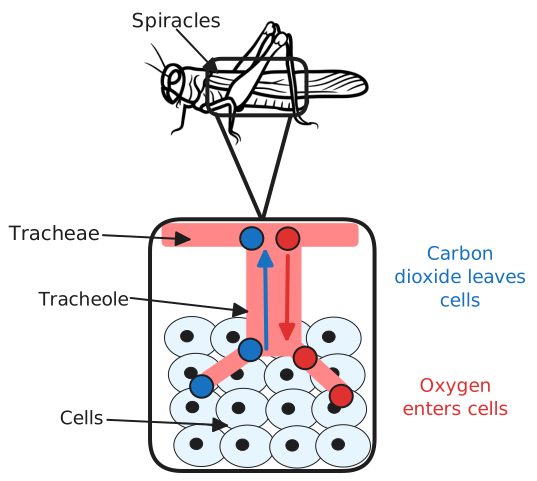
Summary: pathway of gas exchange in insects
- Oxygen → enters through spiracles → into tracheae → tracheoles → respiring cells
- Carbon dioxide → leaves cells → tracheoles → tracheae → out through spiracles
What are the adaptations of the insect tracheal system for efficient gas exchange?
What are the adaptations of the insect tracheal system for efficient gas exchange?
- Highly branched tracheoles: large surface area
- Thin walls (one cell thick): short diffusion pathway
- Tracheoles supply tissues directly: no need for a transport system, so diffusion distance is short
- Steep concentration gradient maintained. Oxygen is constantly used up in respiration, keeping oxygen concentration in the tissues low
- Ventilation / movement: larger or more active insects use rhythmic body movements (abdominal pumping) to move air in and out
Fish
What you need to know (from the AQA specification)
What you need to know (from the AQA specification)
Adaptations of gas exchange surfaces, shown by gas exchange:
- across the gills of fish (gill lamellae and filaments including the counter-current principle)
Fish live in water, which has a much lower oxygen concentration than air. Efficient gas exchange is essential; this is achieved by the gills.
Structure of the Gills
- Water enters through the mouth, flows over the gills, and exits through the operculum (a flap that covers the gills)
- Each gill is made of many thin gill filaments stacked on top of each other
- Each filament is covered with rows of gill lamellae, which are thin folds that further increase the surface area
- Inside each lamella is a dense network of capillaries carrying blood
- (Note: Lamellae = plural, lamella = singular)
Are the lamellae the capillaries?
Are the lamellae the capillaries?
No: they’re different structures.
- The lamellae are thin folds on the surface of the gill filaments. They are the exchange surface (one cell thick).
- Inside each lamella is a network of capillaries that carry the blood.
So: capillaries sit inside the lamellae. Gases diffuse across the lamella wall to/from the blood in the capillaries.
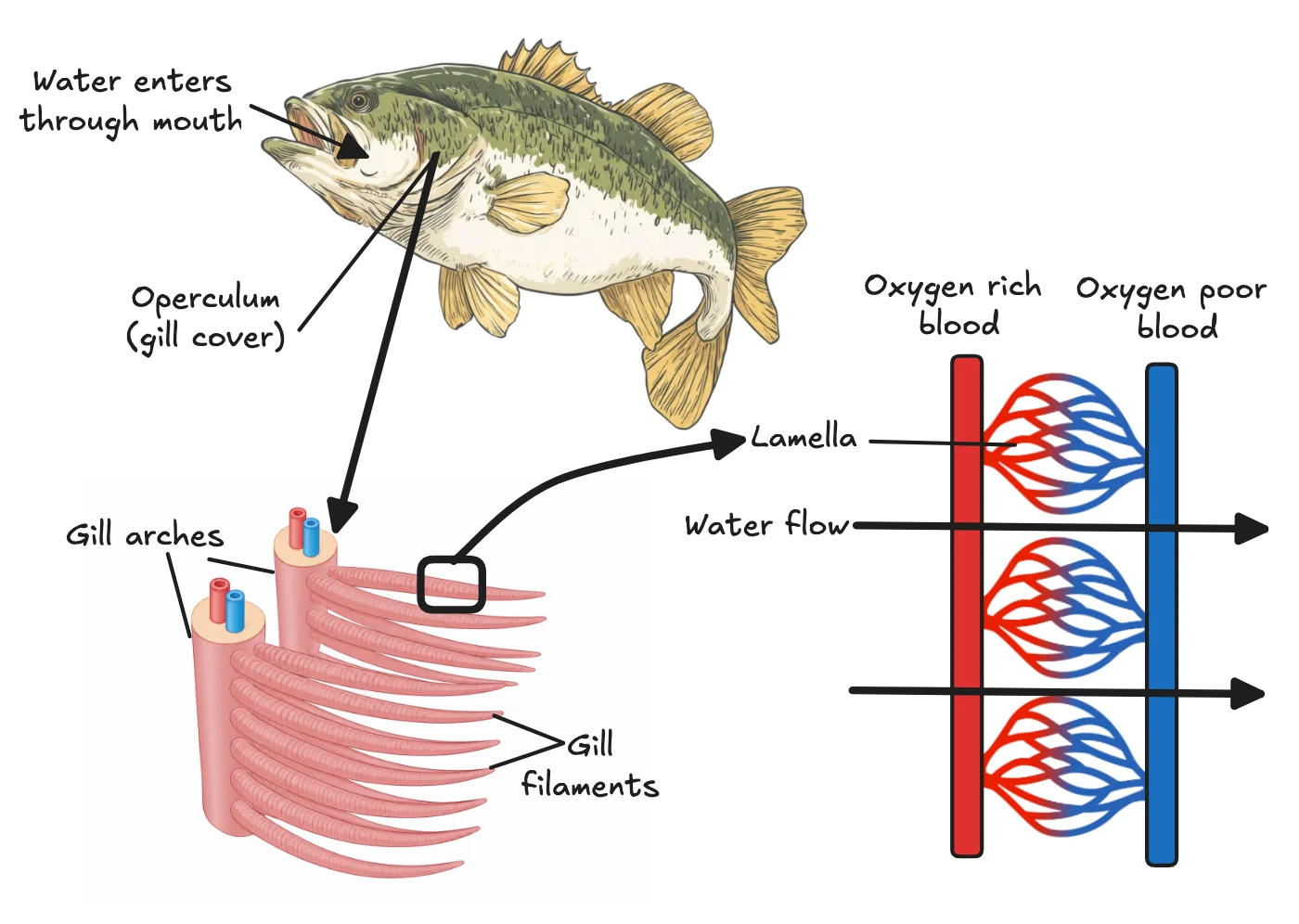
Gas Exchange and the Counter-current System
As water flows over a lamella:
- Oxygen diffuses from the water → across the lamella → into the blood
- Carbon dioxide diffuses from the blood → out of the lamella → into the water
The key adaptation in fish is the counter-current principle:
- Blood flows through the capillaries in the lamellae in one direction
- Water flows over the lamellae in the opposite direction
Because they flow in opposite directions, the water always has a higher oxygen concentration than the blood next to it. This maintains a steep concentration gradient along the entire length of the lamellae, so oxygen continues to diffuse from water into blood all the way along.
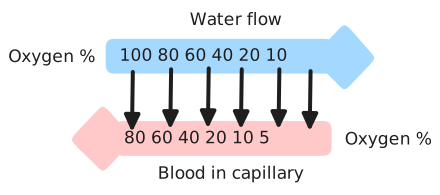
Why does counter-current flow matter?
Why does counter-current flow matter?
If blood and water flowed in the same direction (parallel flow), they would reach equilibrium partway along the lamella. At that point, no further oxygen could diffuse across. Only about 50% of the oxygen in the water would be absorbed.
With counter-current flow, the gradient is maintained the whole way along the lamella, and around 80% of the oxygen in the water is absorbed.
Dicotyledonous Plants
What you need to know (from the AQA specification)
What you need to know (from the AQA specification)
Adaptations of gas exchange surfaces, shown by gas exchange:
- by the leaves of dicotyledonous plants (mesophyll and stomata).
Plants need gas exchange for two processes:
- Photosynthesis (during the day): take in carbon dioxide, release oxygen
- Respiration (continuously): take in oxygen, release carbon dioxide
Where gas exchange happens
- Inside the leaf, gases diffuse between the mesophyll cells and the air spaces in the spongy mesophyll (large surface area)
- Gases enter and leave the leaf through pores called stomata, typically found on the underside of the leaf
- (Note: stomata = plural, stoma = singular)
- Each stoma is opened or closed by a pair of guard cells:
- When water enters the guard cells (by osmosis), they become turgid and the stoma opens. This allows gas exchange, but water vapour also escapes
- When water leaves the guard cells, they become flaccid and the stoma closes. This reduces water loss but also limits gas exchange.
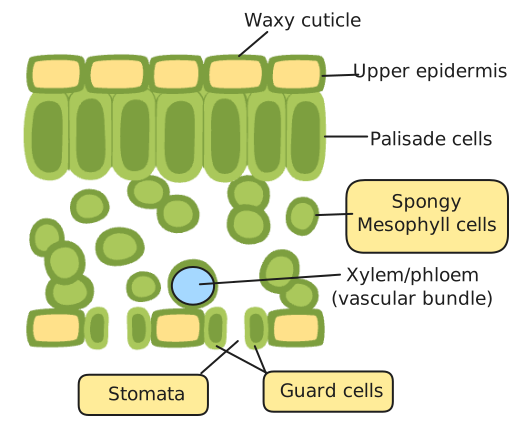
This is why stomata are typically open during the day (when photosynthesis is happening) and closed at night (to reduce water loss when not needed).
What are the adaptations of a dicotyledonous plant leaf for efficient gas exchange?
What are the adaptations of a dicotyledonous plant leaf for efficient gas exchange?
- Many stomata: entry/exit points across the whole leaf
- Spongy mesophyll with many air spaces: large surface area for diffusion
- The leaf is thin, so it has a short diffusion pathway from the atmosphere to the mesophyll cells
- Stomata open in the day (when photosynthesis requires CO₂), allowing the steepest concentration gradient when needed
Water Loss vs Gas Exchange
What you need to know (from the AQA specification)
What you need to know (from the AQA specification)
Structural and functional compromises between the opposing needs for efficient gas exchange and the limitation of water loss shown by terrestrial insects and xerophytic plants.
Terrestrial insects and xerophytic plants live in dry environments and must balance two opposing needs:
- They need gas exchange surfaces that are large, thin and moist, but these features also lose water rapidly by evaporation
- They need to limit water loss, but doing so also reduces gas exchange
Terrestrial Insects
Key adaptations for reducing water loss:
- Spiracles can close (using small valves) when oxygen demand is low. This reduces water vapour escaping.
- Waxy, waterproof cuticle on the exoskeleton, which reduces evaporation across the body surface
- Hairs around the spiracles trap a layer of moist air. This reduces the water potential gradient between the inside and outside, slowing evaporation
Xerophytic Plants
Xerophytes are plants adapted to dry, hot, or windy habitats (e.g. cacti, marram grass) where water loss must be minimised.
Key adaptations for reducing water loss:
- Sunken stomata (in pits): trap moist air around the stoma, reducing the water potential gradient between the leaf and the outside, so less water diffuses out
- Hairs on the epidermis: trap a layer of moist air at the leaf surface, also reducing the water potential gradient between leaf and outside
- Rolled / curled leaves: enclose the stomata so they are sheltered from the wind (wind would normally remove moist air from around the stomata and steepen the water potential gradient, increasing water loss)
- Reduced number of stomata: fewer stomata for evaporation of water
- Thick waxy cuticle: waterproof barrier across the rest of the leaf surface
- Small leaves or spines (e.g. cacti): reduce the surface area available for water loss
Exam tip
When explaining many of these xerophyte adaptations, the key idea is how they reduce the water potential gradient between the leaf and the surrounding air. The smaller the gradient, the less water diffuses out.
All of these adaptations reduce water loss but also reduce the rate of gas exchange, so xerophytes typically photosynthesise more slowly than well-watered plants.
Human Gas Exchange System
What you need to know (from the AQA specification)
What you need to know (from the AQA specification)
The gross structure of the human gas exchange system limited to the alveoli, bronchioles, bronchi, trachea and lungs.
The essential features of the alveolar epithelium as a surface over which gas exchange takes place.
The human gas exchange system delivers oxygen from the atmosphere to the blood (and removes carbon dioxide). Air follows this pathway:
Trachea → Bronchi → Bronchioles → Alveoli
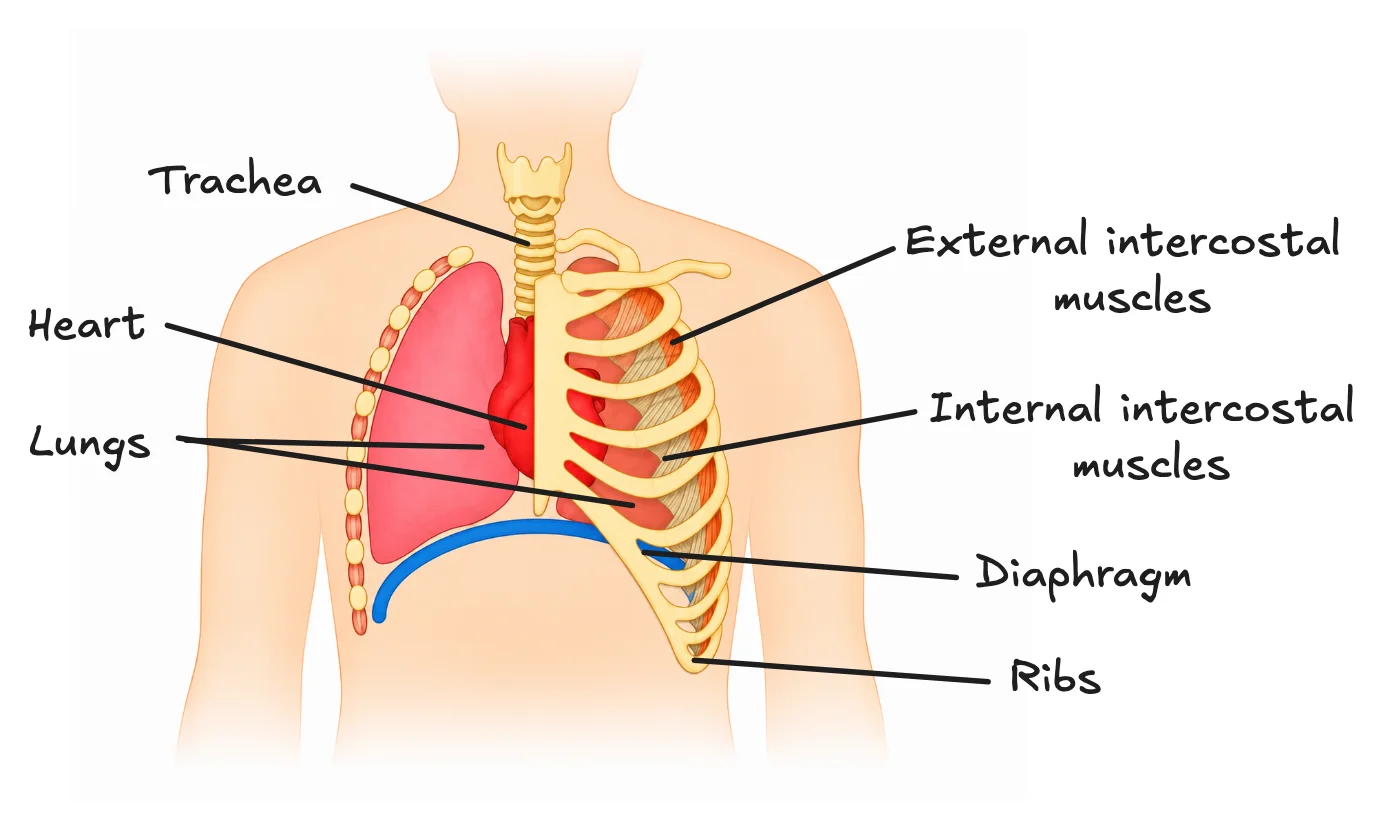
- Trachea: the main windpipe, supported by C-shaped rings of cartilage that keep it open
- Bronchi: the trachea splits into two bronchi, one leading to each lung
- Bronchioles: each bronchus branches repeatedly into smaller and smaller bronchioles
- Alveoli: tiny air sacs at the end of each bronchiole, where gas exchange takes place
The whole system is moved by the ribcage, intercostal muscles, and diaphragm during breathing (covered in the next section).
What is the difference between internal and external intercostal muscles?
What is the difference between internal and external intercostal muscles?
They are an antagonistic pair that contract in opposite directions:
- External intercostals contract during inspiration: pull the ribs up and out (helps the chest expand)
- Internal intercostals contract during forced expiration (e.g. exercise): pull the ribs down and in (helps push more air out)
At rest, normal expiration is passive, so the internal intercostals don’t usually contract. See the Ventilation section below for the full mechanism.
Alveolar Epithelium
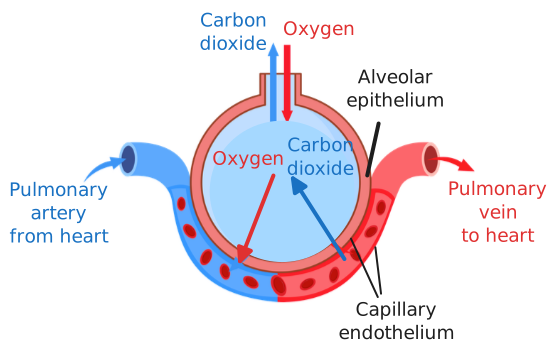
Each alveolus is lined with a single layer of thin, flat cells, called the alveolar epithelium. This is the exchange surface, sitting right next to a network of capillaries:
- Oxygen diffuses from the alveolus → across the alveolar epithelium → across the capillary endothelium → into the blood
- Carbon dioxide diffuses the other way (blood → alveolus)
What are the adaptations of alveoli for efficient gas exchange?
What are the adaptations of alveoli for efficient gas exchange?
- Large surface area: the lungs contain millions of alveoli, hugely increasing the total area available for diffusion
- Short diffusion pathway: both the alveolar epithelium and the capillary endothelium are only one cell thick, so gases only have to travel across two thin cell layers
- Good blood supply: a dense capillary network constantly removes oxygenated blood and brings in deoxygenated blood, maintaining a steep concentration gradient on the blood side
- Ventilation: breathing continually replaces the air in the alveoli with fresh, oxygen-rich air, maintaining the concentration gradient on the alveolar side
- Moist surface: gases dissolve in the moisture before diffusing, which is needed for diffusion across the membrane
Ventilation
What you need to know (from the AQA specification)
What you need to know (from the AQA specification)
Ventilation and the exchange of gases in the lungs. The mechanism of breathing to include the role of the diaphragm and the antagonistic interaction between the external and internal intercostal muscles in bringing about pressure changes in the thoracic cavity.
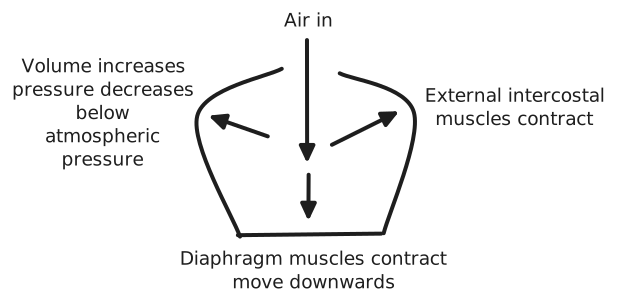
Ventilation is the movement of air in and out of the lungs. It works by changing the volume of the thoracic cavity, which changes the pressure inside the lungs. Air then moves down the pressure gradient, from high to low pressure.
Inspiration (breathing in): active
- Diaphragm contracts and moves downwards
- External intercostal muscles contract, pulling the ribcage upwards and outwards
- Volume of the thoracic cavity increases
- So pressure inside the lungs decreases below atmospheric pressure
- Air moves down the pressure gradient, from outside (high pressure) into the lungs (low pressure)
Inspiration is an active process because it requires muscle contraction (uses ATP).
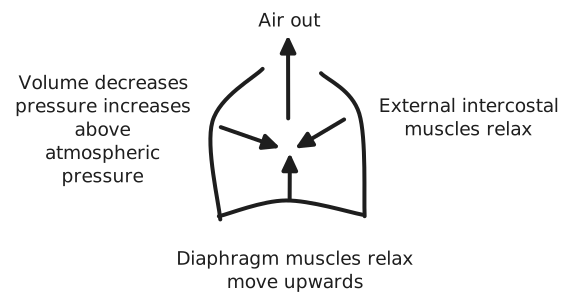
Expiration (breathing out): usually passive
- Diaphragm relaxes and domes upwards (returns to its resting shape)
- External intercostal muscles relax, allowing the ribcage to fall downwards and inwards (helped by gravity and the elastic recoil of the lungs)
- Volume of the thoracic cavity decreases
- So pressure inside the lungs increases above atmospheric pressure
- Air moves down the pressure gradient, out of the lungs (high pressure) into the atmosphere (low pressure)
Antagonistic Intercostal Muscles
The external and internal intercostal muscles work as an antagonistic pair (they contract in opposite directions):
-
Inspiration: External intercostals contract during inspiration, pulling ribs up and out. The internal intercostal muscles relax.
-
Forced Expiration: Internal intercostals contract during forced expiration (e.g. exercise), pulling ribs down and in to expel more air. The external intercostal muscles relax.
At rest, normal expiration is passive. The internal intercostals only contract during forced/active breathing out (e.g. during exercise).
See Antagonistic Pairs (skeletal muscles) for more detail on how antagonistic muscle pairs work in general, e.g. the biceps/triceps at the elbow.
Lung Disease & Risk Factors
What you need to know (from the AQA specification)
What you need to know (from the AQA specification)
Students should be able to:
- interpret information relating to the effects of lung disease on gas exchange and/or ventilation
- interpret data relating to the effects of pollution and smoking on the incidence of lung disease
- analyse and interpret data associated with specific risk factors and the incidence of lung disease
- evaluate the way in which experimental data led to statutory restrictions on the sources of risk factors
- recognise correlations and causal relationships.
A typical exam question in this section will give you data (a graph or table) about smoking or pollution and lung function, and ask you to:
- Describe what the data shows
- Explain the mechanism: how damage to the lungs reduces gas exchange
- Sometimes evaluate whether the data is enough to prove cause (vs just a correlation)
Scientists measured the lung function of three groups of men from age 25 to age 75:
- non-smokers
- continuous smokers
- ex-smokers (men who smoked until age 50, then stopped)
Lung function was measured using FEV₁ (forced expiratory volume in 1 second: the volume of air a person can breathe out in 1 second), expressed as a percentage of the average value at age 25.
You don’t need to learn FEV₁. Exam questions explain any unfamiliar measurements.
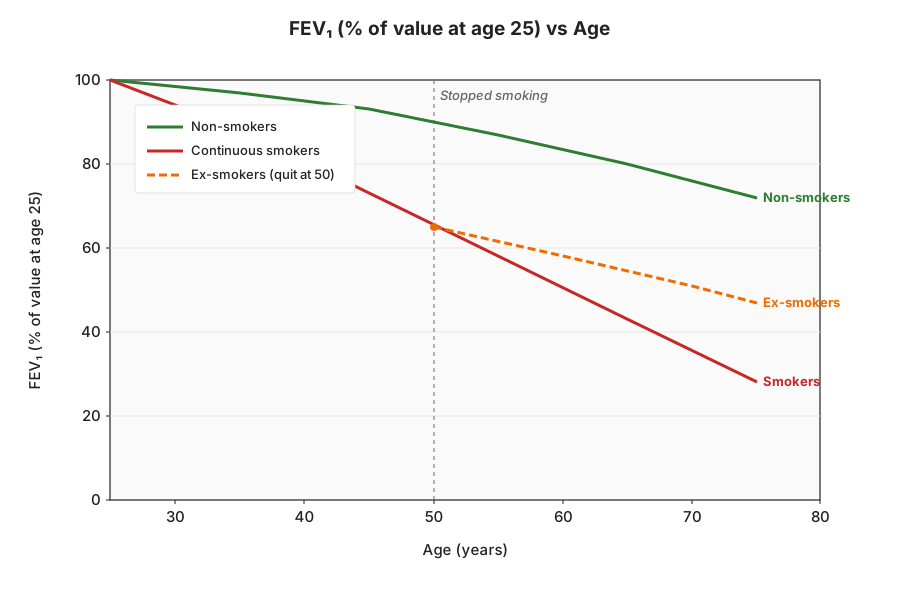
(a) Describe the effect of smoking on FEV₁ shown in Figure 1. (2 marks)
(b) Smoking damages alveoli, reducing the number of alveoli and thickening the alveolar walls. Explain how this reduces the rate of gas exchange in the lungs. (3 marks)
(5 marks)
Hint
For (a): comment on the trend in non-smokers AND how the smokers’ line compares. What happens when smokers quit at age 50?
For (b): think about the three principles of an efficient gas exchange surface: what happens to surface area, diffusion pathway, and rate of diffusion?
Mark Scheme
(a): 2 marks
- FEV₁ declines with age (visible in both non-smokers and smokers from age 25, and in ex-smokers from age 50 onwards) (1 mark)
- Smokers’ FEV₁ declines faster than non-smokers (so smokers have lower FEV₁ at any given age) OR when smokers stop at age 50, their decline slows down (follows the non-smokers’ rate) (1 mark)
(b): 3 marks
- Fewer alveoli means reduced (total) surface area for gas exchange (1 mark)
- Thickened alveolar walls mean a longer / increased diffusion pathway (1 mark)
- This (reduced surface area and longer diffusion pathway) leads to a slower / reduced rate of (gaseous) diffusion of oxygen into the blood (and CO₂ out) (1 mark)
How this topic is tested
This analysis is based on past paper data from 2017 to 2025. It is intended for interest only and is not predictive of what will appear in future papers.
- Tested in 8 of 9 years (2017–2025): 26 question parts worth 63 marks.
- 7th most-examined topic overall by marks, 2nd in Unit 3.
Marks by year
Most-tested spec points
- Adaptations of Gas Exchange Surfaces: tested in 9 parts (21 marks)
- Lung Disease, Risk Factors & Correlation: tested in 6 parts (14 marks)
- Ventilation & the Mechanism of Breathing: tested in 3 parts (11 marks)
- The Human Gas Exchange System: tested in 3 parts (10 marks)
- Dissecting Gas Exchange Systems: tested in 1 part (2 marks)
- Measuring Air Volumes: tested in 1 part (2 marks)
Also links to: Magnification & Resolution, Principles & Limitations of Microscopes, SA:V and Metabolic Rate.
Maths and practical skills
- Units and standard form (MS 0.1): e.g. 2025 P3 Q6.3
- Significant figures (MS 1.1): e.g. 2021 P1 Q2.5
- Uncertainty and error (MS 1.11): e.g. 2024 P1 Q3.5
- Using equations (MS 2.2, 2.3): e.g. 2025 P3 Q6.3
- Scientific drawings (AT e): e.g. 2025 P3 Q6.1
- Percentages, ratios and fractions (MS 0.3): e.g. 2021 P1 Q2.5
- Averages (MS 1.2): e.g. 2024 P1 Q3.4
- Straight-line graphs (y = mx + c) (MS 3.3): e.g. 2020 P1 Q6.2
Tips from examiner reports
What students commonly get wrong
- Rate of diffusion is slower, not lessWatch out: damage (e.g. a thicker diffusion barrier or a smaller surface area) means gases diffuse more slowly, so the rate of diffusion is lower. "Less diffusion" doesn't describe what has changed. 2020 P1 Q6.1 · 2022 P1 Q8.3
- Insects: the exchange surface is the tracheolesWatch out: for adaptations of the insect gas exchange surface, write about the tracheoles (highly branched, thin walls, supply tissues directly), not the spiracles. Give the feature and explain it, e.g. highly branched tracheoles give a large surface area for rapid diffusion. 2023 P1 Q2.2 · 2017 P1 Q9.1
- Breathing in: muscles contract and move the ribsWhen describing breathing in, say the external intercostal muscles contract and move the ribcage up and out, and the diaphragm contracts and flattens. Don't say muscles "expand" or push the lungs, and keep the two intercostal muscles separate. 2024 P1 Q3.1 · 2025 P3 Q6.2 · 2018 P1 Q10.1
Exam Question Practice
A grasshopper has a tracheal system. Air enters through spiracles and moves along tubes to the respiring tissues.
Name one adaptation of the gas exchange surface in this system, and explain its importance.
(2 marks)
Hint
Where does gas exchange actually happen in an insect: the spiracles, the tracheae or the tracheoles? Pick one feature of that surface and link it to diffusion.
Mark Scheme
Max 2 marks: one adaptation and why it matters
Either
- The tracheole walls are thin (one cell thick) (1 mark)
- So there is a short diffusion pathway and rapid diffusion into the cells (1 mark)
Or
- Tracheoles reach right into the tissues, next to the muscle fibres (1 mark)
- So gases diffuse directly into the cells, over a short diffusion pathway (1 mark)
Or
- The tracheoles are highly branched (1 mark)
- So there is a large surface area for rapid diffusion, or a short diffusion pathway (1 mark)
Also accepted / rejected
Also accepted
- “Touch” or “are close to” the cells for “reach into” (point 3)
- “Very many tracheoles” for highly branched (point 5)
Not accepted
- Features of the spiracles or tracheae; the tracheoles are the gas exchange surface
Tips
- The gas exchange surface is the tracheoles, so describe a feature of the tracheoles, not the spiracles
- Link the feature to diffusion, not just “gas exchange”, e.g. highly branched tracheoles give a large surface area for rapid diffusion
- Fluid moving out of the tracheoles, and saving water, aren’t features of the gas exchange surface
Leaves take in carbon dioxide for photosynthesis and release oxygen.
Describe and explain how the structure of a leaf is adapted for efficient gas exchange.
Do not refer to organelles in your answer.
(4 marks)
Hint
Follow the route gases take between the air and the cells inside a leaf, and link each adaptation to faster diffusion.
Mark Scheme
Max 4 marks
- Many stomata (1 mark)
- Stomata allow gases to diffuse in and out (1 mark)
- Air spaces in the mesophyll (1 mark)
- Mesophyll cells have a large surface area for diffusion (1 mark)
- Leaves have a large surface area to volume ratio, so diffusion is faster (1 mark)
- Leaves are thin, giving a short diffusion pathway (1 mark)
Tips
- Say there are many stomata, and that they allow gases to diffuse in and out
- Link every adaptation to diffusion; “for gas exchange” on its own isn’t enough
- Describe the large surface area of the mesophyll cells (their membranes), not just the large surface area of the whole leaf
- The short diffusion pathway comes from the leaf being thin, not from thin membranes or the leaf being flat
- Stick to the question. Xerophytic adaptations, the waxy cuticle, guard cells opening and closing, or light absorption gain no marks
- Use the right term, stomata, not “stroma” or “spiracles”
Ventilation keeps a steep oxygen concentration gradient between the air in the alveoli and the blood.
Describe how we breathe in.
(3 marks)
Hint
Which muscles contract, and what does each one move? How do these movements change the volume and pressure inside the chest?
Mark Scheme
- The diaphragm contracts and flattens (moves down) (1 mark)
- The external intercostal muscles contract, pulling the ribs up and out (1 mark)
- The volume of the thoracic cavity increases, so the pressure decreases (1 mark)
Also accepted / rejected
Also accepted
- “Thorax” or “lungs” instead of “thoracic cavity” (point 3)
Tips
- The diaphragm contracts and flattens; the external intercostal muscles contract and pull the ribs up and out
- The intercostal muscles move the ribs, not the diaphragm
- Then say what this does: the volume of the thoracic cavity increases and the pressure decreases
- Say “thoracic cavity”, not “chest”
- The route air takes through the airways gains no marks
Comments from mark scheme