What this topic covers
What this topic covers
This page covers membrane structure (fluid-mosaic model), all five modes of transport across membranes, and how cells are adapted for rapid transport. The specific spec points are flagged at the start of each section below.
Cell membranes form a partially permeable barrier between the inside and outside of cells (and around organelles). Substances cross them in five main ways, covered in detail below:
- Simple diffusion
- Facilitated diffusion
- Osmosis
- Active transport
- Co-transport
Fluid-Mosaic Model
What you need to know (from the AQA specification)
What you need to know (from the AQA specification)
- The basic structure of all cell membranes, including cell-surface membranes and the membranes around the cell organelles of eukaryotes, is the same.
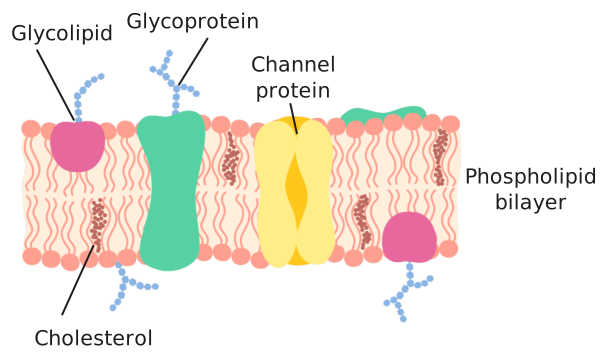
- The arrangement and any movement of phospholipids, proteins, glycoproteins and glycolipids in the fluid-mosaic model of membrane structure.
- Cholesterol may also be present in cell membranes where it restricts the movement of other molecules making up the membrane.
The structure of cell membranes is described by the fluid-mosaic model:
- Fluid: the phospholipids can move freely (laterally) within their layer
- Mosaic: different proteins, glycoproteins, glycolipids and cholesterol are scattered throughout, like tiles in a mosaic
Components
Phospholipid bilayer
- Two layers of phospholipids:
- Hydrophilic heads point outward (facing water)
- Hydrophobic tails point inward
- This controls which substances can enter and leave the cell
- Lipid-soluble (non-polar) substances can pass through the bilayer directly by simple diffusion, e.g. fatty acids and monoglycerides absorbed in the ileum
Proteins
These can be embedded in one layer of the membrane or span the whole bilayer.
- Channel proteins: form pores for transporting water-soluble substances (specific ions / polar molecules) across the membrane (passive only)
- Carrier proteins: bind a molecule, then undergo a conformational change to release it on the other side (used in passive facilitated diffusion AND active transport)
- Glycoproteins (see below) are a type of membrane protein
Important: what each protein can do
- Channel proteins are passive only. They can only transport substances down a concentration gradient (no shape change, no ATP).
- Carrier proteins are versatile, as they can act in passive facilitated diffusion (down the gradient, no ATP) OR in active transport (against the gradient, using ATP). The conformational change is the same; only the energy source differs.
In exam mark schemes, “active transport requires a carrier protein”. Channel proteins will be rejected.
Glycoproteins & Glycolipids
- Glycoproteins: proteins with carbohydrate chains; involved in cell recognition, and act as:
- Receptors: e.g. bind to hormones and neurotransmitters
- Cell-surface markers: e.g. antigens
- Glycolipids: lipids with carbohydrate chains; also act as receptors in cell signalling. They help maintain membrane stability and help cells attach to each other.
Cholesterol
Sits between the phospholipid tails and restricts the movement of other molecules in the membrane. This maintains membrane stability and fluidity across a range of temperatures (less fluid when hot, more fluid when cold).
Why are the hydrophobic tails arranged inward?
Why are the hydrophobic tails arranged inward?
The cell is in a watery environment, both inside (cytoplasm) and outside. The hydrophilic heads face the water; the hydrophobic tails hide away in the middle. This is what makes the bilayer stable.
Interactive (Explore)
Now that you know what’s in a membrane, see each mode in action. Switch between the 5 modes to compare how things move.
Simple Diffusion
What you need to know (from the AQA specification)
What you need to know (from the AQA specification)
Movement across membranes occurs by simple diffusion (involving limitations imposed by the nature of the phospholipid bilayer).
The passive movement of molecules from a region of higher concentration to a region of lower concentration, down a concentration gradient.
- Molecules pass directly through the phospholipid bilayer
- No ATP needed
- Only works for: small, non-polar (lipid-soluble) molecules, e.g. O₂, CO₂, steroid hormones, and fatty acids / monoglycerides absorbed in the ileum
Why can't polar / charged molecules simply diffuse through?
Why can't polar / charged molecules simply diffuse through?
The hydrophobic tails in the middle of the bilayer repel polar and charged molecules. They need channel or carrier proteins to cross (facilitated diffusion).
What could the rate of simple diffusion depend on?
What could the rate of simple diffusion depend on?
- Concentration gradient: a steeper gradient between the inside and outside of the membrane gives a faster rate of diffusion
- Surface area: a larger surface area gives a faster rate of diffusion
- Thickness of membrane / diffusion distance: a thinner membrane means a reduced diffusion distance, so a faster rate of diffusion
- Temperature: at higher temperatures particles have more kinetic energy, so the rate of diffusion is faster
Facilitated Diffusion
What you need to know (from the AQA specification)
What you need to know (from the AQA specification)
Movement across membranes occurs by facilitated diffusion (involving the roles of carrier proteins and channel proteins).
Like simple diffusion (passive, down a concentration gradient, no ATP), but uses proteins to help polar / charged / large molecules cross.
Two types of protein:
- Channel proteins: form a water-filled pore that allows specific ions (e.g. Na⁺, K⁺) to pass through. Some channels are gated (they open and close in response to a signal; see synaptic transmission and nerve impulses for examples).
- Carrier proteins: bind a molecule, then undergo a conformational change to release it on the other side. Used for larger molecules like glucose and amino acids.
What could the rate of facilitated diffusion depend on?
What could the rate of facilitated diffusion depend on?
- Concentration gradient: a steeper gradient gives a faster rate (until saturation)
- Number of channel / carrier proteins: more proteins means a faster rate, up to a maximum where all proteins are saturated (no more spare capacity)
- Temperature: higher temperatures give a faster rate (until proteins denature)
Osmosis
What you need to know (from the AQA specification)
What you need to know (from the AQA specification)
Movement across membranes occurs by osmosis (explained in terms of water potential).
The passive movement of water across a partially permeable membrane, from a region of higher water potential to a region of lower water potential.
Osmosis underpins many other topics on this site, including water uptake by root hair cells, transpiration, tissue fluid formation, and water reabsorption in the kidney.
Water potential (Ψ)
- Pure water has the highest water potential = 0 kPa
- Adding solutes lowers water potential, making values become more negative
- Water moves down a water potential gradient (from less negative to more negative)
| Solution | Water potential |
|---|---|
| Pure water | 0 kPa (highest) |
| Dilute solution | Small negative number (e.g. −100 kPa) |
| Concentrated solution | Large negative number (e.g. −2000 kPa) |
Which way does water move between two cells, one at −300 kPa and one at −800 kPa?
Which way does water move between two cells, one at −300 kPa and one at −800 kPa?
Water moves from the cell at −300 kPa (the higher, less negative water potential) into the cell at −800 kPa (the lower, more negative water potential).
What could the rate of osmosis depend on?
What could the rate of osmosis depend on?
- Water potential gradient: a steeper gradient (bigger Ψ difference) gives a faster rate
- Surface area of membrane: a larger surface area gives a faster rate
- Thickness of membrane: a thinner membrane gives a faster rate
- Number of aquaporins: more aquaporins gives a faster rate (water crosses aquaporins much faster than it crosses the bilayer directly)
- Temperature: higher temperatures give a faster rate (more kinetic energy)
Active Transport
What you need to know (from the AQA specification)
What you need to know (from the AQA specification)
Movement across membranes occurs by active transport (involving the role of carrier proteins and the importance of the hydrolysis of ATP).
The movement of molecules or ions against a concentration gradient (from low to high concentration), using ATP and carrier proteins.
Active transport is essential in many other topics, including mineral ion uptake by root hair cells, glucose reabsorption in the kidney, and the Na⁺/K⁺ pump in resting neurones.
Steps:
- The molecule binds to a carrier protein on one side of the membrane
- ATP is hydrolysed to ADP + Pᵢ (releasing energy)
- The carrier protein undergoes a conformational change, moving the molecule across the membrane
- The molecule is released on the other side
What could the rate of active transport depend on?
What could the rate of active transport depend on?
- Number of carrier proteins: more proteins gives a faster rate (up to saturation)
- Rate of respiration: ATP supply depends on respiration; less respiration means less ATP and therefore slower active transport
- Temperature: affects enzymes involved in respiration (and the carrier proteins themselves)
- Anything that affects ATP availability: e.g. respiratory inhibitors (cyanide), low oxygen
Note: concentration gradient is NOT a factor, because active transport moves AGAINST the gradient, so making the gradient bigger doesn’t help.
Co-Transport
What you need to know (from the AQA specification)
What you need to know (from the AQA specification)
Movement across membranes occurs by co-transport (illustrated by the absorption of sodium ions and glucose by cells lining the mammalian ileum).
Two substances are moved together by the same carrier protein. One (Na⁺) moves down its concentration gradient, and this drives the other (glucose) against its gradient.
Worked example: glucose absorption in the ileum (small intestine):
- Sodium-potassium pump (active transport) on the basal membrane (blood side) actively pumps Na⁺ out of the epithelial cell into the blood (using ATP)
- This creates a low Na⁺ concentration inside the epithelial cell
- Na⁺ from the ileum lumen then moves into the cell by facilitated diffusion, bringing glucose with it through a co-transporter protein (against the glucose gradient)
- Glucose builds up inside the cell, then moves into the blood by facilitated diffusion
The same Na⁺/glucose co-transporter is also used in glucose reabsorption in the proximal convoluted tubule of the kidney.
What could the rate of co-transport depend on?
What could the rate of co-transport depend on?
- Na⁺ concentration gradient: a bigger gradient (lots of Na⁺ in the lumen, very little in the cell) gives a faster rate
- Number of co-transporter proteins on the apical membrane: more proteins gives a faster rate
- Activity of the Na⁺/K⁺ pump: if the pump slows, the Na⁺ concentration inside the cell builds up, the gradient collapses, and co-transport slows down too
- ATP supply (indirectly, via the pump): anything that reduces respiration (low oxygen, respiratory inhibitors) will eventually stop co-transport
- Surface area: e.g. microvilli increase the number of co-transporters available
Adaptations for Rapid Transport
What you need to know (from the AQA specification)
What you need to know (from the AQA specification)
Cells may be adapted for rapid transport across their internal or external membranes by an increase in surface area of, or by an increase in the number of protein channels and carrier molecules in, their membranes.
Students should be able to:
- explain the adaptations of specialised cells in relation to the rate of transport across their internal and external membranes
- explain how surface area, number of channel or carrier proteins and differences in gradients of concentration or water potential affect the rate of movement across cell membranes.
Cells specialised for transport (e.g. ileum epithelial cells, root hair cells) maximise their rate by:
- Increased surface area: e.g. microvilli on ileum cells; long projections on root hair cells
- More channel / carrier proteins in the membrane
- More mitochondria: to supply ATP for active transport
For the rate factors specific to each transport mode, see the “What could the rate of … depend on?” callout under each section above.
Required Practical 3
What you need to know (from the AQA specification)
What you need to know (from the AQA specification)
Required practical 3: Production of a dilution series of a solute to produce a calibration curve with which to identify the water potential of plant tissue.
Water Potential of Plant Tissue (Potatoes)
Aim: Use a dilution series of sucrose solutions to find the water potential of plant tissue (e.g. potato).
Method:
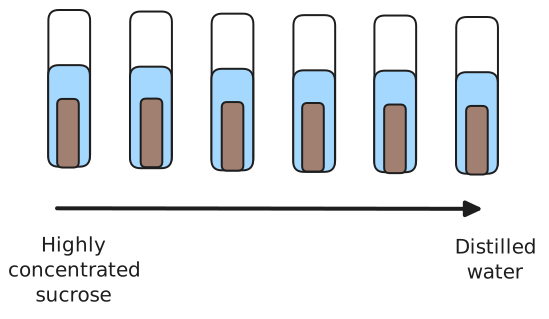
- Make a dilution series of sucrose solutions (the independent variable), e.g. 0.0, 0.2, 0.4, 0.6, 0.8, 1.0 mol dm⁻³
- Cut potato cylinders of identical mass / length / surface area (control variables)
- Place one in each sucrose solution; leave for a set time at a set temperature (control variables)
- Re-weigh: calculate % change in mass (the dependent variable)
- Plot % change in mass (y-axis) vs sucrose concentration (x-axis)
- The x-intercept (where % change = 0) gives the sucrose concentration with the same water potential as the potato cells.
Why % change in mass, not absolute change?
Cylinders may have slightly different starting masses. Using percentage change standardises across all samples so they can be compared fairly.
Formula: % change = (final mass − initial mass) ÷ initial mass × 100
Example results
A student cut six potato cylinders of starting mass 2.50 g and left them in different sucrose solutions for 30 minutes:
| Sucrose conc. (mol dm⁻³) | Initial mass (g) | Final mass (g) | Change (g) | % change |
|---|---|---|---|---|
| 0.0 | 2.50 | 2.81 | +0.31 | +12.4 |
| 0.2 | 2.50 | 2.63 | +0.13 | +5.2 |
| 0.4 | 2.50 | 2.42 | −0.08 | −3.2 |
| 0.6 | 2.50 | 2.25 | −0.25 | −10.0 |
| 0.8 | 2.50 | 2.13 | −0.37 | −14.8 |
| 1.0 | 2.50 | 2.05 | −0.45 | −18.0 |
What’s happening:
- In dilute sucrose (0.0, 0.2) the cells have a lower water potential than the solution, so water enters the cells by osmosis and mass increases.
- In concentrated sucrose (0.4 onwards) the cells have a higher water potential than the solution, so water leaves the cells by osmosis and mass decreases.
- Somewhere between 0.2 and 0.4 the cells and the solution have the same water potential, so there’s no net water movement and no mass change.
Example graph
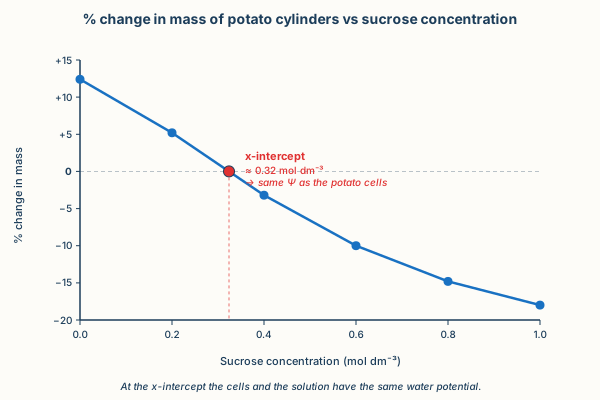
Reading the graph:
The x-intercept (where % change = 0) is approximately 0.32 mol dm⁻³. At this concentration there’s no net water movement, so the potato cells must have the same water potential as 0.32 mol dm⁻³ sucrose.
Why blot the cylinders dry before weighing?
Why blot the cylinders dry before weighing?
Excess surface water would add mass that isn’t from osmosis, making the final reading too high and skewing the % change. Blot all cylinders the same way (with the same paper towel, same number of dabs) so it’s a controlled step.
Required Practical 4
What you need to know (from the AQA specification)
What you need to know (from the AQA specification)
Required practical 4: Investigation into the effect of a named variable on the permeability of cell-surface membranes.
Membrane Permeability
Aim: Investigate the effect of a named variable (e.g. temperature, ethanol concentration, pH) on the permeability of cell-surface membranes.
Standard method (using beetroot):
- Cut equal-sized beetroot cylinders of equal mass / surface area (control variables); rinse thoroughly to remove pigment from the cut surfaces (otherwise free pigment will inflate the readings)
- Place one cylinder into each of several water baths at different temperatures (the independent variable). Alternatively, you can use different ethanol concentrations / pH
- Leave for a fixed time (control variable)
- Measure the intensity of red pigment in the surrounding solution using a colorimeter (the dependent variable), or visually rank by eye if no colorimeter
- Higher absorbance = more pigment released = greater membrane damage = higher permeability
Why beetroot? It contains a red pigment (betalain) in its vacuoles. If the cell-surface and tonoplast membranes are damaged, the pigment leaks out, making the surrounding solution darker red.
At higher temperature (or higher ethanol concentration), more pigment is released because:
- Phospholipids gain kinetic energy and move more, so gaps form in the bilayer
- Membrane proteins denature (loss of tertiary structure), so channels and carriers no longer fit and the bilayer is disrupted further
- The membrane becomes more permeable overall
Example results
A student tested beetroot cylinders at four temperatures and measured absorbance of the surrounding solution:
| Temperature (°C) | Absorbance |
|---|---|
| 0 | 0.05 |
| 20 | 0.10 |
| 40 | 0.20 |
| 50 | 0.55 |
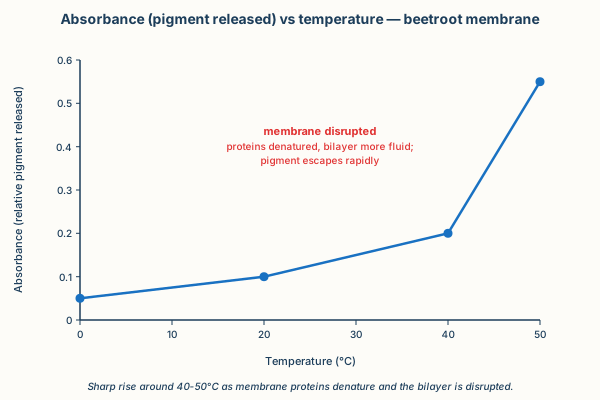
Reading the graph:
- 0-40°C: small, gradual rise as phospholipids gain a bit of kinetic energy.
- 40-50°C: much steeper rise. Membrane proteins denature and the phospholipid bilayer becomes more fluid / disrupted, so the membrane becomes more permeable and pigment escapes faster.
What would happen if you kept heating above 50°C: would absorbance fall like an enzyme curve?
What would happen if you kept heating above 50°C: would absorbance fall like an enzyme curve?
No. With an enzyme, denaturation stops the reaction, so activity drops past the optimum. With a membrane, denaturation makes it leakier, so absorbance keeps rising until all the pigment is out. Then it plateaus. It never decreases.
Why must you rinse the beetroot cylinders thoroughly before starting?
Why must you rinse the beetroot cylinders thoroughly before starting?
Cutting the beetroot damages cells on the cut surfaces, releasing pigment that’s nothing to do with the experiment. If you don’t rinse it off, the surrounding solution will start coloured already, making your absorbance readings too high and not a true measure of membrane damage caused by your variable.
How this topic is tested
This analysis is based on past paper data from 2017 to 2025. It is intended for interest only and is not predictive of what will appear in future papers.
- Tested in 7 of 9 years (2017–2025): 25 question parts worth 68 marks.
- 6th most-examined topic overall by marks, 2nd in Unit 2.
Marks by year
Most-tested spec points
- Osmosis: tested in 7 parts (24 marks)
- Required Practical 4: tested in 7 parts (18 marks)
- Active Transport: tested in 5 parts (18 marks)
- Membrane Structure & the Fluid-Mosaic Model: tested in 6 parts (16 marks)
- Facilitated Diffusion: tested in 4 parts (13 marks)
- Co-Transport: tested in 3 parts (12 marks)
Also links to: ATP Hydrolysis, Phospholipids, ATP Synthesis.
Maths and practical skills
- Percentages, ratios and fractions (MS 0.3): e.g. 2024 P1 Q4.5
- Area, volume and surface area of shapes (MS 4.1): e.g. 2022 P1 Q3.4
- Colorimeter or potometer measurements (AT b): e.g. 2020 P1 Q4.3
- Glassware and serial dilutions (AT c): e.g. 2020 P1 Q4.4
- Significant figures (MS 1.1): e.g. 2022 P1 Q3.4
- Standard deviation and range (MS 1.10): e.g. 2017 P3 Q6.7
- Rate from a straight-line graph (MS 3.5): e.g. 2018 P1 Q2.2
- Identifying variables, including control variables (PS 2.4): e.g. 2017 P1 Q6.1
Tips from examiner reports
What students commonly get wrong
- Active transport needs a carrier proteinWatch out: active transport uses carrier proteins and ATP, not channel proteins. 2024 P1 Q2.1 · 2021 P1 Q10.2
- Water moves by osmosis, down a water potential gradientWatch out: explain water movement using water potential, not "water concentration", and call it osmosis, not diffusion. 2024 P1 Q4.4 · 2023 P1 Q4.1
- How co-transport worksWhen explaining co-transport in the ileum, start with the Na⁺/K⁺ pump: it actively transports Na⁺ out of the cell into the blood, keeping the Na⁺ concentration low inside the cell. Na⁺ then moves in from the lumen by facilitated diffusion through a co-transporter, carrying glucose with it. 2020 P1 Q1.2 · 2021 P1 Q10.2
Exam Question Practice
A few exam-style questions on this topic to try. Have a go at each one before opening the answer.
Some molecules cross cell-surface membranes by facilitated diffusion. Others cross by active transport.
Describe each of these processes.
(3 marks)
Hint
Consider: What types of molecules need help crossing? What direction relative to the gradient? What provides the energy (if any)? What type of protein is involved in each?
Mark Scheme
- Both move polar or charged molecules or ions that can’t pass through the phospholipid bilayer (1 mark)
- Facilitated diffusion: movement down a concentration gradient through a carrier or channel protein (1 mark)
- Active transport: movement against a concentration gradient through a carrier protein, using ATP (1 mark)
Also accepted / rejected
Tips
- Say facilitated diffusion uses channel or carrier proteins; “transport proteins” or “proteins” is too vague
- Say active transport uses carrier proteins (not channel proteins) and ATP
- Facilitated diffusion is passive: it does not use ATP
- Describe movement down or against a concentration gradient, not “along” or “with” it
- Mention that these processes move polar or charged molecules (e.g. ions)
A scientist set up the apparatus in Figure 1 to investigate osmosis.
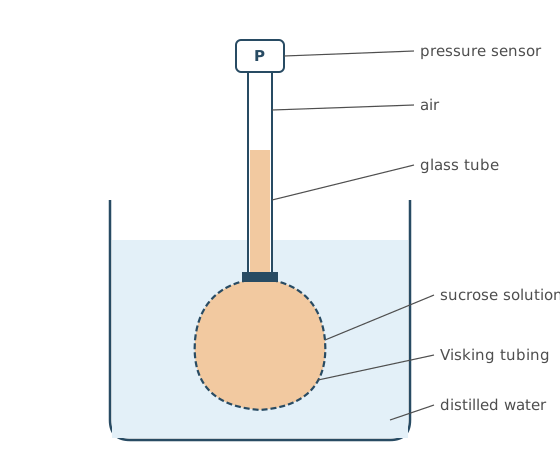
After an hour, the air pressure in the tube had increased.
Use your knowledge of osmosis to explain why.
(3 marks)
Hint
Compare the water potential of the two solutions. What type of membrane separates them? Where will water move, and what effect will this have on the volume inside?
Mark Scheme
- The sucrose solution has a lower water potential than the water in the beaker (1 mark)
- So water moves into the bag by osmosis, across the partially permeable Visking tubing (1 mark)
- The volume of solution increases, squashing the air into a smaller volume (1 mark)
Also accepted / rejected
Also accepted
- “More negative water potential” (point 1)
- “Selectively permeable” or “semi-permeable” (point 2)
Tips
- Use water potential, not “water concentration”: the sucrose solution has a lower water potential than the water
- Name the Visking tubing as the partially permeable membrane and give the direction water moves (into the sucrose solution)
- Say what changes: the volume of the sucrose solution increases, so the volume of air decreases
- Apply osmosis to this apparatus rather than just giving a definition
Epithelial cells lining the ileum are specialised for the absorption of products of digestion.
SGLT1 is a carrier protein found in the cell-surface membrane of these cells. It transports glucose and sodium ions (Na⁺) into the cell.
Sodium ions are actively transported out of these cells into the blood.
The movement of Na⁺ out of the cell allows the absorption of glucose into the cell lining the ileum.
Explain how.
(2 marks)
Hint
What does moving Na⁺ out do to the Na⁺ concentration inside the cell compared with the ileum? What else does the carrier protein bring in with Na⁺?
Mark Scheme
- (Maintains/creates) a concentration/diffusion gradient for Na⁺ (from the ileum into the cell) (1 mark)
- Na⁺ moving in by facilitated diffusion brings glucose with it
OR Na⁺ moving in by co-transport brings glucose with it (1 mark)
Also accepted / rejected
1. Accept “(maintains/creates) a lower concentration of Na⁺ inside the cell than outside”.
2. Accept “co-transporter” for “co-transport”.
Tips
- Start with the gradient: moving Na⁺ out keeps the Na⁺ concentration inside the cell lower than in the ileum
- Then link it to the carrier protein: Na⁺ diffuses back into the cell by co-transport and brings glucose with it
Cordgrass grows in salt marshes. At high tide, its roots are covered by sea water.
Scientists think that cordgrass roots absorb water from the sea water around them.
Describe an experiment that you could do to investigate whether cordgrass root cells have a lower water potential than sea water.
You are given:
- fresh cordgrass roots
- sea water
- laboratory equipment
(4 marks)
Hint
How could you tell if water moves into or out of root tissue? What would you measure before and after, and how would you make it fair?
Mark Scheme
Max 4 marks, from one method only
Method 1: change in mass
- Measure the mass of the root pieces before and after (1 mark)
- Leave them in sea water for a set time (1 mark)
- Blot dry before weighing again (1 mark)
- An increase in mass means water entered by osmosis, so the root cells have a lower water potential (1 mark)
Method 2: looking at cells for plasmolysis
Plasmolysis is when water leaves a plant cell and the cell membrane pulls away from the cell wall.
- Put thin pieces of root tissue on a slide (1 mark)
- Add sea water (1 mark)
- Look at the cells with an optical microscope (1 mark)
- If the cells stay turgid (don’t plasmolyse), the root cells have a lower water potential; if they plasmolyse, they don’t (1 mark)
Also accepted / rejected
Also accepted
- Length or diameter instead of mass (point 1)
- A dilution series of sea water (point 2)
- Working out the percentage of plasmolysed cells (point 8)
Tips
- Measure the mass (or length) of root pieces, leave them in sea water for a set time, blot dry, then measure again; the drying step is often missed
- An increase in mass means water entered by osmosis, so the root cells have a lower water potential
- It’s water that moves by osmosis, not “sea water”
- A potometer measures transpiration, not osmosis in cells
Anthocyanins are coloured pigments found in the vacuoles of some plant cells, including red cabbage. Anthocyanins cannot move across undamaged cell membranes.
A student investigated how to extract anthocyanins from red cabbage.
She mixed 5 g of finely chopped red cabbage with 50 cm³ of extraction solvent for 30 minutes.
She investigated three different extraction solvents:
- X – Ethanol, water and acid
- Y – Ethanol and water
- Z – Water
After 30 minutes, the student filtered the samples. She placed each filtrate in a colorimeter and measured the light absorbance.
Her results are shown in Figure 1.
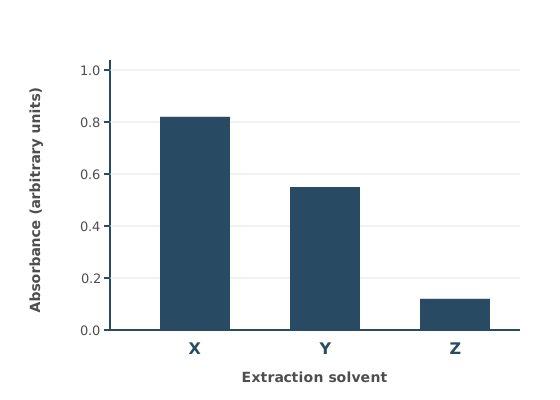
Use your knowledge of membrane structure to explain the results in Figure 1.
(4 marks)
Hint
What does a higher absorbance tell you about the pigment released? Which part of the membrane could ethanol damage, and which part could acid damage?
Mark Scheme
- Higher absorbance shows more anthocyanin
OR Higher absorbance shows more membrane damage/permeability
OR (Z not zero because) some anthocyanin is released when the cabbage is chopped
OR (Z not zero because) some membrane damage when the cabbage is chopped (1 mark) - More membrane damage/permeability results in more anthocyanin release (1 mark)
- (X and Y greater than water because) phospholipids dissolve in ethanol (1 mark)
- (X greater than Y because) acid denatures membrane proteins (1 mark)
Also accepted / rejected
Accept pigment for anthocyanin.
1. A direct comparative statement is not needed; it can be taken from the answer as a whole.
1 and 2. Accept most for more.
4. Accept a description of denaturation in terms of a change in tertiary structure or the breaking of hydrogen/ionic bonds.
Tips
- Link the graph to the aim: higher absorbance means more anthocyanin released, which means more membrane damage
- Ethanol dissolves the phospholipids, so X and Y are higher than water (Z)
- Acid denatures the membrane proteins, so X is higher than Y
Also accepted
Not accepted