What you need to know (from the AQA specification)
What you need to know (from the AQA specification)
- The semi-conservative replication of DNA ensures genetic continuity between generations of cells.
- The process of semi-conservative replication of DNA in terms of:
- unwinding of the double helix
- breakage of hydrogen bonds between complementary bases in the polynucleotide strands
- the role of DNA helicase in unwinding DNA and breaking its hydrogen bonds
- attraction of new DNA nucleotides to exposed bases on template strands and base pairing
- the role of DNA polymerase in the condensation reaction that joins adjacent nucleotides.
When does DNA replication occur and why?
Every time a cell divides, each daughter cell must receive a complete, identical copy of the DNA. To make this possible, DNA must be replicated before division begins. This happens during the S phase of interphase in the cell cycle.
If a cell divided without first copying its DNA, each daughter cell would receive only half the genetic information.
Semi-Conservative Replication
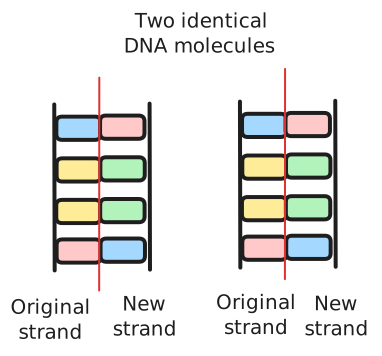
DNA replication is semi-conservative. This means that each new DNA molecule contains one original strand and one newly-made strand.
- Semi = half; Conservative = kept the same
- Each daughter DNA molecule keeps half of the original parent DNA (one strand) and gains one new strand, built by complementary base pairing with the original strand (called the template strand)
- This is what makes the copy identical to the parent, and what preserves the genetic information across cell divisions
The Process of Semi-Conservative Replication
Before reading the steps, make sure you’re confident with nucleotide structure and base pairing. Replication is essentially un-pairing the original bases, then re-pairing them with new free nucleotides.
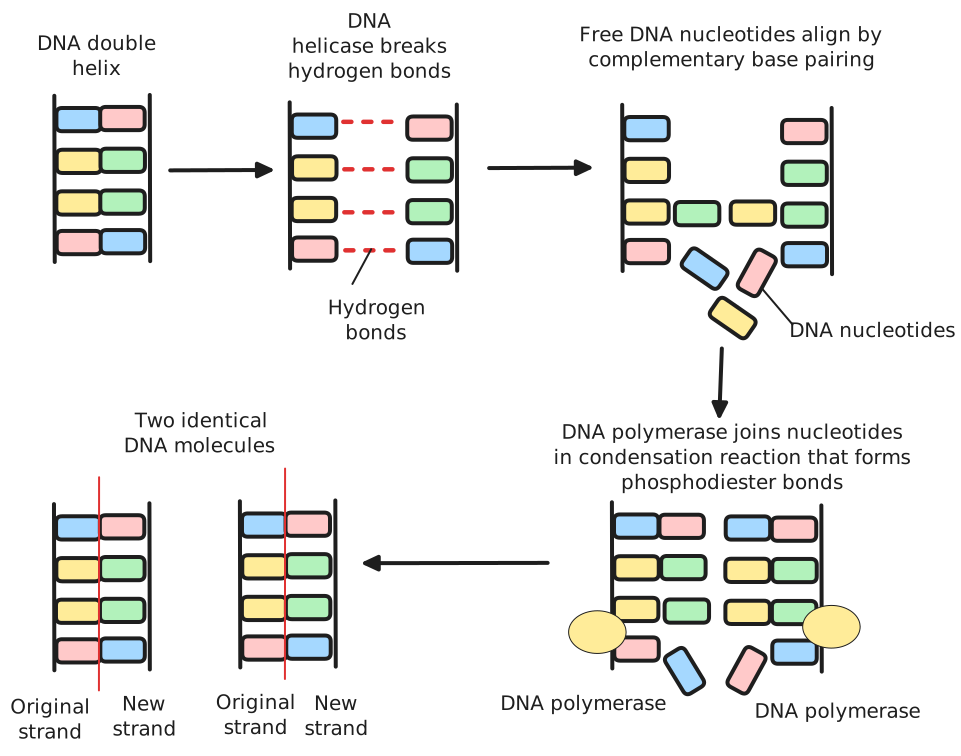
Step 1: DNA helicase unwinds the double helix
- The enzyme DNA helicase breaks the hydrogen bonds between complementary base pairs (A–T, C–G)
- This unwinds the double helix and separates the two polynucleotide strands
- Each separated strand now acts as a template for a new strand
Step 2: Free DNA nucleotides align by complementary base pairing
- Free DNA nucleotides (present in the nucleus) are attracted to the exposed bases on each template strand
- They line up by complementary base pairing:
- A pairs with T
- C pairs with G
- Hydrogen bonds form between the bases of the template and the incoming free nucleotides
Step 3: DNA polymerase joins the nucleotides
- The enzyme DNA polymerase moves along the template strand
- It catalyses condensation reactions between adjacent nucleotides on the new strand
- These condensation reactions form phosphodiester bonds between the sugar of one nucleotide and the phosphate of the next, building the sugar–phosphate backbone
- The result is a new polynucleotide strand that is complementary to the template
Step 4: Two identical DNA molecules
- There are now two complete DNA molecules, each made of one original strand + one new strand (semi-conservative)
- The two molecules are genetically identical to the original, and to each other
Summary of Enzymes
| Enzyme | Role |
|---|---|
| DNA helicase | Unwinds the double helix and breaks the hydrogen bonds between complementary bases |
| DNA polymerase | Catalyses condensation reactions that form phosphodiester bonds between adjacent nucleotides on the new strand |
Don't mix up the enzymes!
- DNA polymerase ≠ RNA polymerase. RNA polymerase does an equivalent job during transcription (covered in DNA & protein synthesis), but that’s a different process
- DNA polymerase only forms phosphodiester bonds (the sugar–phosphate backbone), NOT hydrogen bonds between complementary bases
- DNA helicase BREAKS hydrogen bonds: it does NOT hydrolyse them (no water added).
Meselson–Stahl experiment
What you need to know (from the AQA specification)
What you need to know (from the AQA specification)
Students should be able to evaluate the work of scientists in validating the Watson–Crick model of DNA replication.
When Watson and Crick proposed their double helix model in 1953, they suggested DNA replication was semi-conservative. But two other models were also plausible at the time, and scientists needed evidence to decide between them.
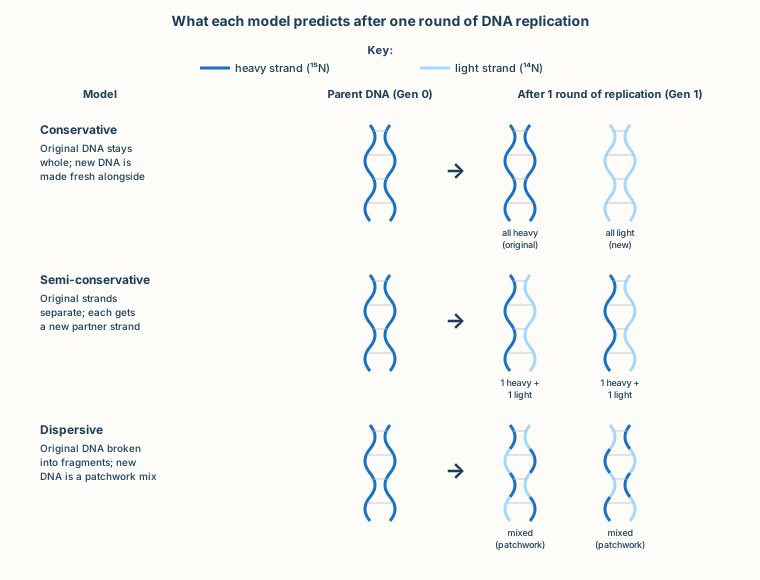
The three competing models
Each model makes a different prediction about what daughter DNA molecules look like after one round of replication:
The Meselson–Stahl experiment (1958)
Meselson and Stahl tested which model was correct using nitrogen isotopes:
- They grew bacteria in a medium containing ¹⁵N (heavy nitrogen) for many generations, so all the bacterial DNA was “heavy”
- They then transferred the bacteria to a medium containing only ¹⁴N (normal, lighter nitrogen)
- As the bacteria divided, any new DNA strands used the lighter ¹⁴N, while original strands kept their heavier ¹⁵N
- They extracted DNA after each generation and used centrifugation to separate it by density (heavier DNA sinks lower in the tube)
What semi-conservative predicts (and what was observed)
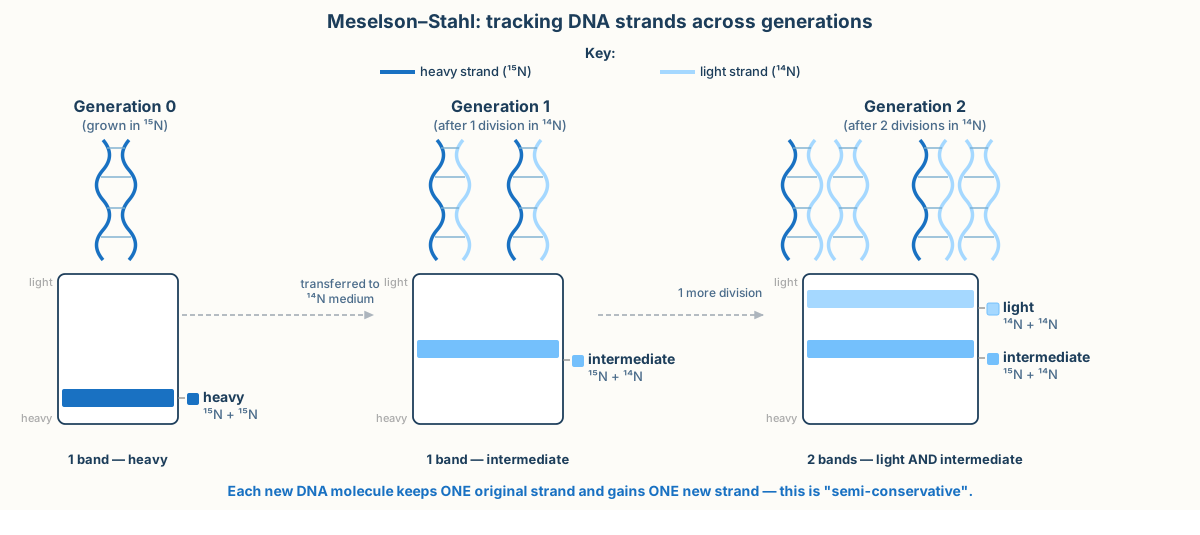
Generation 0: all DNA is heavy (both strands ¹⁵N). One band at the bottom of the tube.
Generation 1: every parent DNA molecule has been replicated once. Under semi-conservative replication:
- The two original heavy strands separate
- Each acts as a template for a new light strand built from ¹⁴N nucleotides
- Every daughter molecule = 1 heavy strand + 1 light strand (This is the ONE intermediate band)
Generation 2: each Gen 1 molecule replicates again:
- Each Gen 1 molecule has 1 heavy strand (¹⁵N) + 1 light strand (¹⁴N). These separate, each acts as a template.
- The heavy strand acts as template and the free ¹⁴N nucleotides pair with it. The newly-built strand is light.
- Daughter = 1 heavy + 1 new light = intermediate density
- The light strand acts as template and free ¹⁴N nucleotides pair with it. The newly-built strand is light.
- Daughter = 1 light + 1 new light = light density
- So every Gen 1 molecule produces one intermediate daughter + one fully-light daughter
Why this rules out the other two models
Why does Generation 1 rule out the conservative model?
Why does Generation 1 rule out the conservative model?
- Conservative model predicts the original heavy double helix stays completely intact, both old strands stay together
- So at Gen 1 you’d expect two bands, one heavy (the intact parent) and one light (the new molecule)
- But the actual result shows only one intermediate band, no heavy band, no light band
Why does Generation 2 rule out the dispersive model?
Why does Generation 2 rule out the dispersive model?
- Dispersive model predicts each new molecule is a random patchwork of old heavy fragments and new light fragments
- At Gen 1 this would also produce one intermediate band, so Gen 1 alone cannot distinguish dispersive from semi-conservative
- At Gen 2, the actual result shows two distinct bands: one intermediate, one fully light. Dispersive would predict more than two bands because random fragmentation means different molecules end up with different proportions of ¹⁵N and ¹⁴N fragments, giving a range of densities.
Only semi-conservative replication matches both the Gen 1 result AND the Gen 2 result
For an exam-style question using exactly this experiment, see Which model of DNA replication is supported? in the Exam Question Practice section below.
How this topic is tested
This analysis is based on past paper data from 2017 to 2025. It is intended for interest only and is not predictive of what will appear in future papers.
- Tested in 5 of 9 years (2017–2025): 7 question parts worth 20 marks.
- 40th most-examined topic overall by marks, 4th in Unit 1.
- Not tested in 2023–2025.
Marks by year
Most-tested spec points
- Semi-Conservative Replication: tested in 6 parts (18 marks)
Also links to: Antibody Structure & Action, Translation, The Cell Cycle.
Maths and practical skills
- Percentages, ratios and fractions (MS 0.3): e.g. 2020 P1 Q5.2
Tips from examiner reports
What students commonly get wrong
- Helicase breaks hydrogen bonds, but it isn't hydrolysisWatch out: DNA helicase breaks the hydrogen bonds between the two strands, but this isn't a hydrolysis reaction. Hydrolysis uses water to break covalent bonds, such as phosphodiester or glycosidic bonds. 2018 P1 Q9.1 · 2019 P1 Q6.2
- What DNA polymerase doesWatch out: DNA polymerase joins adjacent nucleotides by forming phosphodiester bonds in condensation reactions. It doesn't form the hydrogen bonds or the complementary base pairs, and it joins nucleotides, not bases. 2018 P1 Q9.1 · 2019 P1 Q6.2 · 2020 P1 Q5.1
- Replication happens in interphaseWatch out: DNA replication happens during interphase (the S phase), before the cell divides. It isn't part of mitosis. 2019 P1 Q6.1
Exam Question Practice
A few exam-style questions on this topic to try. Have a go at each one before opening the answer.
Describe the role of two named enzymes in the process of semi-conservative replication of DNA.
(3 marks)
Hint
Which enzyme separates the two strands, and which bonds does it break? Which enzyme joins the new nucleotides, and with what bond?
Mark Scheme
- (DNA) helicase breaks hydrogen/H bonds (between the DNA strands) (1 mark)
- DNA polymerase joins the (DNA) nucleotides (1 mark)
- Forming phosphodiester bonds (1 mark)
Also accepted / rejected
Tips
- Helicase breaks hydrogen bonds; it doesn’t hydrolyse them
- DNA polymerase joins adjacent nucleotides with phosphodiester bonds; it doesn’t form the hydrogen bonds between complementary bases
Describe the role of DNA polymerase in the semi-conservative replication of DNA.
(2 marks)
Hint
What does DNA polymerase join together? What type of reaction is it, and what bond forms?
Mark Scheme
Max 2 marks
- Joins (adjacent DNA) nucleotides (1 mark)
- (Catalyses) condensation (reactions) (1 mark)
- (Catalyses the formation of) phosphodiester bonds (between adjacent nucleotides) (1 mark)
Also accepted / rejected
1. Reject suggestions that it forms hydrogen bonds or joins complementary bases.
1. Reject “nucleotide bases”.
Tips
- DNA polymerase joins adjacent nucleotides in condensation reactions, forming phosphodiester bonds
- It doesn’t form hydrogen bonds or pair up complementary bases
- Say nucleotides, not bases: phosphodiester bonds aren’t formed between bases
Scientists investigated the cell cycle in liver cells taken from rats at different ages.
The scientists determined the percentage of liver cells undergoing DNA replication by using a chemical called EdU. Cells use EdU instead of nucleotides containing thymine during DNA replication.
Describe how EdU would be incorporated into new DNA during semi-conservative replication.
(5 marks)
Hint
What separates the two strands, and how? Which base would EdU pair with, given that it replaces thymine? Which enzyme joins the new nucleotides, and with what bond?
Mark Scheme
- DNA helicase (1 mark)
- Breaks hydrogen bonds (between the two DNA strands) (1 mark)
- EdU is complementary to adenine (on the template strand)
OR EdU forms hydrogen bonds with adenine (on the template strand) (1 mark) - DNA polymerase joins (adjacent) nucleotides (incorporating EdU into the new strand) (1 mark)
- Phosphodiester bonds form (between nucleotides) (1 mark)
Also accepted / rejected
2. Reject “hydrolyses hydrogen bonds”.
2 and 3. Accept H bonds for hydrogen bonds.
4. Reject if DNA polymerase is said to carry out complementary base pairing or to join nucleotides to the template strand.
Tips
- Hydrogen bonds are broken by DNA helicase; they aren’t hydrolysed
- DNA polymerase joins adjacent nucleotides; it doesn’t carry out complementary base pairing or join bases together
- Write ‘adenine’ in full: ‘A’ isn’t a specification abbreviation
Scientists grew bacteria with only heavy nitrogen (¹⁵N) until all their DNA contained ¹⁵N. They then moved the bacteria to only light nitrogen (¹⁴N). After each generation, they extracted the DNA and centrifuged it. Denser DNA (containing more ¹⁵N) forms a band lower down the tube.
Figure 1 shows their results. Figure 2 shows three possible models of DNA replication.
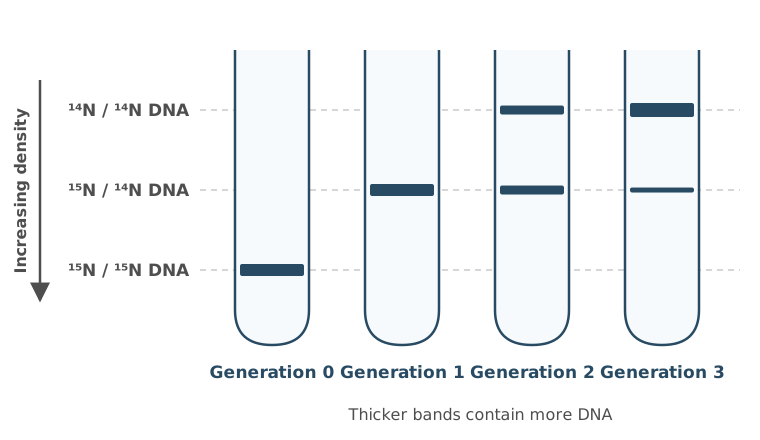
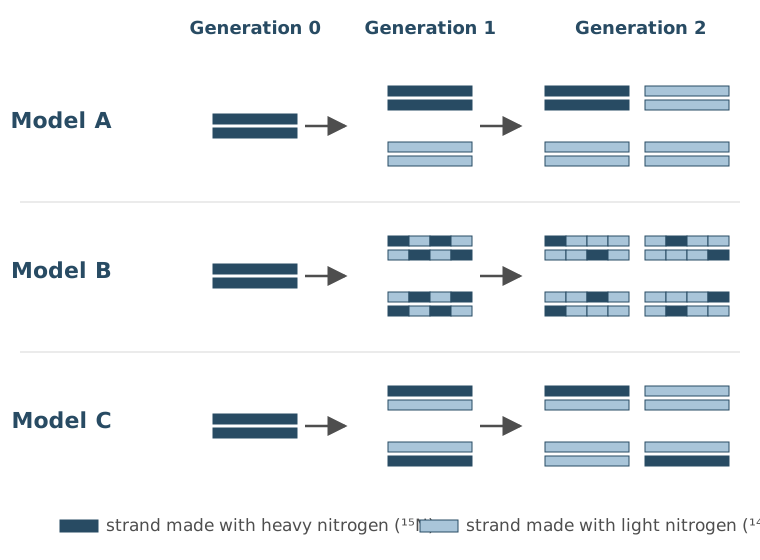
Which model, A, B or C, is supported by the results? Give its name, and explain why the results do not support the other two models.
(3 marks)
Hint
For each model, predict how many bands you’d see in generations 1, 2 and 3, and where. Which prediction matches Figure 1?
Mark Scheme
- (Model) C and (name) semi-conservative (replication) (1 mark)
Explanation
- (Model) A (is not supported because) there would be two bands in generation 1
OR (only) one band is shown in generation 1
OR a heavy/¹⁵N/¹⁵N band would still be present in generation 1/2/3
OR there would be no intermediate/¹⁵N/¹⁴N band
OR there would be a 1 : 3 ratio of heavy to light bands in generation 2 (1 mark) - (Model) B (is not supported because) there would only be one band in generation 2/3
OR the band would get gradually lighter instead of forming a separate light/¹⁴N/¹⁴N band (1 mark)
Also accepted / rejected
Accept answers 2 and 3 in either order.
Accept “density” or “position” for band.
1. Reject “helicase hydrolyses hydrogen bonds”.
2. Reject any suggestion that DNA polymerase joins complementary nucleotides or forms hydrogen bonds.
2. Reject joining RNA nucleotides or forming RNA.