Haemoglobin
What you need to know (from the AQA specification)
What you need to know (from the AQA specification)
The haemoglobins are a group of chemically similar molecules found in many different organisms. Haemoglobin is a protein with a quaternary structure. The role of haemoglobin and red blood cells in the transport of oxygen.
Oxygen is transported around the body by haemoglobin (Hb), a globular protein with a quaternary structure found inside red blood cells. It consists of:
- Four polypeptide chains: two α chains and two β chains
- Each chain contains a haem group, which is a prosthetic group (a non-protein molecule permanently bound to the protein) with an iron ion (Fe²⁺) at its centre
- The Fe²⁺ ion binds oxygen, and each haem group can carry one O₂ molecule
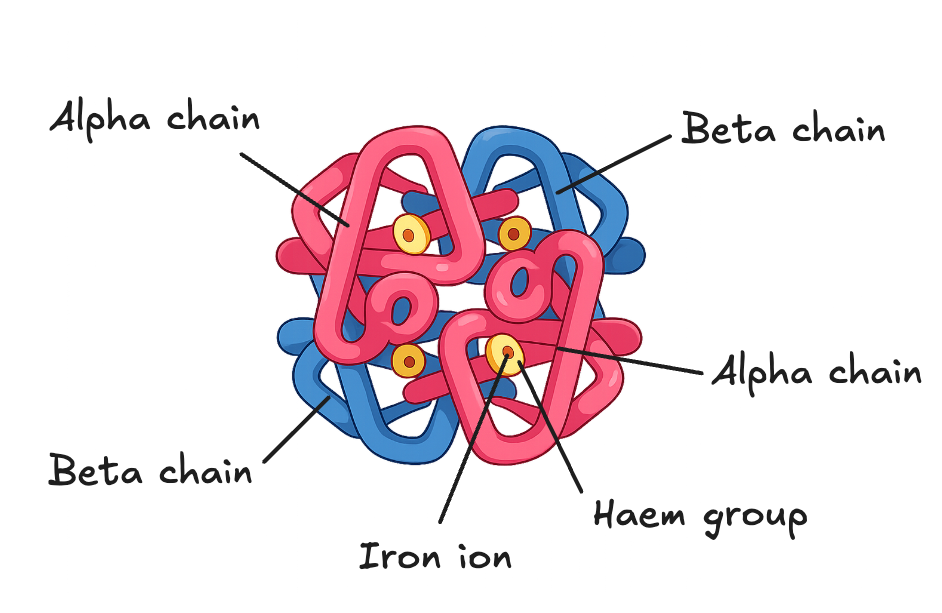
Each Hb molecule can therefore bind up to four oxygen molecules, forming oxyhaemoglobin, a reversible reaction:
Haemoglobin + 4O₂ ⇌ Oxyhaemoglobin
Why iron deficiency causes anaemia
Each haem group requires an Fe²⁺ ion to bind oxygen. Without enough dietary iron, the body cannot produce sufficient haemoglobin, reducing the blood’s oxygen-carrying capacity. This is iron-deficiency anaemia. Symptoms include fatigue and breathlessness because tissues receive less oxygen for aerobic respiration.
How are red blood cells specifically adapted to maximise oxygen transport?
How are red blood cells specifically adapted to maximise oxygen transport?
- Biconcave disc shape: increases surface area and minimises the diffusion pathway to the centre of the cell
- No nucleus: maximises the volume available for haemoglobin
- No mitochondria: prevents oxygen being consumed in aerobic respiration during transport
Oxygen Dissociation Curve
What you need to know (from the AQA specification)
What you need to know (from the AQA specification)
The loading, transport and unloading of oxygen in relation to the oxyhaemoglobin dissociation curve. The cooperative nature of oxygen binding to show that the change in shape of haemoglobin caused by binding of the first oxygens makes the binding of further oxygens easier.
To understand how haemoglobin loads and unloads oxygen, we first need to understand partial pressure.
Partial pressure of oxygen (pO₂) is a measure of oxygen concentration. The greater the oxygen concentration, the higher the partial pressure. The same applies to carbon dioxide (pCO₂).
- In the lungs, pO₂ is high → haemoglobin loads oxygen → oxyhaemoglobin forms
- In the tissues, pO₂ is low → oxyhaemoglobin unloads oxygen → haemoglobin is regenerated
The oxygen dissociation curve shows the percentage saturation of haemoglobin at any given pO₂.
The graph below shows three curves; click each one to explore what happens at low and high pO₂, and why the curve shifts position.
Cooperative Nature of Binding
If you look at the graph above, you can see it has a characteristic S-shape (sigmoid).
The S-shape arises because haemoglobin binds oxygen cooperatively:
- The first oxygen binds, changing the tertiary and quaternary structure of haemoglobin (start of curve, shallow)
- This conformational change makes the remaining binding sites more accessible
- The 2nd and 3rd oxygen molecules therefore bind more easily (steep rise in the middle of the curve)
- The curve levels off at the top because almost all the binding sites are already full (haemoglobin is nearly saturated)
Bohr Effect
What you need to know (from the AQA specification)
What you need to know (from the AQA specification)
The effects of carbon dioxide concentration on the dissociation of oxyhaemoglobin (the Bohr effect).
In actively respiring tissues, CO₂ concentration is high. Carbon dioxide dissolves in the blood, forming carbonic acid, which lowers the pH. This decrease in pH causes a conformational change in haemoglobin which reduces its affinity for oxygen.
The result: the oxygen dissociation curve shifts to the right, so at any given pO₂, haemoglobin releases more oxygen.
What is the advantage of the Bohr effect?
What is the advantage of the Bohr effect?
- In actively respiring tissues, more CO₂ is produced → lower pH → haemoglobin has a reduced affinity for oxygen → more oxygen is released
- This increases the oxygen available for aerobic respiration, reducing reliance on anaerobic respiration and lactate production
Animal Adaptations to Environment
What you need to know (from the AQA specification)
What you need to know (from the AQA specification)
Many animals are adapted to their environment by possessing different types of haemoglobin with different oxygen transport properties.
Different animals have haemoglobin with different affinities for oxygen, adapted to their environment.
Animals living in low oxygen environments (e.g. high altitude, burrows) tend to have haemoglobin with a higher affinity for oxygen. Their dissociation curve shifts to the left, allowing them to load oxygen even at low pO₂.
Other instances of oxygen dissociation curve shifting to the left include:
- Foetal haemoglobin (HbF) also has a higher affinity for oxygen than adult haemoglobin (HbA), allowing the fetus to load oxygen from maternal blood across the placenta, where pO₂ is relatively low.
- Myoglobin, found in muscle cells, also has a higher affinity than haemoglobin. It acts as an oxygen store in muscles, only releasing oxygen when pO₂ is very low, such as during intense exercise.
Click the “High Altitude Animal” curve in the graph above to see a left-shifted curve in action.
Circulatory System
What you need to know (from the AQA specification)
What you need to know (from the AQA specification)
The general pattern of blood circulation in a mammal. Names are required only of the coronary arteries and of the blood vessels entering and leaving the heart, lungs and kidneys.
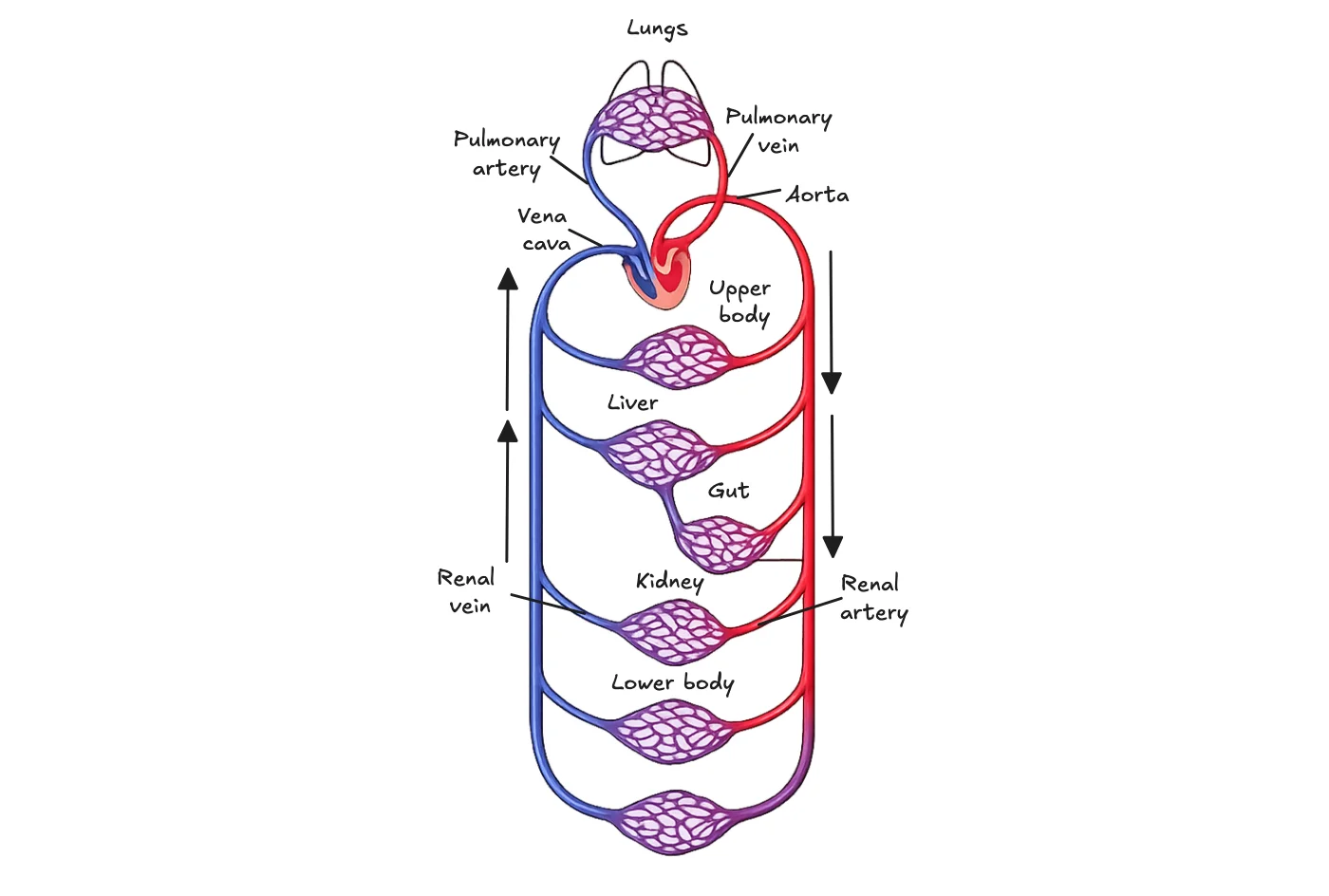
Mammals have a double circulatory system. This means the blood passes through the heart twice per circuit.
- Pulmonary circulation: right ventricle → lungs → left atrium
- Systemic circulation: left ventricle → body → right atrium
Why is a double circulatory system advantageous to humans?
Why is a double circulatory system advantageous to humans?
- In a single circulatory system (e.g. fish), blood loses pressure as it passes through the gas exchange organ (the gills).
- A double circulatory system solves this. The blood returns to the left ventricle after the lungs and is pumped at high pressure to the body.
- This maintains a high pressure in the systemic circulation, allowing oxygen and nutrients to be delivered to tissues quickly.
- It also keeps oxygenated and deoxygenated blood separate, increasing the efficiency of oxygen delivery.
Key named vessels you need to know:
| Location | Vessel entering | Vessel leaving |
|---|---|---|
| Heart | Vena cava (right side), Pulmonary vein (left side) | Aorta (left side), Pulmonary artery (right side) |
| Lungs | Pulmonary artery | Pulmonary vein |
| Kidneys | Renal artery | Renal vein |
Coronary arteries branch off the aorta and supply the cardiac muscle with oxygenated blood. Blockage causes a myocardial infarction (heart attack).
Blood Vessels
What you need to know (from the AQA specification)
What you need to know (from the AQA specification)
The structure of arteries, arterioles and veins in relation to their function. The structure of capillaries and the importance of capillary beds as exchange surfaces.
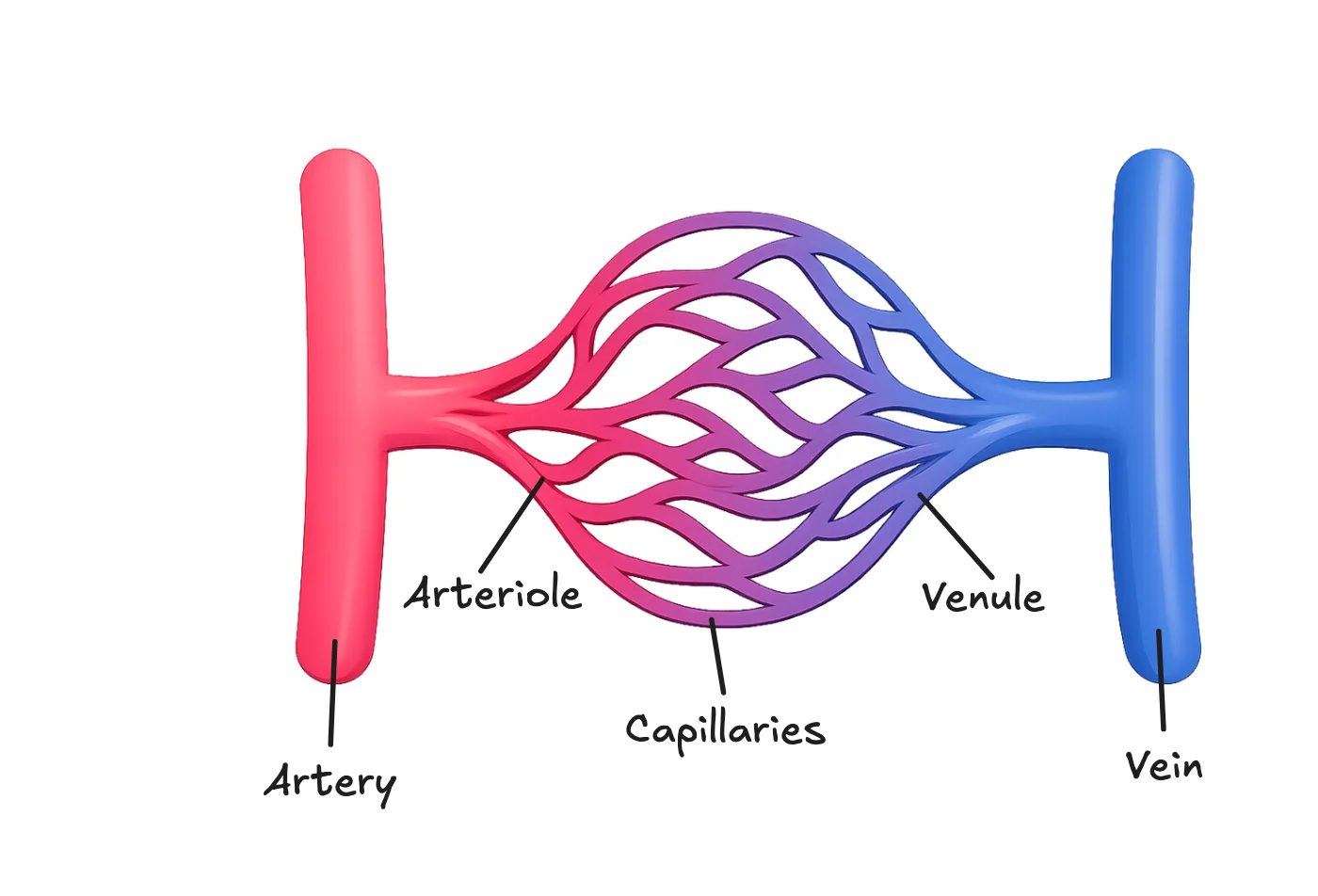
Blood leaves the heart via the aorta and travels to the body’s tissues through five types of vessel, each adapted to its function:
Artery → Arteriole → Capillary → Venule → Vein
Arteries
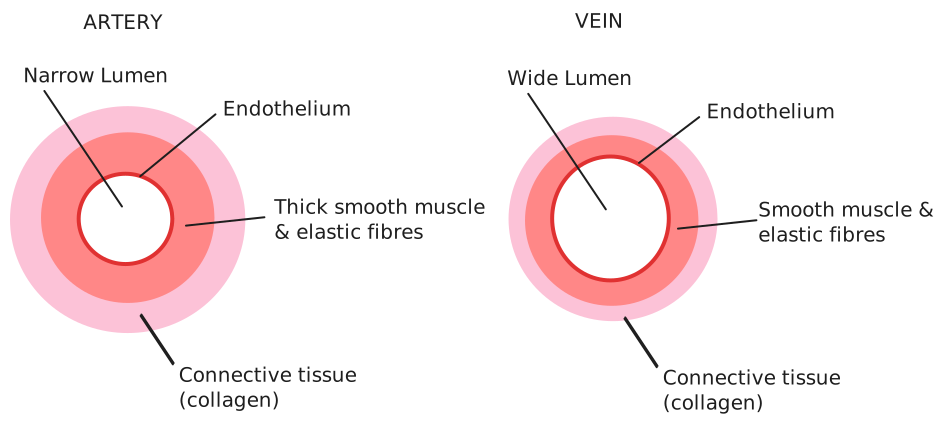
Carry blood away from the heart at high pressure.
- Elastic tissue in the wall stretches and recoils to maintain pressure between heartbeats
- Smooth muscle (thick) withstands high blood pressure
- Smooth endothelium reduces friction
- Relatively narrow lumen maintains high blood pressure
Arterioles
Smaller branches of arteries that control blood distribution to capillaries. Blood flow must be regulated so that tissues receive blood according to their metabolic needs (e.g. during exercise, more blood is directed to skeletal muscles). Arterioles do this via:
- Vasoconstriction: smooth muscle contracts, narrowing the vessel and reducing blood flow to the capillaries
- Vasodilation: smooth muscle relaxes, widening the vessel and increasing blood flow to the capillaries
Veins
Return blood to the heart at low pressure.
- Large lumen: low resistance to blood flow
- Thin walls: only a small amount of elastic and muscular tissue, as blood is under low pressure
- Valves: to prevent backflow of blood
- Surrounding skeletal muscles squeeze the vein walls, pushing blood towards the heart
Capillaries
The site of gas and nutrient exchange between blood and tissues.
- One cell thick (single layer of endothelial cells): very short diffusion pathway
- Very narrow lumen: slows blood flow, allowing more time for diffusion
- Extensive capillary beds: large surface area for exchange
Tissue Fluid
What you need to know (from the AQA specification)
What you need to know (from the AQA specification)
The structure of capillaries and the importance of capillary beds as exchange surfaces. The formation of tissue fluid and its return to the circulatory system.
Cells do not receive oxygen and nutrients directly from capillaries. Instead, substances first leave the blood to form tissue fluid, a watery fluid that bathes all cells.
Tissue fluid contains small molecules (oxygen, glucose, amino acids, water) but not red blood cells, platelets, or large plasma proteins, as these are too large to leave capillary walls.
Formation of Tissue Fluid
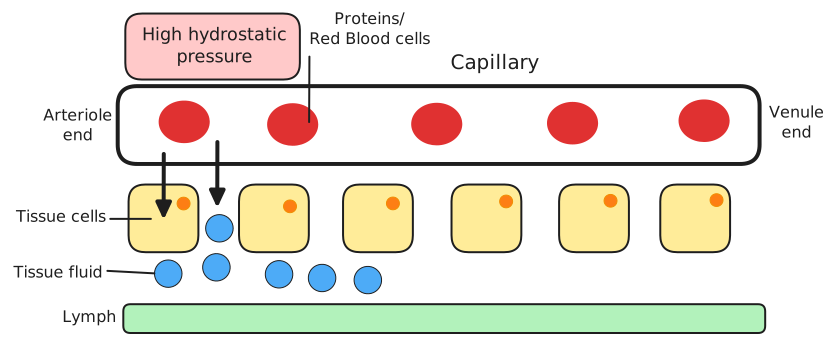
- At the arteriole end of a capillary bed, the hydrostatic pressure inside the capillary is high.
- This forces fluid out through the capillary walls into the surrounding spaces, forming tissue fluid.
- Oxygen and nutrients can then diffuse from the tissue fluid into cells.
Reabsorption of Tissue Fluid
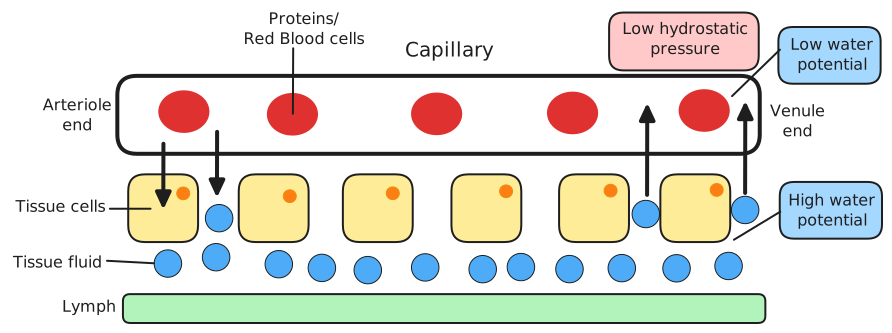
- As fluid is lost from the capillary, the plasma protein concentration inside increases (proteins cannot leave).
- This lowers the water potential of the blood relative to the tissue fluid.
- At the venule end, water moves back into the capillary by osmosis, along with dissolved waste products (CO₂, urea).
Summary
- Arteriole end: high hydrostatic pressure → fluid forced out of capillary
- Venule end: low water potential in blood → water drawn back in by osmosis
At the arteriole end, tissue fluid has a higher water potential than the blood. Why doesn't water simply move back into the capillary by osmosis here?
At the arteriole end, tissue fluid has a higher water potential than the blood. Why doesn't water simply move back into the capillary by osmosis here?
At the arteriole end, hydrostatic pressure inside the capillary is still very high. This hydrostatic pressure exceeds the osmotic gradient created by the plasma proteins, so the net movement of fluid is still outward, not inward.
It is only at the venule end that hydrostatic pressure has fallen (fluid has been lost from the capillary along the way). Here, the osmotic gradient, created by the plasma proteins that remain in the blood, becomes the dominant force, and water moves back in by osmosis.
Lymph
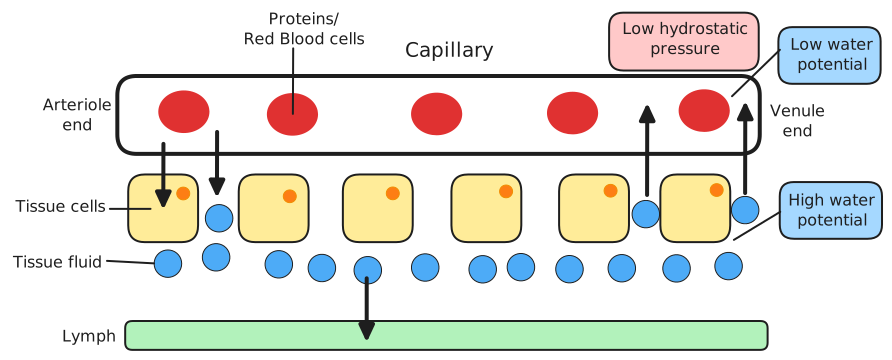
- Not all the tissue fluid is reabsorbed at the venule end.
- Excess fluid drains into the lymphatic system, which returns it to the circulatory system via the thoracic duct. Lymph is moved through the lymphatic vessels by the pressure of surrounding skeletal muscles.
Explore Tissue Fluid
- Small molecules (water, O₂, glucose) are carried in the blood inside capillaries alongside red blood cells and large plasma proteins.
- Use the simulation below to explore what happens at each end of the capillary bed, and predict what goes wrong in two abnormal conditions.
Oedema
Oedema is swelling caused by excess accumulation of tissue fluid. Two common causes:
What could cause oedema?
What could cause oedema?
- High blood pressure: increases hydrostatic pressure at the arteriole end, forcing more fluid out of the capillaries than can be reabsorbed or drained by the lymphatic system.
- Low plasma protein concentration: raises the water potential of the blood, reducing the water potential gradient at the venule end, so less water is reabsorbed by osmosis.
Heart
Heart Structure
What you need to know (from the AQA specification)
What you need to know (from the AQA specification)
The gross structure of the human heart.
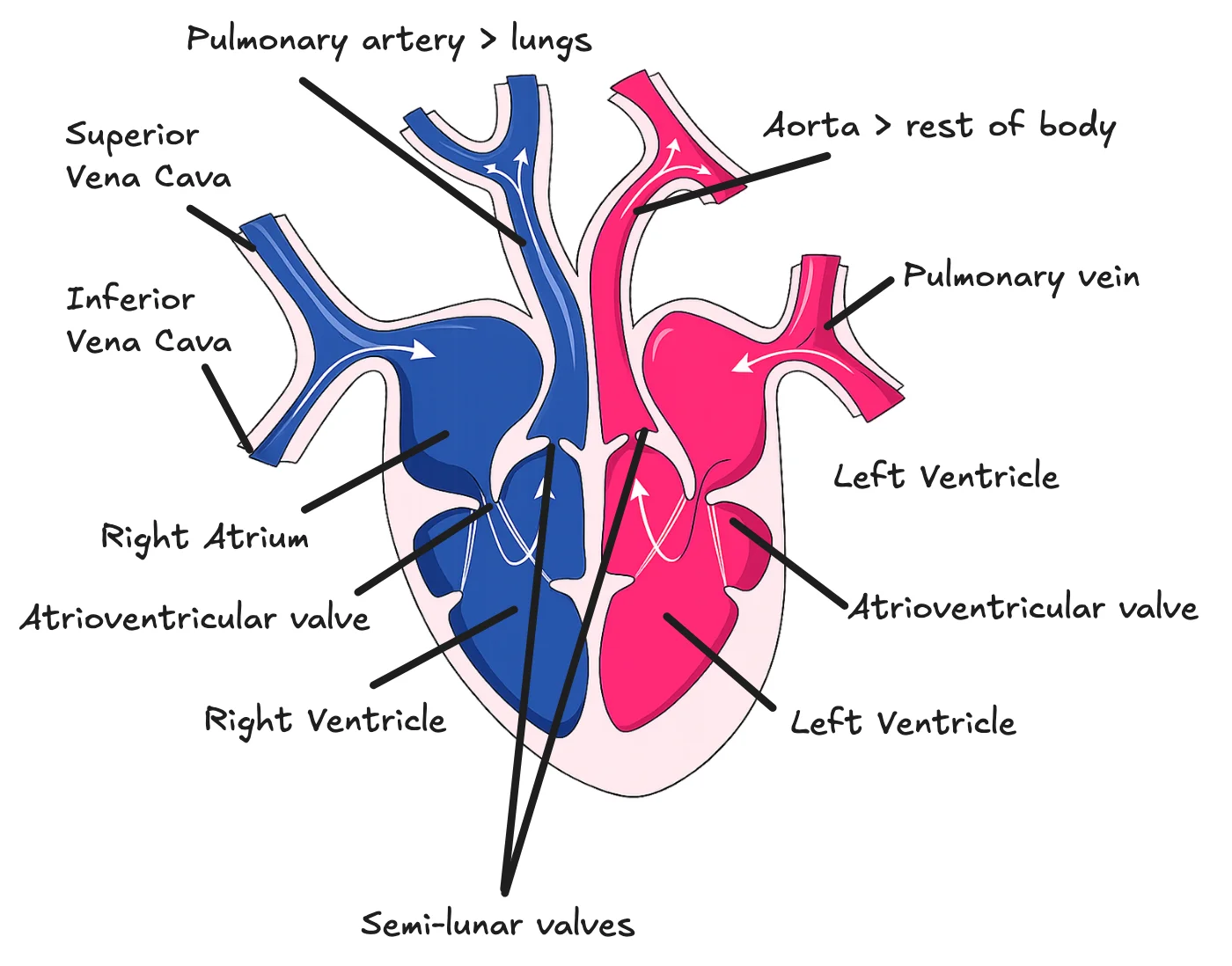
The heart is made of cardiac muscle, which is myogenic. This means it can generate its own contractions without relying on nervous or hormonal input. It initiates its own contractions via the sinoatrial node (SAN) in the right atrium.
The heart has four chambers: right atrium, right ventricle, left atrium and left ventricle. Its key features:
- Atria (upper chambers): receive blood returning to the heart. Thinner walls, as they only pump blood a short distance into the ventricles below.
- Ventricles (lower chambers): pump blood out of the heart. Thicker, more muscular walls than the atria; the left ventricle is thicker than the right (see the question below).
- Septum: a muscular wall separating the left and right sides of the heart, so oxygenated and deoxygenated blood don’t mix.
- Atrioventricular (AV) valves: between the atria and ventricles (bicuspid on the left, tricuspid on the right). Prevent backflow of blood into the atria when the ventricles contract.
- Semilunar (SL) valves: at the exits of the ventricles into the pulmonary artery and aorta. Prevent backflow of blood into the ventricles after they contract.
Why is the left ventricle thicker than the right ventricle?
Why is the left ventricle thicker than the right ventricle?
The left ventricle must pump blood around the entire body (systemic circulation), a much longer distance at high pressure. The right ventricle only pumps blood to the lungs (pulmonary circulation), which are nearby and require far less pressure. The thicker muscular wall of the left ventricle generates the greater force needed for systemic circulation.
Cardiac Cycle
What you need to know (from the AQA specification)
What you need to know (from the AQA specification)
Pressure and volume changes and associated valve movements during the cardiac cycle that maintain a unidirectional flow of blood.
The cardiac cycle describes the sequence of events in one heartbeat. Valves open and close in response to pressure differences. They open when pressure is higher on one side and close when it reverses, ensuring unidirectional blood flow.
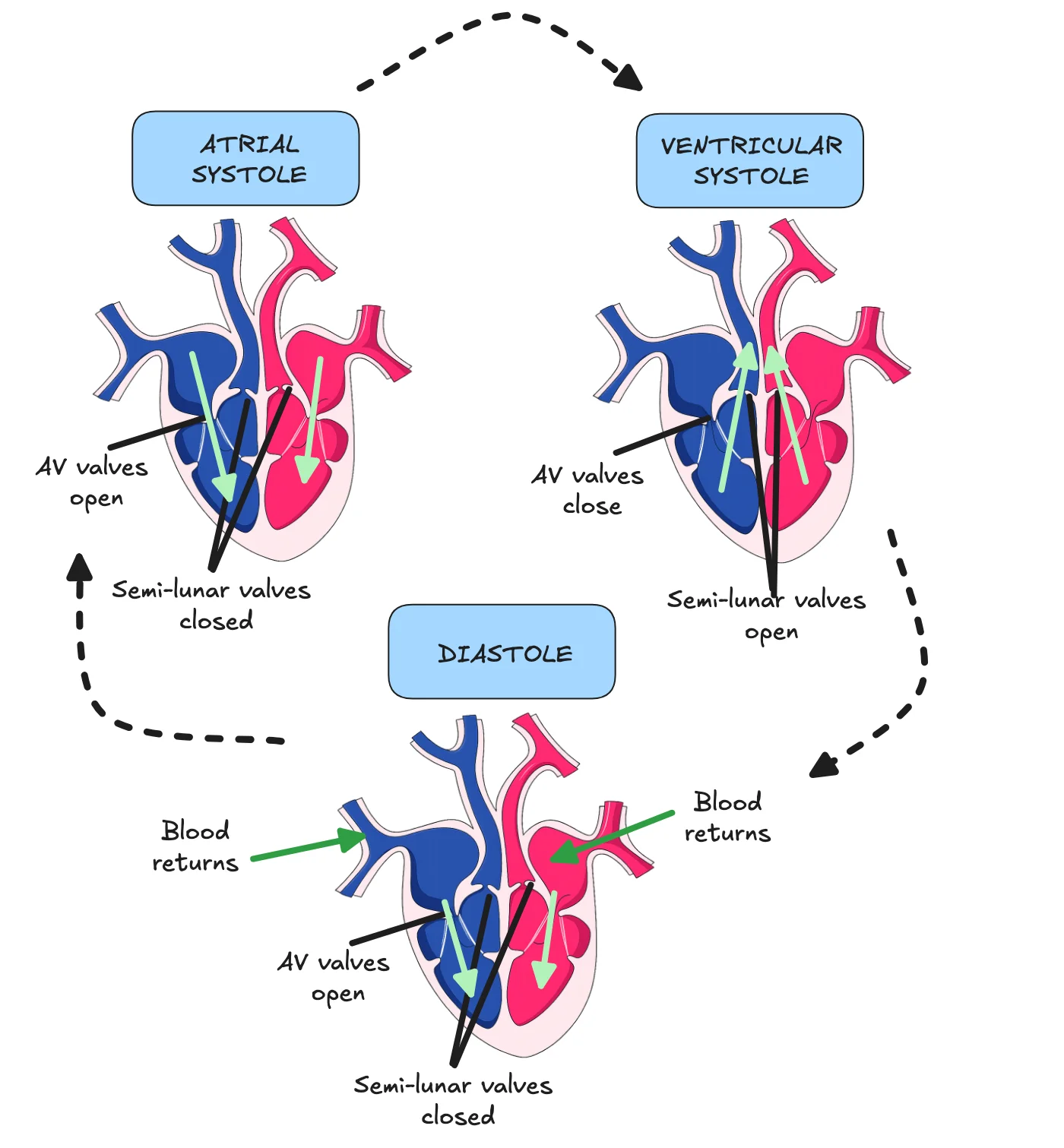
Atrial Systole
- Atria walls contract → volume decreases, pressure increases
- Pressure in atria exceeds pressure in ventricles → AV valves open
- Blood is forced from atria into ventricles
- SL valves remain closed (arterial pressure exceeds ventricular pressure)
Ventricular Systole
- Ventricle walls contract → volume decreases, pressure increases
- Pressure in ventricles exceeds pressure in atria → AV valves close (prevents backflow)
- Pressure in ventricles exceeds pressure in aorta/pulmonary artery → SL valves open
- Blood is ejected into the aorta and pulmonary artery
Diastole
- All cardiac muscle relaxes → pressure in heart falls
- Pressure in aorta/pulmonary artery exceeds ventricular pressure → SL valves close (prevents backflow)
- Blood flows passively from veins into atria, then into ventricles
- AV valves open as atrial pressure exceeds ventricular pressure
How this topic is tested
This analysis is based on past paper data from 2017 to 2025. It is intended for interest only and is not predictive of what will appear in future papers.
- Tested in 9 of 9 years (2017–2025): 36 question parts worth 80 marks.
- 3rd most-examined topic overall by marks, 1st in Unit 3.
Marks by year
Most-tested spec points
- Oxygen Transport & the Dissociation Curve: tested in 8 parts (18 marks)
- Heart Structure & the Cardiac Cycle: tested in 6 parts (14 marks)
- Cardiovascular Data & Risk Factors: tested in 4 parts (12 marks)
- Blood Circulation in a Mammal: tested in 4 parts (10 marks)
- Structure of Arteries, Arterioles & Veins: tested in 3 parts (6 marks)
- Capillaries & Tissue Fluid: tested in 2 parts (4 marks)
Also links to: Colorimetry & Glucose Calibration Curve, SA:V and Metabolic Rate, Ventilation & the Mechanism of Breathing.
Maths and practical skills
- Moving between graphs, numbers and equations (MS 3.1): e.g. 2025 P1 Q6.3
- Percentages, ratios and fractions (MS 0.3): e.g. 2024 P1 Q8.3
- Standard deviation and range (MS 1.10): e.g. 2020 P3 Q6.7
- Using equations (MS 2.3): e.g. 2024 P1 Q8.3
- Colorimeter or potometer measurements (AT b): e.g. 2025 P1 Q6.2
- Units and standard form (MS 0.1): e.g. 2025 P1 Q6.3
- Principles of sampling (MS 1.5): e.g. 2025 P1 Q6.4
- Plotting graphs (MS 3.2): e.g. 2019 P1 Q9.1
Tips from examiner reports
What students commonly get wrong
- Water moves by osmosis, not tissue fluidWatch out: when explaining the return of tissue fluid, say water moves back into the capillary by osmosis, not "tissue fluid". Be precise, e.g. "the blood has a lower water potential than the tissue fluid, so water moves from the tissue fluid into the capillary by osmosis." 2023 P1 Q9.6 · 2017 P1 Q3.3
- Arteries don't pump bloodWatch out: the muscle in artery walls doesn't pump blood, and the aorta isn't a second pump. Elastic tissue stretches when blood surges in and recoils, which smooths blood flow and maintains pressure. Vasoconstriction happens in arterioles, not the aorta. 2024 P1 Q8.1 · 2020 P1 Q3.2
- Valves: explain the causeWhen explaining how a valve keeps blood flowing one way, give the pressure cause for both: it opens when pressure is higher behind it, and closes when pressure is higher in front of it. Saying when it opens or closes isn't enough. 2019 P3 Q3.3
- Haemoglobin affinity: loading and unloading
- If haemoglobin has a lower affinity for oxygen, this means oxygen is unloaded more easily, but loaded less easily.
- If haemoglobin has a higher affinity for oxygen, this means oxygen is loaded more easily, but unloaded less easily.
Exam Question Practice
Some chemicals, such as nitrites, change the iron in some haemoglobin molecules so that they can no longer bind oxygen.
Figure 1 shows the dissociation curve for oxyhaemoglobin:
- with no nitrite exposure
- after nitrite exposure, when 40% of the haemoglobin can no longer bind oxygen.
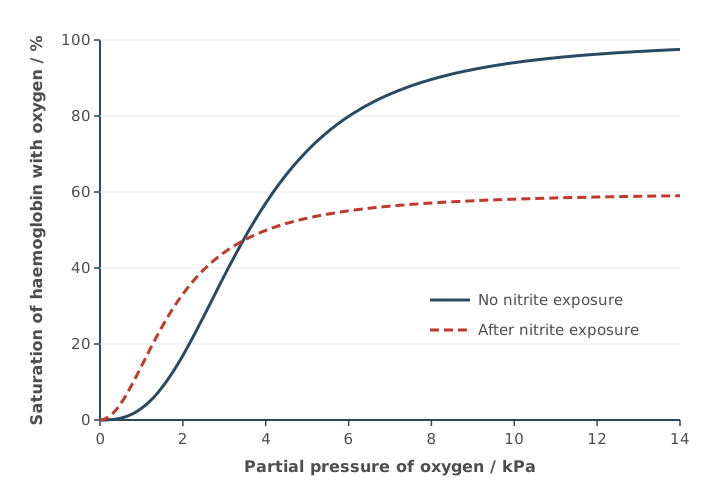
Using Figure 1, what can you conclude about how exposure to nitrites affects the loading and unloading of oxygen by haemoglobin?
Explain your answer.
(3 marks)
Hint
Compare the two curves at high pO₂ (in the lungs) and at low pO₂ (in respiring tissues). How much oxygen is loaded, and how readily is it unloaded?
Mark Scheme
Loading
- Less oxygen is loaded at high pO₂: the maximum saturation is only 60% (1 mark)
Unloading
- At low pO₂, haemoglobin has a higher affinity for oxygen (1 mark)
- So less oxygen is unloaded to respiring tissues at low pO₂ (1 mark)
Also accepted / rejected
Tips
- Use the figure: after nitrite exposure, haemoglobin loads less oxygen at high pO₂ (maximum 60% saturation)
- At low pO₂ it has a higher affinity for oxygen, so it unloads less oxygen to respiring tissues
- Don’t say it “loads more readily at low pO₂”; the point is it unloads less
- The Bohr effect and pH aren’t relevant
Blood leaving a kidney is low in oxygen. Before it can supply oxygen to the heart muscle, it must pass through the lungs.
Describe the route taken by blood from a kidney to the coronary arteries.
Name the major blood vessels (arteries and veins) and the heart valves the blood passes through.
(5 marks)
Hint
Start at the renal vein and follow the blood back to the heart, through the right side, to the lungs and back, through the left side, and out to the coronary arteries. Name every vessel and valve.
Mark Scheme
- Renal vein → vena cava → right atrium (1 mark)
- Through the atrioventricular valve into the right ventricle (1 mark)
- Through the semilunar valve into the pulmonary artery → lungs → pulmonary vein (1 mark)
- Left atrium → atrioventricular valve → left ventricle (1 mark)
- Through the semilunar valve into the aorta → coronary arteries (1 mark)
Also accepted / rejected
Also accepted
- “Tricuspid” (right) and “bicuspid” or “mitral” (left) for the atrioventricular valves
- “Pulmonary valve” and “aortic valve” for the semilunar valves
Not accepted
- “AV valve” written instead of atrioventricular valve (penalised once)
Tips
- Don’t stop at the lungs. Continue through the left side of the heart and out to the coronary arteries
- Don’t mix up the pulmonary artery (heart to lungs) and the pulmonary vein (lungs to heart)
- Name the valves correctly, with an atrioventricular (tricuspid) valve on the right, an atrioventricular (bicuspid) valve on the left, and a semilunar valve leaving each ventricle
- Write “atrioventricular valve” in full, not “AV valve”
The aorta carries blood at high pressure away from the left ventricle.
Describe two features of the aorta wall, and explain how each is related to the function of the aorta.
(2 marks)
Hint
Name a tissue in the wall, then explain what it does as blood surges through with each heartbeat.
Mark Scheme
Max 2 marks
- Smooth muscle that can withstand the high pressure (1 mark)
- Elastic tissue that stretches and recoils, smoothing out the blood pressure (1 mark)
- A smooth endothelium that reduces friction (1 mark)
- Collagen (protein) that stops the wall splitting under high pressure (1 mark)
Also accepted / rejected
Also accepted
- “Expands” for stretches (point 2)
Not accepted
- “Contracts and relaxes” for recoils (point 2)
- “Thick wall” on its own, without naming the muscle
Tips
- Name a structure and link it to a function: smooth muscle withstands high pressure; elastic tissue stretches and recoils to smooth or maintain blood pressure
- Give both stretch and recoil
- Muscle in the aorta wall doesn’t pump blood
- The smooth endothelium (not epithelium) reduces friction
After a severe burn, the capillaries near the burn become leaky. Plasma proteins move out of the capillaries into the tissue fluid.
Explain how this affects the return of tissue fluid to the capillaries.
(2 marks)
Hint
How do proteins in the tissue fluid change its water potential? Which way will water then move by osmosis?
Mark Scheme
- The proteins lower the water potential of the tissue fluid (1 mark)
- So less water returns to the capillaries by osmosis (1 mark)
Also accepted / rejected
Also accepted
- The water potential of the blood is higher than before, or the water potential gradient is smaller (point 1)
- “No water returns” (point 2)
Not accepted
- “WP” for water potential (point 1)
Tips
- Proteins in the tissue fluid lower its water potential, so say which way it changes and where
- It’s water that moves back by osmosis, not “tissue fluid”
- Give the direction: less water returns to the capillaries
Also accepted
Not accepted