Genome and Proteome
What you need to know (from the AQA specification)
What you need to know (from the AQA specification)
The concept of the genome as the complete set of genes in a cell and of the proteome as the full range of proteins that a cell is able to produce.
- Genome: the complete set of genetic material (all DNA) in a cell, including every gene
- Proteome: the full range of proteins that a cell is able to produce
The proteome is larger than the genome, because alternative splicing of pre-mRNA allows one gene to code for more than one protein. You can explore this further in genome projects in Unit 8.
Structure of mRNA and tRNA
What you need to know (from the AQA specification)
What you need to know (from the AQA specification)
The structure of molecules of messenger RNA (mRNA) and of transfer RNA (tRNA).
mRNA
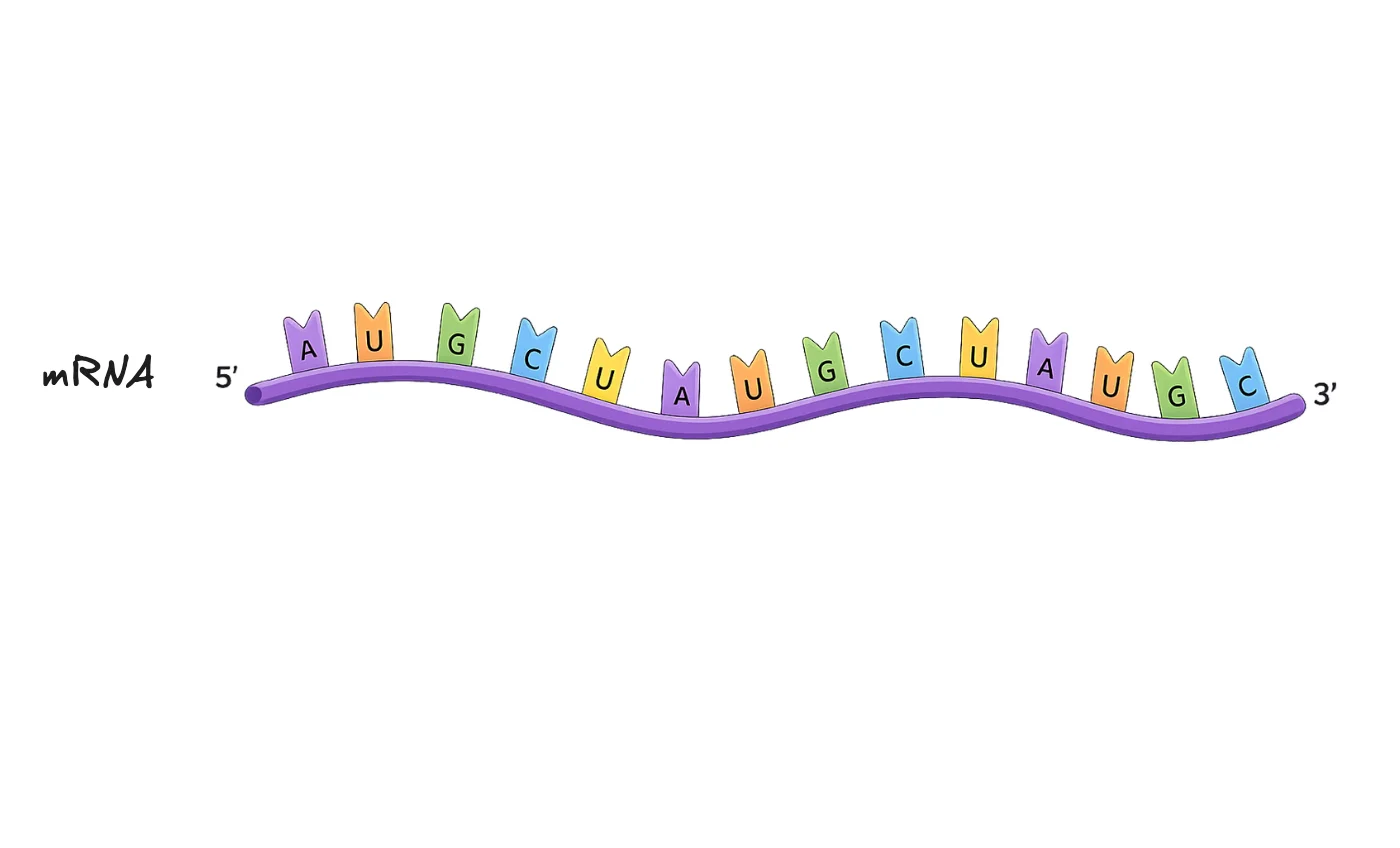
mRNA (messenger RNA) is a single-stranded polynucleotide chain produced during transcription. Key features:
- Contains the nitrogenous base uracil (U) instead of thymine. Uracil pairs with adenine (A)
- Carries the genetic code from the nucleus to the ribosome
- The code is read in groups of three adjacent bases called codons (e.g. CUG). Each codon codes for a specific amino acid
tRNA
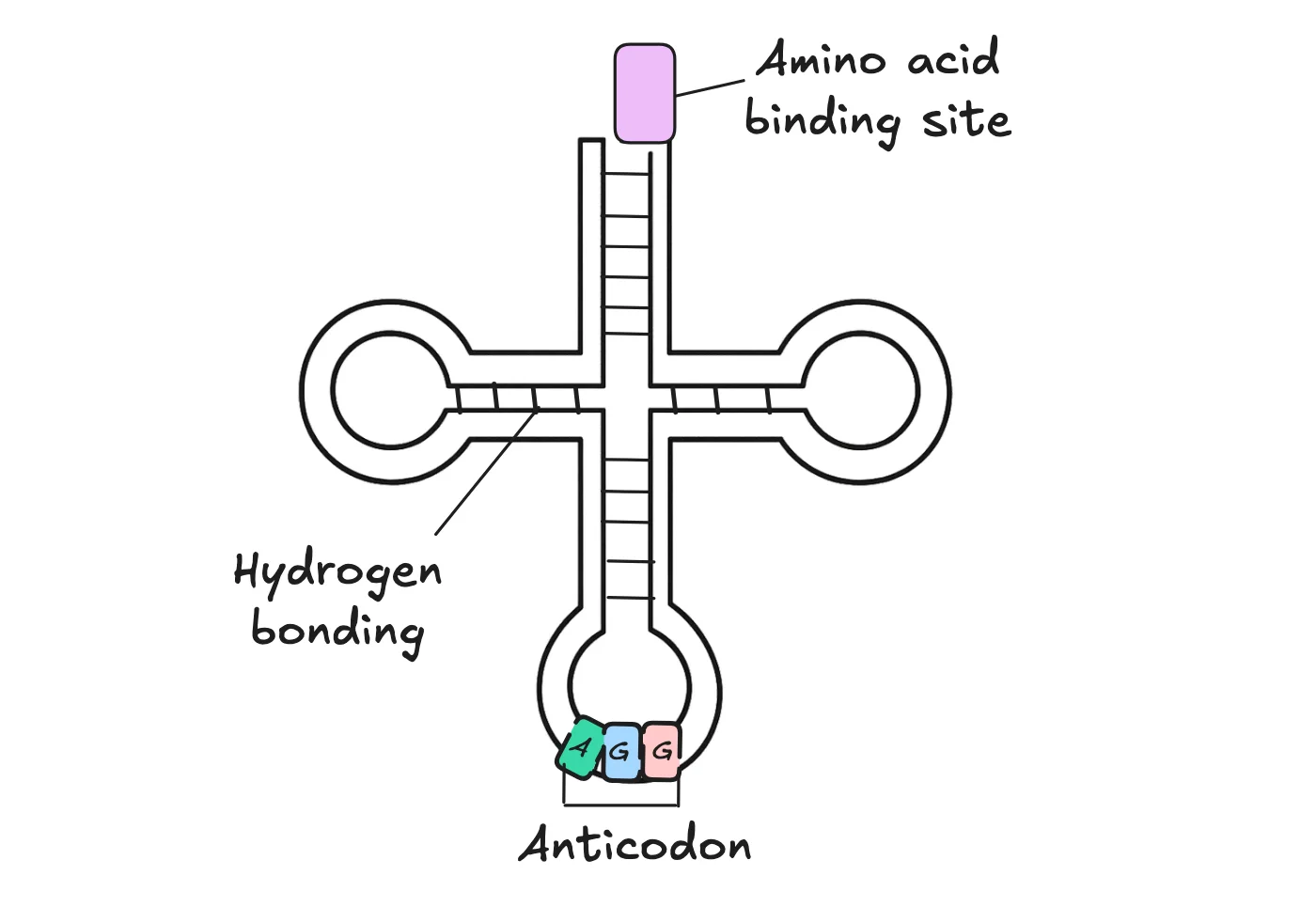
tRNA (transfer RNA) carries amino acids to the ribosome during translation. Key features:
- A single polynucleotide chain folded into a clover-leaf shape, with hydrogen bonds forming between complementary bases within the molecule. These hydrogen bonds help to maintain this structure.
- Has an amino acid attachment site at one end, where a specific amino acid binds
- Has an anticodon, which is a sequence of three bases complementary to a specific mRNA codon. This allows tRNA to recognise and bind to the correct sequence on the mRNA
Common exam mistakes: mRNA vs tRNA
- Both mRNA and tRNA contain uracil, not thymine.
- tRNA is single-stranded but folds back on itself with (internal) hydrogen bonds. It is not double-stranded
- Codons are on mRNA; anticodons are on tRNA
- tRNA is shorter than mRNA, not longer
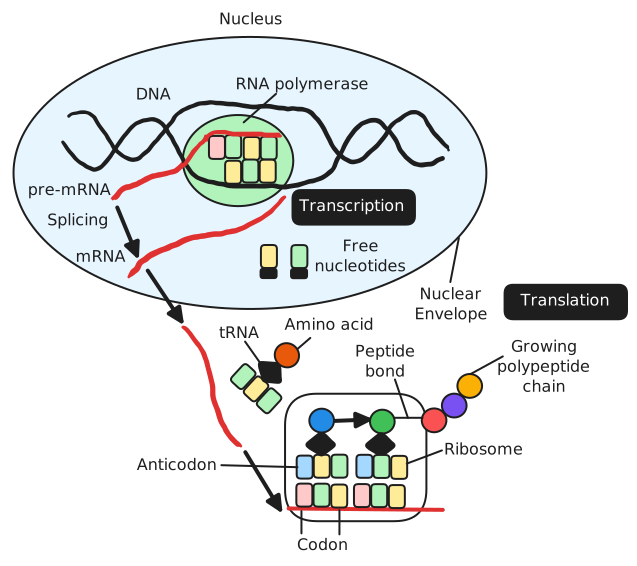
Overview Transcription & Translation
Transcription
What you need to know (from the AQA specification)
What you need to know (from the AQA specification)
Transcription as the production of mRNA from DNA. The role of RNA polymerase in joining mRNA nucleotides.
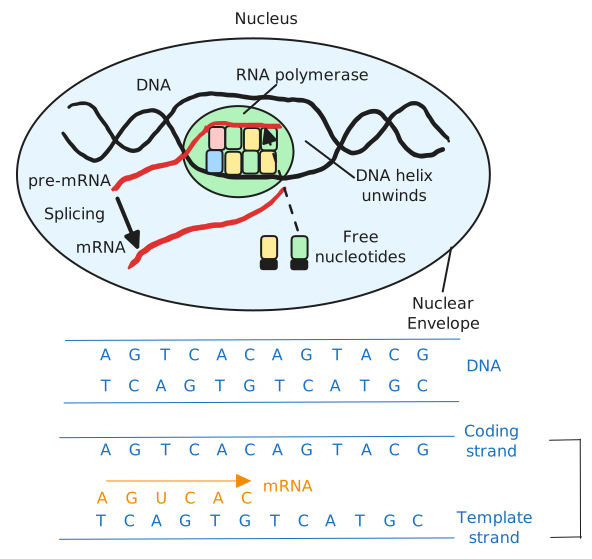
Transcription is the production of mRNA from a DNA template. It takes place in the nucleus:
- RNA polymerase unwinds the double helix and breaks the hydrogen bonds between bases, separating the two strands
- One strand acts as the template strand, and free RNA nucleotides align alongside it by complementary base pairing
- Uracil (U) is used in RNA instead of thymine. Uracil pairs with adenine and cytosine pairs with guanine
- RNA polymerase joins adjacent RNA nucleotides by phosphodiester bonds, building the new mRNA strand
- Formation of phosphodiester bonds is a condensation reaction, which requires ATP
Common exam mistake: transcription
When describing transcription, say RNA nucleotides align against the template strand, not DNA nucleotides. RNA polymerase catalyses the formation of phosphodiester bonds between RNA nucleotides; it does not form hydrogen bonds (the hydrogen bonds form between the RNA nucleotides and the DNA template strand).
What does 3' → 5' direction mean?
What does 3' → 5' direction mean?
Each nucleotide has a sugar with numbered carbon atoms. The 3’ carbon carries an –OH group; the 5’ carbon is where the phosphate attaches. In a polynucleotide strand, one end has a free 5’ phosphate (the 5’ end) and the other has a free 3’ –OH (the 3’ end). RNA polymerase moves along the template strand from its 3’ end to its 5’ end, and always builds the new mRNA strand from the 5’ end to the 3’ end.
Pre-mRNA and Splicing
What you need to know (from the AQA specification)
What you need to know (from the AQA specification)
In prokaryotes, transcription results directly in the production of mRNA from DNA. In eukaryotes, transcription results in the production of pre-mRNA; this is then spliced to form mRNA.
In prokaryotes, transcription produces mRNA directly. It can be translated immediately.
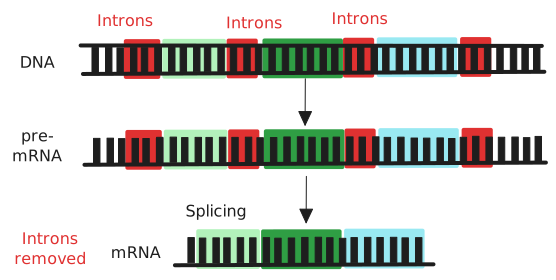
In eukaryotes, transcription first produces pre-mRNA, which contains:
- Introns: non-coding sequences that do not code for amino acids
- Exons: coding sequences that do code for amino acids
The introns are removed and the exons are joined in a process called splicing, producing the final mRNA molecule. This mRNA then leaves the nucleus through nuclear pores and travels to a ribosome in the cytoplasm for translation.
Translation
What you need to know (from the AQA specification)
What you need to know (from the AQA specification)
Translation as the production of polypeptides from the sequence of codons carried by mRNA. The roles of ribosomes, tRNA and ATP.
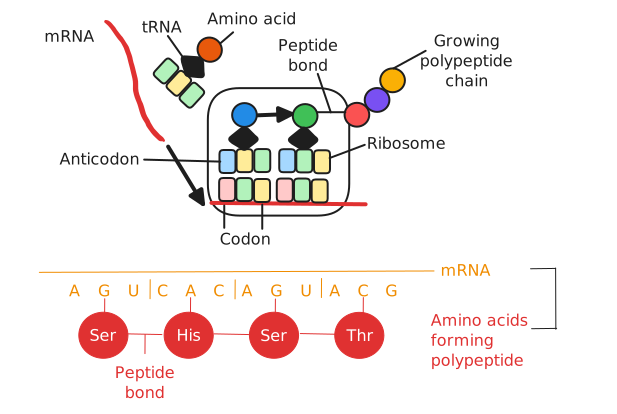
Translation is the production of a polypeptide from the sequence of codons on mRNA. It takes place at ribosomes in the cytoplasm.
- mRNA attaches to a ribosome
- tRNA brings a specific amino acid to the ribosome
- The tRNA anticodon binds to the complementary codon on the mRNA by complementary base pairing
- ATP provides energy for the formation of a peptide bond between adjacent amino acids in a condensation reaction
- The tRNA is released (after its amino acid has joined the growing polypeptide chain)
- The ribosome moves along the mRNA to the next codon
- This process repeats, building up a polypeptide chain, until a stop codon is reached. Once the stop codon is reached the polypeptide is released
Why is ATP needed for translation?
Why is ATP needed for translation?
ATP provides the energy needed for the formation of peptide bonds between adjacent amino acids. Without ATP, amino acids cannot be joined together and no polypeptide chain can be built.
Common exam mistake: translation
It is the amino acid that joins the growing polypeptide chain, not the tRNA. The tRNA carries the amino acid to the ribosome, but once the peptide bond forms, the tRNA detaches and leaves. Also remember, ATP is used in peptide bond formation.
What is the role of ribosomes in translation?
What is the role of ribosomes in translation?
Ribosomes provide the site for translation. They have two subunits that hold the mRNA in place and have binding sites for two tRNA molecules simultaneously. The ribosome moves along the mRNA codon by codon, facilitating anticodon–codon base pairing and catalysing peptide bond formation between adjacent amino acids.
How this topic is tested
This analysis is based on past paper data from 2017 to 2025. It is intended for interest only and is not predictive of what will appear in future papers.
- Tested in 7 of 9 years (2017–2025): 20 question parts worth 56 marks.
- 12th most-examined topic overall by marks, 1st in Unit 4.
Marks by year
Most-tested spec points
- Translation: tested in 5 parts (19 marks)
- Transcription: tested in 5 parts (11 marks)
- Interpreting the Genetic Code: tested in 3 parts (7 marks)
- Genome & Proteome: tested in 2 parts (4 marks)
- mRNA & tRNA Structure: tested in 1 part (3 marks)
Also links to: Gene Mutations, Levels of Protein Structure, DNA Structure.
Tips from examiner reports
What students commonly get wrong
- RNA polymerase forms phosphodiester bondsWatch out: RNA polymerase joins adjacent RNA nucleotides by phosphodiester bonds (between the sugar and phosphate). It doesn't form hydrogen bonds, pair complementary bases, or join the bases together. 2020 P1 Q10.1 · 2025 P1 Q2.2
- mRNA vs tRNA: both single-stranded, both have uracilWatch out: both mRNA and tRNA contain uracil, not thymine, and tRNA is single-stranded: it folds into a clover leaf held by hydrogen bonds, but it isn't double-stranded or a double helix. 2024 P1 Q6.1
- Translation: the amino acid joins, using ATPIn translation, say each tRNA carries a specific amino acid, and that it's the amino acid (not the tRNA) that joins the polypeptide by a peptide bond, using ATP. 2020 P1 Q10.2 · 2021 P1 Q3.1
- Genome isn't genotypeWatch out: the genome is the complete set of genes in a cell, not all the genes in a species or population, and not the genotype. The proteome is the full range of proteins the cell is able to produce: include "able to produce", and don't confuse it with the phenotype. 2022 P3 Q4.1
Exam Question Practice
Scientists studying a bacterium sequenced its genome and then identified its proteome.
Define the terms genome and proteome.
(2 marks)
Hint
One term is about the DNA, the other about the proteins. Is it everything in one cell, or everything in a species?
Mark Scheme
- Genome: the complete set of genes (all the DNA) in a cell (1 mark)
- Proteome: the full range of proteins that a cell is able to produce (that its DNA codes for) (1 mark)
Also accepted / rejected
Tips
- Genome: the complete set of genes (all the DNA) in a cell; “genetic information” or “the genetic code” is too vague
- Proteome: the full range of proteins a cell can produce; “all the proteins in a cell” isn’t enough
- Define both for a cell or organism, not a species or population
mRNA and tRNA are both types of RNA involved in protein synthesis.
Give three ways in which the structure of an mRNA molecule is different from the structure of a tRNA molecule.
| mRNA | tRNA | |
|---|---|---|
| 1 | ||
| 2 | ||
| 3 |
(3 marks)
Hint
Think about the overall shape, relative length, and special features each type has for its function. Make sure you compare like with like.
Mark Scheme
Any three rows, each comparing the same feature (3 marks)
| mRNA | tRNA | |
|---|---|---|
| 1. | Has codons | Has an anticodon |
| 2. | No hydrogen bonds (no base pairing) | Hydrogen bonds between some bases |
| 3. | No amino acid binding site | Has an amino acid binding site |
| 4. | Linear (straight) | Clover-leaf shape (folded) |
| 5. | Long (many nucleotides) | Short (few nucleotides) |
Also accepted / rejected
Not accepted
- A row that doesn’t compare the same feature, e.g. “mRNA has codons, tRNA is folded”
Tips
- Compare the same feature on each row, e.g. mRNA is linear/straight while tRNA is clover-leaf shaped
- mRNA and tRNA both contain uracil and are both single-stranded; neither is a double helix, and tRNA doesn’t contain exons
- Say tRNA has an amino acid binding site, not just “has an amino acid”
- mRNA is longer than tRNA, not shorter
- “mRNA has codons but tRNA doesn’t” isn’t a valid comparison: tRNA has an anticodon
Cells in the pancreas make large amounts of the protein insulin. After transcription, the insulin mRNA leaves the nucleus.
Describe how the insulin polypeptide is made from this mRNA. In your answer, include the roles of ribosomes, tRNA and ATP.
(6 marks)
Hint
Work through translation in order. Where does the ribosome attach, and how much of the mRNA does it cover? What does tRNA bring, and how does it pair with the mRNA? Where is ATP used (two places)?
Mark Scheme
Max 6 marks
- The ribosome attaches to the mRNA (1 mark)
- The ribosome covers two codons at a time, starting at the start codon (AUG) (1 mark)
- ATP provides energy to attach amino acids to tRNA (1 mark)
- tRNA brings a specific amino acid to the ribosome (1 mark)
- tRNA anticodons bind to complementary mRNA codons (1 mark)
- ATP provides energy to form peptide bonds (1 mark)
- The ribosome moves along the mRNA to the stop codon, forming the insulin polypeptide (1 mark)
Also accepted / rejected
Also accepted
- “Binds” or “joins” instead of “attaches” (point 1)
- “Rough endoplasmic reticulum” for the ribosome (point 1)
Tips
- Include both roles of ATP, attaching amino acids to tRNA, and forming peptide bonds. The first is often missed
- Say the ribosome covers two codons at a time
- For codon–anticodon pairing, use both key words. tRNA anticodons bind to complementary mRNA codons
- Describe the ribosome moving along the mRNA, forming a polypeptide, until it reaches a stop codon
What earns marks
- Answers set out in a logical sequence, including the ribosome attaching at the start codon
Table 1 shows some mRNA codons and the amino acid coded for by each codon.
Table 1
| mRNA codon | Amino acid |
|---|---|
| ACC | Thr |
| AUG | Met |
| CAU | His |
| CCU | Pro |
| GGA | Gly |
| GUA | Val |
| UAC | Tyr |
| UGG | Trp |
Figure 1 shows the mRNA base sequence produced when part of a gene coding for a protein is transcribed.
Figure 1
| CAU | GGA | UGG |
|---|
Use Table 1 to work out the sequence of amino acids coded for by the mRNA in Figure 1.
(1 marks)
Hint
Use the mRNA codons directly with the table; don’t convert them to anything else first. Read each three-base sequence carefully.
Mark Scheme
His, Gly, Trp (in this order) (1 mark)
Tips
- Use the mRNA codons in Figure 1 directly (CAU, GGA, UGG): His, Gly, Trp
- Don’t use the complementary sequence (that gives Val, Pro, Thr)
Also accepted
Not accepted