18 of 18 spec points in this unit have notes.
- Notes
- Suggested skills activity
- Coming soon
-
Monohybrid Inheritance
Spec points
Genotype & PhenotypeJump to notes →
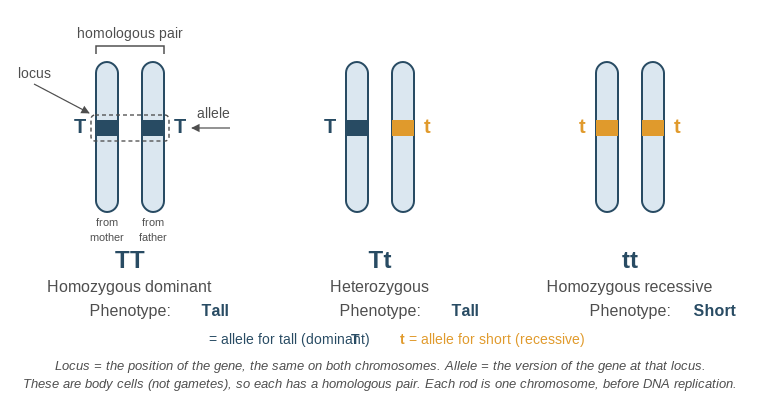
The genotype is the genetic constitution of an organism.
The phenotype is the expression of this genetic constitution and its interaction with the environment.Alleles, Dominance & ZygosityJump to notes →
There may be many alleles of a single gene.
Alleles may be dominant, recessive or codominant.
In a diploid organism, the alleles at a specific locus may be either homozygous or heterozygous.Genetic Diagrams & CrossesJump to notes →
The use of fully labelled genetic diagrams to interpret, or predict, the results of:
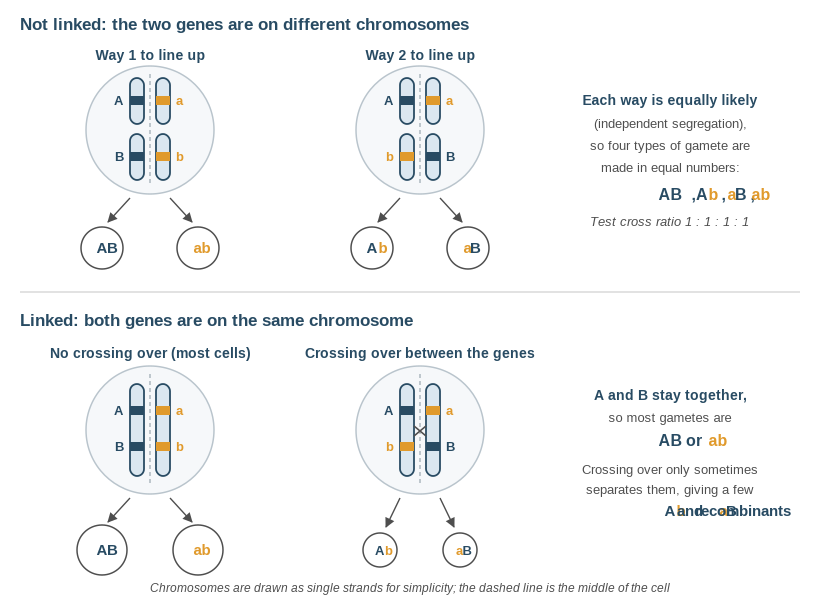
• monohybrid and dihybrid crosses involving dominant, recessive and codominant alleles
• crosses involving sex-linkage, autosomal linkage, multiple alleles and epistasis.Representing Phenotypic RatiosSkillMS 0.3Jump to notes →
Students could use information to represent phenotypic ratios in monohybrid and dihybrid crosses.Probability in InheritanceSkillMS 1.4Jump to notes →
Students could show understanding of the probability associated with inheritance.
-
The Chi-Squared Test
Spec points
The Chi-Squared TestMS 1.9Jump to notes →
Use of the chi-squared (Χ²) test to compare the goodness of fit of observed phenotypic ratios with expected ratios.
Students could use the Χ² test to investigate the significance of differences between expected and observed phenotypic ratios.Investigating Genetic RatiosSkillAT hJump to notes →
Students could investigate genetic ratios using crosses of Drosophila or Fast Plant®
-
Populations
Spec points
Populations, Gene Pools & Allele FrequencyJump to notes →
Species exist as one or more populations.
A population as a group of organisms of the same species occupying a particular space at a particular time that can potentially interbreed.
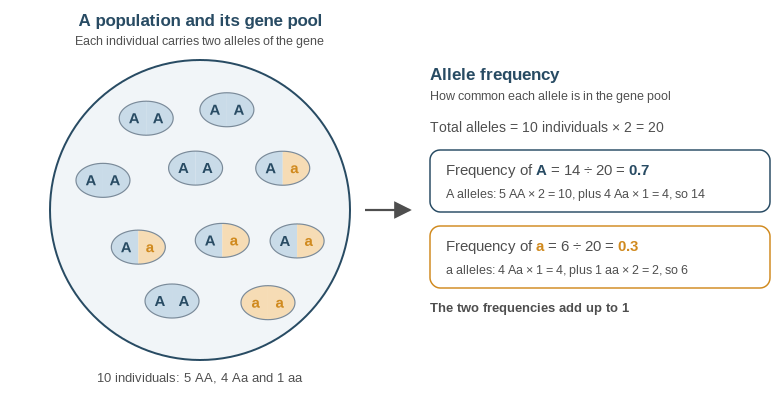
The concepts of gene pool and allele frequency.The Hardy-Weinberg PrincipleMS 2.4Jump to notes →
The Hardy–Weinberg principle provides a mathematical model, which predicts that allele frequencies will not change from generation to generation. The conditions under which the principle applies.
The frequency of alleles, genotypes and phenotypes in a population can be calculated using the Hardy–Weinberg equation:
p² + 2pq + q² = 1
where p is the frequency of one (usually the dominant) allele and q is the frequency of the other (usually recessive) allele of the gene.
Students could calculate allele, genotype and phenotype frequencies from appropriate data using the Hardy–Weinberg equation.Collecting Phenotype Frequency DataSkillAT kJump to notes →
Students could collect data about the frequency of observable phenotypes within a single population.
-
Evolution May Lead to Speciation
Spec points
Sources of Variation in PhenotypeJump to notes →
Individuals within a population of a species may show a wide range of variation in phenotype. This is due to genetic and environmental factors. The primary source of genetic variation is mutation. Meiosis and the random fertilisation of gametes during sexual reproduction produce further genetic variation.Natural Selection & Allele FrequencyJump to notes →
Predation, disease and competition for the means of survival result in differential survival and reproduction, ie natural selection.
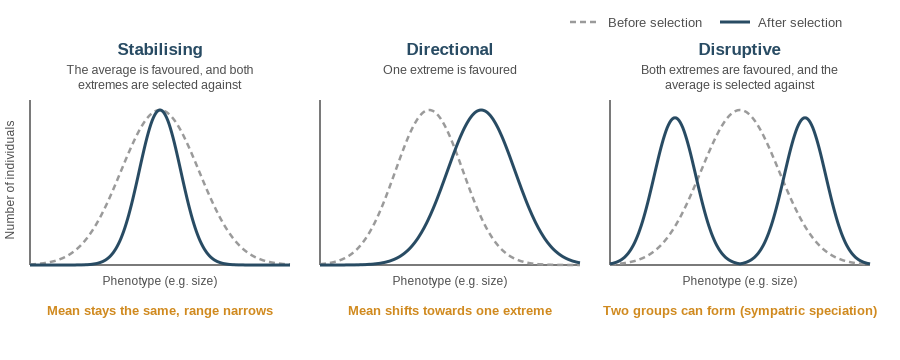
Those organisms with phenotypes providing selective advantages are likely to produce more offspring and pass on their favourable alleles to the next generation. The effect of this differential reproductive success on the allele frequencies within a gene pool.Stabilising, Directional & Disruptive SelectionJump to notes →
The effects of stabilising, directional and disruptive selection.
Evolution as a change in the allele frequencies in a population.Reproductive Separation & SpeciationJump to notes →
Reproductive separation of two populations can result in the accumulation of difference in their gene pools. New species arise when these genetic differences lead to an inability of members of the populations to interbreed and produce fertile offspring. In this way, new species arise from existing species.
Allopatric and sympatric speciation.Genetic DriftJump to notes →
The importance of genetic drift in causing changes in allele frequency in small populations.Explaining Selection, Drift & SpeciationJump to notes →
Students should be able to:
• explain why individuals within a population of a species may show a wide range of variation in phenotype
• explain why genetic drift is important only in small populations
• explain how natural selection and isolation may result in change in the allele and phenotype frequency and lead to the formation of a new species
• explain how evolutionary change over a long period of time has resulted in a great diversity of species.Sampling & Genetic DriftSkillMS 1.5Jump to notes →
Students could apply their knowledge of sampling to the concept of genetic drift.Investigating Random Sampling of AllelesSkillPS 1.2Jump to notes →
Students could devise an investigation to mimic the effects of random sampling on allele frequencies in a population.Computer Modelling of Selection & DriftSkillAT lJump to notes →
Students could use computer programs to model the effects of natural selection and of genetic drift.
-
Populations in Ecosystems
Spec points
Communities, Ecosystems & NichesJump to notes →
Populations of different species form a community. A community and the non-living components of its environment together form an ecosystem. Ecosystems can range in size from the very small to the very large.
Within a habitat, a species occupies a niche governed by adaptation to both abiotic and biotic conditions.Carrying Capacity, Competition & PredationJump to notes →
An ecosystem supports a certain size of population of a species, called the carrying capacity. This population size can vary as a result of:
• the effect of abiotic factors
• interactions between organisms: interspecific and intraspecific competition and predation.Estimating Population SizeJump to notes →
The size of a population can be estimated using:
• randomly placed quadrats, or quadrats along a belt transect, for slow-moving or non-motile organisms
• the mark-release-recapture method for motile organisms. The assumptions made when using the mark-release-recapture method.SuccessionJump to notes →
Ecosystems are dynamic systems.
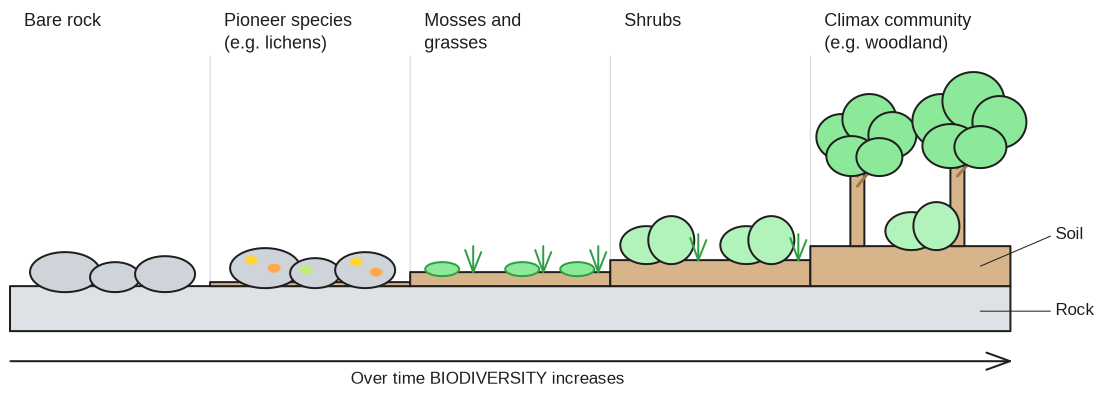
Primary succession, from colonisation by pioneer species to climax community.
At each stage in succession, certain species may be recognised which change the environment so that it becomes more suitable for other species with different adaptations. The new species may change the environment in such a way that it becomes less suitable for the previous species.
Changes that organisms produce in their abiotic environment can result in a less hostile environment and change biodiversity.Conservation & Managing SuccessionJump to notes →
Conservation of habitats frequently involves management of succession.
Students should be able to:
• show understanding of the need to manage the conflict between human needs and conservation in order to maintain the sustainability of natural resources
• evaluate evidence and data concerning issues relating to the conservation of species and habitats and consider conflicting evidence
• use given data to calculate the size of a population estimated using the mark-release-recapture method.Mark-Release-Recapture in PracticeSkillAT hJump to notes →
Students could use the mark-release-recapture method to investigate the abundance of a motile species.Turbidity & Microbial Growth RateSkillAT iJump to notes →
Students could use turbidity measurements to investigate the growth rate of a broth culture of microorganisms.Logarithmic Scales for Population GrowthSkillMS 2.5Jump to notes →
Students could use a logarithmic scale in representing the growth of a population of microorganisms.Required Practical 12Required practicalAT aAT kJump to notes →
Required practical 12: Investigation into the effect of a named environmental factor on the distribution of a given species.
Students could:
• investigate the distribution of organisms in a named habitat using randomly placed frame quadrats, or a belt transect
• use both percentage cover and frequency as measures of abundance of a sessile species.