36 of 36 spec points in this unit have notes.
- Notes
- Suggested skills activity
- Coming soon
-
Monomers and Polymers
Spec points
Monomers & Polymers DefinitionsJump to notes →
The variety of life, both past and present, is extensive, but the biochemical basis of life is similar for all living things.
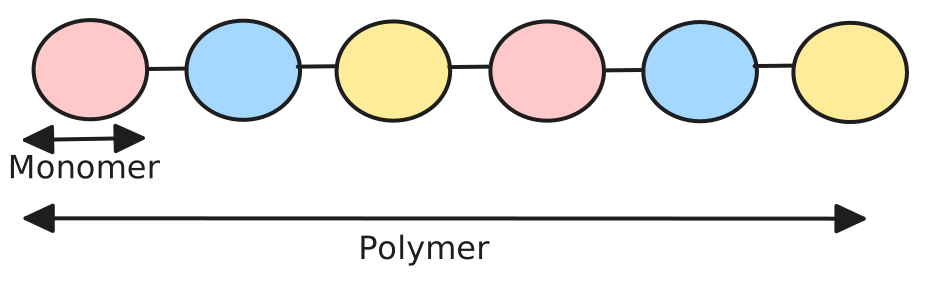
Monomers are the smaller units from which larger molecules are made.
Polymers are molecules made from a large number of monomers joined together.
Monosaccharides, amino acids and nucleotides are examples of monomers.Biological ReactionsJump to notes →
A condensation reaction joins two molecules together with the formation of a chemical bond and involves the elimination of a molecule of water.
A hydrolysis reaction breaks a chemical bond between two molecules and involves the use of a water molecule.
-
Carbohydrates
Spec points
MonosaccharidesJump to notes →
Monosaccharides are the monomers from which larger carbohydrates are made. Glucose, galactose and fructose are common monosaccharides.Disaccharides & Glycosidic BondsJump to notes →
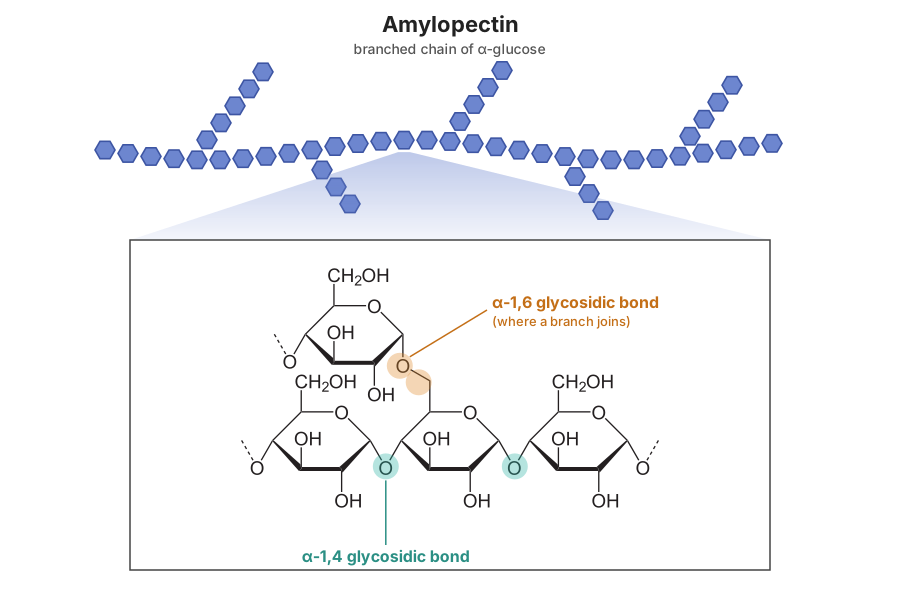
A condensation reaction between two monosaccharides forms a glycosidic bond.
Disaccharides are formed by the condensation of two monosaccharides:
• maltose is a disaccharide formed by condensation of two glucose molecules
• sucrose is a disaccharide formed by condensation of a glucose molecule and a fructose molecule
• lactose is a disaccharide formed by condensation of a glucose molecule and a galactose molecule.Glucose Isomers: α and βJump to notes →
Glucose has two isomers, α-glucose and β-glucose, with structures:Polysaccharides: Structure & FunctionJump to notes →
Polysaccharides are formed by the condensation of many glucose units.
• Glycogen and starch are formed by the condensation of α-glucose.
• Cellulose is formed by the condensation of β-glucose.
The basic structure and functions of glycogen, starch and cellulose. The relationship of structure to function of these substances in animal cells and plant cells.Biochemical Tests for CarbohydratesAT fJump to notes →
Biochemical tests using Benedict's solution for reducing sugars and non-reducing sugars and iodine/potassium iodide for starch.
Students could use, and interpret the results of, qualitative tests for reducing sugars, non-reducing sugars and starch.Chromatography of MonosaccharidesSkillAT gJump to notes →
Students could use chromatography, with known standard solutions, to separate a mixture of monosaccharides and identify their components.Colorimetry & Glucose Calibration CurveSkillAT cTopic page →
Students could produce a dilution series of glucose solution and use colorimetric techniques to produce a calibration curve with which to identify the concentration of glucose in an unknown solution.
-
Lipids
Spec points
Triglycerides & Ester BondsJump to notes →
Triglycerides and phospholipids are two groups of lipid.
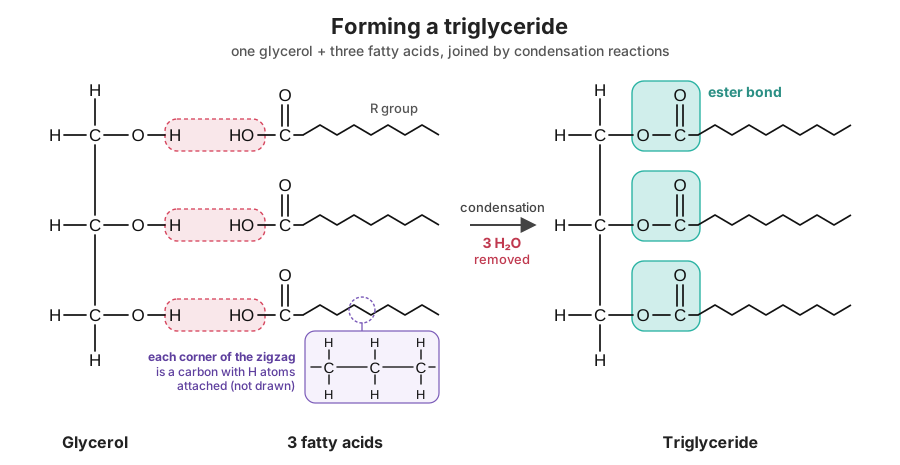
Triglycerides are formed by the condensation of one molecule of glycerol and three molecules of fatty acid.
A condensation reaction between glycerol and a fatty acid (RCOOH) forms an ester bond.Saturated & Unsaturated Fatty AcidsJump to notes →
The R-group of a fatty acid may be saturated or unsaturated.
Students should be able to recognise, from diagrams, saturated and unsaturated fatty acids.PhospholipidsJump to notes →
In phospholipids, one of the fatty acids of a triglyceride is substituted by a phosphate-containing group.Relating Structure to PropertiesJump to notes →
The different properties of triglycerides and phospholipids related to their different structures.
Students should be able to explain the different properties of triglycerides and phospholipids.Emulsion Test for LipidsAT fJump to notes →
The emulsion test for lipids.
Students could use, and interpret the results of, the emulsion test for lipids.
-
Protein Properties
Spec points
Amino Acid StructureJump to notes →
Amino acids are the monomers from which proteins are made. The general structure of an amino acid as: NH₂-C(R)(H)-COOH where NH₂ represents an amine group, COOH represents a carboxyl group and R represents a side chain. The twenty amino acids that are common in all organisms differ only in their side group.Peptide Bonds & PolypeptidesJump to notes →
A condensation reaction between two amino acids forms a peptide bond.
• Dipeptides are formed by the condensation of two amino acids.
• Polypeptides are formed by the condensation of many amino acids.
A functional protein may contain one or more polypeptides.Levels of Protein StructureJump to notes →
The role of hydrogen bonds, ionic bonds and disulfide bridges in the structure of proteins.
Proteins have a variety of functions within all living organisms. The relationship between primary, secondary, tertiary and quaternary structure, and protein function.
Students should be able to relate the structure of proteins to properties of proteins named throughout the specification.Biuret Test for ProteinsAT fJump to notes →
The biuret test for proteins.
Students could use, and interpret the results of, a biuret test for proteins.Chromatography of Amino AcidsSkillAT gJump to notes →
Students could use chromatography with known standard solutions, to separate a mixture of amino acids and identify their components.
-
Enzymes
Spec points
Activation EnergyJump to notes →
Each enzyme lowers the activation energy of the reaction it catalyses.Induced-Fit ModelJump to notes →
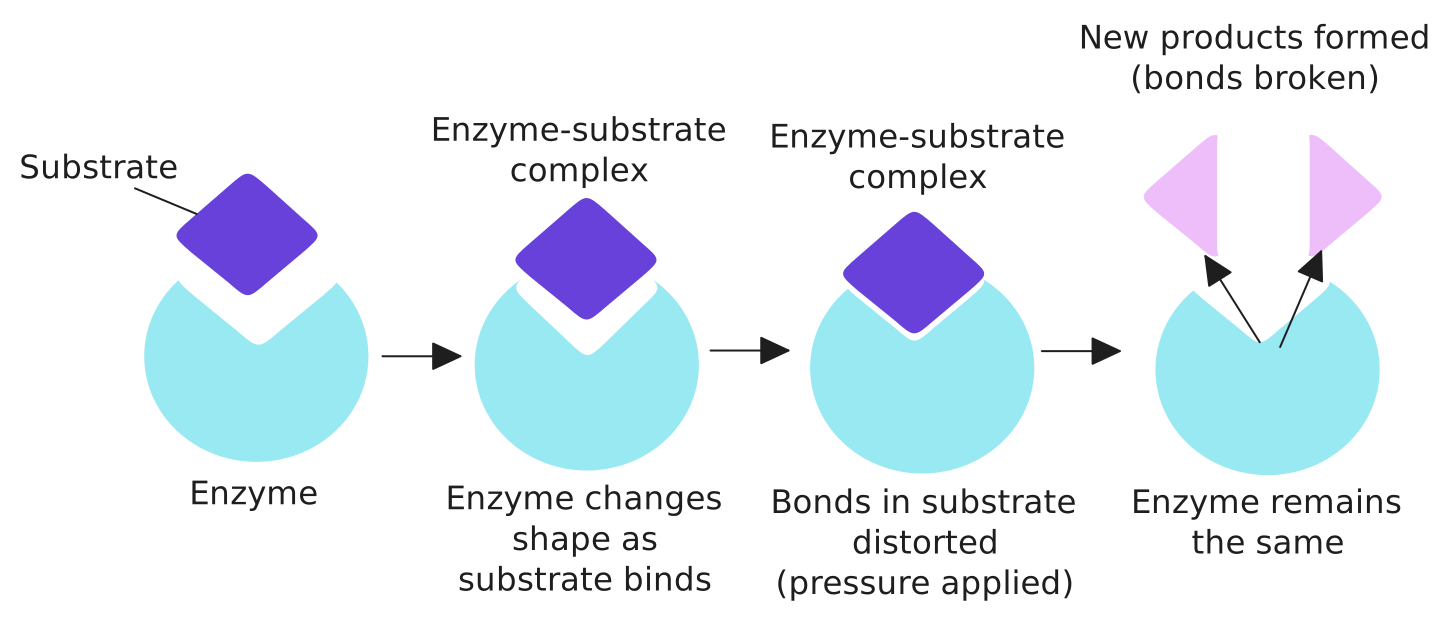
The induced-fit model of enzyme action.
Students should be able to appreciate how models of enzyme action have changed over time.Active Site & Enzyme SpecificityJump to notes →
The properties of an enzyme relate to the tertiary structure of its active site and its ability to combine with complementary substrate(s) to form an enzyme-substrate complex.
• The specificity of enzymes
Students should be able to appreciate that enzymes catalyse a wide range of intracellular and extracellular reactions that determine structures and functions from cellular to whole-organism level.Factors Affecting Rate of ReactionJump to notes →
• The effects of the following factors on the rate of enzyme-controlled reactions – enzyme concentration, substrate concentration, concentration of competitive and of non-competitive inhibitors, pH and temperature.Required Practical 1Required practicalPS 2.4PS 3.3MS 3.2MS 3.6Jump to notes →
Required practical 1: Investigation into the effect of a named variable on the rate of an enzyme-controlled reaction.
Students could identify the variables that must be controlled in their investigation into rate of reaction.
Students could calculate the uncertainty of their measurements of the rate of reaction.
Students could select an appropriate format for the graphical presentation of the results of their investigation into the rate of enzyme-controlled reactions.
Students could use a tangent to find the initial rate of an enzyme-controlled reaction.Calculating pH from Hydrogen Ion ConcentrationSkillMS 0.5Topic page →
Students could be given the hydrogen ion concentration of a solution in order to calculate its pH, using the formula:
pH = -log₁₀[H⁺]
-
Structure of DNA & RNA
Spec points
Nucleic Acids as Information CarriersJump to notes →
Deoxyribonucleic acid (DNA) and ribonucleic acid (RNA) are important information-carrying molecules. In all living cells, DNA holds genetic information and RNA transfers genetic information from DNA to the ribosomes.
Ribosomes are formed from RNA and proteins.
Students should be able to appreciate that the relative simplicity of DNA led many scientists to doubt that it carried the genetic code.Nucleotide StructureJump to notes →
Both DNA and RNA are polymers of nucleotides. Each nucleotide is formed from a pentose, a nitrogen-containing organic base and a phosphate group.
• The components of a DNA nucleotide are deoxyribose, a phosphate group and one of the organic bases adenine, cytosine, guanine or thymine.
• The components of an RNA nucleotide are ribose, a phosphate group and one of the organic bases adenine, cytosine, guanine or uracil.Phosphodiester BondsJump to notes →
• A condensation reaction between two nucleotides forms a phosphodiester bond.DNA StructureJump to notes →
A DNA molecule is a double helix with two polynucleotide chains held together by hydrogen bonds between specific complementary base pairs.RNA StructureJump to notes →
An RNA molecule is a relatively short polynucleotide chain.Calculating Base FrequenciesSkillMS 0.3Jump to notes →
Students could use incomplete information about the frequency of bases on DNA strands to find the frequency of other bases.
-
DNA Replication
Spec points
Semi-Conservative ReplicationJump to notes →
The semi-conservative replication of DNA ensures genetic continuity between generations of cells.
The process of semi-conservative replication of DNA in terms of:
• unwinding of the double helix
• breakage of hydrogen bonds between complementary bases in the polynucleotide strands
• the role of DNA helicase in unwinding DNA and breaking its hydrogen bonds
• attraction of new DNA nucleotides to exposed bases on template strands and base pairing
• the role of DNA polymerase in the condensation reaction that joins adjacent nucleotides.Validating the Watson–Crick ModelJump to notes →
Students should be able to evaluate the work of scientists in validating the Watson–Crick model of DNA replication.
-
ATP
Spec points
ATP StructureJump to notes →
A single molecule of adenosine triphosphate (ATP) is a nucleotide derivative and is formed from a molecule of ribose, a molecule of adenine and three phosphate groups.ATP HydrolysisJump to notes →
Hydrolysis of ATP to adenosine diphosphate (ADP) and an inorganic phosphate group (Pᵢ) is catalysed by the enzyme ATP hydrolase.
• The hydrolysis of ATP can be coupled to energy-requiring reactions within cells.
• The inorganic phosphate released during the hydrolysis of ATP can be used to phosphorylate other compounds, often making them more reactive.ATP SynthesisJump to notes →
ATP is resynthesised by the condensation of ADP and Pᵢ. This reaction is catalysed by the enzyme ATP synthase during photosynthesis, or during respiration.
-
Water and Inorganic Ions
Spec points
3.1.7 Water
Water as a Metabolite & SolventJump to notes →
Water is a major component of cells. It has several properties that are important in biology. In particular, water:
• is a metabolite in many metabolic reactions, including condensation and hydrolysis reactions
• is an important solvent in which metabolic reactions occurThermal Properties of WaterJump to notes →
• has a relatively high heat capacity, buffering changes in temperature
• has a relatively large latent heat of vaporisation, providing a cooling effect with little loss of water through evaporationCohesion & Surface TensionJump to notes →
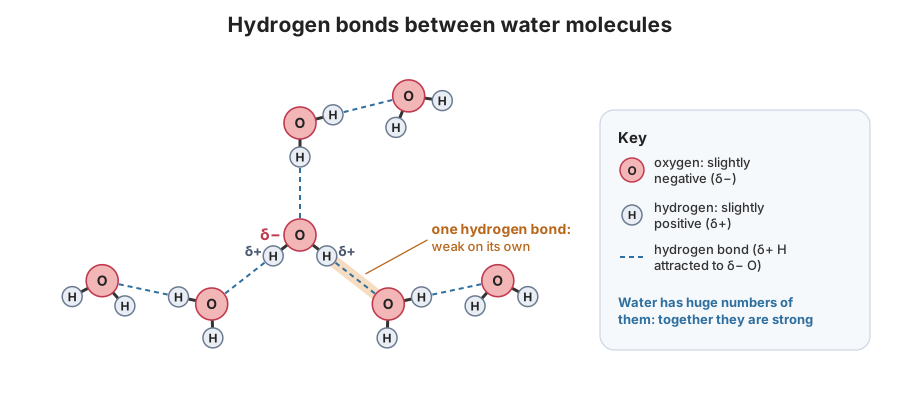
• has strong cohesion between water molecules; this supports columns of water in the tube-like transport cells of plants and produces surface tension where water meets air.
3.1.8 Inorganic Ions
Role of Inorganic IonsJump to notes →
Inorganic ions occur in solution in the cytoplasm and body fluids of organisms, some in high concentrations and others in very low concentrations.
Each type of ion has a specific role, depending on its properties.Named Ions & Their RolesJump to notes →
Students should be able to recognise the role of ions in the following topics: hydrogen ions and pH; iron ions as a component of haemoglobin; sodium ions in the co-transport of glucose and amino acids; and phosphate ions as components of DNA and of ATP.