Gene Mutations
What you need to know (from the AQA specification)
What you need to know (from the AQA specification)
Gene mutations involve a change in the base sequence of chromosomes. They can arise spontaneously during DNA replication and include base deletion and base substitution. Due to the degenerate nature of the genetic code, not all base substitutions cause a change in the sequence of encoded amino acids. Mutagenic agents can increase the rate of gene mutation.
A gene mutation is a change in the base sequence of chromosomal DNA. Every mutation creates a new allele of the gene.
Gene mutations can occur spontaneously during DNA replication, or can be triggered by mutagenic agents. These are factors that increase the rate of mutation:
- UV radiation
- Ionising radiation (e.g. X-rays, gamma rays)
- Chemical mutagens (e.g. some components of cigarette smoke)
Types of Gene Mutation
There are two main types you need to know for Unit 4 (there are more in Unit 8).
Base Substitution
One base is replaced by a different base (e.g. A replaced by G). This changes a single codon. Depending on what the new codon codes for, the effect varies:
- Silent: the new codon codes for the same amino acid (because the genetic code is degenerate). No change in the polypeptide.
- Missense: the new codon codes for a different amino acid, potentially altering the protein’s tertiary structure and function.
- Nonsense: the new codon is a stop codon, ending translation early and producing a truncated, non-functional polypeptide.
Base Deletion (and Addition)
A base is removed (deletion) or added (addition/insertion). Because codons are read in groups of three, this shifts the reading frame of every codon downstream. This causes a frameshift mutation, altering every amino acid from that point onwards.
Why is a frameshift usually so much worse than a substitution?
Why is a frameshift usually so much worse than a substitution?
A substitution changes one codon at most. One amino acid is affected. A frameshift shifts the reading frame for every codon downstream. That means potentially every amino acid from the mutation site onwards is wrong, almost certainly producing a non-functional protein.
Why doesn't a mutation always change the amino acid sequence?
Why doesn't a mutation always change the amino acid sequence?
The genetic code is degenerate, which means that most amino acids are coded for by more than one codon. A base change often still codes for the same amino acid. Also, if the mutation is in a non-coding region (an intron or between genes), it won’t affect the polypeptide at all.
Common exam mistake: mutation chain of reasoning
When explaining how a mutation affects a protein, follow the full chain: changed base sequence → changed codon → changed amino acid → changed primary structure → changed tertiary structure → changed function. Many students stop too early, e.g. saying “the protein changes shape” without linking back to the amino acid sequence change.
You can explore specific mutation examples in gene mutations in Unit 8.
Chromosome Mutations
What you need to know (from the AQA specification)
What you need to know (from the AQA specification)
Mutations in the number of chromosomes can arise spontaneously by chromosome non-disjunction during meiosis.
So far we’ve looked at changes to the DNA base sequence. But mutations can also affect whole chromosomes.
Non-disjunction occurs when homologous chromosomes (meiosis I) or sister chromatids (meiosis II) fail to separate properly. This produces gametes with an abnormal chromosome number:
- Some gametes receive an extra chromosome (n + 1)
- Some gametes receive one fewer chromosome (n − 1)
If this gamete is then fertilised by a normal gamete, the resulting zygote has an abnormal chromosome number. For example, non-disjunction of chromosome 21 can lead to trisomy 21 (Down syndrome).
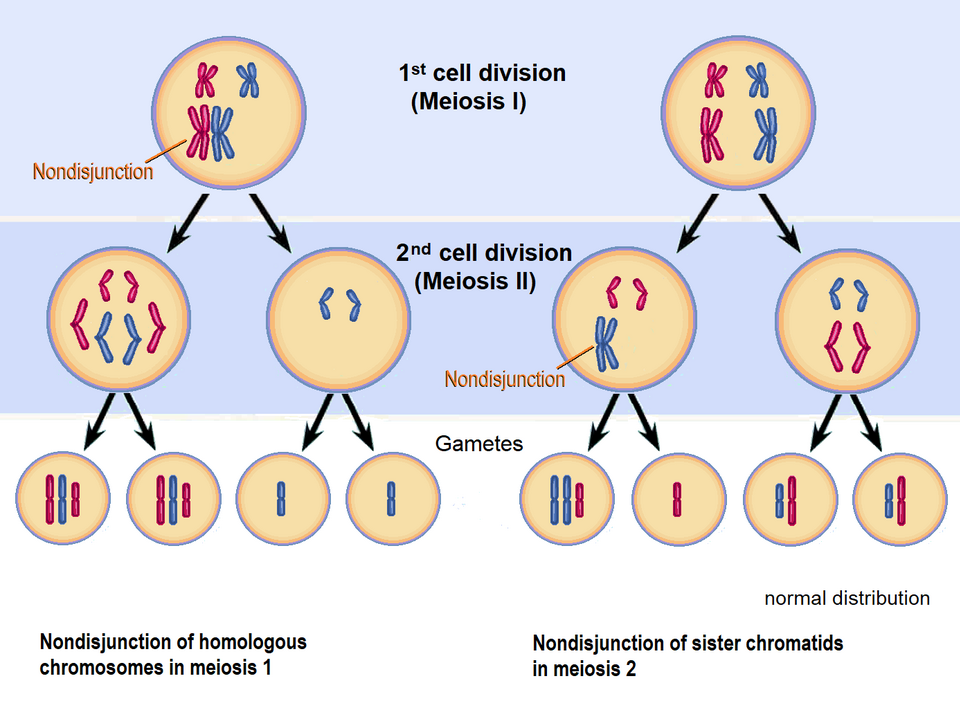
Image: Wikimedia Commons, CC BY-SA 3.0
Common exam mistake: non-disjunction
Non-disjunction affects one chromosome pair only, not all chromosomes. A gamete produced by non-disjunction still carries almost all chromosomes correctly; only the one affected pair is abnormal (n+1 or n−1).
Meiosis
What you need to know (from the AQA specification)
What you need to know (from the AQA specification)
Meiosis produces daughter cells that are genetically different from each other.
The process of meiosis only in sufficient detail to show how:
- two nuclear divisions result usually in the formation of four haploid daughter cells from a single diploid parent cell
- genetically different daughter cells result from the independent segregation of homologous chromosomes
- crossing over between homologous chromosomes results in further genetic variation among daughter cells.
Why is meiosis needed?
When a sperm and egg fuse at fertilisation, each contributes half the genetic information, so meiosis halves the chromosome number (2n → n) in advance, ensuring the resulting zygote has the correct diploid number (2n).
Meiosis involves two successive divisions, producing four haploid cells that are genetically non-identical to each other.
Before meiosis begins, the cell must complete interphase. DNA replication occurs and the cell grows, ensuring each daughter cell will receive a complete set of chromosomes.
What are homologous chromosomes?
What are homologous chromosomes?
A matching pair of chromosomes, where one is inherited from mum and one from dad. These carry the same genes at the same positions (loci), but may carry different alleles of those genes.
| Homologous chromosomes | Sister chromatids | |
|---|---|---|
| Origin | One maternal, one paternal | Identical copies from DNA replication |
| Genetic content | Same genes, possibly different alleles | Genetically identical |
| Joined at centromere? | No | Yes |
| Separate in… | Meiosis I | Meiosis II / Mitosis |
In a diploid human cell there are 23 pairs of homologous chromosomes (46 total).
Meiosis I
In meiosis I, the homologous chromosome pairs separate and it reduces the chromosome number by half.
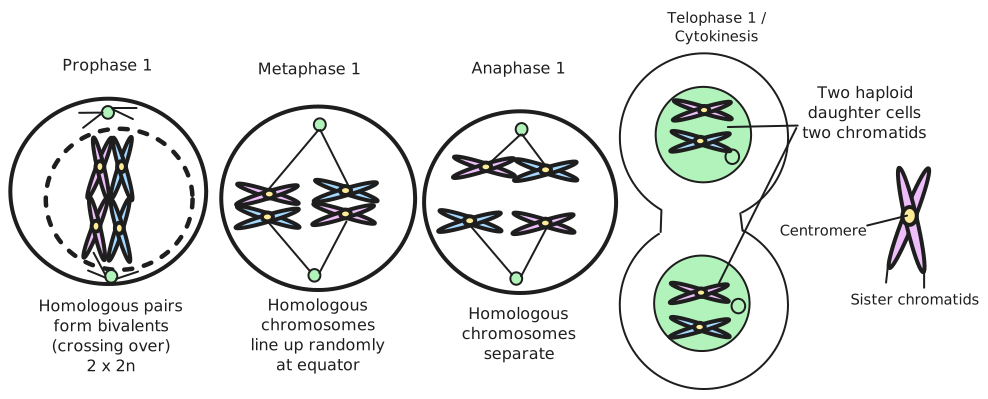
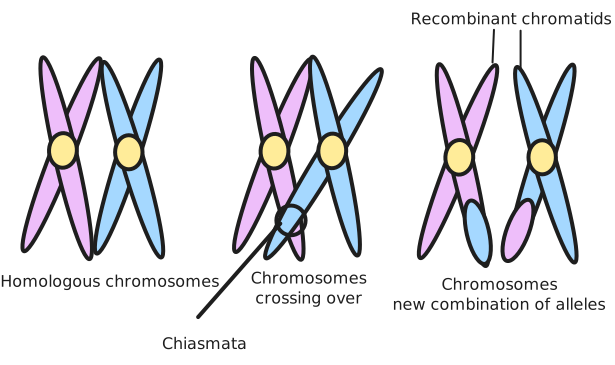
- Prophase I: Homologous chromosomes pair up to form bivalents. Non-sister chromatids may exchange sections of DNA at chiasmata. This is crossing over
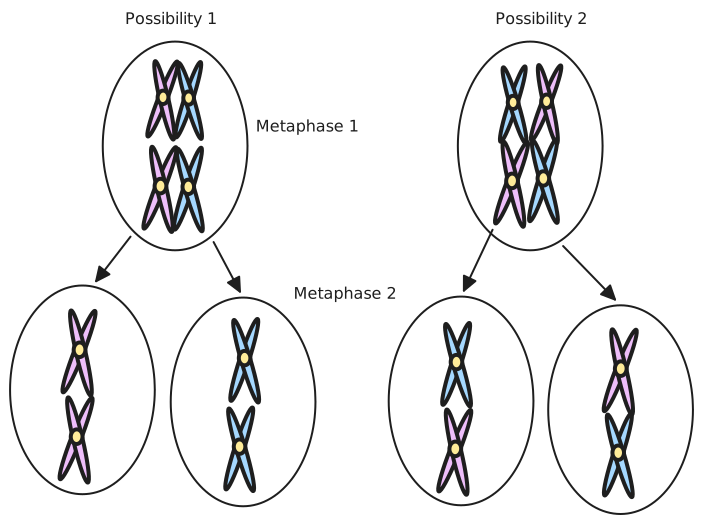
- Metaphase I: Homologous pairs of chromosomes line up randomly at the equator (centre of the cell) - this is random (independent segregation)
- Anaphase I: Homologous chromosomes are pulled to opposite poles; chromatids remain joined at their centromeres
- Telophase I / Cytokinesis: Two haploid cells form, each containing one chromosome from each homologous pair (still as two chromatids)
Meiosis II
In meiosis II, the sister chromatids separate, similar in mechanism to mitosis.
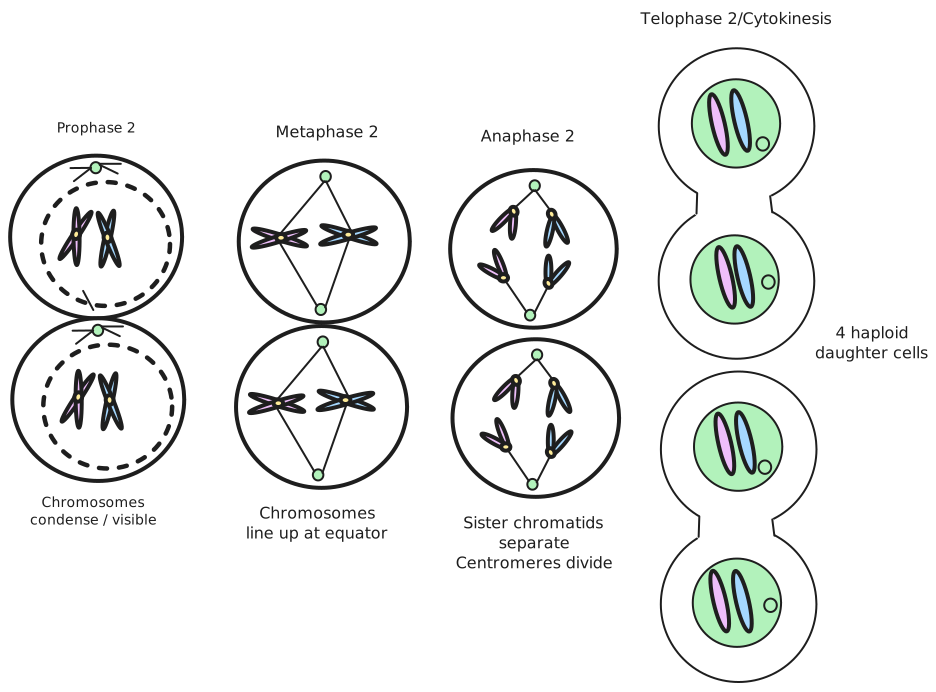
- Chromosomes align at the equator of each cell (metaphase 2)
- Centromeres split and chromatids are pulled to opposite poles (anaphase 2)
- Four haploid daughter cells are produced, genetically non-identical to each other
Meiosis vs Mitosis
| Meiosis | Mitosis | |
|---|---|---|
| Divisions | 2 | 1 |
| Daughter cells | 4 | 2 |
| Ploidy | Haploid (n) | Diploid (2n) |
| Genetic identity | Non-identical | Identical |
| Purpose | Gamete formation | Growth / repair |
Sources of Genetic Variation
What you need to know (from the AQA specification)
What you need to know (from the AQA specification)
Students should be able to:
- complete diagrams showing the chromosome content of cells after the first and second meiotic division, when given the chromosome content of the parent cell
- explain the different outcome of mitosis and meiosis
- recognise where meiosis occurs when given information about an unfamiliar life cycle
- explain how random fertilisation of haploid gametes further increases genetic variation within a species.
Meiosis creates genetic diversity in two ways during meiosis I, with random fertilisation adding further variation afterwards.
Crossing Over
During prophase I, non-sister chromatids of homologous chromosomes break and rejoin at chiasmata, exchanging sections of DNA. This produces recombinant chromosomes with new combinations of alleles that weren’t present in either parent chromosome.
Independent Segregation
During metaphase I, homologous chromosome pairs line up randomly at the equator and independently of every other pair (Independently means that one pair does not affect the other pair). So each gamete gets a different random mix of maternal and paternal chromosomes - there are different combinations
Random Fertilisation
Any male gamete can fuse with any female gamete. This random fusion further increases genetic variation in offspring.
Calculating different combinations
The number of possible chromosome combinations from independent segregation is 2ⁿ, where n = the number of homologous pairs.
For humans (n = 23): 2²³ ≈ 8 million possible gametes from independent segregation alone.
When a sperm and egg fuse, each gamete independently carries 2²³ combinations, so the number of possible offspring is:
2²³ × 2²³ = 2⁴⁶ ≈ 70 trillion
And this is before crossing over is even considered, which increases variation further still.
Sources of genetic variation: summary
The following processes produce new combinations of alleles:
- Crossing over between homologous chromosomes (Prophase I)
- Independent segregation of homologous chromosomes (Metaphase I)
- Random fertilisation of gametes
Variation between individuals is also the basis of DNA profiling / genetic fingerprinting in Unit 8, which uses non-coding repeats (VNTRs) whose number varies between people.
How this topic is tested
This analysis is based on past paper data from 2017 to 2025. It is intended for interest only and is not predictive of what will appear in future papers.
- Tested in 7 of 9 years (2017–2025): 21 question parts worth 45 marks.
- 23rd most-examined topic overall by marks, 3rd in Unit 4.
Marks by year
Most-tested spec points
- The Process of Meiosis: tested in 12 parts (25 marks)
- Chromosome Non-disjunction: tested in 3 parts (7 marks)
- Meiosis, Fertilisation & Variation: tested in 2 parts (6 marks)
- Gene Mutations: tested in 2 parts (5 marks)
Also links to: Stages of Mitosis, The Chi-Squared Test, The Triplet Code.
Maths and practical skills
- Choosing and using a statistical test (MS 1.9): e.g. 2019 P1 Q4.3
- Units and standard form (MS 0.1, 0.2): e.g. 2025 P1 Q7.1
- Percentages, ratios and fractions (MS 0.3): e.g. 2022 P1 Q4.4
- Powers, exponentials and logs on a calculator (MS 0.5): e.g. 2025 P1 Q7.1
- Tables, bar charts and histograms (MS 1.3): e.g. 2025 P1 Q7.2
- Probability (MS 1.4): e.g. 2019 P1 Q4.4
- Area, volume and surface area of shapes (MS 4.1): e.g. 2018 P3 Q3.3
Tips from examiner reports
What students commonly get wrong
- Homologous chromosomes carry the same genesWatch out: homologous chromosomes are a pair that carry the same genes (at the same loci), which is why they can pair up and swap alleles in meiosis. Saying "one from each parent" isn't enough. 2018 P1 Q1.5
- Say "homologous pairs" for crossing over and independent segregationWhen describing crossing over or independent segregation, say it happens between homologous chromosomes (pairs). "Chiasma" alone doesn't get the mark. 2023 P1 Q10.3
- Non-disjunction: what happens and the resultWatch out: in non-disjunction, one pair of homologous chromosomes (or sister chromatids) fails to separate, so both move to the same pole. One gamete gets an extra copy of that chromosome (n + 1), and the other gets none (n − 1). If one of these gametes is fertilised, the zygote has an abnormal chromosome number, e.g. trisomy 21 (Down syndrome). 2025 P1 Q7.4 · 2022 P1 Q4.3
- Every mutation makes a new alleleWhen explaining mutations, say a mutation forms a new allele: a new version of the gene with a different base sequence. This is true even if the amino acid sequence doesn't change (the genetic code is degenerate). For a positive effect, say the new allele increases the chance of survival and reproductive success, so it's more likely to be passed on. 2020 P1 Q10.3
Exam Question Practice
Figure 1 shows the chromosomes in a parent cell, and in the two cells produced by the first division of meiosis.
In the second division, non-disjunction happens in chromosome N. Everything else divides normally.
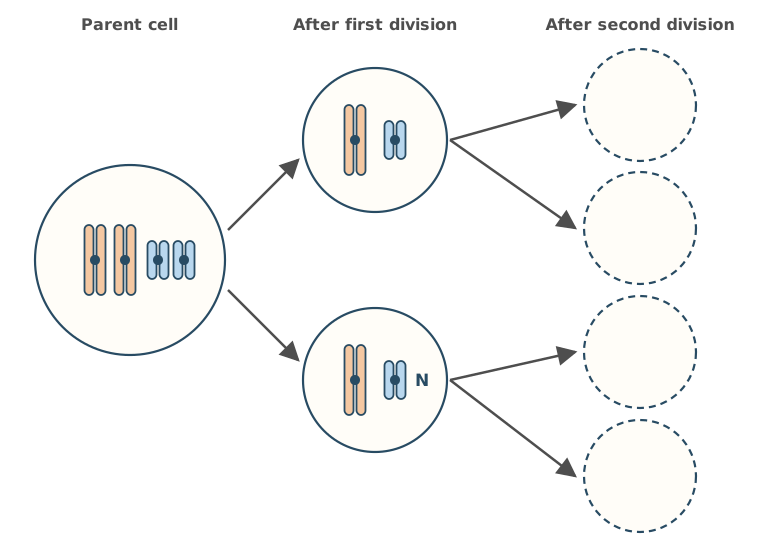
Complete Figure 1 to show the chromosomes in the four cells produced by the second division.
(2 marks)
Hint
In the second division, what separates? What happens to chromosome N if non-disjunction occurs?
Mark Scheme
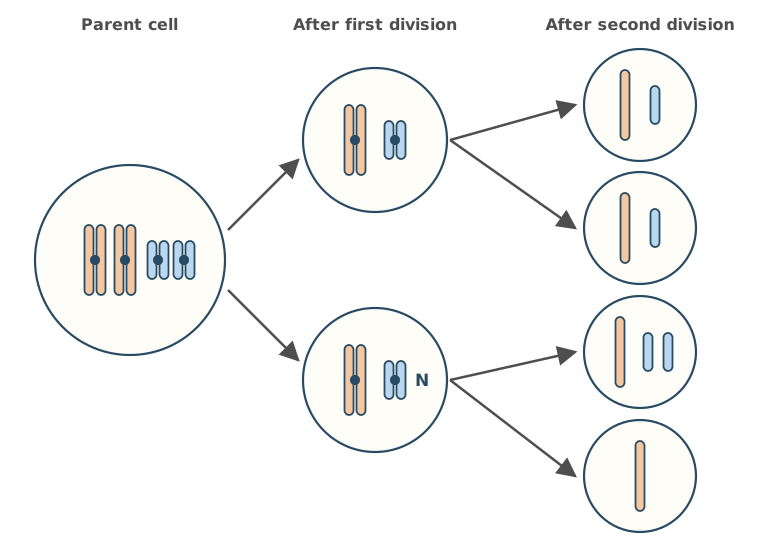
- Top two cells: each has one long and one short chromosome (single chromatids) (1 mark)
- Bottom two cells: one has one long and two short, the other has one long only (1 mark)
Also accepted / rejected
Tips
- In the second division the sister chromatids separate, so draw single chromatids in the daughter cells
- For chromosome N, both chromatids go into one daughter cell and none into the other; only that chromosome is affected, so no cell ends up with no chromosomes
Body cells of a female fruit fly, Drosophila melanogaster, contain 8 chromosomes.
Figure 1 shows the appearance of these 8 chromosomes just as a cell enters meiosis.
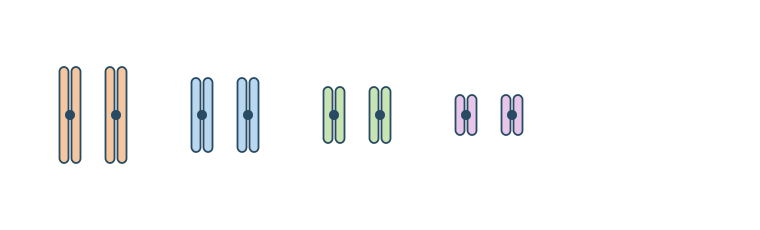
Using the information in Figure 1, draw the chromosomes as they would appear in one cell at the end of the first meiotic division.
(1 marks)
Hint
The first meiotic division separates homologous pairs. How many of these eight chromosomes end up in each cell, and are they still made of two chromatids?
Mark Scheme
Four chromosomes, one from each pair, so each is a different size, and each still made of two chromatids, drawn in any order (1 mark)
For example,
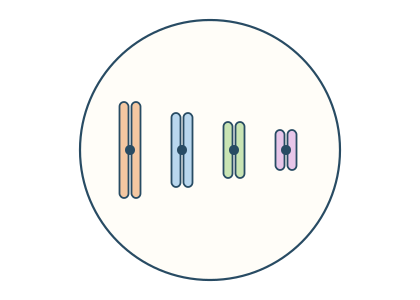
Tips
- Draw 4 chromosomes, one from each homologous pair, so each one is a different size
- Each chromosome still has two chromatids at the end of the first meiotic division
- Don’t draw 8 single chromatids (the result of mitosis), 8 chromosomes with two chromatids (no halving) or 4 single chromatids (the result of the second division)
New alleles arise by mutation, which increases genetic variation within a species.
Describe and explain the other processes that increase genetic variation within a species.
(4 marks)
Hint
Think about what happens to homologous chromosomes during meiosis, and what happens when gametes meet.
Mark Scheme
- Independent segregation of homologous chromosomes (in meiosis) (1 mark)
- Crossing over between homologous chromosomes (1 mark)
- Random fertilisation of gametes (1 mark)
- These produce new combinations of alleles (1 mark)
Also accepted / rejected
Also accepted
- “Random” for independent, and “assortment” for segregation (point 1)
- “Random fusion of gametes” (point 3)
- New combinations of maternal and paternal chromosomes, as an extra point
- If no other marks: 1 mark for “meiosis produces genetically different cells”
Not accepted
- “Random mating” (point 3)
Tips
- Say crossing over happens between homologous chromosomes, and independent segregation is of homologous pairs
- Finish by saying these produce new combinations of alleles
- Say fertilisation of gametes is random, not just “fertilisation is random”
- Migration and natural selection change allele frequencies but don’t create new combinations; non-disjunction is a mutation, which the question excludes
Ferns have a diploid form (the sporophyte) and a haploid form (the gametophyte).
Figure 1 shows the life cycle of a fern.
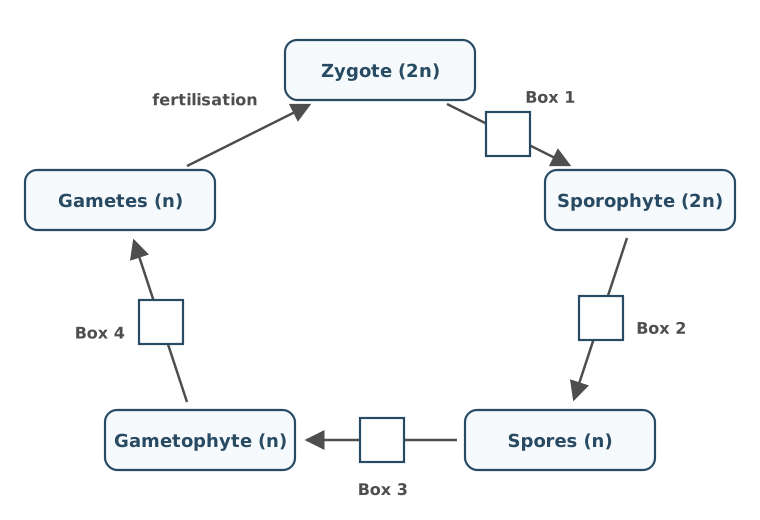
Complete each box on Figure 1 with an appropriate letter to show the type of cell division happening between each stage in the life cycle. Use ‘P’ to represent mitosis and ‘Q’ to represent meiosis.
(2 marks)
Hint
At each arrow, does the number of chromosome sets stay the same or halve? Which type of division halves it?
Mark Scheme
- Q in box 2 (1 mark)
- P in boxes 1, 3 and 4 (1 mark)
Also accepted / rejected
Accept answers written beside the box but clearly intended for that box.
1. Accept ‘meiosis’ for ‘Q’ (spelling must be correct)
2. Accept ‘mitosis’ for ‘P’ (spelling must be correct)
1. Reject anything other than ‘Q/meiosis’ written in box 2
2. Reject anything other than ‘P/mitosis’ written in boxes 1, 3 and 4.
If 1 x Q and 3 x P but written in incorrect boxes = 0 marks
Tips
- Use the labels on the life cycle: meiosis halves the chromosome number, so it only happens where a diploid stage produces haploid cells
- Students often find the meiosis box but wrongly put meiosis in other boxes too; divisions that keep the same chromosome number are mitosis
Also accepted