In Inheritance you worked out genotypes of offspring from two parents, answering questions such as “what is the predicted genotype & phenotype of offspring?” In this topic, we look at the whole population, asking questions such as “how common is each allele in the population?”
Populations and Gene Pools
What you need to know (from the AQA specification)
What you need to know (from the AQA specification)
Species exist as one or more populations.
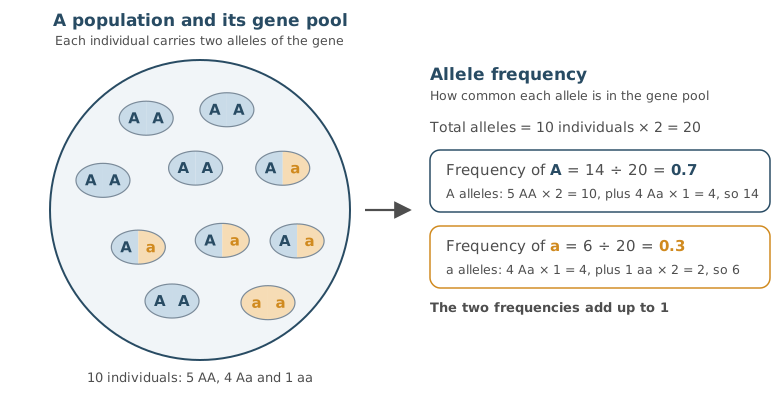
A population as a group of organisms of the same species occupying a particular space at a particular time that can potentially interbreed.
The concepts of gene pool and allele frequency.
- Population: A group of organisms of the same species, in a particular space, at a particular time, that can potentially interbreed
- A species can be made up of one or more populations, e.g. two groups of the same species of frog living in separate ponds are two populations
- Gene pool: All the alleles in a population
- Allele frequency: How common one allele is in the gene pool, as a proportion of all the alleles of that gene (a number between 0 and 1)
What's the difference between a population and a community?
What's the difference between a population and a community?
A population is one species. A community is all the populations of different species living in the same place at the same time.
The Hardy–Weinberg Principle
What you need to know (from the AQA specification)
What you need to know (from the AQA specification)
The Hardy–Weinberg principle provides a mathematical model, which predicts that allele frequencies will not change from generation to generation. The conditions under which the principle applies.
The frequency of alleles, genotypes and phenotypes in a population can be calculated using the Hardy–Weinberg equation:
p² + 2pq + q² = 1
where p is the frequency of one (usually the dominant) allele and q is the frequency of the other (usually recessive) allele of the gene.
Students could calculate allele, genotype and phenotype frequencies from appropriate data using the Hardy–Weinberg equation.
Students could collect data about the frequency of observable phenotypes within a single population.
The Hardy–Weinberg principle predicts that allele frequencies will not change from one generation to the next. This only works if these conditions are met:
- The population is large
- Mating is random
- There is no mutation
- There is no selection (no allele gives an advantage or disadvantage)
- There is no migration (no individuals move in or out of the population)
What does it mean if the actual allele frequencies in the population are different from what Hardy–Weinberg predicts?
What does it mean if the actual allele frequencies in the population are different from what Hardy–Weinberg predicts?
It’s likely that one of these above conditions isn’t being met. For example, there is selection, migration, etc, so one of these factors is changing the population.
Why does the Hardy–Weinberg principle only work in a large population?
Why does the Hardy–Weinberg principle only work in a large population?
In a small population, chance alone can change allele frequencies from one generation to the next, because a few individuals happening to reproduce more makes a big difference. This is called genetic drift (see Evolution may lead to speciation). In a large population, these chance effects even out.
The equations
There are two equations. The first is about alleles, and the second is about genotypes:
-
p + q = 1
- p = frequency of the dominant allele (e.g. A)
- q = frequency of the recessive allele (e.g. a)
-
p² + 2pq + q² = 1
- p² = frequency of homozygous dominant (AA)
- 2pq = frequency of heterozygous (Aa)
- q² = frequency of homozygous recessive (aa)
Where do these come from?
-
p + q = 1: This gene has only two alleles, so every allele in the gene pool is either A or a. Their frequencies must add up to 1 (100%). For example, if 70% of the alleles are A (p = 0.7), the other 30% must be a (q = 0.3)
-
p² + 2pq + q² = 1: Every individual has one of three genotypes (AA, Aa or aa), so their frequencies must also add up to 1. Each term comes from combining the alleles at random, like one Punnett square for the whole population:
- The chance of getting A from both parents is p × p = p² (AA)
- The chance of getting a from both parents is q × q = q² (aa)
- There are two ways to be heterozygous (A from one parent and a from the other, or the other way round), so it’s pq + pq = 2pq (Aa)
Alleles from one parent
Alleles from the other parent
| A (p) | a (q) | |
|---|---|---|
| A (p) | AAp² | Aapq |
| a (q) | Aapq | aaq² |
Steps for a Hardy–Weinberg calculation
- Find the frequency of the recessive phenotype. This is q²
- Why? The recessive phenotype can only be aa, so its frequency is exactly q². The dominant phenotype could be AA or Aa (p² + 2pq), so you can’t use it to work out p directly
- If you’re given an allele frequency (p or q) instead, skip to step 3
- Square root it to get q
- Work out p = 1 − q
- Use p and q to find what the question asks for: p², 2pq or q²
- If the question asks for a percentage, multiply by 100
Worked example: what percentage are carriers?
In a population of snails, 9% have a yellow shell, which is caused by a recessive allele. What percentage of the snails are heterozygous?
- Yellow is the recessive phenotype, so q² = 0.09
- q = √0.09 = 0.3
- p = 1 − 0.3 = 0.7
- Heterozygous = 2pq = 2 × 0.7 × 0.3 = 0.42
- 0.42 × 100 = 42%
Common mistakes
- If you’re given the percentage with the dominant phenotype, subtract it from 100% first. What’s left is the recessive phenotype, q²
- The recessive phenotype frequency is q², not q. Take the square root before you do anything else
- Heterozygotes are 2pq, not pq. Don’t divide 2pq by 2
- Write the equation correctly: p² + 2pq + q² = 1 (not 2pq²)
- Show and label your working (e.g. “q² = 0.09”), as you can get a mark for it even if the final answer is wrong
Practice
1. Cystic fibrosis is caused by a recessive allele. About 1 in 2500 people have cystic fibrosis. What percentage of people are carriers?
1. Cystic fibrosis is caused by a recessive allele. About 1 in 2500 people have cystic fibrosis. What percentage of people are carriers?
- Affected people are homozygous recessive, so q² = 1 ÷ 2500 = 0.0004
- q = √0.0004 = 0.02
- p = 1 − 0.02 = 0.98
- Carriers are heterozygous, so 2pq = 2 × 0.98 × 0.02 = 0.0392
- 0.0392 × 100 = 3.92% (about 1 in 25 people)
2. In a population of pea plants, 75% have purple flowers (dominant) and 25% have white flowers. What is the frequency of the homozygous dominant genotype?
2. In a population of pea plants, 75% have purple flowers (dominant) and 25% have white flowers. What is the frequency of the homozygous dominant genotype?
- White is the recessive phenotype, so q² = 0.25
- q = √0.25 = 0.5
- p = 1 − 0.5 = 0.5
- Homozygous dominant = p² = 0.5 × 0.5 = 0.25
(Notice that the 75% purple includes both AA and Aa plants, so you can’t use it as p².)
3. The frequency of a recessive allele in a population is 0.2. What percentage of the population is heterozygous?
3. The frequency of a recessive allele in a population is 0.2. What percentage of the population is heterozygous?
- This time you’re given the allele frequency, so q = 0.2 (no square root needed)
- p = 1 − 0.2 = 0.8
- 2pq = 2 × 0.8 × 0.2 = 0.32, so 32%
Comparing real data with Hardy–Weinberg
You could collect data on the frequency of an observable phenotype in one population (e.g. shell colour in a population of snails). Scientists then compare the numbers they observe with the numbers Hardy–Weinberg predicts, using the chi-squared test.
If the difference is significant, at least one of the conditions isn’t being met, e.g. there is selection, mutation, migration or non-random mating.
Tip
When you explain why real frequencies don’t match Hardy–Weinberg, use the context in the question and name a condition that’s being broken (e.g. “the allele is selected against”). Crossing over, codominance and independent segregation aren’t reasons.
How this topic is tested
This analysis is based on past paper data from 2017 to 2025. It is intended for interest only and is not predictive of what will appear in future papers.
- Tested in 8 of 9 years (2017–2025): 15 question parts worth 28 marks.
- 35th most-examined topic overall by marks, 4th in Unit 7.
Marks by year
Most-tested spec points
- The Hardy-Weinberg Principle: tested in 8 parts (16 marks)
- Populations, Gene Pools & Allele Frequency: tested in 2 parts (3 marks)
Also links to: Types of Gene Mutation, Effects of Mutations on the Polypeptide, The Chi-Squared Test.
Maths and practical skills
- Percentages, ratios and fractions (MS 0.3): e.g. 2021 P3 Q1.4
- Using equations (MS 2.4): e.g. 2019 P2 Q6.5
- Significant figures (MS 1.1): e.g. 2021 P3 Q1.4
Exam Question Practice
One past paper question for each part of the topic. Try each one before opening the answer.
Define the biological term population.
(2 marks)
Hint
What is the precise biological definition of a population? Include all required elements: organisms, species, place, and time.
Mark Scheme
- A group (of organisms) of the same species in a (particular) space at a (particular) time (1 mark)
- That can (potentially) interbreed (1 mark)
Comments from mark scheme
Tips from examiner reports
Tips from the examiner report
- Include every part: a group of organisms of the same species, in a particular space, at a particular time, that can interbreed
- Don’t leave out the time, and don’t define a community (all the populations of different species)
What is a gene pool?
(1 marks)
Hint
Is a gene pool about genes or alleles, and in a population or a species?
Mark Scheme
All the alleles in a population (1 mark)
Comments from mark scheme
Accept: The number of alleles in a population.
Note: All or number of alleles in a species on its own is not enough on its own.
Tips from examiner reports
Tips from the examiner report
- It’s all the alleles (not genes) in a population, not a species
In fruit flies, a gene for body colour has a dominant allele for grey body, G, and a recessive allele for black body, g.
A population of fruit flies contained 19% grey-bodied flies.
Use the Hardy–Weinberg equation to calculate the percentage of flies heterozygous for gene G.
Show your working.
Answer = ________ %
(2 marks)
Hint
What does 2pq represent in Hardy-Weinberg? Make sure you’re using the correct values for p and q from the data given.
Walkthrough and mark scheme
Walkthrough
Step 1: find q². Grey is the dominant phenotype, so the 19% grey flies include both GG and Gg. You can only be sure of the genotype of the black flies (gg), so start with them: 100% − 19% = 81%, so q² = 0.81.
Step 2: find q and p. q = √0.81 = 0.9, and p = 1 − 0.9 = 0.1.
Step 3: find the heterozygotes. Heterozygous = 2pq = 2 × 0.1 × 0.9 = 0.18, so 18%.
Mark scheme
-
Correct answer of 18 (%) = 2 marks (2 marks)
-
Incorrect answer but shows understanding that 2pq = heterozygous/carriers = 1 mark
OR Incorrect answer but shows understanding that 1 – (p² + q²) = heterozygous/carriers = 1 mark
Comments from mark scheme
1. Accept 0.18 for one mark.
2. Accept understanding of 2pq by using a calculation involving 2 x two different numbers.
Tips from examiner reports
Tips from the examiner report
- Grey is dominant, so q² = 0.81 (black), q = 0.9 and p = 0.1
- Heterozygotes = 2pq = 2 × 0.1 × 0.9 = 0.18, so 18%; don’t divide 2pq by 2
- Write the equation correctly: p² + 2pq + q² = 1, not 2pq²
In mice, one type of autoimmune disease is inherited as a dominant allele. Would the Hardy–Weinberg principle hold true for a population of mice, some of which had this autoimmune disease?
Explain your answer.
(2 marks)
Hint
Which Hardy–Weinberg condition is about survival and reproduction? Would the disease affect it?
Walkthrough and mark scheme
Walkthrough
Step 1: find the condition the context affects. A disease can affect whether mice survive and reproduce, so the relevant Hardy–Weinberg condition is no selection.
Step 2: answer “no” and explain it. Mice with the disease are less likely to survive and reproduce, so they’re selected against. Fewer of them pass on the allele, so the allele frequency changes (decreases), and the principle doesn’t hold.
Step 3: or answer “yes” and explain it. If the disease doesn’t affect survival or reproduction, there’s no selection, so the allele frequency stays constant. Either answer can score, as long as you explain it.
Mark scheme
Max 2 marks
No – no mark
- Mice with autoimmune disease will be unlikely to reproduce/survive
OR Mice with autoimmune disease will be selected against (1 mark) - Will not pass on allele (for autoimmune disease)
OR Allele frequency (for autoimmune disease) will reduce/change (1 mark)
Yes – no mark
- As long as the autoimmune disease did not affect the mice’s ability to reproduce/survive (1 mark)
- The allele frequency will remain constant/not change (1 mark)
Comments from mark scheme
Award as mark points 1 and 2, OR 3 and 4
Tips from examiner reports
Tips from the examiner report
- Pick the relevant condition, which is no selection: if the disease stops mice surviving or reproducing, the allele isn’t passed on and its frequency falls, so the principle doesn’t hold
- Or argue it holds if the disease doesn’t affect survival or reproduction, so allele frequency stays constant
- “No births or deaths” is a mark-release-recapture assumption, not Hardy–Weinberg, and a dominant allele doesn’t automatically increase in frequency
Scientists determined the frequencies of the ABO alleles and ABO phenotypes in a large population. They then used a statistical test to determine if the frequencies of the four phenotypes differed significantly from the frequencies expected according to the Hardy–Weinberg equation.
The scientists concluded that the observed frequencies of the four phenotypes differed significantly from the expected frequencies.
Use your knowledge of the Hardy–Weinberg principle to suggest two reasons why.
1 = ________
2 = ________
(2 marks)
Hint
Which conditions must be true for the Hardy–Weinberg principle to apply? Which could fail in a real human population?
Walkthrough and mark scheme
Walkthrough
Step 1: list the conditions. Hardy–Weinberg needs a large population, random mating, no mutation, no selection and no migration.
Step 2: rule out what the stem tells you. The question says the population is large, so population size isn’t a reason.
Step 3: give two of the others as things that are happening. e.g. there is selection for or against a blood group, there is migration (immigration or emigration), there is mutation, or mating isn’t random.
Mark scheme
Max 2 marks
- Selection (against/for a blood group/phenotype/allele) (1 mark)
- (High rate of) mutation (1 mark)
- Immigration/emigration (1 mark)
- No random mating. (1 mark)
Comments from mark scheme
1 to 4. Reject converse statements as context would be incorrect’
Ignore births/deaths.
3. Accept ‘migration’ or population is not isolated.
4. Ignore no ‘random fertilisation’.
Tips from examiner reports
Tips from the examiner report
- Give conditions that break Hardy–Weinberg: selection, mutation, migration, or non-random mating
- Phrase them as happening (e.g. “there was migration”), not the converse
- The stem says the population is large, and crossing over, codominance or independent segregation aren’t reasons
1. Accept descriptions of ‘space’ eg area, part of the world, habitat, ecosystem
2. Accept that can produce fertile offspring