Translocation
What you need to know (from the AQA specification)
What you need to know (from the AQA specification)
Phloem as the tissue that transports organic substances in plants.
Photosynthesis uses carbon dioxide and water to produce oxygen and glucose. This glucose needs to be transported around the plant so it can be used for respiration, growth or storage.
Phloem transports the products of photosynthesis around the plant, mainly as sucrose. The process, known as translocation, involves the transport of organic substances (mainly sucrose and amino acids) from ‘sources’ to ‘sinks’.
What are ‘sources’ and ‘sinks’?
- Source: where organic substances are produced or released (e.g. leaves where photosynthesis occurs, or storage organs releasing stored sugars)
- Sink: where organic substances are used or stored (e.g. roots, developing fruits, growing tips)
Direction of translocation
Translocation does not always move from leaf to root. It moves from any source to any sink. For example, a storage organ in the root can act as a source in spring, transporting sucrose upward to growing shoot tips.
Why is sucrose transported rather than glucose?
Why is sucrose transported rather than glucose?
Sucrose is less reactive than glucose (it is a non-reducing sugar), so it is less likely to interfere with metabolic reactions during transport. It is also more soluble, allowing more to be transported in solution.
Structure of Phloem
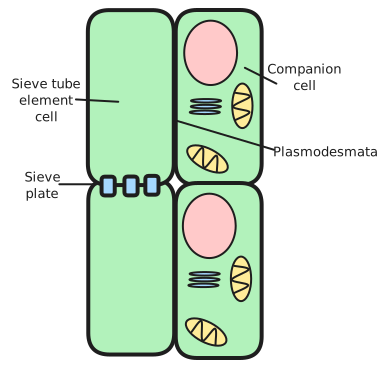
Phloem is made up of two main cell types:
Sieve tube elements:
- Living cells but have very little cytoplasm, no nucleus, few organelles
- This maximises the space available for the flow of organic substances
- Sieve plates are between adjacent sieve tube elements. These are perforated end walls with pores that allow the flow of sap from one element to the next
Companion cells:
- Closely associated with sieve tube elements, connected by many plasmodesmata
- Have a dense cytoplasm, a nucleus, and many mitochondria
- Provide metabolic support to the sieve tube elements (e.g. produce ATP for active loading of sucrose)
Mass Flow Hypothesis
What you need to know (from the AQA specification)
What you need to know (from the AQA specification)
The mass flow hypothesis for the mechanism of translocation in plants.
Translocation vs mass flow
Translocation is the process of the movement of organic substances (mainly sucrose) from source to sink in the phloem.
Mass flow is the proposed mechanism (a hypothesis) that explains how translocation works. It’s the best-supported explanation we currently have, but as you’ll see below, there’s also evidence against it.
How does the mass flow hypothesis work?
-
Active loading at the source: sucrose is actively loaded into the sieve tube elements at the source (e.g. leaf)
- This involves active transport of hydrogen ions (H+) out of the companion cell using ATP
- H+ ions then flow back into the companion cell via co-transport proteins, carrying sucrose with them
- Sucrose then passes into the sieve tube element through plasmodesmata
-
Water enters from the xylem by osmosis: the high concentration of sucrose in the sieve tube lowers the water potential, so water enters from the surrounding xylem by osmosis.
-
This increases the hydrostatic pressure in the sieve tube elements (in the phloem) at the source end
-
Mass flow (to respiring cells): the high hydrostatic pressure at the source and lower pressure at the sink creates a pressure gradient. This drives the flow of phloem sap (containing dissolved sucrose) from source to sink
-
Unloading at the sink: sucrose is unloaded from the phloem by active transport or facilitated diffusion (e.g. for respiration or storage). This raises the water potential in the sieve tube, so water leaves by osmosis, lowering the hydrostatic pressure at the sink end
Why is active transport needed for loading sucrose?
Why is active transport needed for loading sucrose?
Sucrose needs to be moved against its concentration gradient into the sieve tube elements (from a lower concentration to a higher concentration). This requires energy in the form of ATP, which is why companion cells have many mitochondria.
Animation
Evidence for Mass Flow
What you need to know (from the AQA specification)
What you need to know (from the AQA specification)
The use of tracers and ringing experiments to investigate transport in plants.
Radioactive tracers
- Plants are supplied with radioactive carbon dioxide (¹⁴CO₂)
- The plant uses this carbon dioxide in photosynthesis to produce radioactive sugars
- Autoradiography can then be used to track where these radioactive sugars travel in the plant
- Results show that radioactive sugars are found moving up and down the plant in the phloem, providing evidence that phloem transports sucrose from source to sink
Ringing experiments
- A ring of bark (containing the phloem) is removed from the stem of a woody plant, leaving the xylem intact
- Above the ring: sugars accumulate and the tissue swells
- Below the ring: sugars are depleted and the tissue eventually dies
- This provides evidence that sucrose is transported in the phloem (not the xylem)
- Water transport is unaffected because the xylem is still intact
Evidence Against Mass Flow
- Not all solutes move at the same rate: mass flow predicts bulk movement of phloem sap, so all dissolved substances should travel together at the same speed. The fact that different solutes move at different rates suggests an additional, selective mechanism is involved.
- Sieve plates may impede flow: sieve plates create resistance that would require a very large pressure gradient to overcome. The pressures measured in phloem are not always large enough to drive flow through sieve plates at the observed rates.
- Bidirectional transport: substances can move in opposite directions in the phloem at the same time, which cannot be explained by a single pressure-driven mass flow.
Translocation in the phloem is examined as part of mass transport in plants. See how it's tested on that page →
Tips from examiner reports
What students commonly get wrong
- Sucrose, by mass flow, not diffusionWhen describing translocation, name sucrose as the carbohydrate, say it's co-transported into the phloem with H⁺ by companion cells, and say it moves by mass flow: the whole solution (sap) flows down a hydrostatic pressure gradient. Don't call this diffusion, which is individual molecules moving down a concentration gradient. 2022 P1 Q9.1
- Tracer experiments: explain, don't describeWhen interpreting a radioactive tracer experiment, explain the results: the radioactive carbon is used in photosynthesis to make sugars, which are then translocated in the phloem. Just saying where the radioactivity appears isn't enough. 2018 P1 Q8.1
Exam Question Practice
Plants make carbohydrate in their leaves by photosynthesis.
Describe how carbohydrate is transported in a plant.
(5 marks)
Hint
Which carbohydrate is moved, and in which tissue? How does it get in, why does water follow, and what makes the contents flow?
Mark Scheme
Max 5 marks
- Sucrose is actively loaded into the phloem (co-transported with H⁺ ions) (1 mark)
- By companion cells (1 mark)
- This lowers the water potential in the phloem, so water enters by osmosis (from the xylem) (1 mark)
- This creates a high hydrostatic pressure (a pressure gradient) (1 mark)
- The contents move by mass flow to respiring cells or storage organs (1 mark)
- Sucrose is unloaded by active transport (1 mark)
Also accepted / rejected
Tips
- Name the carbohydrate: sucrose
- Companion cells load sucrose (co-transport with H⁺); this lowers the water potential, so water enters by osmosis and the hydrostatic pressure rises
- The contents move by mass flow down the pressure gradient, not by diffusion
- Say where it goes (respiring cells or storage organs) and how it leaves the phloem
Scientists investigated the effect of a respiratory poison on mass transport in tomato plants.
- In plant A, they applied the poison to a short section of the stem, shown by the red arrows in Figure 1. They did not apply poison to plant B (the control).
- They then supplied carbon dioxide containing radioactively labelled carbon to one leaf of each plant, shown by the dashed boxes.
- After 4 hours, they found the position of the radioactively labelled carbon in each plant (Figure 1), and measured the water content of the leaf supplied with labelled carbon dioxide (Table 1).
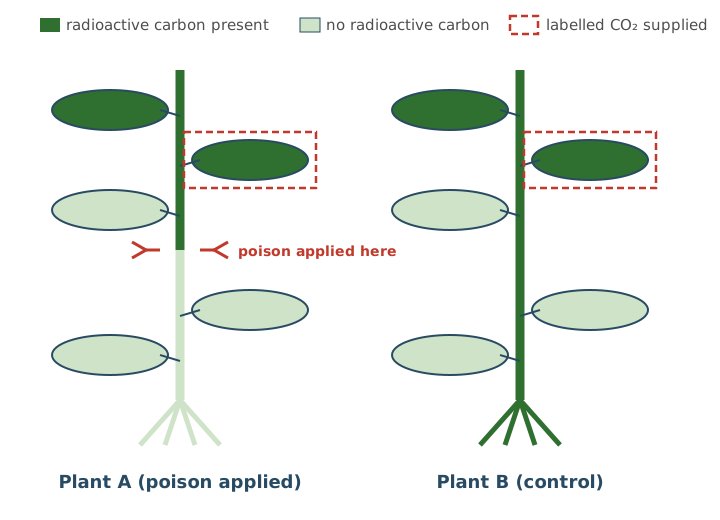
Table 1
| Plant | Mean water content of the leaf / % (± 2 standard deviations) |
|---|---|
| A (poison applied) | 81.2 ± 3.1 |
| B (control) | 82.0 ± 2.8 |
The scientists concluded that the poison stopped transport in the phloem.
Explain how the results in Figure 1 support this conclusion.
(2 marks)
Hint
What does the leaf make from the labelled carbon dioxide? Which tissue moves that product around the plant, and where does the movement stop in plant A?
Mark Scheme
EITHER
- The radioactively labelled carbon is converted into sugar/organic substances in photosynthesis (1 mark)
- Mass flow/translocation in the phloem throughout the plant only in the control/B
OR Movement of sugar/organic substances in the phloem throughout the plant only in the control/B (1 mark)
OR
- Movement in the phloem requires living cells/respiration/active transport/ATP (1 mark)
- The poison stops respiration/active transport/ATP production, so transport in the phloem throughout the plant only in the control/B (1 mark)
Also accepted / rejected
Do not mix and match: award either mark points 1 and 2, or 3 and 4.
1. For organic substance accept a named organic substance, e.g. glucose, sucrose, amino acid.
2. Accept “translocation/mass transport in the phloem past the poisoned section only in the control/B”.
2. Accept the converse for plant A, i.e. movement of sugar in the phloem stops (beyond the poisoned section) in plant A.
Tips
- Explain, don’t just describe: the labelled carbon dioxide is used in photosynthesis to make sugar, and sugar is moved by translocation in the phloem
- Then say that this movement past the poisoned section only happens in the control plant
Also accepted