What does ‘All cells arise from other cells’ mean?
Every cell in your body (about 37 trillion) ultimately came from a single fertilised egg. That egg divided into two cells, those cells divided again, and so on through many rounds of cell division. Every new cell arose from a pre-existing cell dividing. This is what the idea “all cells arise from other cells” means.
Why do cells need to divide?
Why do cells need to divide?
- Growth: producing more cells as an organism develops
- Repair: replacing cells lost through damage or injury
- Replacement: many cell types wear out and must be continuously renewed (e.g. red blood cells, skin cells)
The Cell Cycle
What you need to know (from the AQA specification)
What you need to know (from the AQA specification)
- Within multicellular organisms, not all cells retain the ability to divide.
- Eukaryotic cells that do retain the ability to divide show a cell cycle.
- DNA replication occurs during the interphase of the cell cycle.
- Mitosis is the part of the cell cycle in which a eukaryotic cell divides to produce two daughter cells, each with the identical copies of DNA produced by the parent cell during DNA replication.
Before a cell can divide, it must prepare carefully. The cell cycle describes the full sequence of events in a cell’s life, from its formation by the division of a parent cell to its own division into two daughter cells.
The cell cycle has two main stages:
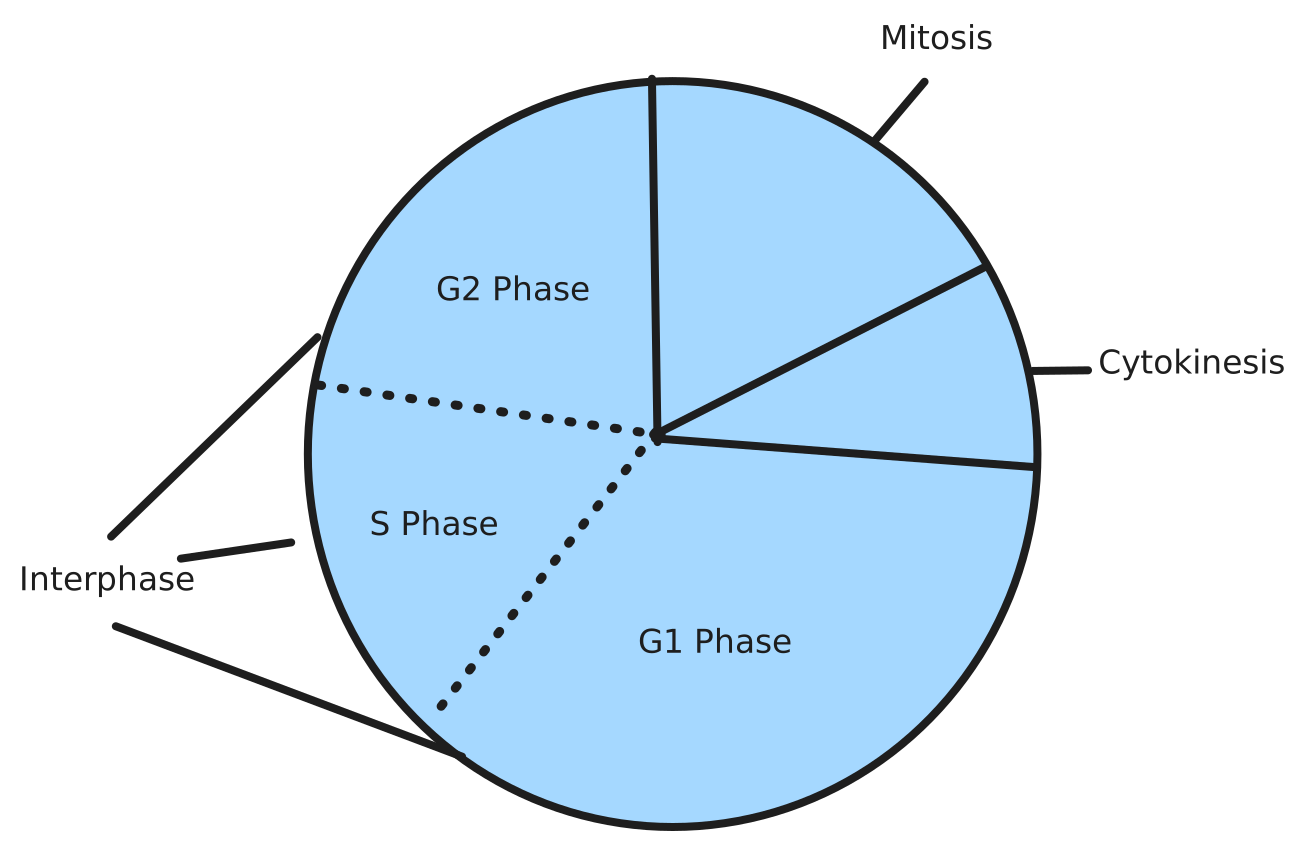
- Interphase: the cell grows and replicates its DNA. This is the longest part of the cycle.
- M phase: the cell divides, first the nucleus (mitosis), then the cytoplasm (cytokinesis).
Why can't a cell just divide straight away without any preparation?
Why can't a cell just divide straight away without any preparation?
Because a dividing cell needs to pass a complete, identical copy of its DNA to each daughter cell. If it divided without first replicating its DNA, each daughter cell would receive only half the genetic information, which is not enough to survive.
The cell also needs to grow large enough so that dividing it produces two daughter cells that each have enough organelles and cytoplasm to survive and function independently.
Interphase
During interphase, chromosomes are decondensed and not visible under a light microscope. It is subdivided into three stages:
| Phase | What happens |
|---|---|
| G₁ (Gap 1) | The cell grows and produces new organelles and proteins. The cell checks it is ready to replicate its DNA. |
| S (Synthesis) | DNA replication occurs: every chromosome is copied, producing two identical sister chromatids joined at the centromere. |
| G₂ (Gap 2) | The cell continues to grow. DNA is checked for errors. The cell prepares the machinery for mitosis (e.g. spindle proteins). |
M phase (Mitosis)
Once interphase is complete, the cell enters the M phase, starting with mitosis, where the nucleus divides, distributing one copy of each chromosome to each end of the cell.
Note
This page covers the mitotic cell cycle. M phase here refers to mitosis. In reproductive cells, M phase instead involves meiosis, a different type of nuclear division that produces gametes with half the chromosome number.
M phase (Cytokinesis)
After the cell has completed mitosis (M phase) the cytoplasm divides, producing two separate daughter cells. Note: Cytokinesis is not part of mitosis, as it occurs after telophase.
Stages of Mitosis
What you need to know (from the AQA specification)
What you need to know (from the AQA specification)
- The behaviour of chromosomes during interphase, prophase, metaphase, anaphase and telophase of mitosis.
- The role of spindle fibres attached to centromeres in the separation of chromatids.
- Division of the cytoplasm (cytokinesis) usually occurs, producing two new cells.
Mitosis produces genetically identical daughter cells and is used for growth, repair, and asexual reproduction.
Sexual reproduction uses meiosis instead (covered in Genetic Diversity: Mutation and Meiosis), which produces genetically varied gametes.
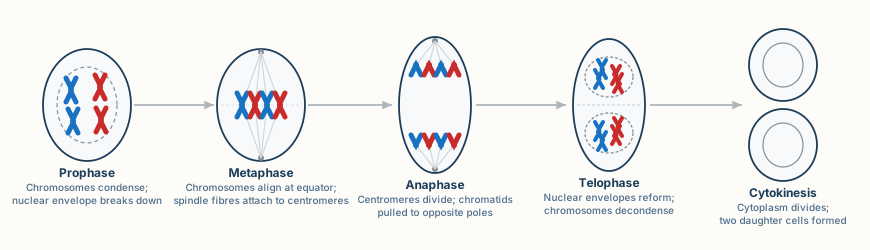
Step 1: Prophase
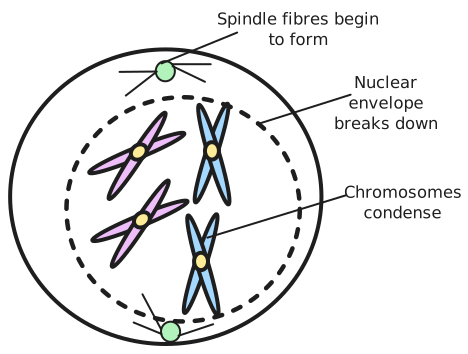
- Chromosomes condense (shorten and thicken), becoming visible under a microscope
- The nuclear envelope breaks down
- Spindle fibres form at opposite poles of the cell, and in late prophase they begin to attach to the centromeres
Step 2: Metaphase
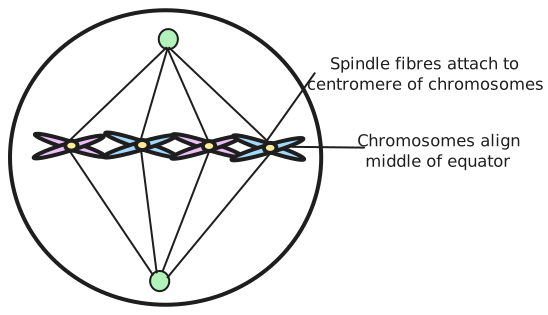
- Spindle fibres are attached to the centromeres of each chromosome
- Chromosomes are moved to the equator (middle) of the cell, which is called the metaphase plate
- Each chromosome is held under tension, pulled equally toward both poles
Step 3: Anaphase
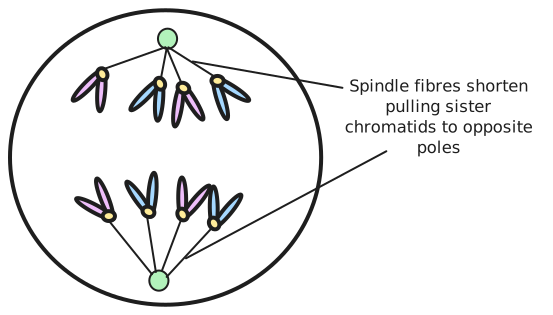
- The centromeres divide (split)
- Spindle fibres shorten, pulling the two sister chromatids of each chromosome to opposite poles
- Each chromatid is now called a chromosome in its own right
- The cell elongates as chromosomes move apart
Common exam error: anaphase vs meiosis I
In anaphase of mitosis, it is the centromeres that divide. Sister chromatids separate. Do not write that homologous chromosomes are separated (that happens in meiosis I). The chromosomes moving to opposite poles are chromatids, not homologous pairs.
Step 4: Telophase
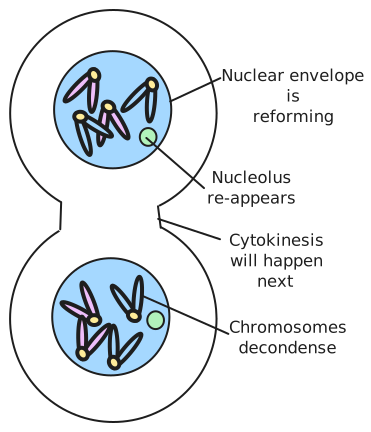
- Chromosomes arrive at the poles and begin to decondense
- A nuclear envelope reforms around each group of chromosomes
- Two new nuclei are now present in a single cell
Cytokinesis
- The cytoplasm divides to produce two separate daughter cells
- In animal cells: the membrane pinches inward at the equator
- In plant cells: a new cell plate forms at the equator, which becomes the new cell wall
Required Practical 2: Root Tip Squash
What you need to know (from the AQA specification)
What you need to know (from the AQA specification)
Preparation of stained squashes of cells from plant root tips; set-up and use of an optical microscope to identify the stages of mitosis in these stained squashes and calculation of a mitotic index.
Root tip cells are ideal for studying mitosis because the root tip meristem (zone of actively dividing cells) contains many cells in different stages of the cell cycle.
The method
- Cut the terminal ~5 mm from a root tip (this is the meristem region)
- Place in hydrochloric acid (HCl) for ~10 minutes
- Rinse in distilled water, then add toluidine blue stain (stains chromosomes purple)
- Place on a slide with a coverslip and gently squash the tissue
- Observe under an optical microscope
Why use hydrochloric acid?
Why use hydrochloric acid?
- Breaks down the links between cell walls, allowing cells to separate
- Allows the stain to diffuse into cells
- Stops cell division: so you capture a snapshot of cells at different stages of the cycle
Why press the coverslip down?
Why press the coverslip down?
- Spreads cells into a single layer so they don’t overlap
- Allows light to pass through individual cells
- Makes each cell and its chromosomes clearly visible under the microscope
Calculating the mitotic index
The mitotic index is a measure of how many cells in a sample are actively dividing:
$$\text{Mitotic index} = \frac{\text{number of cells in mitosis}}{\text{total number of cells observed}}$$
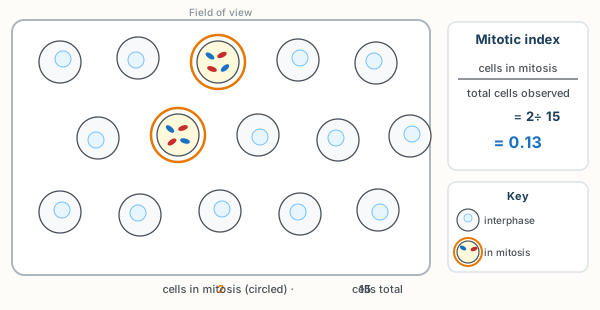
When looking at diagrams you can assume if we can see visible chromosomes the cell is in mitosis.
A higher mitotic index means a greater proportion of cells are dividing. Cancer cells typically have a high mitotic index; mature, differentiated cells have a low one.
Express as a decimal, not a percentage
The mitotic index is a proportion (e.g. 0.13), not a percentage. Express it as a decimal unless the question specifically asks for a percentage.
Cancer (Uncontrolled Cell Division)
What you need to know (from the AQA specification)
What you need to know (from the AQA specification)
Mitosis is a controlled process. Uncontrolled cell division can lead to the formation of tumours and of cancers. Many cancer treatments are directed at controlling the rate of cell division.
The cell cycle is normally controlled cell division. There are certain proteins that check whether the cell is ready to progress from one phase to the next (e.g. whether DNA has been correctly replicated before mitosis begins).
Mutations in the genes involved in regulating the cell cycle can lead to uncontrolled cell division, which leads to the formation of tumours and cancers.
Examples of genes that control the cell cycle (mutations in these can lead to cancer, covered in detail in Unit 8):
- Tumour suppressor genes
- Proto-oncogenes (which can mutate into oncogenes)
Cancer Treatments
Many cancer treatments work by targeting rapidly dividing cells, for example chemotherapy drugs that block mitosis or DNA replication.
This is why cancer treatments also affect healthy rapidly dividing cells (e.g. hair follicle cells, gut lining cells).
Binary Fission in Prokaryotes
What you need to know (from the AQA specification)
What you need to know (from the AQA specification)
Binary fission in prokaryotic cells involves:
- Replication of the circular DNA and of plasmids
- Division of the cytoplasm to produce two daughter cells, each with a single copy of the circular DNA and a variable number of copies of plasmids
Prokaryotic cells (bacteria) have no nucleus and no linear chromosomes. They cannot undergo mitosis (which depends on spindle fibres and a nuclear envelope). Instead, bacteria divide by binary fission, a simpler and faster process. This is also exploited in in vivo cloning to amplify DNA.
Why can't prokaryotes use mitosis to divide?
Why can't prokaryotes use mitosis to divide?
Mitosis relies on:
- A nuclear envelope to contain and then release chromosomes
- Spindle fibres (made of tubulin proteins attached to centromeres) to pull chromatids apart
Prokaryotes have neither:
- They have no nuclear envelope, so their circular DNA is free in the cytoplasm
- They have no centromeres on their circular DNA
- They have no spindle fibres
Binary fission achieves the same outcome (two daughter cells, each with a copy of the DNA) by a different, simpler mechanism.
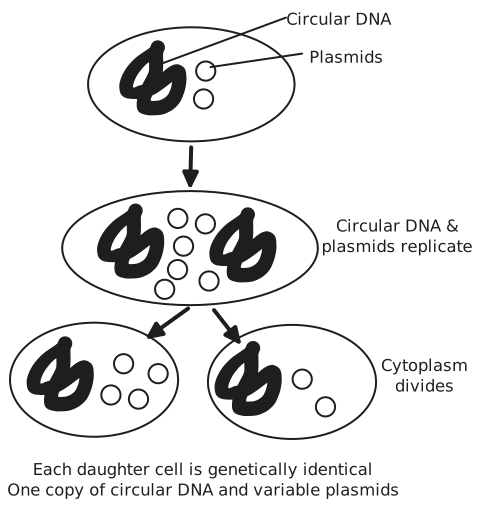
Steps of binary fission
- The circular DNA replicates (using DNA polymerase and helicase, exactly as in semi-conservative replication)
- Plasmids also replicate independently (number of copies passed to daughter cells varies)
- The cell elongates, and the two DNA copies move to opposite ends
- A new cell wall and membrane forms across the middle
- The cell splits into two daughter cells, each with
- One copy of the circular DNA
- Variable number of plasmids
Because prokaryotes can divide in as little as 20 minutes under ideal conditions, binary fission allows bacteria to grow into very large populations extremely rapidly.
Binary fission vs mitosis
| Feature | Binary fission (prokaryotes) | Mitosis (eukaryotes) |
|---|---|---|
| DNA form | Single circular chromosome | Multiple linear chromosomes |
| Plasmids | Present; replicate and distributed variably | Absent |
| Nucleus | Absent | Present; nuclear envelope breaks down and reforms |
| Spindle fibres | Absent | Present; pull chromatids apart |
| Speed | Very fast (~20 min) | Slower (hours) |
| Products | 2 genetically identical daughter cells | 2 genetically identical daughter cells |
Viral Replication
What you need to know (from the AQA specification)
What you need to know (from the AQA specification)
Being non-living, viruses do not undergo cell division. Following injection of their nucleic acid, the infected host cell replicates the virus particles.
Viruses are acellular and non-living
Viruses are not cells. They can be described as ‘acellular’ (not made of cells, as they have no cytoplasm and no organelles).
They are ‘non-living’ because they have no ribosomes, so they cannot make proteins or replicate on their own. Instead they must hijack the machinery of a host cell (e.g. HIV uses T helper cells as its host cell).
Steps of viral replication
- Attachment proteins on the virus bind to complementary receptors on the host cell surface
- The viral nucleic acid (DNA or RNA) enters the host cell
- The nucleic acid is replicated inside the cell using host cell enzymes
- The host cell’s ribosomes produce viral proteins (translation)
- New virus particles are assembled and released by either lysis (bursting the cell) or budding. This often kills the host cell.
The HIV page covers a detailed example. HIV is a retrovirus that uses reverse transcriptase to convert its RNA into DNA, which is then incorporated into the host cell’s genome.
How this topic is tested
This analysis is based on past paper data from 2017 to 2025. It is intended for interest only and is not predictive of what will appear in future papers.
- Tested in 9 of 9 years (2017–2025): 25 question parts worth 57 marks.
- 11th most-examined topic overall by marks, 3rd in Unit 2.
Marks by year
Most-tested spec points
- Stages of Mitosis: tested in 9 parts (23 marks)
- Required Practical 2: tested in 7 parts (12 marks)
- Binary Fission in Prokaryotes: tested in 5 parts (12 marks)
- The Cell Cycle: tested in 4 parts (9 marks)
- Uncontrolled Cell Division: Tumours & Cancer: tested in 3 parts (7 marks)
Also links to: Factors Affecting Rate of Reaction.
Maths and practical skills
- Logarithms and log scales (MS 2.5): e.g. 2023 P1 Q8.4
- Units and standard form (MS 0.1, 0.2): e.g. 2021 P1 Q6.1
- Percentages, ratios and fractions (MS 0.3): e.g. 2023 P1 Q8.4
- Choosing and using a statistical test (MS 1.9): e.g. 2024 P1 Q5.3
- Moving between graphs, numbers and equations (MS 3.1): e.g. 2025 P1 Q8.5
Tips from examiner reports
What students commonly get wrong
- Prophase and anaphaseWatch out: spindle fibres start attaching to the centromeres in prophase, not only in metaphase. In anaphase, say the centromeres split before the chromatids are pulled to opposite poles. 2024 P1 Q5.1
- Mitotic index is a proportionWatch out: the mitotic index is a proportion (e.g. 0.13), so don't convert it to a percentage unless asked. Because it's a proportion, having more or fewer cells in the field of view doesn't change it. 2022 P3 Q3.4 · 2022 P3 Q3.5
- Describing binary fissionWhen describing binary fission, say the circular DNA and the plasmids both replicate, then the cytoplasm divides, giving each cell one copy of the circular DNA and a variable number of plasmids. "The genetic material replicates" isn't specific enough. 2025 P3 Q1.1 · 2017 P1 Q4.1
Exam Question Practice
A few exam-style questions on this topic to try. Have a go at each one before opening the answer.
Describe what happens to the chromosomes during metaphase and during anaphase of mitosis.
(4 marks)
Hint
For each stage, think about where the chromosomes are and what they are attached to. What happens at the centromeres to let the chromatids separate?
Mark Scheme
Max 2 marks for metaphase
Metaphase
- The chromosomes line up at the equator (middle) of the cell (1 mark)
- They are attached to the spindle fibres by their centromeres (1 mark)
- Each chromosome is fully condensed, made of two sister chromatids (1 mark)
Anaphase
- The centromeres divide (1 mark)
- The chromatids are pulled to opposite poles (1 mark)
Also accepted / rejected
Tips
- In metaphase, say where the chromosomes are (lined up at the equator) and what holds them there (spindle fibres attached at the centromeres)
- In anaphase, say the centromeres divide and the chromatids are pulled to opposite poles
- Don’t include meiosis events such as homologous chromosomes separating or crossing over
A student made a stained squash of onion root tip cells. Figure 1 shows the student’s drawing of one field of view.
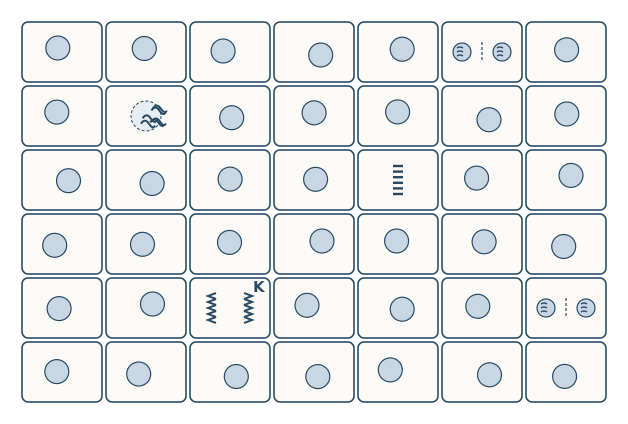
Name the stage of mitosis shown in cell K. Explain the appearance of this cell.
(2 marks)
Hint
In cell K, where are the chromosomes, and what is happening to them?
Mark Scheme
- Anaphase (1 mark)
- Chromatids moved/pulled to opposite poles/ends (1 mark)
Also accepted / rejected
1. Reject “anaphase I (of meiosis)”.
2. Accept chromosomes for chromatids. Reject homologous chromosomes for chromatids.
Tips
- Cell K is in anaphase (not metaphase)
- Explain what’s happening: the chromatids are being pulled to opposite poles; “the centromere splits” alone isn’t enough
Before making a stained squash, a student soaked onion root tips in hydrochloric acid for 10 minutes.
Suggest why the student soaked the root tips in hydrochloric acid.
(2 marks)
Hint
What holds plant cells together? What would acid do to that, and why would it help with squashing and staining?
Mark Scheme
Max 2 marks
- To break down links between cells/cell walls
OR To separate cells/cell walls
OR To break down/hydrolyse cellulose/the cell wall (1 mark) - Allowing the stain to pass/diffuse into the cells
OR Allowing the cells to be (more easily) squashed (1 mark) - To stop mitosis (1 mark)
Also accepted / rejected
1. Ignore references to any bonds.
3. Accept “to stop cell division/the cell cycle”.
Tips
- The acid breaks down the links between cells (e.g. the middle lamella) so the cells separate and can be squashed, and the stain can get in
- It doesn’t kill bacteria or dissolve membranes
A student made a stained squash of onion root tip cells. Figure 1 shows the student’s drawing of one field of view.
Use Figure 1 to calculate a mitotic index for the cells in this field of view.
Mitotic index = ________
(1 marks)
Hint
Count the cells in mitosis and the total number of cells. Is a mitotic index a proportion or a percentage?
Mark Scheme
0.1 / 0.12 / 0.119 (1 mark)
(5 cells in mitosis ÷ 42 cells in total)
Also accepted / rejected
Accept any correct rounding of 0.119047…
Reject answers given as a percentage.
Tips
- Mitotic index = cells in mitosis ÷ total cells, given as a proportion (0.12), not a percentage
Students in a class each made a stained squash of onion root tip cells using the same method, and calculated a mitotic index. They calculated different mitotic indices.
Apart from student errors, suggest two explanations why.
(2 marks)
Hint
Apart from mistakes, why might different roots, or different parts of a root, have more cells dividing?
Mark Scheme
Max 2 marks
- (Onion roots) are a different age
OR (Onions) grown in different conditions (1 mark) - (Root tips) from different (onion) plants/bulbs/species (1 mark)
- A single field of view is not representative of a root tip
OR (Other) students may have looked at more fields of view
OR (Other) students may have calculated a mean (1 mark) - (Different fields of view are from) different parts of the root tip (1 mark)
- Cells/roots undergo mitosis/cell division at different times/rates (1 mark)
Also accepted / rejected
1. Accept suitable descriptions of conditions, e.g. different temperatures.
3. Accept “samples” for “fields of view”.
4. Reject different-sized fields of view. Reject a different number of cells (per field of view).
Tips
- Suggest biological reasons: roots of different ages or grown in different conditions, different plants, or different parts of the root tip viewed
- The index is a proportion, so more or fewer cells in the field of view doesn’t change it
- Don’t give student errors or a different method: the question rules both out
Describe binary fission in bacteria.
(3 marks)
Hint
Think about the two types of DNA in a bacterium that must be copied, and then how the cell splits into two.
Mark Scheme
- The circular DNA is replicated (1 mark)
- The plasmids are replicated (1 mark)
- The cytoplasm divides to produce two daughter cells (1 mark)
Also accepted / rejected
Also accepted
- “Doubles” for replicated (points 1 and 2)
- A new cell-surface membrane forming between the two cells, or “cytokinesis” (point 3)
Not accepted
- “Chromosome” for the circular DNA, or describing mitosis (point 1)
Tips
- Make two separate points about DNA. The circular DNA replicates, and the plasmids replicate. “Genetic material replicates” gets neither mark
- Bacteria divide by binary fission, not mitosis, so don’t describe the stages of mitosis
- Bacteria don’t have membrane-bound organelles, so don’t describe organelles being copied
Viruses can only replicate inside a host cell.
Describe how a virus replicates.
(3 marks)
Hint
A virus can’t replicate by itself. Go through the stages: getting in, copying, making parts, leaving.
Mark Scheme
Max 3 marks
- Attachment proteins bind to receptors on the host cell (1 mark)
- The viral nucleic acid enters the cell (1 mark)
- The nucleic acid is replicated in the cell, or reverse transcriptase makes DNA from RNA (1 mark)
- The cell makes viral proteins (capsid and enzymes) (1 mark)
- New viruses are assembled and released (1 mark)
Also accepted / rejected
Also accepted
- “DNA”, “RNA” or “genetic material” for nucleic acid (points 2 and 3)
- “Bud off” or “burst out” for released (point 5)
Tips
- Link attachment proteins to receptors on the host cell
- The viral nucleic acid enters and is replicated; the cell makes viral proteins, then new viruses are assembled and released; don’t skip assembly
- Viruses don’t replicate by binary fission or mitosis, and “inject genetic information” is too vague
Also accepted
Not accepted