19 of 21 spec points in this unit have notes.
- Notes
- Suggested skills activity
- Coming soon
-
Surface Area to Volume Ratio
Spec points
Size and Surface Area to Volume RatioJump to notes →
The relationship between the size of an organism or structure and its surface area to volume ratio.
Changes to body shape and the development of systems in larger organisms as adaptations that facilitate exchange as this ratio reduces.SA:V and Metabolic RateJump to notes →
Students should be able to appreciate the relationship between surface area to volume ratio and metabolic rate.Investigating Diffusion with Agar BlocksSkillPS 1.1Topic page →
Students could use agar blocks containing indicator to determine the effect of surface area to volume ratio and concentration gradient on the diffusion of an acid or alkali.Calculating SA:V RatiosSkillMS 4.1Jump to notes →
Students could be given the dimensions of cells with different shapes from which to calculate the surface area to volume ratios of these cells.
-
Gas Exchange
Spec points
Adaptations of Gas Exchange SurfacesJump to notes →
Adaptations of gas exchange surfaces, shown by gas exchange:
• across the body surface of a single-celled organism
• in the tracheal system of an insect (tracheae, tracheoles and spiracles)
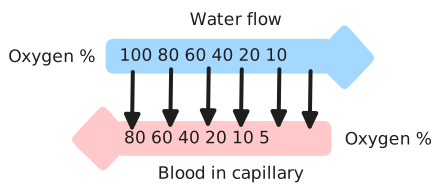
• across the gills of fish (gill lamellae and filaments including the counter-current principle)
• by the leaves of dicotyledonous plants (mesophyll and stomata).Limiting Water Loss in Insects & XerophytesJump to notes →
Structural and functional compromises between the opposing needs for efficient gas exchange and the limitation of water loss shown by terrestrial insects and xerophytic plants.The Human Gas Exchange SystemJump to notes →
The gross structure of the human gas exchange system limited to the alveoli, bronchioles, bronchi, trachea and lungs.
The essential features of the alveolar epithelium as a surface over which gas exchange takes place.Ventilation & the Mechanism of BreathingJump to notes →
Ventilation and the exchange of gases in the lungs. The mechanism of breathing to include the role of the diaphragm and the antagonistic interaction between the external and internal intercostal muscles in bringing about pressure changes in the thoracic cavity.Lung Disease, Risk Factors & CorrelationJump to notes →
Students should be able to:
• interpret information relating to the effects of lung disease on gas exchange and/or ventilation
• interpret data relating to the effects of pollution and smoking on the incidence of lung disease
• analyse and interpret data associated with specific risk factors and the incidence of lung disease
• evaluate the way in which experimental data led to statutory restrictions on the sources of risk factors
• recognise correlations and causal relationships.Dissecting Gas Exchange SystemsSkillAT jTopic page →
Students could dissect mammalian lungs, the gas exchange system of a bony fish or of an insect.Microscopy of Gas Exchange SurfacesSkillAT dTopic page →
Students could use an optical microscope to:
• examine prepared mounts of gas exchange surfaces of a mammal, fish and insect, or temporary mounts of gills
• examine vertical sections through a dicotyledonous leaf.Measuring Air VolumesSkillAT bTopic page →
Students could use three-way taps, manometers and simple respirometers to measure volumes of air involved in gas exchange.Pulmonary Ventilation RateSkillMS 2.2Topic page →
Students could be given values of pulmonary ventilation rate (PVR) and one other measure, requiring them to change the subject of the equation:
PVR = tidal volume × breathing rate
-
Digestion and Absorption
Spec points
Digestion of Large Biological MoleculesJump to notes →
During digestion, large biological molecules are hydrolysed to smaller molecules that can be absorbed across cell membranes.
Digestion in mammals of:
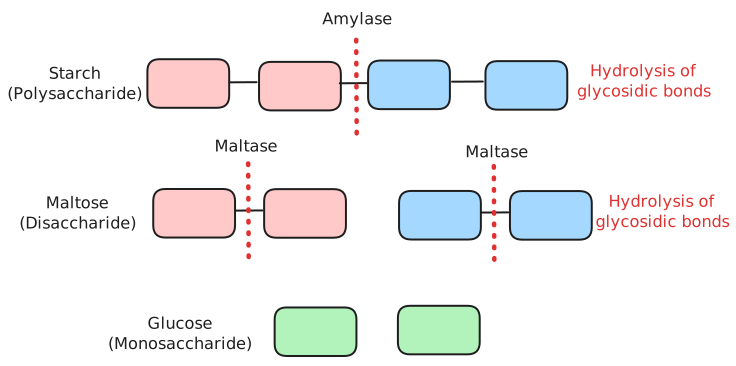
• carbohydrates by amylases and membrane-bound disaccharidases
• lipids by lipase, including the action of bile salts
• proteins by endopeptidases, exopeptidases and membrane-bound dipeptidases.Absorption in the IleumJump to notes →
Mechanisms for the absorption of the products of digestion by cells lining the ileum of mammals, to include:
• co-transport mechanisms for the absorption of amino acids and of monosaccharides
• the role of micelles in the absorption of lipids.Investigating Digestion & AbsorptionSkillPS 1.1Topic page →
Students could:
• design and carry out investigations into the effect of a pH or bile salts on the rate of reaction catalysed by a digestive enzyme
• use Visking tubing models to investigate the absorption of the products of digestion.
-
Mass Transport in Animals
Spec points
Haemoglobin StructureJump to notes →
The haemoglobins are a group of chemically similar molecules found in many different organisms. Haemoglobin is a protein with a quaternary structure.Oxygen Transport & the Dissociation CurveJump to notes →
The role of haemoglobin and red blood cells in the transport of oxygen. The loading, transport and unloading of oxygen in relation to the oxyhaemoglobin dissociation curve. The cooperative nature of oxygen binding to show that the change in shape of haemoglobin caused by binding of the first oxygens makes the binding of further oxygens easier. The effects of carbon dioxide concentration on the dissociation of oxyhaemoglobin (the Bohr effect).Different Haemoglobins & AdaptationJump to notes →
Many animals are adapted to their environment by possessing different types of haemoglobin with different oxygen transport properties.Blood Circulation in a MammalJump to notes →
The general pattern of blood circulation in a mammal. Names are required only of the coronary arteries and of the blood vessels entering and leaving the heart, lungs and kidneys.Heart Structure & the Cardiac CycleJump to notes →
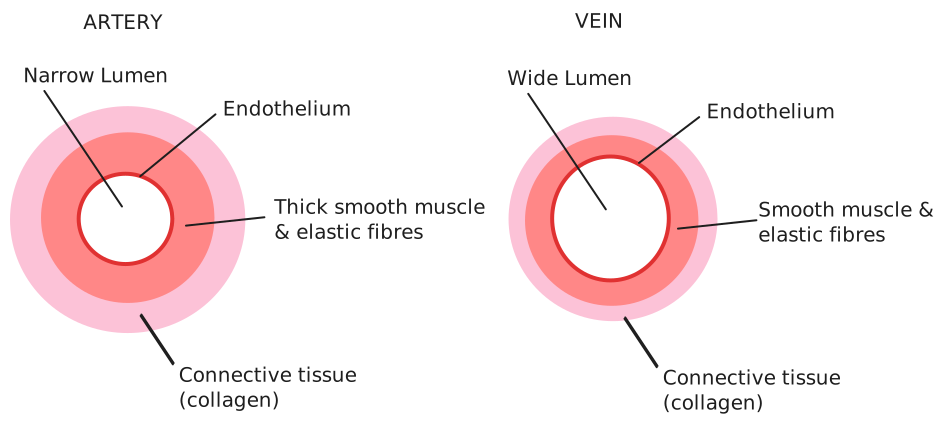
The gross structure of the human heart. Pressure and volume changes and associated valve movements during the cardiac cycle that maintain a unidirectional flow of blood.Structure of Arteries, Arterioles & VeinsJump to notes →
The structure of arteries, arterioles and veins in relation to their function.Capillaries & Tissue FluidJump to notes →
The structure of capillaries and the importance of capillary beds as exchange surfaces. The formation of tissue fluid and its return to the circulatory system.Cardiovascular Data & Risk Factors
Students should be able to:
• analyse and interpret data relating to pressure and volume changes during the cardiac cycle
• analyse and interpret data associated with specific risk factors and the incidence of cardiovascular disease
• evaluate conflicting evidence associated with risk factors affecting cardiovascular disease
• recognise correlations and causal relationships.Required Practical 5Required practicalAT j
Required practical 5: Dissection of animal or plant gas exchange system or mass transport system or of organ within such a system.Investigating Pulse & Heart RateSkillAT hTopic page →
Students could design and carry out an investigation into the effect of a named variable on human pulse rate or on the heart rate of an invertebrate, such as Daphnia.Calculating Cardiac OutputSkillMS 2.2Topic page →
Students could be given values of cardiac output (CO) and one other measure, requiring them to change the subject of the equation:
CO = stroke volume × heart rate
-
Mass Transport in Plants: Xylem
Spec points
Xylem & the Cohesion-Tension TheoryJump to notes →
Xylem as the tissue that transports water in the stem and leaves of plants. The cohesion-tension theory of water transport in the xylem.Using a PotometerSkillAT bJump to notes →
Students could set up and use a potometer to investigate the effect of a named environmental variable on the rate of transpiration.
-
Mass Transport in Plants: Phloem
Spec points
Phloem & the Mass Flow HypothesisJump to notes →
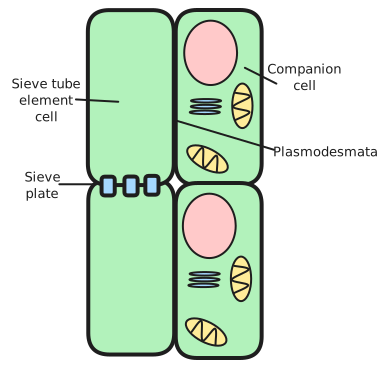
Phloem as the tissue that transports organic substances in plants. The mass flow hypothesis for the mechanism of translocation in plants. The use of tracers and ringing experiments to investigate transport in plants.Evaluating Evidence for Mass FlowJump to notes →
Students should be able to:
• recognise correlations and causal relationships
• interpret evidence from tracer and ringing experiments and to evaluate the evidence for and against the mass flow hypothesis.