What you need to know (from the AQA specification)
What you need to know (from the AQA specification)
- The relationship between the size of an organism or structure and its surface area to volume ratio.
- Changes to body shape and the development of systems in larger organisms as adaptations that facilitate exchange as this ratio reduces.
- Students should be able to appreciate the relationship between surface area to volume ratio and metabolic rate.
Surface Area
Organisms exchange substances (oxygen, carbon dioxide, nutrients, waste) with their environment across a surface. This surface depends on the organism, for example:
- In single-celled organisms (e.g. an amoeba), the surface is the cell membrane
- In human lungs, the surfaces are the alveoli
- In fish, the surfaces are the gills
- In plants, the surfaces are the leaves
Volume
The amount of substance organisms need to exchange depends on their volume. If organisms have a larger volume, they have more cells, so a greater demand for nutrients. It makes sense that someone who is larger (i.e. has a higher volume) would have higher total energy requirements than someone who is smaller (i.e. lower volume).
The ratio between these two, the surface area to volume ratio (SA:V), determines whether the organisms can use simple diffusion, or whether specialised exchange surfaces and transport systems are needed. (You’ll learn what these specialised transport systems are in this unit.)
Calculating SA:V Ratio
As an organism (or structure) gets larger, its volume increases faster than its surface area, so its SA:V ratio decreases.
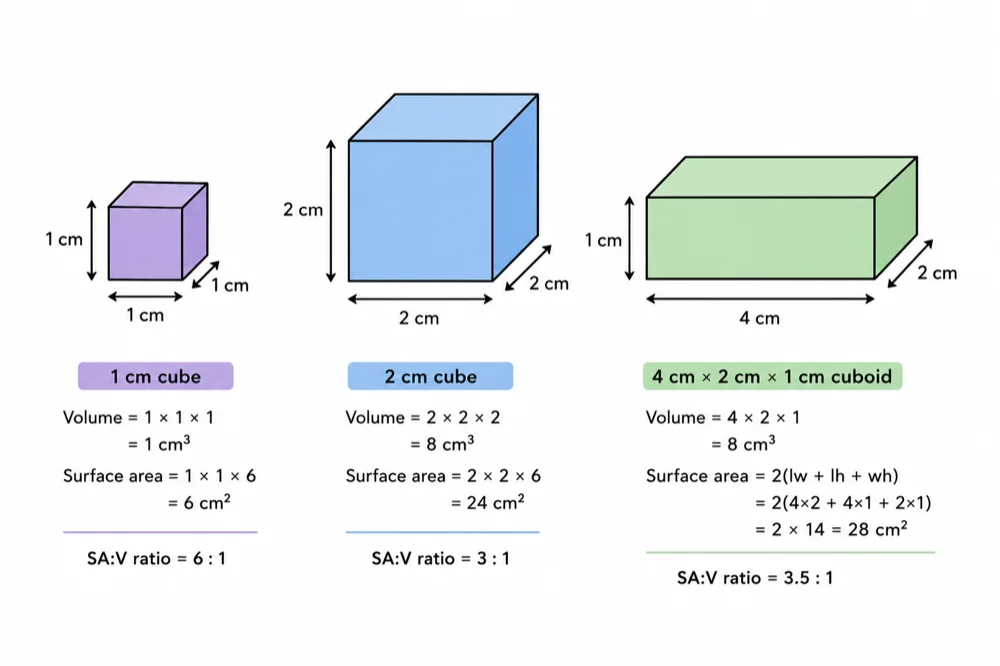
The image above shows three worked examples.
- Doubling the side length of a cube (1 cm → 2 cm) halves the SA:V ratio (6:1 → 3:1).
- The 2 cm cube and the 4 × 2 × 1 cuboid have the same volume (8 cm³), but the cuboid has a higher SA:V (3.5:1 vs 3:1).
- Flatter / more elongated shapes give a higher SA:V ratio, even at the same volume.
You need to be able to calculate SA:V for any given shape (cube, cuboid, sphere). Exam questions may give the dimensions and ask you to work it out. You’ll be given the formula for a sphere, so don’t worry about memorising it.
Single-celled vs Multicellular Organisms
- Single-celled organisms have a large SA:V ratio. This means they can absorb and release gases (and other substances) by diffusion directly across their outer surface.
- Multicellular organisms have a smaller SA:V ratio. Diffusion across the body surface alone is too slow to meet the demands of all their cells (long diffusion distances, slow rate of diffusion).
- They compensate with adaptations and development of specialised systems:
- Flattened or elongated body shapes (e.g. flatworms), which increase the surface area relative to volume
- Folded / branched exchange surfaces. Alveoli in lungs, villi in the small intestine, root hairs in plants, all increase surface area
- Mass transport systems. The circulatory system in animals and xylem/phloem in plants move substances quickly between exchange surfaces and tissues
SA:V and Metabolic Rate
Smaller organisms have a higher SA:V ratio, so they lose heat to the environment more rapidly (especially in cold environments).
To maintain a stable body temperature, they need a higher metabolic rate. A higher metabolic rate means more respiration, so more heat is released.
Examples include:
- Small mammals (e.g. shrews, mice) have a high SA:V so they lose heat rapidly. To compensate, they have a high metabolic rate and must eat frequently to fuel respiration.
- Large mammals (e.g. elephants, whales) have a low SA:V, so they lose heat slowly. Because of this, they don’t need as high a metabolic rate per unit mass.
Animals in cold climates often have compact body shapes (e.g. seals are rounder with shorter limbs) to reduce SA:V and minimise heat loss. The reverse is true for animals in hot climates.
How this topic is tested
This analysis is based on past paper data from 2017 to 2025. It is intended for interest only and is not predictive of what will appear in future papers.
- Tested in 4 of 9 years (2017–2025): 7 question parts worth 15 marks.
- 44th most-examined topic overall by marks, 5th in Unit 3.
Marks by year
Most-tested spec points
- Size and Surface Area to Volume Ratio: tested in 4 parts (6 marks)
- SA:V and Metabolic Rate: tested in 2 parts (6 marks)
- Calculating SA:V Ratios: tested in 1 part (3 marks)
Maths and practical skills
- Significant figures (MS 1.1): e.g. 2024 P3 Q3.2
- Using equations (MS 2.2, 2.3): e.g. 2024 P3 Q3.2
Tips from examiner reports
What students commonly get wrong
- Heat is released, not producedWhen linking SA:V to metabolic rate, explain fully: a larger SA:V means more heat lost, so a higher metabolic rate (more respiration) is needed to release heat and keep body temperature constant. Watch out: say heat or energy is released, never "produced". 2024 P3 Q3.1 · 2019 P1 Q9.4
- SA:V = surface area ÷ volumeWatch out: the SA:V ratio is surface area ÷ volume, not volume ÷ surface area. 2022 P1 Q8.2
- Why larger animals need specialised systemsDon't just say larger animals have a smaller SA:V ratio. Explain the advantage: a specialised exchange system overcomes the long diffusion pathway, giving faster diffusion. 2021 P1 Q2.1
Exam Question Practice
Coeliac disease damages the villi in the small intestine.
Scientists used microscope images of villi from a healthy person and from a person with coeliac disease. They calculated the surface area to volume ratio of one villus from each person. Some of their results are shown in Table 1.
Table 1
| Villus | Surface area / µm² | Volume / µm³ | Surface area:volume ratio |
|---|---|---|---|
| Healthy | 9.6 × 10³ | 3.4 × 10⁴ | |
| Damaged | 4.3 × 10³ | 0.15:1 |
Complete Table 1. Give your calculated surface area:volume ratio and volume to 2 significant figures.
(2 marks)
Hint
Which way round is the ratio: surface area ÷ volume, or volume ÷ surface area? Rearrange for the missing volume. Check the significant figures.
Mark Scheme
1 mark for each correct value (2 marks)
- Healthy villus ratio: 0.28:1
- Damaged villus volume: 2.9 × 10⁴ µm³ (29 000)
Working:
- Healthy ratio: 9.6 × 10³ ÷ 3.4 × 10⁴ = 0.28
- Damaged volume: 4.3 × 10³ ÷ 0.15 = 28 667
- To 2 significant figures: 29 000
If neither is right, 1 mark for 0.2824 or 28 667 (right working, not to 2 significant figures).
Tips
- Surface area:volume ratio is surface area ÷ volume: 9.6 × 10³ ÷ 3.4 × 10⁴ = 0.28:1
- For the volume, rearrange: 4.3 × 10³ ÷ 0.15 = 28 667, which is 29 000 to 2 significant figures (not 28 000)
Porphyra is a red seaweed that grows on rocks on the seashore. It is covered by seawater at high tide.
The body of Porphyra is a thin, flat sheet only one or two cells thick.
Unlike plants, Porphyra does not have xylem tissue.
Suggest how Porphyra is able to survive without xylem tissue.
(1 marks)
Hint
The seaweed is covered by seawater and its body is very thin. How could water and ions reach every cell without a transport system?
Mark Scheme
Short diffusion pathway (to cells)
OR It has a surface permeable (to water/ions into cells) (1 mark)
Also accepted / rejected
Tips
- Apply what you know about why larger organisms need transport systems: the thin body gives a short diffusion pathway to every cell
Accept the idea of not needing structural support as it is supported by the water.
Ignore pores/stomata.