18 of 19 spec points in this unit have notes.
- Notes
- Suggested skills activity
- Coming soon
-
Photosynthesis
Spec points
The Light-Dependent ReactionJump to notes →
The light-dependent reaction in such detail as to show that:
• chlorophyll absorbs light, leading to photoionisation of chlorophyll
• some of the energy from electrons released during photoionisation is conserved in the production of ATP and reduced NADP
• the production of ATP involves electron transfer associated with the transfer of electrons down the electron transfer chain and passage of protons across chloroplast membranes and is catalysed by ATP synthase embedded in these membranes (chemiosomotic theory)
• photolysis of water produces protons, electrons and oxygen.The Light-Independent ReactionJump to notes →
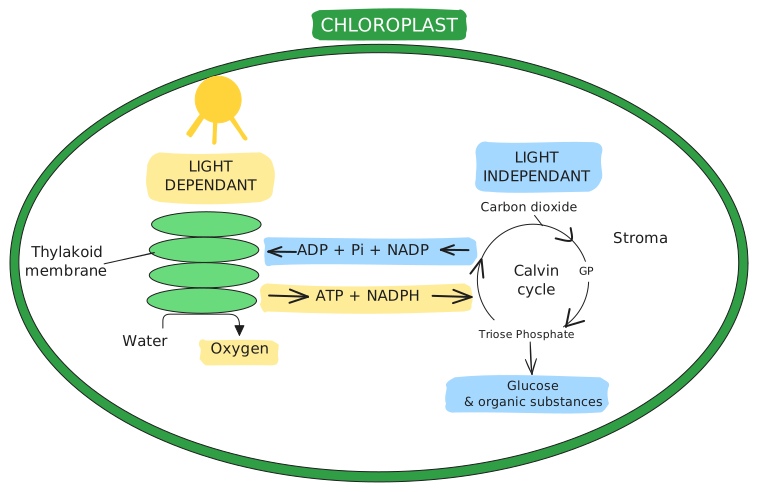
The light-independent reaction uses reduced NADP from the light-dependent reaction to form a simple sugar. The hydrolysis of ATP, also from the light-dependent reaction, provides the additional energy for this reaction.
The light-independent reaction in such detail as to show that:
• carbon dioxide reacts with ribulose bisphosphate (RuBP) to form two molecules of glycerate 3-phosphate (GP). This reaction is catalysed by the enzyme rubisco
• ATP and reduced NADP from the light-dependent reaction are used to reduce GP to triose phosphate
• some of the triose phosphate is used to regenerate RuBP in the Calvin cycle
• some of the triose phosphate is converted to useful organic substances.Limiting Factors & Agricultural PracticeJump to notes →
Students should be able to:
• identify environmental factors that limit the rate of photosynthesis
• evaluate data relating to common agricultural practices used to overcome the effect of these limiting factors.Investigating Rate of PhotosynthesisSkillAT aJump to notes →
Students could devise and carry out experiments to investigate the effect of named environmental variables on the rate of photosynthesis using aquatic plants, algae or immobilised algal beads.
-
Chromatography
Spec points
Required Practical 7Required practicalAT gAT bJump to notes →
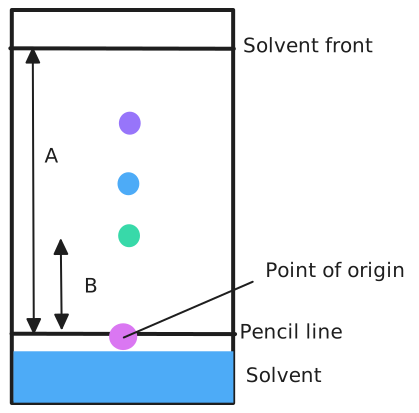
Required practical 7: Use of chromatography to investigate the pigments isolated from leaves of different plants, eg, leaves from shade-tolerant and shade-intolerant plants or leaves of different colours.
-
Dehydrogenase
Spec points
3.5.1 Photosynthesis
Required Practical 8Required practicalAT gAT bJump to notes →
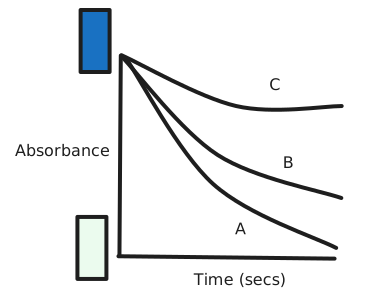
Required practical 8: Investigation into the effect of a named factor on the rate of dehydrogenase activity in extracts of chloroplasts.
3.5.2 Respiration
Investigating Dehydrogenase ActivitySkillAT bJump to notes →
Students could use a redox indicator to investigate dehydrogenase activity.
-
Respiration
Spec points
GlycolysisJump to notes →
Respiration produces ATP.
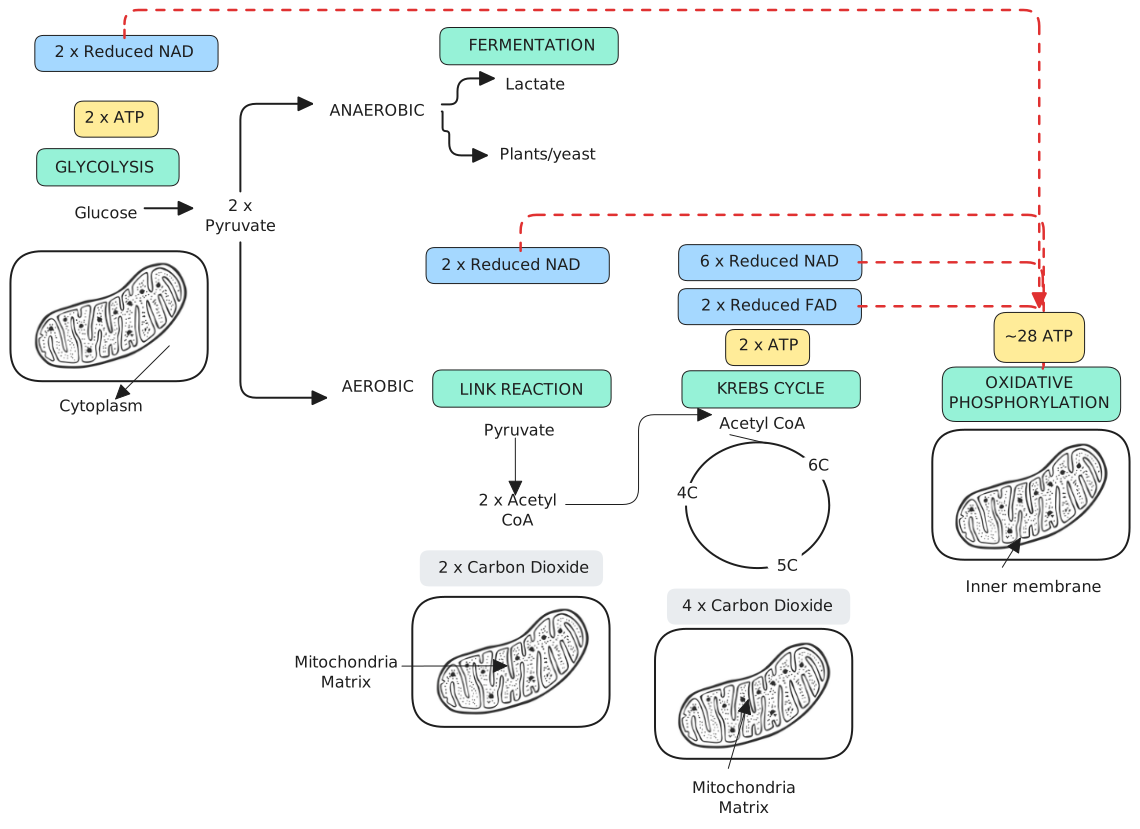
Glycolysis is the first stage of anaerobic and aerobic respiration. It occurs in the cytoplasm and is an anaerobic process.
Glycolysis involves the following stages:
• phosphorylation of glucose to glucose phosphate, using ATP
• production of triose phosphate
• oxidation of triose phosphate to pyruvate with a net gain of ATP and reduced NAD.Anaerobic RespirationJump to notes →
If respiration is only anaerobic, pyruvate can be converted to ethanol or lactate using reduced NAD. The oxidised NAD produced in this way can be used in further glycolysis.The Link Reaction & Krebs CycleJump to notes →
If respiration is aerobic, pyruvate from glycolysis enters the mitochondrial matrix by active transport.
Aerobic respiration in such detail as to show that:
• pyruvate is oxidised to acetate, producing reduced NAD in the process
• acetate combines with coenzyme A in the link reaction to produce acetylcoenzyme A
• acetylcoenzyme A reacts with a four-carbon molecule, releasing coenzyme A and producing a six-carbon molecule that enters the Krebs cycle
• in a series of oxidation-reduction reactions, the Krebs cycle generates reduced coenzymes and ATP by substrate-level phosphorylation, and carbon dioxide is lostOxidative PhosphorylationJump to notes →
• synthesis of ATP by oxidative phosphorylation is associated with the transfer of electrons down the electron transfer chain and passage of protons across inner mitochondrial membranes and is catalysed by ATP synthase embedded in these membranes (chemiosomotic theory)Other Respiratory SubstratesJump to notes →
• other respiratory substrates include the breakdown products of lipids and amino acids, which enter the Krebs cycle.Required Practical 9Required practicalAT bAT i
Required practical 9: Investigation into the effect of a named variable on the rate of respiration of cultures of single-celled organisms.
-
Energy & Ecosystems
Spec points
Biomass & Its MeasurementJump to notes →
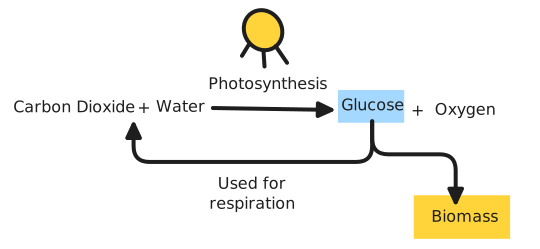
In any ecosystem, plants synthesise organic compounds from atmospheric, or aquatic, carbon dioxide.
Most of the sugars synthesised by plants are used by the plant as respiratory substrates. The rest are used to make other groups of biological molecules. These biological molecules form the biomass of the plants.
Biomass can be measured in terms of mass of carbon or dry mass of tissue per given area. The chemical energy store in dry biomass can be estimated using calorimetry.Gross & Net Primary ProductionJump to notes →
Gross primary production (GPP) is the chemical energy store in plant biomass, in a given area or volume.
Net primary production (NPP) is the chemical energy store in plant biomass after respiratory losses to the environment have been taken into account,
ie NPP = GPP – R
where GPP represents gross production and R represents respiratory losses to the environment.
This net primary production is available for plant growth and reproduction. It is also available to other trophic levels in the ecosystem, such as herbivores and decomposers.Net Production of ConsumersJump to notes →
The net production of consumers (N), such as animals, can be calculated as:
N = I – (F + R)
where I represents the chemical energy store in ingested food, F represents the chemical energy lost to the environment in faeces and urine and R represents the respiratory losses to the environment.Primary & Secondary ProductivityJump to notes →
Primary and secondary productivity is the rate of primary or secondary production, respectively. It is measured as biomass in a given area in a given time eg kJ ha⁻¹ year⁻¹.Farming Practices & Energy TransferJump to notes →
Students should be able to appreciate the ways in which production is affected by farming practices designed to increase the efficiency of energy transfer by:
• simplifying food webs to reduce energy losses to non-human food chains
• reducing respiratory losses within a human food chain.Calculating Gross Primary ProductionSkillMS 0.1Jump to notes →
Students could be given data from which to calculate gross primary production and to derive the appropriate units.Measuring Dry Mass & Energy of BiomassSkillAT aJump to notes →
Students could carry out investigations to find the dry mass of plant samples or the energy released by samples of plant biomass.Calculating Net Productivity & EfficiencySkillMS 2.4Jump to notes →
Students could be given data from which to calculate:
• the net productivity of producers or consumers from given data
• the efficiency of energy transfers within ecosystems.Calculating Percentage YieldsSkillMS 0.3Jump to notes →
Students could be given data from which to calculate percentage yields.
-
Nutrient Cycles
Spec points
Role of Microorganisms in RecyclingJump to notes →
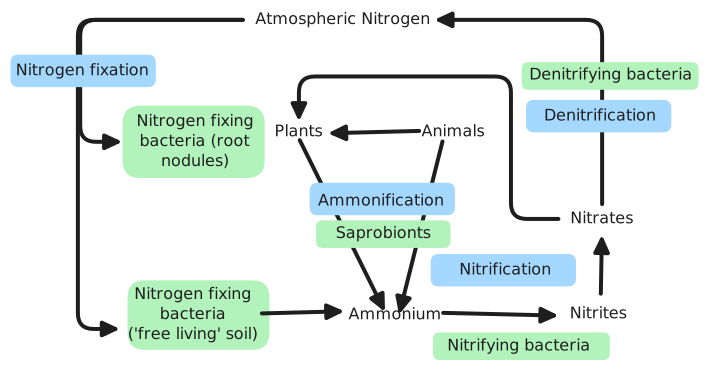
Nutrients are recycled within natural ecosystems, exemplified by the nitrogen cycle and the phosphorus cycle.
Microorganisms play a vital role in recycling chemical elements such as phosphorus and nitrogen.
• The role of saprobionts in decomposition.
• The role of mycorrhizae in facilitating the uptake of water and inorganic ions by plants.The Nitrogen CycleJump to notes →
• The role of bacteria in the nitrogen cycle in sufficient detail to illustrate the processes of saprobiotic nutrition, ammonification, nitrification, nitrogen fixation and denitrification.
(The names of individual species of bacteria are not required).Fertilisers & Environmental IssuesJump to notes →
The use of natural and artificial fertilisers to replace the nitrates and phosphates lost by harvesting plants and removing livestock.
The environmental issues arising from the use of fertilisers including leaching and eutrophication.Investigating Minerals & Plant GrowthSkillPS 1.1Topic page →
Students could devise investigations into the effect of named minerals on plant growth.