Enzymes are proteins, and are biological catalysts. They can speed up the rate of biological reactions (e.g. respiration, photosynthesis) without being used up themselves.
Why is this important? Most essential life processes (e.g. digestion, respiration) would happen far too slowly for us to be alive without enzymes!
Enzymes can work in two main places:
- Intracellular: Enzymes that are present within the cells (i.e. inside the cell membrane). Examples could include:
- DNA polymerase, responsible for building new DNA strands and present within the nucleus (inside the cell)
- RNA polymerase, used in transcription to create mRNA
- Catalase, responsible for breaking down hydrogen peroxide inside cells
- Extracellular: Enzymes that are released to work outside cells. Examples can include:
- Digestive enzymes (e.g. amylase, which is in your saliva, or proteases, which are present in the small intestine). These are present outside the cells in your gut, allowing nutrients to be broken down efficiently and absorbed
Activation Energy
What you need to know (from the AQA specification)
What you need to know (from the AQA specification)
Each enzyme lowers the activation energy of the reaction it catalyses.
So how do enzymes (these biological catalysts) actually speed up the reactions?
They work by lowering the reaction’s activation energy. This is the amount of energy required for the reaction to get started.
A reaction needs energy (activation energy) to get started, as it needs to break the existing chemical bonds in the reactant molecules.
If you look at the graph below, can you see that the reaction catalysed by an enzyme needs a lower activation energy than the uncatalysed reaction?
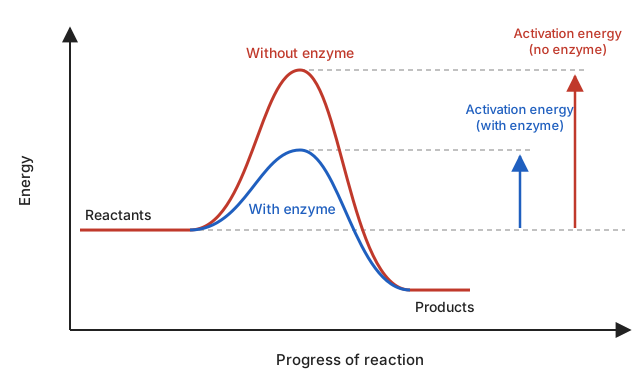
Why couldn’t we just use heat as a supply of energy? Why do we have to use enzymes? In our bodies, our cells work at around 37 °C, which is nowhere near hot enough for most reactions to get going on their own. Similarly, other living organisms have temperature limits. Note: in industry, you’ll notice they often supply heat and catalysts to speed up the rate of reactions.
Enzyme Specificity & Active Site
What you need to know (from the AQA specification)
What you need to know (from the AQA specification)
The properties of an enzyme relate to the tertiary structure of its active site and its ability to combine with complementary substrate(s) to form an enzyme-substrate complex.
- The specificity of enzymes
Students should be able to appreciate that enzymes catalyse a wide range of intracellular and extracellular reactions that determine structures and functions from cellular to whole-organism level.
Can any enzyme then catalyse any reaction? No, an enzyme catalyses one reaction, or one type of reaction. This is called specificity, and it comes directly from the enzyme’s shape: its active site.
Enzymes have an ‘active site’, which is specific to certain substrates.
If you remember back to the proteins topic, enzymes are proteins, and a protein’s structure determines its function.
Remember back to protein structure…
- The sequence of amino acids in the polypeptide (its primary structure) is determined by a gene
- That sequence determines how the chain folds, and which bonds form between R groups, giving the enzyme its tertiary structure
- The tertiary structure determines the precise 3D shape of the active site
- Only a substrate with a shape complementary to the active site can bind and form an enzyme-substrate complex
So if a substrate isn’t complementary to the active site, it cannot bind, and the enzyme cannot catalyse that reaction. This is why a change to the amino acid sequence (through a gene mutation) can stop an enzyme functioning (if it changes the tertiary structure of the active site).
The Induced-Fit Model
What you need to know (from the AQA specification)
What you need to know (from the AQA specification)
The induced-fit model of enzyme action. Students should be able to appreciate how models of enzyme action have changed over time.
So we know that enzymes are specific (have a specific active site for certain substrates), and they lower the activation energy of reactions, but how do they actually do this?
This is where the most recent induced-fit model comes in.
It was originally explained by the lock and key model (you probably remember it from GCSE), which says the active site was a fixed shape and that the substrate fitted in exactly, like a lock and key.
This does help to explain the specificity part well, but it needed to be refined to take into account that the enzyme’s shape changed slightly once it bound to the specific substrate (i.e. it didn’t stay completely fixed). So the lock and key model was refined to the induced-fit model.
What is the induced-fit model?
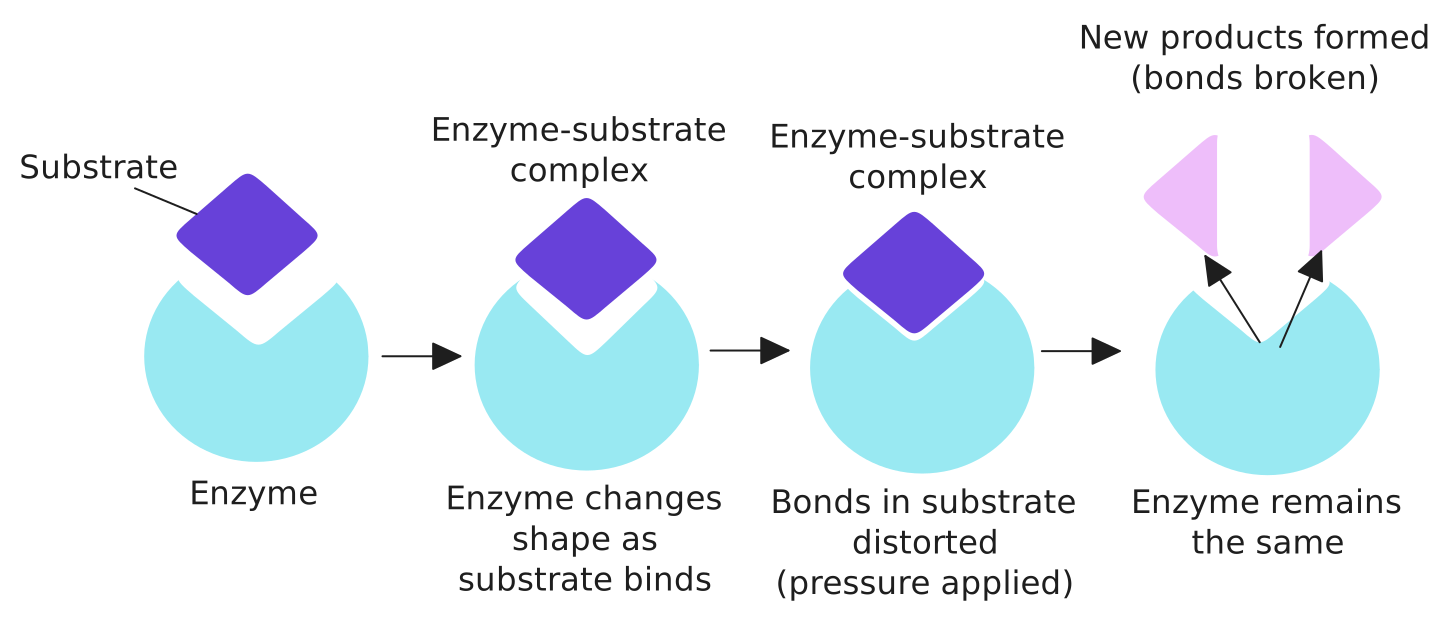
- The substrate is not a perfect fit for the active site to begin with
- As the substrate binds, the enzyme’s active site changes shape slightly. This moulds closely around the substrate, and results in a tighter fit
- This tighter fit puts strain on the bonds within the substrate
- The strained bonds break more easily, which lowers the activation energy
- Products are formed and released, and the active site returns to its original shape.
Tip
Remember, in the induced-fit model the enzyme’s active site changes shape slightly when the substrate binds. If you describe the active site as a fixed, exact fit, you are describing lock and key, not induced fit.
How can two enzymes with different amino acid sequences catalyse the same reaction?
How can two enzymes with different amino acid sequences catalyse the same reaction?
The key idea is that only the active site region has to be the same shape.
Two enzymes can have different amino acid sequences overall, but if those sequences happen to fold into a tertiary structure with the same active site shape, both can bind the same substrate and catalyse the same reaction.
Common exam mistakes
- Say the substrate fits into the active site. In the induced-fit model, the active site moulds itself around the substrate, leading to a tighter fit.
- This is a bit pedantic, but you need to write tertiary structure out in full. Examiners have flagged answers written as “3°”
- The amino acid sequence determines the tertiary structure. So a change in the amino acid sequence (primary structure) can lead to a change in tertiary structure.
Factors Affecting Rate of Reaction
What you need to know (from the AQA specification)
What you need to know (from the AQA specification)
The effects of the following factors on the rate of enzyme-controlled reactions – enzyme concentration, substrate concentration, concentration of competitive and of non-competitive inhibitors, pH and temperature.
Let’s start by defining what rate of reaction means. This can be looked at in two ways:
- how quickly substrate is used up, or
- how quickly product is formed
Tip
Describe enzyme activity using substrate or product, not vague wording. Be specific: the substrate concentration decreased, or the product was formed faster.
Now, let’s look at the factors that affect the rate of reaction:
- Enzyme concentration
- Substrate concentration
- Inhibitors (competitive or non-competitive)
- pH
- Temperature
Enzyme Concentration
A higher enzyme concentration means more active sites available, so more enzyme-substrate complexes can form at any one time, and the rate increases.
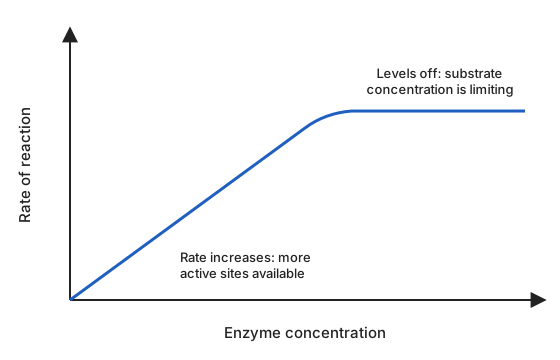
- As enzyme concentration increases, rate increases proportionally, as long as there is plenty of substrate
What do you think happens when the rate levels off?
What do you think happens when the rate levels off?
At this point there is more than enough enzyme, and substrate concentration has become the limiting factor (i.e. there isn’t enough substrate). Adding more enzyme makes no difference because there isn’t enough substrate to fill the active sites already available.
Substrate Concentration
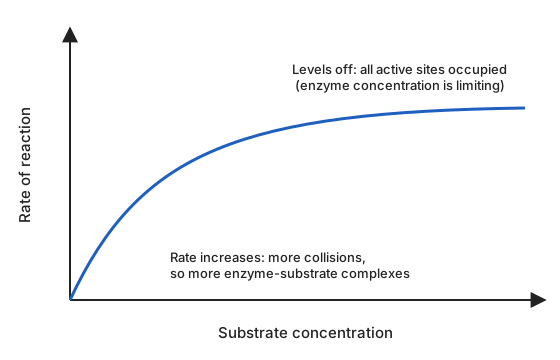
A higher substrate concentration means there will be more successful collisions with active sites, so more enzyme-substrate complexes form and the rate increases.
- As substrate concentration increases, rate increases at first
Why do you think the rate plateaus?
Why do you think the rate plateaus?
- The rate then plateaus because all the active sites are occupied (saturated). The enzymes are working as fast as they can, so adding more substrate cannot increase the rate further
- At this point enzyme concentration is the limiting factor
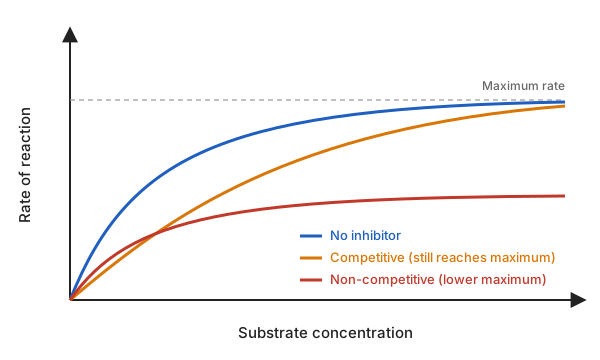
Competitive Inhibitors
A competitive inhibitor has a shape similar to the substrate, so it is complementary to the active site.
- It binds to the active site itself
- While it is bound, the substrate cannot enter, so fewer enzyme-substrate complexes form and the rate falls
- The substrate and inhibitor are effectively competing for the same active sites
This means that…increasing the substrate concentration reduces the effect of the inhibitor. With more substrate molecules around, they are more likely to reach an active site before an inhibitor does. So the maximum rate can still be reached, it just takes a higher substrate concentration to get there.
Non-Competitive Inhibitors
A non-competitive inhibitor binds somewhere other than the active site.
- The inhibitor binds to a site other than the active site (the allosteric site)
- This changes the enzyme’s tertiary structure
- Because the tertiary structure has changed, the active site changes shape
- The substrate is no longer complementary to the active site, so it cannot bind and fewer enzyme-substrate complexes form
This means that…increasing substrate concentration does not overcome a non-competitive inhibitor, because the substrate and inhibitor aren’t competing for the same site. The enzyme has changed shape so cannot bind to the substrate, so the rate of reaction will decrease.
pH
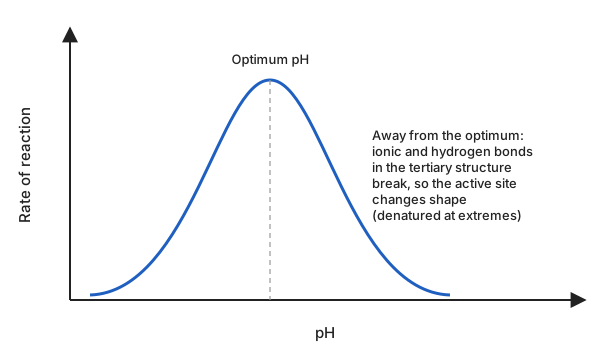
Every enzyme has an optimum pH at which its rate of reaction is highest. Move away from that optimum in either direction and the rate falls.
Why does pH have this effect?
- A change in pH means a change in the concentration of hydrogen ions
- These interfere with the ionic bonds and hydrogen bonds that hold the enzyme’s tertiary structure in place
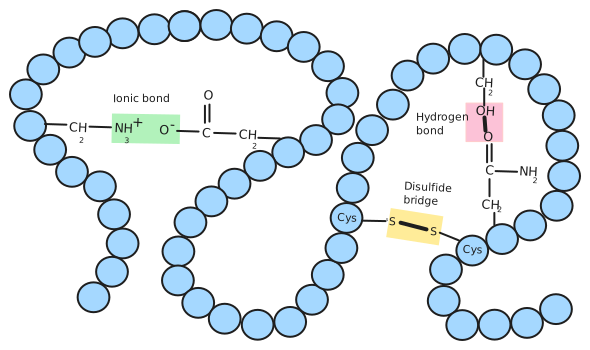
- As those bonds break, the active site changes shape and is no longer complementary to the substrate
- Fewer enzyme-substrate complexes form, so the rate drops. At extreme pH the enzyme becomes denatured (this means the active site changes shape so much that the substrate no longer fits)
Temperature
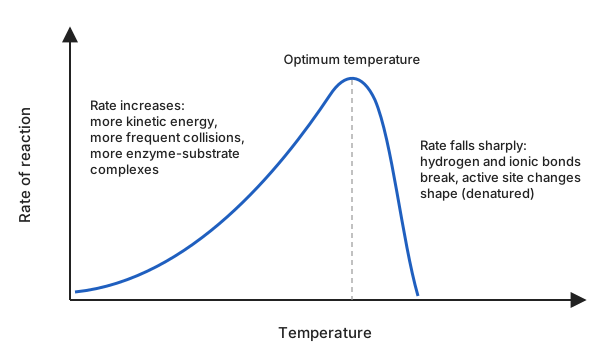
Similarly to pH, every enzyme has an optimum temperature, where the rate of reaction is the highest, but above the optimum the enzyme becomes denatured.
Below the optimum
- Increasing temperature gives molecules more kinetic energy
- Substrate and enzyme molecules move faster, so there are more frequent collisions between substrates and active sites
- More enzyme-substrate complexes form per second, so the rate increases
Above the optimum
- The extra energy makes the enzyme molecule vibrate more
- This vibration breaks the hydrogen bonds and ionic bonds holding the tertiary structure together
- The active site changes shape and is no longer complementary to the substrate
- The enzyme is denatured, and unlike the effect of cooling, this is permanent
Why can a high temperature give a fast rate at first, then a falling rate?
Why can a high temperature give a fast rate at first, then a falling rate?
Denaturation isn’t instant, it happens over time. At a temperature above the optimum, the enzymes that are still intact work quickly at first because of the high kinetic energy. But as time passes, more and more enzyme molecules become denatured, so fewer active sites remain and the rate falls away.
This is why a 60 °C curve can start steeper than a 50 °C curve but end up lower.
Common exam mistake
Enzymes are denatured, not “killed”. They are proteins, not living things. Similarly, avoid saying the active site is “destroyed”, it has changed shape so it no longer fits the substrate.
Required Practical 1
What you need to know (from the AQA specification)
What you need to know (from the AQA specification)
Required practical 1: Investigation into the effect of a named variable on the rate of an enzyme-controlled reaction.
Students could:
- identify the variables that must be controlled in their investigation into rate of reaction
- calculate the uncertainty of their measurements of the rate of reaction
- select an appropriate format for the graphical presentation of the results of their investigation into the rate of enzyme-controlled reactions
- use a tangent to find the initial rate of an enzyme-controlled reaction.
The variable you investigate (the independent variable) is usually temperature, pH, substrate concentration or enzyme concentration, i.e. one of the factors we explored above that can change the rate of reaction
Measuring the rate
These are common scenarios:
- Catalase + hydrogen peroxide: collect the oxygen gas produced and measure its volume over time
- How it works: catalase breaks hydrogen peroxide down into water and oxygen. The faster the enzyme (catalase) works, the more oxygen is collected each minute (e.g. in a gas syringe or an upturned measuring cylinder)
- Amylase + starch: sample at intervals and test with iodine solution, timing how long until it no longer goes blue-black (all starch broken down)
- How it works: amylase hydrolyses starch into maltose, and iodine only turns blue-black when starch is present, so once it all turns orange-brown, all the starch has been broken down
- Trypsin + milk: time how long the cloudy milk takes to turn clear as the protein is hydrolysed
- How it works: milk is cloudy because of the protein casein in milk. The enzyme trypsin hydrolyses it into smaller soluble polypeptides, so the milk goes clear. The faster it clears, the higher the rate of reaction.
In exams, you’ll usually be given an unfamiliar enzyme and reaction (e.g. polyphenol oxidase browning apple tissue, or lactase). Focus on the principles below: how rate is measured, which variables to control, and what makes a valid control.
Calculating rate
There are two methods, depending on what you measured.
Method 1: 1 ÷ time taken (when you only know how long the reaction took)
- Rate = 1 ÷ time taken
- Example: at 30 °C, the starch is all broken down after 40 s (we know this because the iodine changes colour from blue-black to orange-brown)
- So rate = 1 ÷ 40 = 0.025 s⁻¹
- If instead we measured it at 40 °C, we find it only takes 25 s
- So rate = 1 ÷ 25 = 0.04 s⁻¹. A shorter time means a faster rate of reaction.
Method 2: the gradient of a graph (when you measured the amount of product or substrate over time)
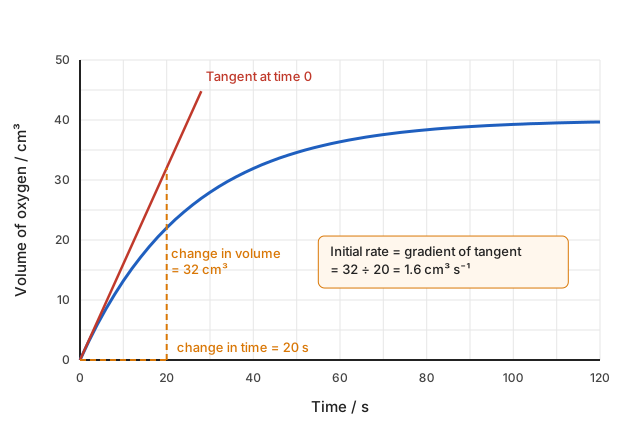
- Use the initial rate: the rate at the very start of the reaction, where the curve is steepest. Why? As the reaction goes on, substrate is used up, so the rate slows down. If you measured later, you’d be seeing the effect of the substrate running out, not the effect of the variable you’re testing.
- To find the initial rate, draw a tangent:
- Draw a straight line (a tangent) that just touches the curve at time 0, following the steepest part at the start
- Pick a point on the tangent and draw a large triangle down to the time axis (the bigger the triangle, the more accurate your reading)
- Initial rate = gradient of the tangent = change in y ÷ change in x, with units (e.g. cm³ s⁻¹)
- Read the values off the tangent, not the curve: the curve has already started to slow down
Controlling the other variables
Whichever variable you are testing, the others must be kept constant:
- Keep temperature constant with a water bath
- Keep pH constant with a buffer solution
- Keep volumes and concentrations of enzyme and substrate the same
- Leave time for solutions to reach the set temperature before mixing
Tip
For a negative control, use a boiled (denatured) enzyme, with everything else identical. This shows that any change you observe is genuinely caused by enzyme activity.
How this topic is tested
This analysis is based on past paper data from 2017 to 2025. It is intended for interest only and is not predictive of what will appear in future papers.
- Tested in 8 of 9 years (2017–2025): 26 question parts worth 59 marks.
- 10th most-examined topic overall by marks, 1st in Unit 1.
Marks by year
Most-tested spec points
- Factors Affecting Rate of Reaction: tested in 12 parts (31 marks)
- Induced-Fit Model: tested in 6 parts (16 marks)
- Active Site & Enzyme Specificity: tested in 6 parts (14 marks)
- Activation Energy: tested in 5 parts (11 marks)
- Required Practical 1: tested in 2 parts (4 marks)
Also links to: Levels of Protein Structure, ATP Hydrolysis.
Maths and practical skills
- Percentages, ratios and fractions (MS 0.3): e.g. 2025 P1 Q3.2
- Units and standard form (MS 0.2): e.g. 2018 P1 Q4.2
- Averages (MS 1.2): e.g. 2024 P1 Q7.1
- Moving between graphs, numbers and equations (MS 3.1): e.g. 2018 P1 Q4.3
Tips from examiner reports
What students commonly get wrong
- Explain how the enzyme lowers activation energyWhen explaining how an enzyme speeds up a reaction, don't stop at "lowers the activation energy". Say the active site changes shape around the substrate (not just "the tertiary structure changes"), which bends or strains the bonds in the substrate so they break more easily. 2025 P1 Q2.4 · 2018 P1 Q4.1
- Temperature doesn't lower the activation energyWatch out: a higher temperature gives molecules more kinetic energy, so more collisions have enough energy to reach the activation energy. It doesn't lower the activation energy; only enzymes do that. 2024 P1 Q7.3
- Denaturation: name the right bondsWhen explaining denaturation, say the hydrogen and ionic bonds between R groups in the tertiary structure break. Don't just say "bonds break", and don't say peptide bonds break: they join the amino acids in the primary structure, which stays the same. 2017 P1 Q4.2
- Inhibitors: say exactly where they bindA competitive inhibitor binds to the active site, so say "active site", not just "a binding site". A non-competitive inhibitor binds to a site other than the active site, not "at the side of the active site". 2025 P1 Q3.3 · 2019 P1 Q1.1
Exam Question Practice
Formation of an enzyme-substrate complex increases the rate of reaction.
Explain how.
(2 marks)
Hint
What does an enzyme lower? What does binding to the active site do to the bonds in the substrate?
Mark Scheme
- Reduces activation energy (1 mark)
- Due to bending bonds
OR Without enzyme, very few substrates have sufficient energy for reaction (1 mark)
Comments from mark scheme
Tips from examiner reports
Tips from the examiner report
- Go beyond ‘lowers the activation energy’: explain that the enzyme bends (puts strain on) bonds in the substrate
- Don’t describe how the enzyme-substrate complex forms: the question asks why the rate increases
Describe the induced-fit model of enzyme action and how an enzyme acts as a catalyst.
(3 marks)
Hint
What happens to the active site when the substrate binds? How does that make the reaction easier?
Mark Scheme
- Substrate binds to the active site/enzyme
OR Enzyme-substrate complex forms (1 mark) - Active site changes shape (slightly) so it is complementary to substrate
OR Active site changes shape (slightly) so distorting/breaking/forming bonds in the substrate (1 mark) - Reduces activation energy (1 mark)
Comments from mark scheme
1. Accept for ‘binds’, fits
In 1914, a group of scientists investigated enzyme action.
After studying their results, the scientists reached the following conclusions:
An enzyme is a substance which causes a reaction to occur at “ordinary” temperatures by being present, but not by its ability to combine with another substance. An enzyme changes the rate of a reaction without itself being changed by that reaction.
Our current understanding of enzyme action is based on the induced-fit model.
Describe similarities and differences between the conclusions from 1914 and our current understanding of enzyme action.
Similarities = ________
Differences = ________
(4 marks)
Hint
Compare the 1914 conclusions with the induced-fit model. What do both agree on about what enzymes do? What does the modern model say about the substrate and the active site that the 1914 scientists denied?
Mark Scheme
Similarities
- Enzymes are not changed/can be reused (in reactions) (1 mark)
- Increase rate of reaction at low/ordinary/normal/room temperature
OR (Causes/allows) reaction(s) at low/ordinary/normal/room temperature
OR (Both) lower activation energy (1 mark)
Differences
- Active site changes shape (in induced fit model) (1 mark)
- Enzyme-substrate complex forms
OR Enzyme/active site and substrate bind/touch (1 mark)
Comments from mark scheme
4. Accept ‘E-S complex’
4. Ignore ‘ESC’
Tips from examiner reports
Tips from the examiner report
- Say the active site changes shape when the substrate binds (induced fit); “the tertiary structure changes” is not precise enough
- Be specific about similarities: “both cause reactions” is too vague. Say both are unchanged by the reaction and allow reactions at ordinary temperatures
- Show understanding in your own words rather than copying phrases from the passage
- Use the word “substrate”, not “substance”
What earned marks
- Similarities were answered much better than differences
- Stating that an enzyme-substrate complex forms earned a difference mark
Describe how a non-competitive inhibitor can reduce the rate of an enzyme-controlled reaction.
(3 marks)
Hint
Where does a non-competitive inhibitor bind? What does that do to the active site, and so to the substrate binding?
Mark Scheme
- Attaches to the enzyme at a site other than the active site (1 mark)
- Changes (shape of) the active site
OR Changes tertiary structure (of enzyme) (1 mark) - (So active site and substrate) no longer complementary so less/no substrate can fit/bind (1 mark)
Comments from mark scheme
1. Accept ‘attaches to allosteric/inhibitor site’
3. Accept ‘no longer complementary so less/no enzyme-substrate complexes form’
3. Accept abbreviations of enzyme-substrate complex.
Tips from examiner reports
Tips from the examiner report
- The inhibitor attaches at a site other than the active site; ‘at the side of the active site’ isn’t credited
- Say what that does: the active site changes shape, so it is no longer complementary to the substrate and fewer enzyme-substrate complexes form
- Use ‘complementary’ to describe the shapes of the active site and substrate; don’t just use the phrase ‘complementary substrate’
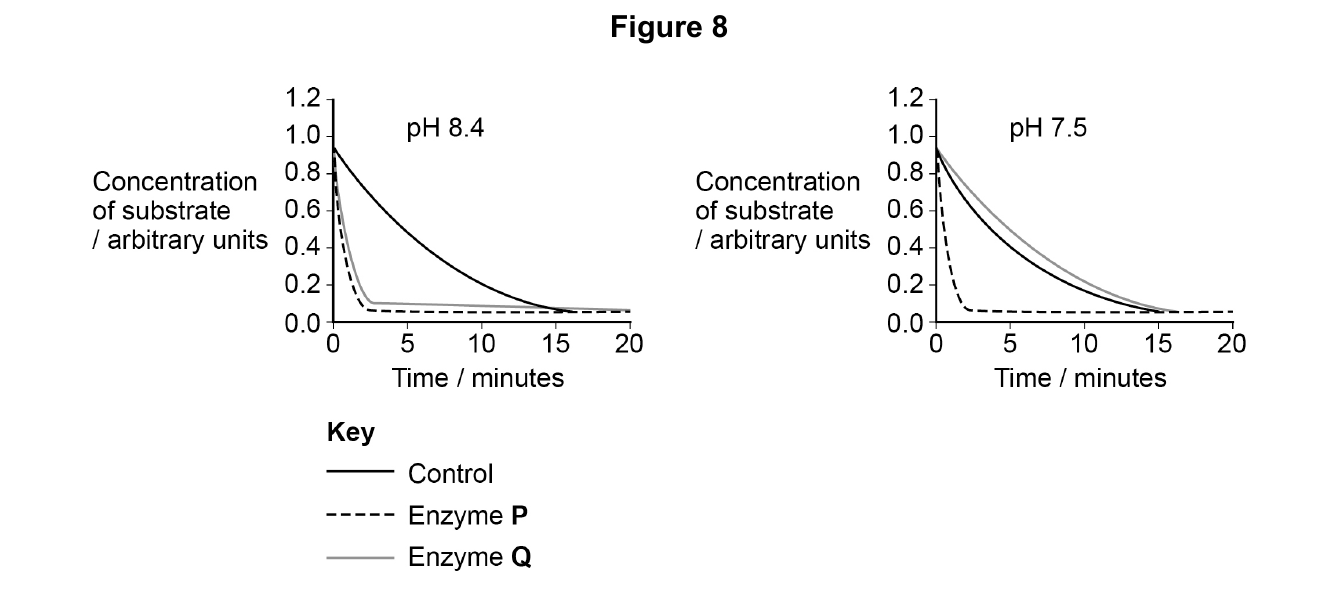
Two enzymes, P and Q, are proteins with quaternary structure which catalyse the same reaction, but they have different amino acid sequences.
Scientists investigated the effect of pH 8.4 and pH 7.5 on the activity of enzymes P and Q.
Figure 8 shows their results.
Describe what the scientists should place in the control tubes in this investigation.
(3 marks)
Hint
A control should show what happens without active enzyme. What else in the tube must stay the same?
Mark Scheme
- Same volume of (each) buffer/pH solution (1 mark)
- Same concentration/mass of substrate (at start) (1 mark)
- Same concentration/mass of denatured enzyme (1 mark)
If no marks gained, accept for 1 mark,
Buffer and substrate and denatured enzyme
OR Buffer and substrate and no enzyme
OR Buffer and substrate and water
Comments from mark scheme
Ignore temperature
Ignore amount for volume, concentration OR mass
Accept pH solution for buffer
3. Accept description of denatured, eg boiled
Tips from examiner reports
Tips from the examiner report
- The control has everything except active enzyme: the same volume of each buffer, the same concentration of substrate, and the same concentration of denatured (boiled) enzyme
- Say “buffer”, not “the same pH”
- Don’t change the independent variable: no different enzyme, pH, substrate or inhibitor
1. Accept ‘reduces Ea’.
2. Accept ‘Due to stress/pressure/tension on bonds’ OR ‘Due to weakening bonds’.
2. Ignore references to ‘breaking bonds’.