Carbohydrates are molecules made of carbon, hydrogen and oxygen, but you probably know them as glucose or sugar. A few of their important functions:
- A source of energy (i.e. can be used now): Glucose is the main respiratory substrate (it’s broken down in respiration to make ATP)
- A store of energy (i.e. can be used as a source at a later time): Starch in plants, glycogen in animals
- Structural support: Cellulose makes up plant cell walls
Carbohydrates are a great example of a previous topic we looked at, monomers and polymers, whereby many small sugar units (monomers) join together to make much larger molecules (polymers). Carbohydrates used for storage (starch and glycogen) are usually in the polymer form, whereas simple sugars (e.g. glucose) used for instant energy are usually in the form of monomers.
Monosaccharides
What you need to know (from the AQA specification)
What you need to know (from the AQA specification)
Monosaccharides are the monomers from which larger carbohydrates are made. Glucose, galactose and fructose are common monosaccharides.
Monosaccharides are the single sugar units (monomers) that all larger carbohydrates are built from. The three you need to know are:
- Glucose
- Galactose
- Fructose
All three have the same chemical formula, C₆H₁₂O₆, but the difference between them is in how their atoms are arranged.
Molasses contains sucrose, glucose and fructose. How many different monosaccharides does it contain?
Molasses contains sucrose, glucose and fructose. How many different monosaccharides does it contain?
Two: glucose and fructose. Sucrose is a disaccharide (made of glucose and fructose joined together), so it doesn’t count as a monosaccharide.
α-glucose and β-glucose
What you need to know (from the AQA specification)
What you need to know (from the AQA specification)
Glucose has two isomers, α-glucose and β-glucose, with structures:
Glucose comes in two forms (isomers): α-glucose and β-glucose. They’re almost identical. The only difference is the position of the OH group on carbon 1:
- α-glucose: the OH on carbon 1 is below the ring
- β-glucose: the OH on carbon 1 is above the ring
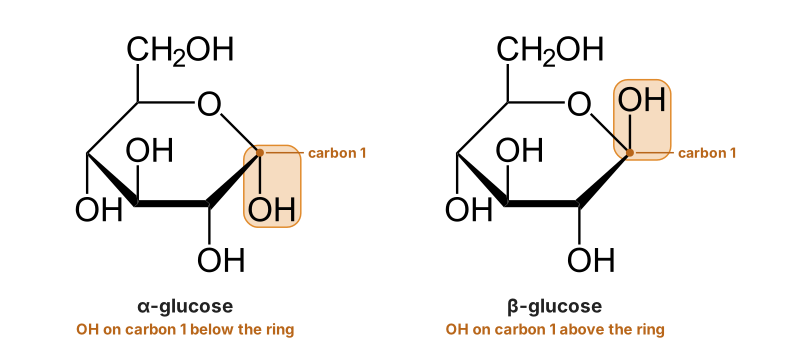
Chemical structures: NEUROtiker, Wikimedia Commons (public domain).
Tip
A way to remember it: ABBA, Alpha Below, Beta Above.
Although this seems like a small structural difference, it actually matters in terms of how each of these monomers and their respective polymers function. As you’ll see below, polymers of α-glucose (starch and glycogen) are energy stores, but polymers of β-glucose (cellulose) are strong structural fibres.
Disaccharides & Glycosidic Bonds
What you need to know (from the AQA specification)
What you need to know (from the AQA specification)
A condensation reaction between two monosaccharides forms a glycosidic bond.
Disaccharides are formed by the condensation of two monosaccharides:
- maltose is a disaccharide formed by condensation of two glucose molecules
- sucrose is a disaccharide formed by condensation of a glucose molecule and a fructose molecule
- lactose is a disaccharide formed by condensation of a glucose molecule and a galactose molecule.
When two monosaccharides join, they form a disaccharide. Remember back to condensation reactions: a molecule of water is removed, and a glycosidic bond forms between the two sugars. It’s important to note that a disaccharide isn’t a polymer, as it’s only 2 monomers joined together. Polymer means many (i.e. think of longer chains).
The reverse reaction, adding water to break the glycosidic bond, is hydrolysis. This is what happens when carbohydrates are digested.
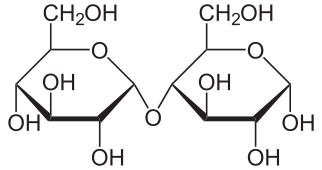
Maltose: two α-glucose molecules joined by a 1-4 glycosidic bond (the O between them, linking carbon 1 of one glucose to carbon 4 of the other). Image: NEUROtiker, Wikimedia Commons (public domain).
| Disaccharide | Made from |
|---|---|
| Maltose | glucose + glucose |
| Sucrose | glucose + fructose |
| Lactose | glucose + galactose |
Two galactose molecules (C₆H₁₂O₆) join to form a disaccharide. What is its chemical formula?
Two galactose molecules (C₆H₁₂O₆) join to form a disaccharide. What is its chemical formula?
C₁₂H₂₂O₁₁
Add the two formulas together (C₁₂H₂₄O₁₂), then take away one water molecule (H₂O) for the condensation reaction.
Polysaccharides
What you need to know (from the AQA specification)
What you need to know (from the AQA specification)
Polysaccharides are formed by the condensation of many glucose units.
- Glycogen and starch are formed by the condensation of α-glucose.
- Cellulose is formed by the condensation of β-glucose.
The basic structure and functions of glycogen, starch and cellulose. The relationship of structure to function of these substances in animal cells and plant cells.
When many glucose molecules join by condensation reactions, they form a polysaccharide. You need to know three, and how their structure affects their function:
- Starch: energy store in plants (made of α-glucose). You might have heard of this in terms of starchy food, like bread, wheat, etc.
- Glycogen: energy store in animals (made of α-glucose). You might have heard of glycogen stores in humans (e.g. glycogen loading before a marathon).
- Cellulose: structural, in plant cell walls (made of β-glucose)
Starch
Starch is a mixture of two polysaccharides of α-glucose:
- Amylose: a long, unbranched chain (1-4 glycosidic bonds) that coils into a helix
- Amylopectin: a long chain with branches (1-4 and 1-6 glycosidic bonds)
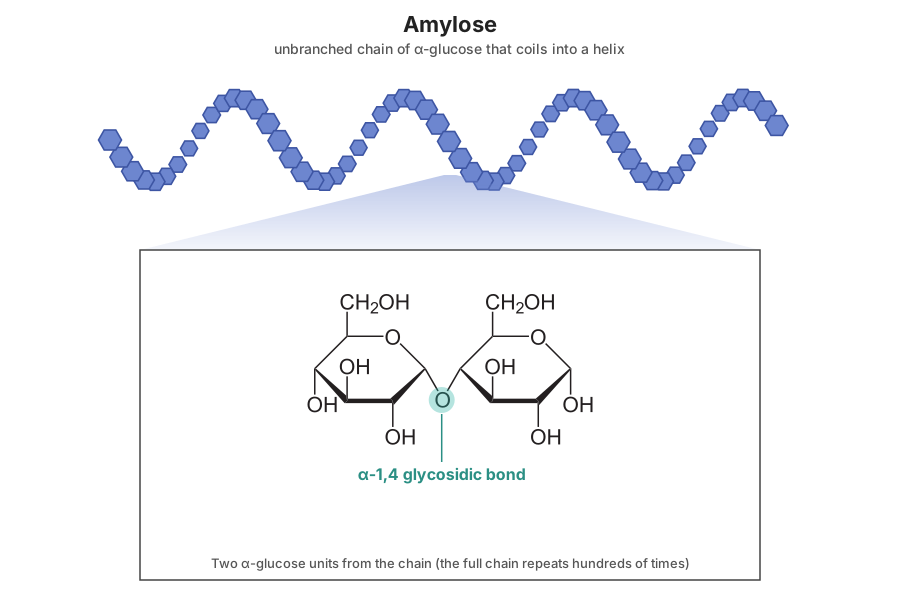
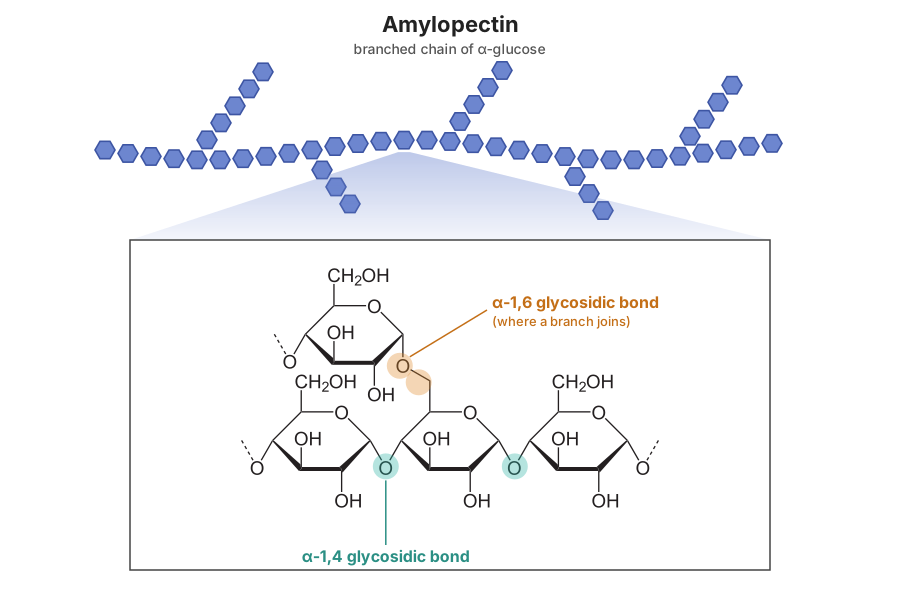
Chemical structures: NEUROtiker, Wikimedia Commons (public domain).
Sometimes it can feel like you’re learning structural facts that don’t mean anything. Try to approach it like this: this is its structure, so how does this affect starch’s function as an energy store?
How is starch suited to being an energy store?
- Insoluble: It doesn’t affect the water potential of the cell, which is really important to ensure water doesn’t move in by osmosis
Why is starch insoluble?
Why is starch insoluble?
- It’s insoluble due to its large structure (too big to be carried around in solution)
- Many of the OH groups are used in the glycosidic bonds joining the glucose molecules together, so there are fewer left to form hydrogen bonds with water
- Many of the remaining OH groups are tucked inside the coiled (helical) structure, so they can’t bond with water either
- Helical (coiled): compact, so lots can be stored in a small space inside the plant cell. The coiling also helps make it insoluble (see above)
- Branched (amylopectin): Has many branched ends for enzymes to work on, so glucose can be released quickly
Glycogen
Glycogen is the energy store in animals (mainly in liver and muscle cells). Like starch, it’s made of α-glucose, but it’s more branched than amylopectin.
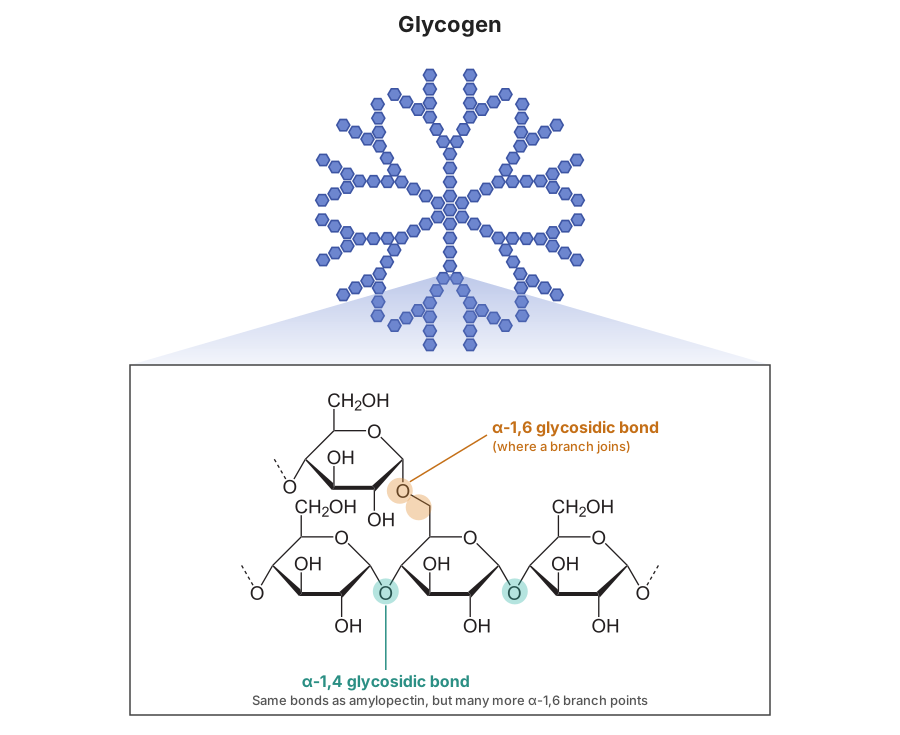
How is glycogen suited to being an energy store? (See if you can work it out yourself first)
How is glycogen suited to being an energy store? (See if you can work it out yourself first)
- Highly branched: lots of ends, so it can be hydrolysed rapidly to release glucose (animals are more active than plants, so they need glucose quickly)
- Compact: lots can be stored in a small space
- Insoluble: doesn’t affect the water potential of the cell
How does glycogen act as a source of energy?
How does glycogen act as a source of energy?
Glycogen is hydrolysed to glucose, and the glucose is then used in respiration to release energy (making ATP).
Note: breaking the glycosidic bonds doesn’t release the energy itself. The energy comes from respiring the glucose.
Cellulose
Cellulose is made of β-glucose. Because the OH on carbon 1 is above the ring in β-glucose, every other β-glucose molecule is flipped upside down (rotated 180°) so the glycosidic bonds can form.
This gives cellulose a very different structure from starch and glycogen:
- Straight, unbranched chains of β-glucose
- Many chains lie side by side, held together by hydrogen bonds
- These chains group together to form microfibrils, which group into fibrils
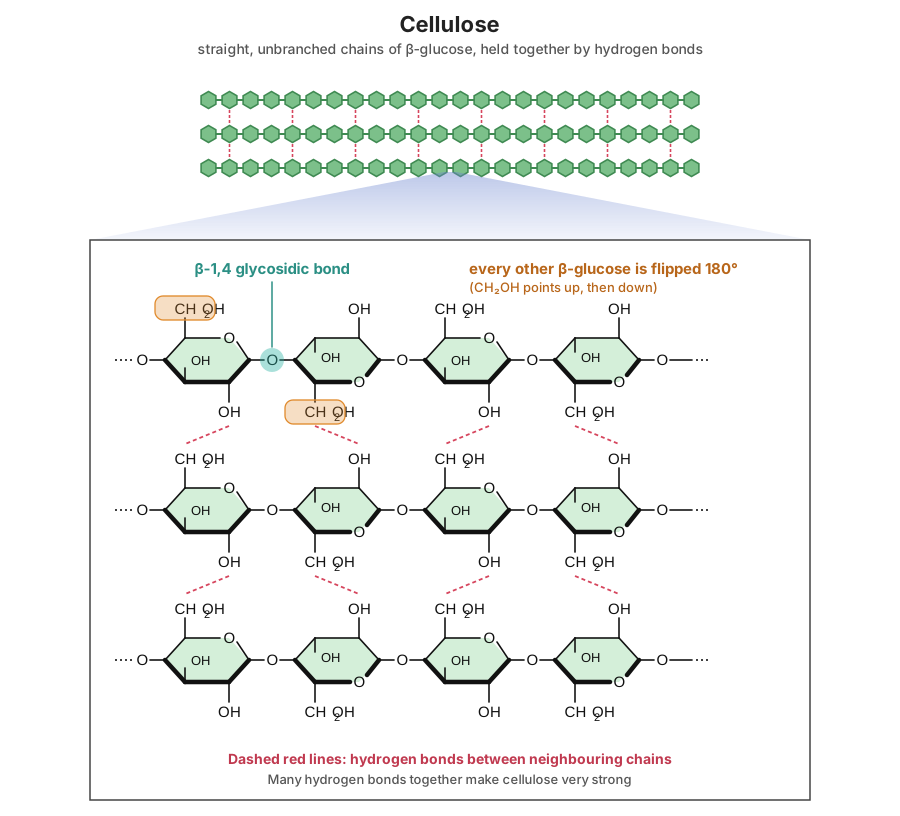
How is cellulose suited to providing structural support?
- Many hydrogen bonds between chains give microfibrils huge strength
- This strength lets the cell wall resist the pressure when water enters the cell, so the cell becomes turgid and doesn’t burst.
Why can't cellulose be used as an energy store like starch?
Why can't cellulose be used as an energy store like starch?
Cellulose is made of β-glucose, so its glycosidic bonds are different from starch’s. Most animals don’t have the enzymes to hydrolyse these bonds, so it can’t be broken down easily to release glucose. Its straight chains and hydrogen bonds make it ideal for strength instead.
Comparing the three polysaccharides
| Starch | Glycogen | Cellulose | |
|---|---|---|---|
| Monomer | α-glucose | α-glucose | β-glucose |
| Found in | plants | animals | plant cell walls |
| Shape | helical (amylose) and branched (amylopectin) | highly branched | straight, unbranched chains |
| Bonds between chains | none | none | hydrogen bonds, forming microfibrils |
| Function | energy store | energy store | structure (strength) |
Tip
When asked to compare two polysaccharides, write each point as a direct comparison, e.g. “starch is made of α-glucose, whereas cellulose is made of β-glucose”.
Biochemical Tests for Carbohydrates
What you need to know (from the AQA specification)
What you need to know (from the AQA specification)
Biochemical tests using Benedict’s solution for reducing sugars and non-reducing sugars and iodine/potassium iodide for starch.
Students could use, and interpret the results of, qualitative tests for reducing sugars, non-reducing sugars and starch.
Reducing sugars (Benedict’s test)
Reducing sugars include all monosaccharides (glucose, fructose, galactose) and some disaccharides (maltose and lactose).
What does 'reducing' mean?
What does 'reducing' mean?
A reducing sugar can donate electrons to another molecule (reducing it). Benedict’s solution contains blue copper(II) ions. A reducing sugar reduces them to copper(I) oxide, which forms the brick-red precipitate.
(You don’t need to learn the chemistry for the exam, but it explains why the colour changes.)
- Add Benedict’s solution to the sample
- Heat it in a boiling water bath for a few minutes
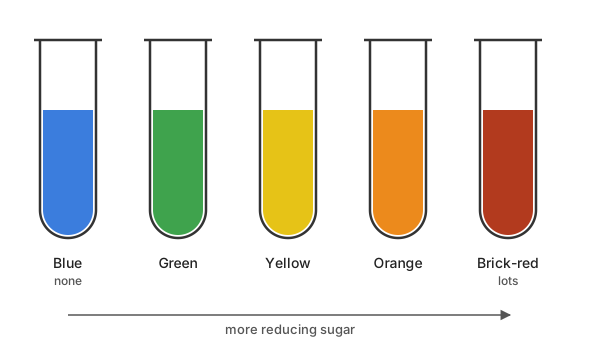
- If a reducing sugar is present, the colour changes from blue to green, yellow, orange or brick-red (a coloured precipitate forms)
The more reducing sugar there is, the further the colour moves towards brick-red.
Tip
Always say you heat the sample with Benedict’s. Saying “use a water bath” without saying it’s heated (or boiling) misses the mark.
Non-reducing sugars
Sucrose is a non-reducing sugar, so it won’t change the colour of Benedict’s solution on its own. To test for it, you first have to break it down into reducing sugars:
- Do the Benedict’s test first. It stays blue (negative), so there’s no reducing sugar
- Boil a new sample with dilute hydrochloric acid. This hydrolyses the glycosidic bond, breaking sucrose into glucose and fructose (both reducing sugars)
- Neutralise with an alkali (e.g. sodium hydrogencarbonate), because Benedict’s doesn’t work in acidic conditions
- Heat with Benedict’s again. If it now turns brick-red, a non-reducing sugar was present
Molasses contains sucrose, glucose and fructose. What result would you expect from a Benedict's test for reducing sugars, and why?
Molasses contains sucrose, glucose and fructose. What result would you expect from a Benedict's test for reducing sugars, and why?
It would turn brick-red, because glucose and fructose are reducing sugars.
The sucrose (a non-reducing sugar) isn’t detected, but that doesn’t stop the colour change: the glucose and fructose already give a positive result.
Starch (iodine test)
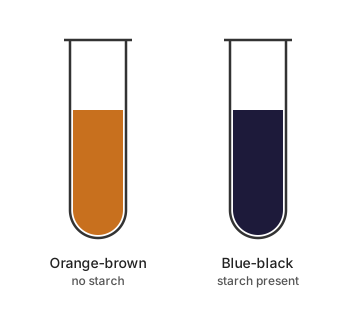
- Add iodine dissolved in potassium iodide solution to the sample
- If starch is present, the colour changes from orange-brown to blue-black
How this topic is tested
This analysis is based on past paper data from 2017 to 2025. It is intended for interest only and is not predictive of what will appear in future papers.
- Tested in 8 of 9 years (2017–2025): 13 question parts worth 34 marks.
- 31st most-examined topic overall by marks, 2nd in Unit 1.
Marks by year
Most-tested spec points
- Polysaccharides: Structure & Function: tested in 6 parts (17 marks)
- Disaccharides & Glycosidic Bonds: tested in 4 parts (10 marks)
- Glucose Isomers: α and β: tested in 2 parts (9 marks)
- Biochemical Tests for Carbohydrates: tested in 2 parts (8 marks)
- Monosaccharides: tested in 1 part (1 marks)
Also links to: Biological Reactions, Biuret Test for Proteins, Emulsion Test for Lipids.
Maths and practical skills
- Percentages, ratios and fractions (MS 0.3): e.g. 2024 P1 Q4.3
Tips from examiner reports
What students commonly get wrong
- Cellulose: microfibrils and flipped monomersWatch out: cellulose is made of microfibrils, not "myofibrils" (those are in muscle). And it's alternate monomers (β-glucose) that are flipped: say "monomer" or "β-glucose", not just "molecule". 2022 P1 Q9.2 · 2023 P1 Q2.1
- Mono, di or poly: maltose is a disaccharideWatch out: maltose is a disaccharide (two glucose molecules), not a monosaccharide or a polysaccharide, and glucose is a monosaccharide. A disaccharide is not a polymer: it's only two monomers. 2023 P3 Q2.3 · 2019 P1 Q10.3
- Glycogen: the animal store, released by hydrolysisWatch out: animals store glucose as glycogen, not starch. When glucose is needed, say glycogen is hydrolysed to glucose, not just "converted" to glucose. 2023 P2 Q10.3 · 2024 P2 Q2.3
- Benedict's test: say heat, and explain the resultWatch out: write heat with Benedict's; "use a water bath" on its own doesn't say it's heated. To explain a positive result, name the reducing sugars present (e.g. glucose, fructose). Sucrose is non-reducing, so it isn't what's detected. 2024 P1 Q4.2
- Non-reducing sugars: show a negative test firstWatch out: to show a non-reducing sugar (e.g. sucrose) is present, first do a normal Benedict's test and say it stays blue (no reducing sugar there). Then boil with acid to hydrolyse it into reducing sugars, neutralise, and heat with Benedict's again. Without the negative first test, a red result could just come from reducing sugars that were already there. 2019 P1 Q10.2
Exam Question Practice
Alpha-gal is a disaccharide found in red meat.
Alpha-gal is made of two galactose molecules. Galactose has the chemical formula C₆H₁₂O₆
Give the chemical formula for the disaccharide, alpha-gal, and describe how it is formed from two galactose molecules.
Formula = ________
Description = ________
(2 marks)
Hint
Add the two galactose formulas together. Which small molecule is removed when they join, and what is that type of reaction called?
Mark Scheme
- C₁₂H₂₂O₁₁ (1 mark)
- Condensation reaction
OR With a glycosidic bond (1 mark)
Comments from mark scheme
Tips from examiner reports
Tips from the examiner report
- Show the water lost in the formula: two C₆H₁₂O₆ minus H₂O gives C₁₂H₂₂O₁₁
- The two monosaccharides join in a condensation reaction, forming a glycosidic bond
Compare and contrast the structure of starch and the structure of cellulose.
(6 marks)
Hint
Compare the monomers, bonds, shape and branching. What do they have in common?
Mark Scheme
Max 6 marks
- Both polysaccharides
OR Both are glucose polymers
OR Both are made of glucose monomers (1 mark) - Both contain glycosidic bonds (between monomers) (1 mark)
- Both contain carbon, hydrogen and oxygen/C, H and O (1 mark)
- Starch has α-glucose and cellulose has β-glucose (1 mark)
- Starch (molecule) is helical/coiled and cellulose (molecule) is straight (1 mark)
- Starch (molecule) is branched and cellulose is not/unbranched (1 mark)
- Cellulose has (micro/macro) fibrils and starch does not (1 mark)
Comments from mark scheme
Must include 1, 2 OR 3 to achieve 6 marks
All statements must be clearly comparative or linked by the candidate, not inferred from separate statements
Additional mark point
8. Starch has 1–6 glycosidic bonds and cellulose does not OR Starch contains two types of molecule and cellulose contains one type of molecule OR Starch is amylose and amylopectin and cellulose is one type of molecule
Tips from examiner reports
Tips from the examiner report
- Write direct comparisons (“starch is α-glucose but cellulose is β-glucose”); separate lists of features score nothing
- Include a similarity (both polysaccharides of glucose, both have glycosidic bonds) to reach full marks
- Cellulose forms microfibrils, not myofibrils (those are in muscle)
- Stick to structure; don’t explain functions
Chitin is a polysaccharide. The chitin monomer is a β-glucose molecule with one OH group replaced by an NHCOCH₃ group. NHCOCH₃ can be represented by N(Ac).
Figure 1 shows the monomer that forms chitin and the chitin polymer.
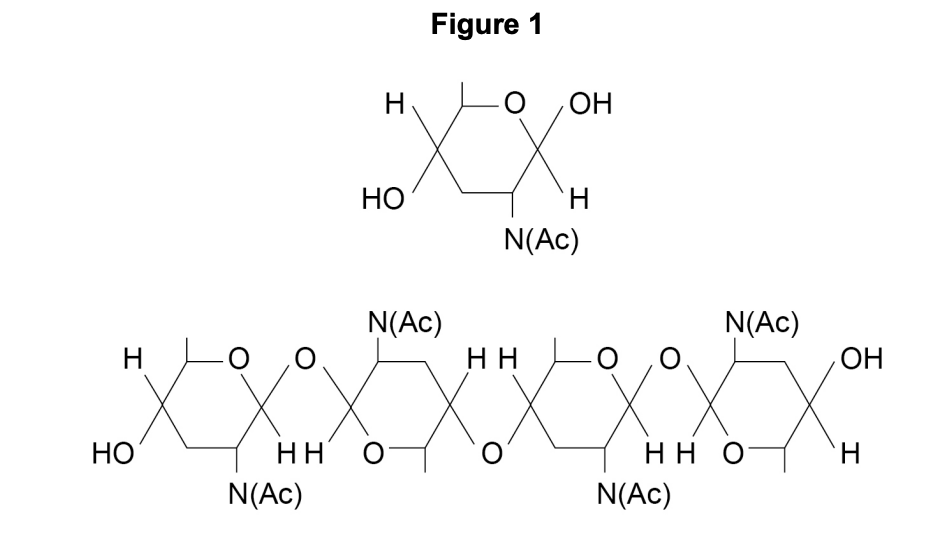
Chitin has a similar structure to cellulose.
Use Figure 1 to describe three ways the structure of chitin is similar to the structure of cellulose.
1 = ________
2 = ________
3 = ________
(3 marks)
Hint
Focus on structural features shown in the diagram. What type of glucose? What type of bond? What is the arrangement of monomers?
Mark Scheme
Max 3 marks
- (Alternate) monomers/glucoses are flipped/upside down/rotated (by 180°) (1 mark)
- (Joined by) glycosidic bonds (1 mark)
- (Forms) straight/linear/unbranched (chains/ molecules) (1 mark)
Comments from mark scheme
Ignore they are both polysaccharides
4. Accept as an additional mark point, ‘contains 1-4 linkages/bonds’
4. Reject if reference made to 1-6
5. Accept as an additional mark point, ‘have β glucose’
Ignore both contain C, H and O
Tips from examiner reports
Tips from the examiner report
- Use features shown in Figure 1: β-glucose, glycosidic (1–4) bonds, unbranched chains, and alternate monomers flipped
- Say “monomer”, not “molecule”
- Don’t mention 1–6 bonds (that’s starch), which cancels the 1–4 mark
- Hydrogen bonds between chains aren’t shown in the figure, so don’t include them
A student used the biochemical test for reducing sugars on a clear sample of molasses.
Describe the biochemical test for a reducing sugar.
Explain the result expected from the test on the sample of molasses.
Description of biochemical test = ________
Explanation of expected result = ________
(3 marks)
Hint
What reagent is used? What conditions are needed? What colour indicates a positive result? Which sugars in the sample would actually react?
Mark Scheme
- Heat with Benedict’s (solution/reagent) (1 mark)
- Red (colour/precipitate) (1 mark)
- (Because) glucose/fructose is/are reducing sugars
OR (Because) glucose/fructose is/are detected (1 mark)
Comments from mark scheme
1. Ignore water bath unqualified
1. Ignore warm
1. Accept Fehling’s for Benedict’s
1. Reject if heat with acid
2. Accept green OR orange OR brown OR yellow
2. Ignore emulsion
3. Reject if sucrose is detected
Tips from examiner reports
Tips from the examiner report
- Say “heat” with Benedict’s reagent; “use a water bath” on its own doesn’t show it is heated
- Don’t describe the non-reducing sugar test (e.g. boiling with acid)
- Explain the positive result: glucose and fructose are reducing sugars. Sucrose is a non-reducing sugar, so it isn’t detected
- Give one expected result (e.g. red); don’t list every possible colour
- Sucrose being present doesn’t stop the colour change, because glucose and fructose are still there
What earned marks
- Most students described heating with Benedict’s reagent and a red result
Describe the biochemical tests you would use to confirm the presence of lipid, non-reducing sugar and amylase in a sample.
(5 marks)
Hint
Which test identifies each type of substance? For the non-reducing sugar, what must you do before the second Benedict’s test? How could you show the amylase is active?
Mark Scheme
Max 5 marks
Lipid
- Add ethanol/alcohol then add water and shake/mix
OR Add ethanol/alcohol and shake/mix then pour into/add water (1 mark) - White/milky emulsion
OR emulsion test turns white/milky (1 mark)
Non-reducing sugar
- Do Benedict’s test and stays blue/negative (1 mark)
- Boil with acid then neutralise with alkali (1 mark)
- Heat with Benedict’s and becomes red/orange (precipitate) (1 mark)
Amylase
- Add biuret (reagent) and becomes purple/violet/mauve/lilac (1 mark)
- Add starch, (leave for a time), test for reducing sugar/absence of starch (1 mark)
Comments from mark scheme
4 max if marks gained from only 2 substance tests.
1. Reject heating emulsion test.
1. Accept ‘Add Sudan III and mix’.
2. Ignore cloudy.
2. Reject precipitate.
2. Accept (for Sudan III) top (layer) red.
3. Ignore details of method for Benedict’s test for this mp.
4. Accept named examples of acids/alkalis.
5. Do not credit mp5 if no attempt at mp4.
5. For ‘heat’ ignore ‘warm’/’heat gently’/’put in a water bath’ but accept stated temperatures ≥60°C.
5. Heat must be stated again, do not accept using residual heat from mp4.
5. Accept ‘do the Benedict’s test’ if full correct method given elsewhere.
5. Accept ‘sodium carbonate, sodium citrate and copper sulfate solution’ for Benedict’s but must have all three if term ‘Benedict’s’ not used.
6. Accept ‘sodium or potassium hydroxide and copper sulfate solution’ for ‘biuret’.
6. Reject heating biuret test.
Tips from examiner reports
Tips from the examiner report
- For a non-reducing sugar, first show a negative Benedict’s test, then boil with acid, neutralise and heat with Benedict’s again; the boiling acid step was hardly ever given
- A positive emulsion test is white or milky; ‘cloudy’ hasn’t been accepted for some time
- Read carefully: amylase is an enzyme (a protein), not amylose
2. Reject if any other named reaction or named bond given.
2. Reject if reaction includes addition of water.
Do not credit answers relating to other carbohydrates.