22 of 24 spec points in this unit have notes.
- Notes
- Suggested skills activity
- Coming soon
-
Gene Mutations
Spec points
Types of Gene MutationJump to notes →
Gene mutations might arise during DNA replication. They include addition, deletion, substitution, inversion, duplication and translocation of bases.Effects of Mutations on the PolypeptideJump to notes →
Gene mutations occur spontaneously. The mutation rate is increased by mutagenic agents. Mutations can result in a different amino acid sequence in the encoded polypeptide.
• Some gene mutations change only one triplet code. Due to the degenerate nature of the genetic code, not all such mutations result in a change to the encoded amino acid.
• Some gene mutations change the nature of all base triplets downstream from the mutation, ie result in a frame shift.
Students should be able to relate the nature of a gene mutation to its effect on the encoded polypeptide.
-
Stem Cells
Spec points
Totipotent Cells & SpecialisationJump to notes →
Totipotent cells can divide and produce any type of body cell.
During development, totipotent cells translate only part of their DNA, resulting in cell specialisation.
Totipotent cells occur only for a limited time in early mammalian embryos.Pluripotent, Multipotent & Unipotent CellsJump to notes →
Pluripotent cells are found in embryos; multipotent and unipotent cells are found in mature mammals and can divide to form a limited number of different cell types.
• Pluripotent stem cells can divide in unlimited numbers and can be used in treating human disorders.
• Unipotent cells, exemplified by the formation of cardiomyocytes.
• Induced pluripotent stem cells (iPS cells) can be produced from adult somatic cells using appropriate protein transcription factors.Evaluating the Use of Stem CellsJump to notes →
Students should be able to evaluate the use of stem cells in treating human disorders.Tissue Culture of ExplantsSkillAT iTopic page →
Students could produce tissue cultures of explants of cauliflower (Brassica oleracea).
-
Regulation Transcription & Translation
Spec points
Transcriptional Factors & OestrogenJump to notes →
In eukaryotes, transcription of target genes can be stimulated or inhibited when specific transcriptional factors move from the cytoplasm into the nucleus. The role of the steroid hormone, oestrogen, in initiating transcription.Epigenetic Control of Gene ExpressionJump to notes →
Epigenetic control of gene expression in eukaryotes.
Epigenetics involves heritable changes in gene function, without changes to the base sequence of DNA. These changes are caused by changes in the environment that inhibit transcription by:
• increased methylation of the DNA or
• decreased acetylation of associated histones.
The relevance of epigenetics on the development and treatment of disease, especially cancer.RNA InterferenceJump to notes →
In eukaryotes and some prokaryotes, translation of the mRNA produced from target genes can be inhibited by RNA interference (RNAi).Interpreting Gene Expression DataJump to notes →
Students should be able to:
• interpret data provided from investigations into gene expression
• evaluate appropriate data for the relative influences of genetic and environmental factors on phenotype.
-
Cancer
Spec points
Benign & Malignant TumoursJump to notes →
The main characteristics of benign and malignant tumours.Oncogenes, Tumour Suppressor Genes & OestrogenJump to notes →
The role of the following in the development of tumours:
• tumour suppressor genes and oncogenes
• abnormal methylation of tumour suppressor genes and oncogenes
• increased oestrogen concentrations in the development of some breast cancers.Evaluating Cancer Evidence & Treatment
Students should be able to:
• evaluate evidence showing correlations between genetic and environmental factors and various forms of cancer
• interpret information relating to the way in which an understanding of the roles of oncogenes and tumour suppressor genes could be used in the prevention, treatment and cure of cancer.
-
Genome Projects
Spec points
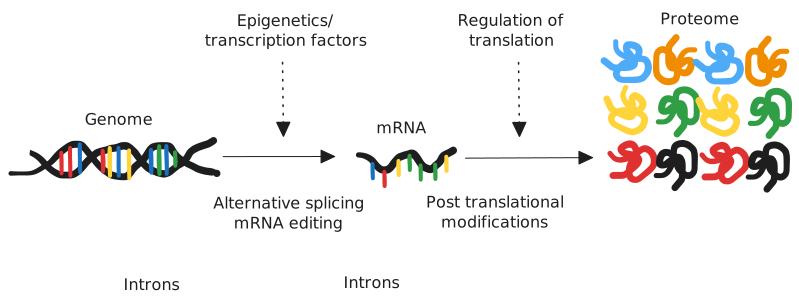
Sequencing Genomes & Determining ProteomesJump to notes →
Sequencing projects have read the genomes of a wide range of organisms, including humans.
Determining the genome of simpler organisms allows the sequences of the proteins that derive from the genetic code (the proteome) of the organism to be determined. This may have many applications, including the identification of potential antigens for use in vaccine production.Complex Genomes & Sequencing MethodsJump to notes →
In more complex organisms, the presence of non-coding DNA and of regulatory genes means that knowledge of the genome cannot easily be translated into the proteome.
Sequencing methods are continuously updated and have become automated.
-
Recombinant DNA
Spec points
Principles of Recombinant DNA TechnologyJump to notes →
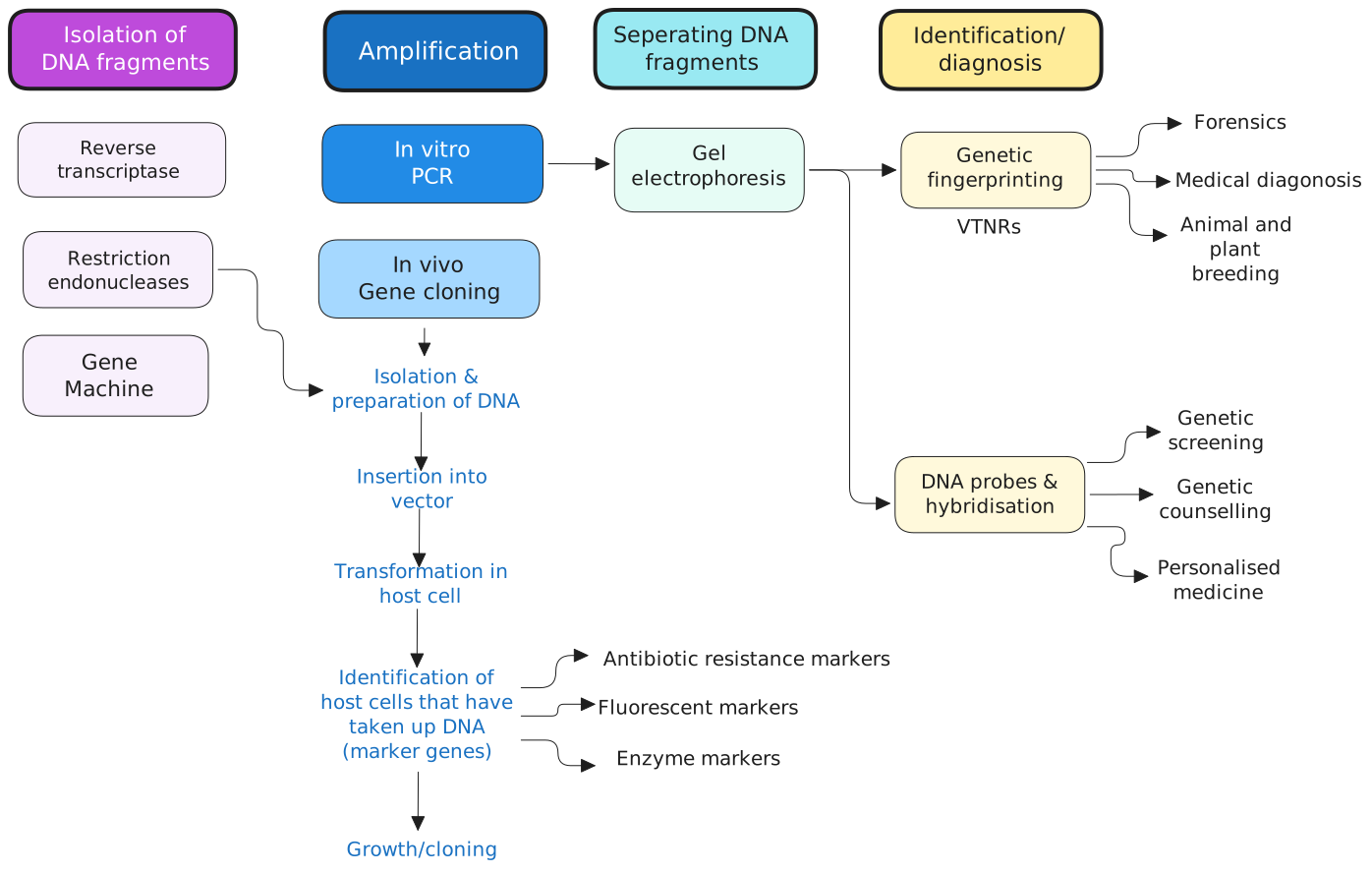
Recombinant DNA technology involves the transfer of fragments of DNA from one organism, or species, to another. Since the genetic code is universal, as are transcription and translation mechanisms, the transferred DNA can be translated within cells of the recipient (transgenic) organism.Producing DNA FragmentsJump to notes →
Fragments of DNA can be produced by several methods, including:
• conversion of mRNA to complementary DNA (cDNA), using reverse transcriptase
• using restriction enzymes to cut a fragment containing the desired gene from DNA
• creating the gene in a 'gene machine'.Amplification by PCR (in vitro)Jump to notes →
Fragments of DNA can be amplified by in vitro and in vivo techniques.
The principles of the polymerase chain reaction (PCR) as an in vitro method to amplify DNA fragments.Transformed Host Cells (in vivo)Jump to notes →
The culture of transformed host cells as an in vivo method to amplify DNA fragments.
• The addition of promoter and terminator regions to the fragments of DNA.
• The use of restriction endonucleases and ligases to insert fragments of DNA into vectors. Transformation of host cells using these vectors.
• The use of marker genes to detect genetically modified (GM) cells or organisms. (Students will not be required to recall specific marker genes in a written paper.)Ethical, Financial & Social Issues
Students should be able to:
• interpret information relating to the use of recombinant DNA technology
• evaluate the ethical, financial and social issues associated with the use and ownership of recombinant DNA technology in agriculture, in industry and in medicine
• balance the humanitarian aspects of recombinant DNA technology with the opposition from environmentalists and anti-globalisation activists
• relate recombinant DNA technology to gene therapy.Investigating Restriction Enzyme SpecificitySkillAT gTopic page →
Students could investigate the specificity of restriction enzymes using extracted DNA and electrophoresis.
-
DNA Probes
Spec points
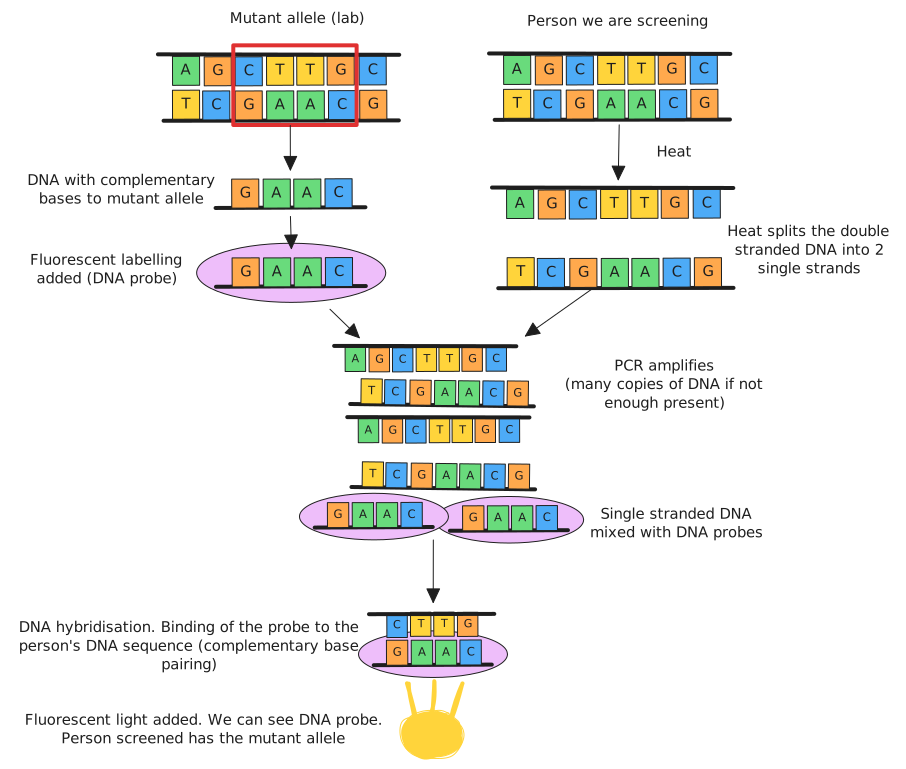
DNA Probes & HybridisationJump to notes →
The use of labelled DNA probes and DNA hybridisation to locate specific alleles of genes.Screening, Counselling & Personalised MedicineJump to notes →
The use of labelled DNA probes that can be used to screen patients for heritable conditions, drug responses or health risks.
The use of this information in genetic counselling and personalised medicine.
Students should be able to evaluate information relating to screening individuals for genetically determined conditions and drug responses.
-
Genetic Fingerprinting
Spec points
Variable Number Tandem RepeatsJump to notes →
An organism's genome contains many variable number tandem repeats (VNTRs). The probability of two individuals having the same VNTRs is very low.The Technique of Genetic FingerprintingJump to notes →
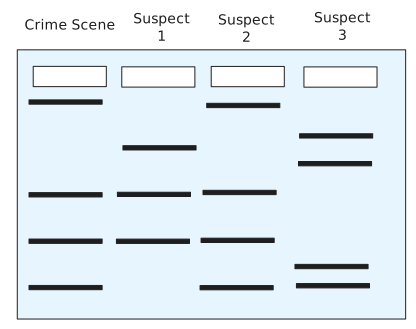
The technique of genetic fingerprinting in analysing DNA fragments that have been cloned by PCR, and its use in determining genetic relationships and in determining the genetic variability within a population.Uses of Genetic FingerprintingJump to notes →
The use of genetic fingerprinting in the fields of forensic science, medical diagnosis, animal and plant breeding.
Students should be able to:
• explain the biological principles that underpin genetic fingerprinting techniques
• interpret data showing the results of gel electrophoresis to separate DNA fragments
• explain why scientists might use genetic fingerprinting in the fields of forensic science, medical diagnosis, animal and plant breeding.Gel Electrophoresis of Food DyesSkillAT gJump to notes →
Students could use gel electrophoresis to produce 'fingerprints' of food dyes.