Genetic Diversity
What you need to know (from the AQA specification)
What you need to know (from the AQA specification)
Genetic diversity as the number of different alleles of genes in a population. Genetic diversity is a factor enabling natural selection to occur.
Genetic diversity arises from the mutations and meiosis covered in the previous topic. Here we look at what it means for populations and how natural selection acts on it.
Definition: Genetic diversity
Genetic diversity is the number of different alleles of genes in a population (a population = organisms of the same species).
It is a key factor in enabling natural selection to occur. Without it, every individual would respond identically to every selection pressure, and populations could not adapt.
What is the advantage of high genetic diversity in a population?
What is the advantage of high genetic diversity in a population?
A population with high genetic diversity has many different alleles. It has more potential to respond to environmental change. A population with low genetic diversity is more vulnerable; if a new disease or environmental shift arrives, fewer individuals may carry a suitable allele.
Natural Selection
What you need to know (from the AQA specification)
What you need to know (from the AQA specification)
The principles of natural selection in the evolution of populations:
- Random mutation can result in new alleles of a gene.
- Many mutations are harmful but, in certain environments, the new allele of a gene might benefit its possessor, leading to increased reproductive success.
- The advantageous allele is inherited by members of the next generation.
- As a result, over many generations, the new allele increases in frequency in the population.
Natural selection acts on genetic diversity. It is the mechanism by which advantageous alleles increase in frequency over generations. Here’s the mechanism:
- A random mutation produces a new allele
- Environmental factors act as selection pressures that affect the survival chances in a population
- In certain environments this allele is beneficial, giving the organism a better chance of survival or reproduction
- That individual is more likely to reproduce and pass the allele on
- Over many generations, the advantageous allele increases in frequency in the population
What is a selection pressure?
What is a selection pressure?
A selection pressure is any environmental factor that affects survival or reproductive success - disease, predation, food availability, climate. The selection pressure determines which alleles are advantageous. Change the selection pressure, and a different allele may become favoured.
Does natural selection act on the individual or the population?
Does natural selection act on the individual or the population?
Natural selection acts on individuals but the effects are seen in the population. Individuals with advantageous alleles survive and reproduce more. But the change (shifting allele frequencies) happens at the population level over many generations. An individual cannot evolve; populations do.
Types of Natural Selection
What you need to know (from the AQA specification)
What you need to know (from the AQA specification)
Directional selection, exemplified by antibiotic resistance in bacteria, and stabilising selection, exemplified by human birth weights.
Different selection pressures affect the type of natural selection. Two important patterns are directional and stabilising selection.
Directional Selection
Directional selection favours one extreme phenotype, shifting the population mean over generations.
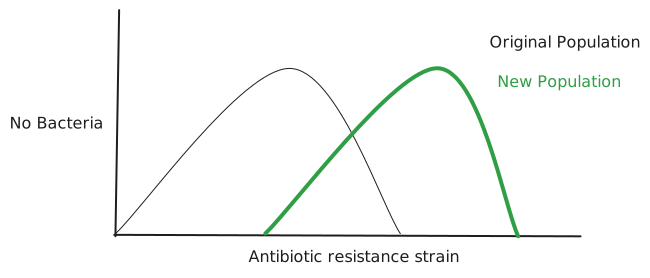
Example: antibiotic resistance in bacteria:
- A random mutation gives some bacteria resistance to an antibiotic
- When antibiotics are present, bacteria without the mutation die; resistant bacteria survive and reproduce
- Over generations, the resistance allele increases in frequency, so the population shifts towards resistance
- You can see how this is exploited in recombinant DNA technology in Unit 8
Common exam mistake: resistance vs immunity
Bacteria become resistant to antibiotics. They are not immune. Immunity involves the immune system responding to a specific antigen. Resistance means the bacterium has an allele that allows it to survive antibiotic exposure.
Stabilising Selection
Stabilising selection favours intermediate phenotypes and selects against both extremes. The mean stays the same, but variation narrows.
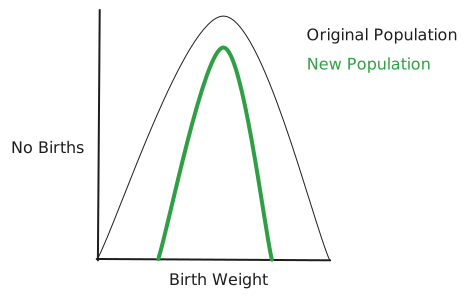
Example: human birth weight:
- Very low birth weight: higher infant mortality
- Very high birth weight: higher risk of complications during birth
- Intermediate birth weight: highest survival
- Individuals with extreme birth weights are less likely to survive and reproduce, so they are less likely to pass on their alleles. Over generations, extreme birth weights decrease in frequency in the population
Adaptations
What you need to know (from the AQA specification)
What you need to know (from the AQA specification)
Natural selection results in species that are better adapted to their environment. These adaptations may be anatomical, physiological or behavioural.
An adaptation is a feature that increases an organism’s chances of survival and reproduction in its environment. Adaptations don’t arise because an organism needs them. A random mutation happens to be beneficial, natural selection favours it, and over many generations it spreads through the population.
Can natural selection select against certain alleles?
Can natural selection select against certain alleles?
Yes. Any allele that reduces survival or reproductive success will be selected against. Individuals carrying it are less likely to survive and reproduce, so the allele decreases in frequency over generations. For example, bacteria without antibiotic resistance die when antibiotics are present. The non-resistance allele decreases in frequency.
Three types of adaptation
- Anatomical: structural / physical features
- Physiological: internal processes and biochemistry
- Behavioural: how an organism acts
Anatomical Adaptations examples
- Large surface area of alveoli for efficient gas exchange
- Streamlined body shape in fish for reducing drag
- Xerophytic adaptations: e.g. sunken stomata, rolled leaves, and thick waxy cuticles in desert plants to reduce water loss
Physiological Adaptations examples
- Fetal haemoglobin has a higher oxygen affinity than adult haemoglobin, allowing efficient oxygen transfer from mother to fetus. (See haemoglobin dissociation curves)
- Desert mammals have a longer loop of Henle. This creates a steeper sodium ion gradient in the medulla, allowing more water to be reabsorbed and producing more concentrated urine. (See the kidney)
- Some bacteria produce enzymes that break down antibiotics
Behavioural Adaptations examples
- Nocturnal activity in desert animals to avoid daytime heat
- Migration to warmer climates in winter
- Courtship displays to attract mates
Required Practical 6: Antimicrobial Substances
What you need to know (from the AQA specification)
What you need to know (from the AQA specification)
Use of aseptic techniques to investigate the effect of antimicrobial substances on microbial growth.
This practical links directly to directional selection and antibiotic resistance, the same evolutionary pressure you investigated theoretically above.
Aseptic Technique
Aseptic technique prevents contamination of the culture (by unwanted microorganisms)
Key steps:
- Sterilise all equipment before use: autoclave glassware and agar; flame the neck of the bottle before removing bacteria
- Work near a Bunsen flame: convection currents carry microorganisms away from the work area
- Incubate at 25°C: not 37°C (body temperature), to reduce the risk of culturing human pathogens
- Disinfect work surfaces and wash hands before starting
- Use a sterile pipette to transfer the culture and a sterile spreader to spread it
- Lift the lid at an angle (don’t remove it completely) to limit contamination from the air
- Put used pipettes and spreaders straight into disinfectant
Method
- Prepare a sterile agar plate and inoculate it evenly with a bacterial culture using a sterile spreader
- Soak small paper discs in different antimicrobial substances (or different concentrations of the same substance)
- Include a control disc soaked in distilled water (no antimicrobial)
- Place discs on the agar surface, evenly spaced
- Secure the lid with two strips of tape (not fully sealed, which would encourage anaerobic bacteria, including pathogens), invert, and incubate at 25°C for 24–48 hours
- Measure the diameter (or calculate the area) of the inhibition zone around each disc
Interpreting Results
- Inhibition zone: the clear area around a disc where bacteria have not grown
- Larger zone = more effective antimicrobial substance
- No zone = bacteria are resistant (or the substance has no effect)
- Area of inhibition zone = π r²
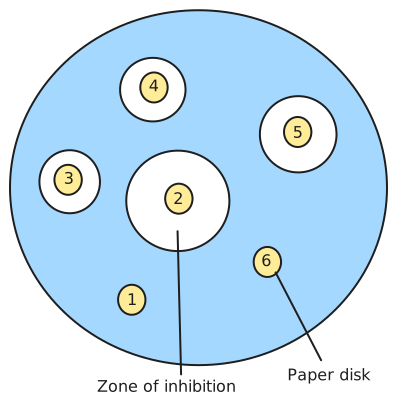
Look at the diagram above. Which antibiotic is most effective? Which show no effect?
Look at the diagram above. Which antibiotic is most effective? Which show no effect?
- Antibiotic 2 is most effective. It has the largest zone of inhibition.
- Antibiotics 1 and 6 have no zone of inhibition, meaning these bacteria are resistant to them (or they have no antimicrobial effect on this species).
What does a large inhibition zone tell you about the antimicrobial substance?
What does a large inhibition zone tell you about the antimicrobial substance?
It is more effective at inhibiting bacterial growth. The larger the zone, the greater the effect on this bacterial species. Note: inhibition zones from different experiments or different bacteria cannot be directly compared.
Why is a control disc (soaked in distilled water) included?
Why is a control disc (soaked in distilled water) included?
To confirm that any inhibition zone is caused by the antimicrobial substance, not the disc itself. It provides a baseline for comparison. Without it, you cannot be sure the disc material has no effect.
How this topic is tested
This analysis is based on past paper data from 2017 to 2025. It is intended for interest only and is not predictive of what will appear in future papers.
- Tested in 7 of 9 years (2017–2025): 21 question parts worth 48 marks.
- 21st most-examined topic overall by marks, 2nd in Unit 4.
Marks by year
Most-tested spec points
- Principles of Natural Selection: tested in 5 parts (15 marks)
- Required Practical 6: tested in 4 parts (10 marks)
- Directional & Stabilising Selection: tested in 3 parts (9 marks)
- Interpreting Selection Data: tested in 2 parts (6 marks)
- Types of Adaptation: tested in 1 part (4 marks)
- Logarithmic Scales for Bacterial Data: tested in 1 part (1 marks)
Also links to: Relating Structure to Properties, Calculating Standard Deviation, Phylogenetic Classification.
Maths and practical skills
- Aseptic technique (AT i): e.g. 2023 P1 Q5.1
- Units and standard form (MS 0.1, 0.2): e.g. 2023 P3 Q3.2
- Percentages, ratios and fractions (MS 0.3): e.g. 2023 P1 Q3.4
- Standard deviation and range (MS 1.10): e.g. 2023 P1 Q5.5
- Averages (MS 1.2, 1.6): e.g. 2023 P3 Q3.2
- Logarithms and log scales (MS 2.5): e.g. 2023 P3 Q3.3
- Using equations (MS 2.2): e.g. 2023 P1 Q5.2
- Area, volume and surface area of shapes (MS 4.1): e.g. 2023 P1 Q5.2
Tips from examiner reports
What students commonly get wrong
- Natural selection: use the context and say "allele"Watch out: when explaining natural selection, use the context in the question (name the selection pressure, e.g. malaria or antibiotics), say the mutation produced an allele, and say allele, not "gene". Stock phrases with no context don't get the marks. 2023 P1 Q3.5 · 2025 P1 Q8.1
- Explain selection with alleles and frequencyWhen explaining directional or stabilising selection, don't just describe the outcome. Explain it: individuals with the favoured phenotype survive and reproduce, pass on their alleles, and the allele frequency changes over generations. 2019 P1 Q4.1 · 2018 P1 Q6.4
- Aseptic technique: what scoresCredited aseptic steps include: disinfect surfaces, flame the neck of the bottle, use a sterile pipette and spreader, lift the lid at an angle, and work near a Bunsen flame (upward air movement). "Flame the plate", "wear gloves" or "work quickly with the lid off" don't score. 2023 P1 Q5.1 · 2022 P1 Q2.3
Exam Question Practice
Myxomatosis is a disease of rabbits caused by the myxoma virus. The virus was released in Australia in 1950 and killed most of the wild rabbits. Today, most wild rabbits in Australia are resistant to myxomatosis.
Use your knowledge of natural selection to explain why resistance is now so common in these rabbits.
(4 marks)
Hint
Where did the resistance come from in the first place? Which rabbits survived the disease, and what did they pass on?
Mark Scheme
- A mutation produced a resistance allele (1 mark)
- Rabbits with this allele survived myxomatosis (were less likely to die from it) (1 mark)
- So they reproduced and passed on the allele (1 mark)
- Over many generations, the frequency of the allele increased (1 mark)
Also accepted / rejected
Tips
- Use the context: a mutation in the rabbits (not in the virus) produced a resistance allele, and rabbits with it survived myxomatosis
- Say “allele”, not “gene” or “trait”
- Finish the chain: they reproduce and pass on the allele, so over generations the allele frequency increases
- This is resistance, not immunity, so don’t describe an immune response
Strains of bacteria with antibiotic resistance are common on farms where large numbers of pigs are kept close together.
Use your knowledge of selection to explain why.
(3 marks)
Hint
Think about why antibiotic use on these farms acts as a selection pressure, which bacteria survive, and what happens to the frequency of the resistance allele over generations.
Mark Scheme
- Antibiotics are used often on these farms, so the bacteria are regularly exposed to them (a selection pressure) (1 mark)
- Bacteria with the resistance allele survive, reproduce and pass on the allele (1 mark)
- So the frequency of the resistance allele increases (1 mark)
Also accepted / rejected
Also accepted
- Instead of point 1, resistant bacteria spread easily between pigs that are kept close together
- “Divide” or “binary fission” instead of “reproduce”
Not accepted
- “Gene” instead of “allele”, or “immunity” instead of “resistance”
Tips
- Link it to the farms. Antibiotics are used a lot there, or resistant bacteria spread easily between pigs kept close together
- Say that bacteria with the resistance allele survive, reproduce and pass on the allele
- Finish with the result, that the frequency of the resistance allele increases
- Use “allele”, not “gene”, and “resistance”, not “immunity”
- This is about antibiotics, not vaccines
Scientists measured the wing length of 1500 house sparrows in a population. A severe winter storm then killed many of the birds, and the scientists recorded which birds died.
Their results are shown in Figure 1.
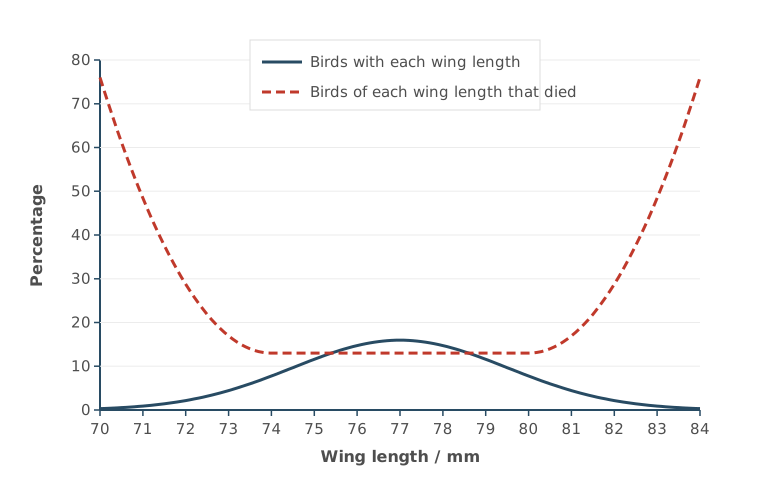
Use Figure 1 to explain how wing length in house sparrows is affected by stabilising selection.
(3 marks)
Hint
Which wing lengths are most likely to die? How does survival link to passing on alleles, and what then happens to allele frequencies?
Mark Scheme
- (Most likely to) die are those with wings shorter than 74 mm
OR (Most likely to) die are those with wings longer than 80 mm (1 mark) - Birds with extreme wing lengths least likely to survive (to reproduce) and so less likely to pass on their alleles (for extreme wing length) (1 mark)
- Extreme wing length decreases in frequency (in the population)
OR Alleles (for extreme wing length) decrease in frequency (in the population) (1 mark)
If neither 1 or 2 awarded allow correct stated wing length less/more likely to survive for 1 mark
Also accepted / rejected
Accept converse answers linked to birds with wing lengths at any value between 74 and 80 mm.
1. For ‘74 mm’ accept any value between 70 mm and 74 mm.
1. For ‘80 mm’ accept any value between 80 mm and 84 mm.
1. If values for both extremes are given, both must be correct.
1. Reject data quoted below 70 mm or above 84 mm.
3. Accept ‘proportion/percentage’ for ‘frequency’.
3. Do not accept ‘number’ for ‘frequency’.
Tips
- Use the principles of natural selection: birds with extreme wing lengths are less likely to survive and reproduce, so they pass on fewer of their alleles
- Finish with allele frequency: the alleles for extreme wing length decrease in frequency (say frequency or proportion, not number)
A student tested whether clove oil kills bacteria. She used a pipette to transfer 0.1 cm³ of a bacterial culture from a bottle onto an agar plate. She then spread the culture over the agar with a spreader.
Describe the aseptic techniques the student should use.
(3 marks)
Hint
Go through her steps one by one: her hands and bench, the pipette, the bottle, the agar plate and the spreader. How does she stop other microorganisms getting in at each step?
Mark Scheme
Max 3 marks
- Disinfect the bench (or wash hands) (1 mark)
- Use a sterile pipette (1 mark)
- Flame the neck of the bottle after removing the lid (1 mark)
- Lift the lid of the agar plate only slightly (at an angle) (1 mark)
- Work near a Bunsen flame, where air moves upwards (1 mark)
- Use a sterile spreader (1 mark)
- Put the used pipette and spreader into disinfectant straight away (1 mark)
Also accepted / rejected
Also accepted
- Antiseptic or alcohol wipes (point 1)
- A pipette from an unopened pack (point 2)
- Flaming the spreader, or dipping it in alcohol and then flaming it (point 6)
Not accepted
- An inoculating loop to transfer the culture (point 2)
- “The flame sterilises the air” (point 5: the rising air carries microbes away)
Tips
- Describe steps that fit this practical: disinfect the bench, sterile pipette, flame the neck of the bottle, lift the lid at an angle, sterile spreader
- Use a pipette, not a loop, to transfer a measured volume
- Don’t flame the lid or the agar; upward air currents carry microbes away, they don’t kill them
- Gloves, working quickly or closing windows gain no marks
A student investigated whether clove oil kills bacteria. She spread five different bacterial cultures on separate agar plates.
On each plate she placed three paper discs: one soaked in clove oil diluted with olive oil, one for a positive control and one for a negative control. She kept the plates at 25 °C for 48 hours, then measured the diameter of the clear zone with no bacterial growth around each disc.
Figure 1 shows one of her plates after 48 hours.
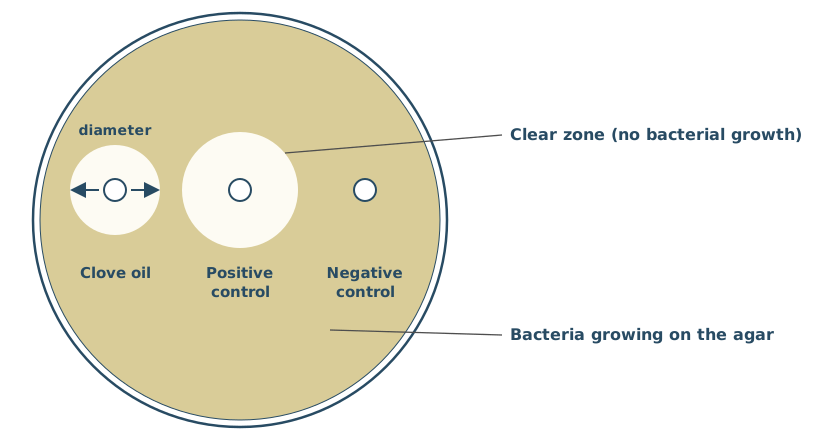
Suggest exactly what the student soaked the discs in to get the positive control and negative control results.
(2 marks)
Hint
A positive control should give a known positive result. A negative control should give a known negative result. What would you soak each disc in?
Mark Scheme
Positive control
- A known antibacterial substance, e.g. an antibiotic or a disinfectant (1 mark)
Negative control
- Olive oil without clove oil, or sterile water (1 mark)
Also accepted / rejected
Also accepted
- A named antibiotic, antiseptic or disinfectant (point 1)
- If the answer isn’t labelled, the first substance counts as the positive control
Tips
- Positive control: a known antimicrobial (e.g. an antibiotic or disinfectant)
- Negative control: sterile water or olive oil without clove oil; “do nothing to the disc” or “add bacteria” is wrong
- Don’t swap them, and antibodies aren’t a positive control
Also accepted
Not accepted