You’ve probably heard that you should drink about 2 litres of water every day, but why is water so important? Water makes up most of your mass (around 60% of your body, and even more of each cell), and nearly every reaction in your body happens in water (e.g. respiration, protein synthesis, DNA replication).
On this page:
- Structure of water
- Water as a Metabolite and a Solvent
- Thermal Properties of Water
- Cohesion and Surface Tension
- Inorganic Ions
- Exam Question Practice
Water has some important properties that make it essential for cells.
Key idea
Most of water’s properties come from one thing: the hydrogen bonds between water molecules.
Structure of water
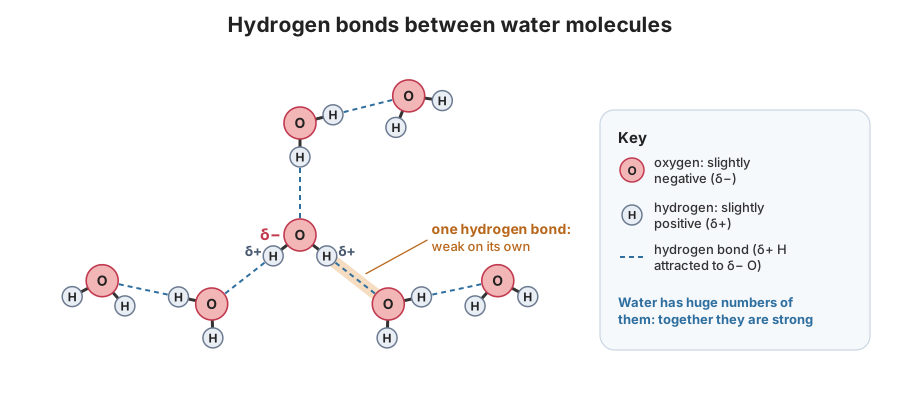
A water molecule (H₂O) is polar.
Definition: Polar
A polar molecule has no overall charge, but the charge is spread unevenly: one end is slightly negative (δ−) and the other end is slightly positive (δ+).
In a water molecule:
- The oxygen atom is slightly negative (δ−)
- The two hydrogen atoms are slightly positive (δ+)
The slightly positive hydrogen of one water molecule is attracted to the slightly negative oxygen of another. This attraction is a hydrogen bond.
Although each one individually is weak, there are large numbers of them, and together they explain most of water’s properties. These are the properties you need to know:
- High heat capacity
- Large latent heat of vaporisation
- Cohesion (water molecules sticking to each other)
- Surface tension
- Solvent*
- Metabolite*
*These two aren’t caused by hydrogen bonds, but they’re still important: water is a good solvent because it’s polar, and it’s a metabolite because it takes part in reactions.
Water as a Metabolite and a Solvent
What you need to know (from the AQA specification)
What you need to know (from the AQA specification)
Water is a major component of cells. It has several properties that are important in biology. In particular, water:
- is a metabolite in many metabolic reactions, including condensation and hydrolysis reactions
- is an important solvent in which metabolic reactions occur
Water is a metabolite: this means it takes part in (is used or produced by) many metabolic reactions in cells.
- It’s removed in condensation reactions, e.g. joining glucose molecules to make starch
- It’s used in hydrolysis reactions, e.g. digestion and ATP hydrolysis
- It’s also used in photosynthesis and produced in respiration
Water is a solvent: because it’s polar (see above), ions and other polar molecules (like glucose) dissolve in it.
- Metabolic reactions happen in solution, e.g. in the cytoplasm
- Dissolved substances can be transported, e.g. in blood plasma, or in the xylem and phloem of plants
Why do ions dissolve in water?
Why do ions dissolve in water?
Take salt (sodium chloride) as an example. In salt, positive sodium ions (Na⁺) and negative chloride ions (Cl⁻) are held tightly together. When you add salt to water:
- The slightly negative oxygen of water molecules is attracted to the positive Na⁺ ions
- The slightly positive hydrogens of water molecules are attracted to the negative Cl⁻ ions
Lots of water molecules cluster around each ion and pull the ions apart. The ions end up spread out through the water, each one surrounded by water molecules: the salt has dissolved.
Thermal Properties of Water
What you need to know (from the AQA specification)
What you need to know (from the AQA specification)
- has a relatively high heat capacity, buffering changes in temperature
- has a relatively large latent heat of vaporisation, providing a cooling effect with little loss of water through evaporation
High heat capacity: it takes a lot of energy to raise the temperature of water. This is because much of the energy goes into breaking hydrogen bonds first.
- This is important as water buffers changes in temperature: the temperature of cells, blood and lakes or seas stays fairly stable
- This keeps the temperature close to the optimum for enzymes
How has water's high heat capacity affected climate change?
How has water's high heat capacity affected climate change?
The oceans have absorbed over 90% of the extra heat trapped by greenhouse gases. Because water has such a high heat capacity, the oceans have warmed only slowly, which has slowed warming on land. But it also means the oceans will stay warmer for a long time, even if emissions fall.
(You don’t need to know this for the exam.)
Large latent heat of vaporisation: it takes a lot of energy to evaporate water (to turn it from liquid to gas), again because hydrogen bonds have to be broken.
- So when water evaporates, it takes lots of heat with it, which has a cooling effect, e.g. sweating in mammals and transpiration in plants
- Because each gram of water removes so much heat, you get a big cooling effect with little loss of water
Heat capacity or latent heat of vaporisation: which one explains why sweating cools you down?
Heat capacity or latent heat of vaporisation: which one explains why sweating cools you down?
Latent heat of vaporisation. Sweat cools you down when it evaporates, and evaporating water takes a lot of heat energy from your skin.
Heat capacity is about how much energy it takes to change the temperature of water, not to evaporate it.
Cohesion and Surface Tension
What you need to know (from the AQA specification)
What you need to know (from the AQA specification)
- has strong cohesion between water molecules; this supports columns of water in the tube-like transport cells of plants and produces surface tension where water meets air.
Cohesion means water molecules stick together, because of the hydrogen bonds between them. This is important in two ways.
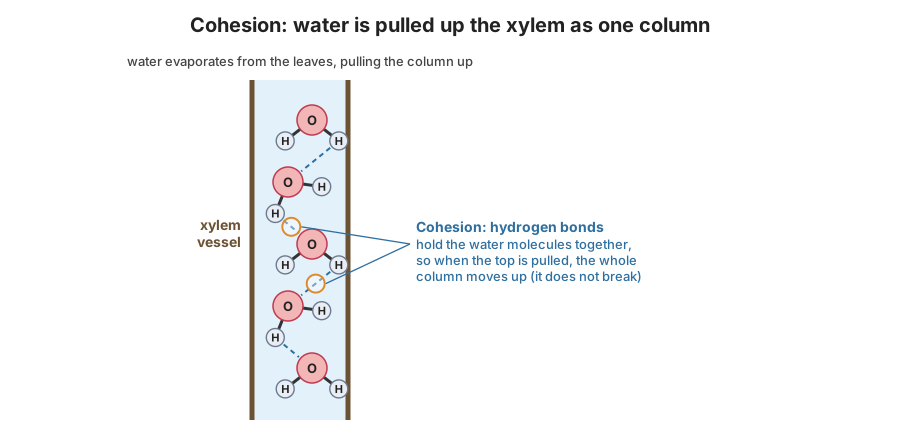
Columns of water in plants: in the xylem, water molecules stick together, so when water evaporates from the leaves, a continuous column of water is pulled up the plant (the transpiration stream). Think of drinking through a straw: the water comes up as one continuous column because the molecules stick together.
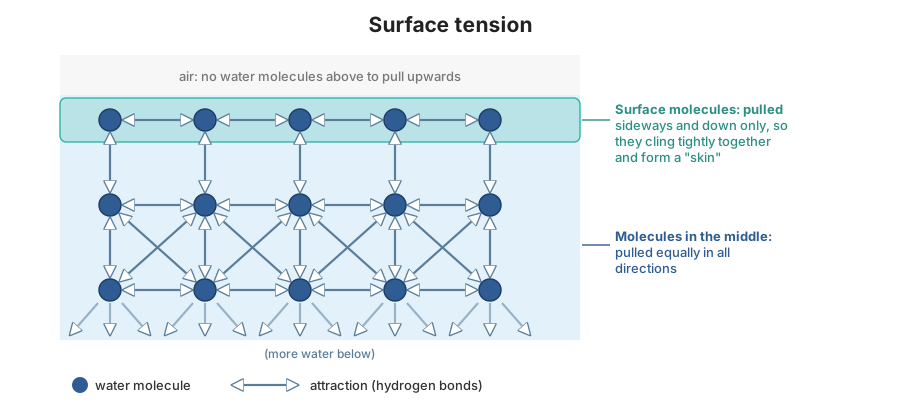
Surface tension: in the middle of the water, each water molecule is pulled equally in all directions by the molecules around it. But at the surface there are no water molecules above (just air), so the surface molecules are only pulled sideways and down, towards the rest of the water. This makes them cling tightly together, so the surface acts like a stretchy “skin”. It’s strong enough for small organisms, such as pond skaters, to stand on.
Don’t confuse cohesion (water molecules sticking to each other) with adhesion (water sticking to other surfaces, like the walls of the xylem).
Inorganic Ions
What you need to know (from the AQA specification)
What you need to know (from the AQA specification)
Inorganic ions occur in solution in the cytoplasm and body fluids of organisms, some in high concentrations and others in very low concentrations.
Each type of ion has a specific role, depending on its properties.
Students should be able to recognise the role of ions in the following topics: hydrogen ions and pH; iron ions as a component of haemoglobin; sodium ions in the co-transport of glucose and amino acids; and phosphate ions as components of DNA and of ATP.
An ion is an atom or group of atoms with an electrical charge. Inorganic ions:
- Don’t contain carbon (organic molecules do)
- Are dissolved in the cytoplasm and body fluids, some in high concentrations and some in very low concentrations
- Each have a specific function, depending on their properties
These ions come up in lots of other topics, so each section links to the page where it’s covered in detail.
Hydrogen ions (H⁺)
The more H⁺ ions there are, the lower the pH (more acidic). pH matters because it affects enzymes: a change in pH changes the charges on the amino acids in the active site, so the substrate can’t bind as well, and a big change can denature the enzyme.
During intense exercise, your muscles produce lactic acid, which releases H⁺ ions. Suggest how this could affect your muscles.
During intense exercise, your muscles produce lactic acid, which releases H⁺ ions. Suggest how this could affect your muscles.
The pH in the muscle falls, so enzymes (e.g. in respiration) work less well. ATP is made more slowly, so the muscles tire and you slow down.
Also, the extra H⁺ makes haemoglobin release more oxygen to the muscles (the Bohr effect).
Iron ions (Fe²⁺)
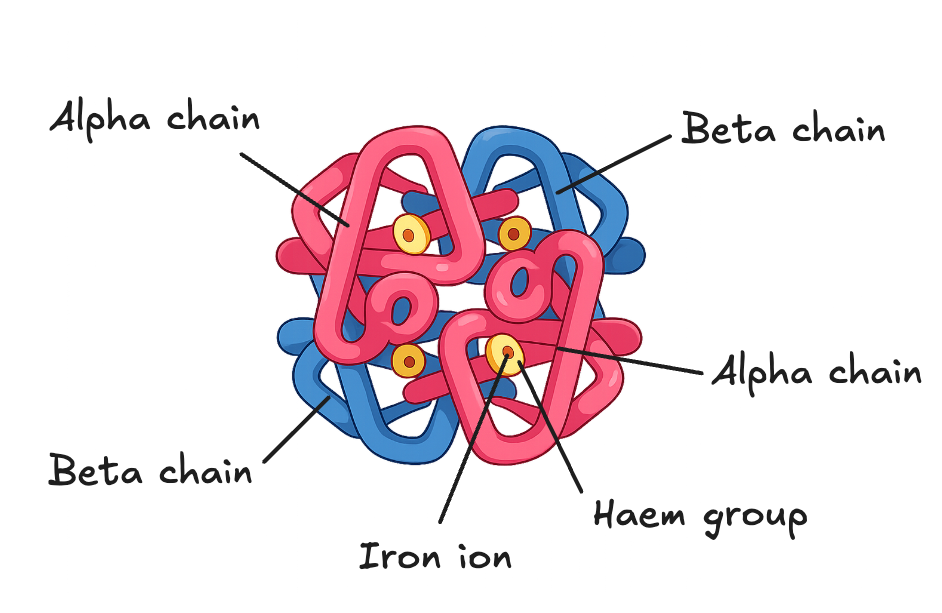
- Iron ions are a component of haemoglobin
- Each of haemoglobin’s four polypeptide chains has a haem group containing an Fe²⁺ ion, and this is where oxygen binds
What happens if someone doesn't have enough iron?
What happens if someone doesn't have enough iron?
They can’t make as much haemoglobin, so their blood carries less oxygen. Less oxygen reaches their cells for aerobic respiration, so less ATP is made. This is called anaemia: people feel tired, weak and breathless.
Sodium ions (Na⁺)
Sodium ions are needed to absorb glucose and amino acids in the ileum by co-transport: the co-transporter protein only carries glucose into the cell if Na⁺ comes in with it.
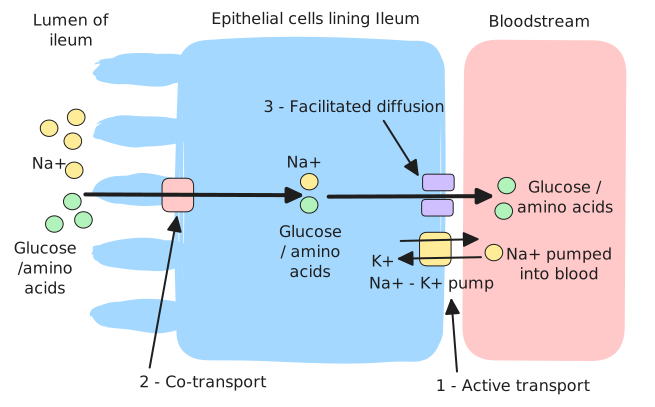
How does co-transport of glucose work? (You'll learn this in Units 2 and 3)
How does co-transport of glucose work? (You'll learn this in Units 2 and 3)
- Na⁺ ions are actively transported out of the epithelial cell into the blood, which lowers the Na⁺ concentration inside the cell
- Na⁺ ions then diffuse into the cell from the ileum, down their concentration gradient, through a co-transporter protein
- The co-transporter carries glucose (or an amino acid) into the cell at the same time, against its concentration gradient
Drinks given to people with severe diarrhoea (oral rehydration solutions) contain both glucose and salt (sodium). Why does this help them absorb water?
Drinks given to people with severe diarrhoea (oral rehydration solutions) contain both glucose and salt (sodium). Why does this help them absorb water?
Na⁺ and glucose are absorbed together into the cells of the ileum by co-transport. This lowers the water potential of the cells, so water follows by osmosis. These drinks have saved millions of lives, e.g. in cholera outbreaks.
Phosphate ions (PO₄³⁻)
Your body recycles roughly its own mass in ATP every day, so cells need a constant supply of phosphate.
- Phosphate is a component of DNA and RNA nucleotides: phosphate groups link nucleotides together in the sugar-phosphate backbone
- Phosphate is a component of ATP: ATP has three phosphate groups, and hydrolysing ATP releases one as an inorganic phosphate (Pᵢ), releasing energy
- (Phosphate is also in phospholipids)
A plant is grown in soil with no phosphate ions. Suggest why it grows poorly.
A plant is grown in soil with no phosphate ions. Suggest why it grows poorly.
Without phosphate, the plant can’t make enough:
- DNA (and RNA), needed for cell division and making proteins
- ATP, needed to release energy for processes like active transport and growth
- Phospholipids, needed for new cell membranes
How this topic is tested
This analysis is based on past paper data from 2017 to 2025. It is intended for interest only and is not predictive of what will appear in future papers.
- Tested in 1 of 9 years (2017–2025): 1 question parts worth 5 marks.
- 52nd most-examined topic overall by marks, 9th in Unit 1.
- Not tested in 2023–2025.
Marks by year
Most-tested spec points
- Cohesion & Surface Tension: tested in 1 part (5 marks)
- Thermal Properties of Water: tested in 1 part (5 marks)
- Water as a Metabolite & Solvent: tested in 1 part (5 marks)
Tips from examiner reports
What students commonly get wrong
- Give the property and why it mattersWatch out: for each property of water, give the property and why it's important to organisms, e.g. "high heat capacity, so it buffers changes in temperature". And don't forget water is a metabolite (used in hydrolysis, released in condensation). 2019 P1 Q10.1
- Water is the solvent, not the soluteWatch out: water is the solvent (the substances dissolved in it are the solutes). Then say why it matters: metabolic reactions happen in solution, and dissolved substances can be transported. 2019 P1 Q10.1
- Heat capacity vs latent heatWatch out: these are different. High heat capacity: a high amount of energy is needed to raise the temperature, so it buffers temperature changes. Large latent heat of vaporisation: a high amount of energy is needed to evaporate it, so it gives a cooling effect (e.g. sweating) with little water lost. 2019 P1 Q10.1
- Cohesion: say what it doesWatch out: don't just write that cohesion "aids transpiration". Explain that it supports columns of water in the xylem (the transpiration stream), or produces surface tension. 2019 P1 Q10.1
- Sodium ions: explain the gradientWatch out: explain why moving Na⁺ out of the cell matters. Active transport of Na⁺ out keeps the Na⁺ concentration low inside the cell, so Na⁺ diffuses in from the ileum through the co-transporter, bringing glucose with it. 2020 P1 Q1.2
Exam Question Practice
Explain five properties that make water important for organisms.
(5 marks)
Hint
Think about water in reactions, as a solvent, how it responds to heating and evaporation, and the attraction between water molecules. Why does each matter to living things?
Mark Scheme
Max 5 marks
- A metabolite in condensation/hydrolysis/ photosynthesis/respiration (1 mark)
- A solvent so (metabolic) reactions can occur
OR A solvent so allowing transport of substances (1 mark) - High heat capacity so buffers changes in temperature (1 mark)
- Large latent heat of vaporisation so provides a cooling effect (through evaporation) (1 mark)
- Cohesion (between water molecules) so supports columns of water (in plants) (1 mark)
- Cohesion (between water molecules) so produces surface tension supporting (small) organisms (1 mark)
Comments from mark scheme
Tips from examiner reports
Tips from the examiner report
- Give each property and why it matters to organisms: e.g. ‘a solvent, so metabolic reactions can occur’
- Water as a metabolite (in hydrolysis, condensation, photosynthesis and respiration) was hardly ever mentioned
- Water is a solvent, not a solute; high heat capacity and latent heat of vaporisation are different properties
- Link cohesion to maintaining the transpiration stream, not just ‘aids transpiration’
Figure 1 shows a cell from the lining of the ileum specialised for absorption of products of digestion.
SGLT1 is a carrier protein found in the cell-surface membrane of this cell, it transports glucose and sodium ions (Na⁺) into the cell.
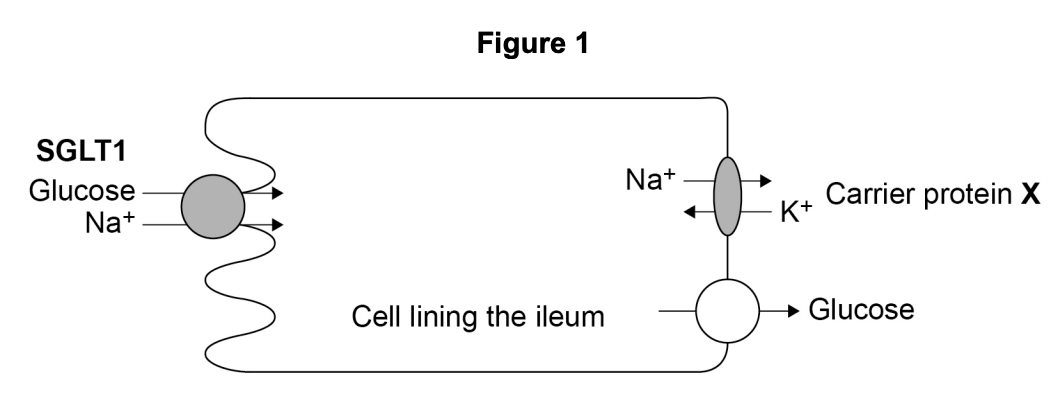
The movement of Na⁺ out of the cell allows the absorption of glucose into the cell lining the ileum.
Explain how.
(2 marks)
Hint
What does moving Na⁺ out do to the Na⁺ concentration inside the cell compared with the ileum? Look at Figure 1: what else does SGLT1 carry in with Na⁺?
Mark Scheme
- (Maintains/generates) a concentration/diffusion gradient for Na⁺ (from ileum into cell) (1 mark)
- Na⁺ moving (in) by facilitated diffusion, brings glucose with it
OR Na⁺ moving (in) by co-transport, brings glucose with it (1 mark)
Comments from mark scheme
1. Accept ‘(Maintains/generates) a lower concentration of Na⁺ inside the cell compared with outside the cell’.
2. Accept ‘co-transporter’ for ‘co-transport’.
Tips from examiner reports
Tips from the examiner report
- Start with the gradient: moving Na⁺ out keeps the Na⁺ concentration inside the cell lower than in the ileum
- Then link it to SGLT1: Na⁺ diffuses back into the cell by co-transport and brings glucose with it
3. For ‘buffer’ accept ‘resist’.
5. For ‘columns of water’ accept ‘transpiration stream’.
Do not credit ‘transpiration’ alone but accept description of ‘stream’.
5. For ‘columns of water’ accept ‘cohesion-tension (theory)’.
5 and 6. For cohesion accept hydrogen bonding
Ignore reference to pH.
Allow other suitable properties but must have a valid explanation.
For example