Homeostasis is the maintenance of a stable internal environment (within restricted limits) despite changes in internal and external conditions.
This includes keeping blood glucose within certain limits. For example, if you eat 5 chocolate bars, your body needs to bring your blood glucose back down. If you have been for a run, it needs to bring your blood glucose back up.
What you need to know (from the AQA specification)
What you need to know (from the AQA specification)
Homeostasis in mammals involves physiological control systems that maintain the internal environment within restricted limits.
Why is homeostasis important?
What you need to know (from the AQA specification)
What you need to know (from the AQA specification)
- The importance of maintaining a stable core temperature and stable blood pH in relation to enzyme activity.
- The importance of maintaining a stable blood glucose concentration in terms of availability of respiratory substrate and of the water potential of blood.
This control of the internal environment is important for:
- Ensuring enzymes (which are involved in many processes) can function optimally
- Preventing cell damage (e.g. preventing cell lysis from changes in water potential)
Temperature and Blood pH
Enzymes control virtually every metabolic reaction in the body. Their activity depends on:
- Temperature — enzymes have an optimum temperature they work best at.
- Too high — even small rises above the optimum cause bonds in the tertiary structure (e.g. hydrogen bonds) to break. This means the shape of the active site no longer fits the substrate, so the enzyme won’t function effectively (it is denatured). See Properties of Proteins for more detail.
- Too low — reduces kinetic energy and slows the rate of metabolic reactions
- Blood pH — similarly, changes in pH (too high or too low) disrupt bonding (e.g. ionic, hydrogen) in the tertiary structure, changing the active site shape
Stable Blood Glucose Concentration
Blood glucose must be kept within narrow limits for two reasons:
- (Too low) Glucose is a respiratory substrate
- Glucose is the primary substrate for cellular respiration. Too little means cells cannot produce sufficient ATP for energy-requiring processes.
- (Too high) Water potential of blood
- Glucose dissolved in blood lowers water potential. If there is too high a concentration of glucose, this creates a water potential gradient that draws water out of cells by osmosis, potentially causing cell damage (shrinkage)
How do systems detect change?
Homeostasis in mammals involves ‘physiological control systems’ (the terminology from the specification). These are the systems inside your body that detect deviations from a set point and trigger corrective responses to return the internal environment to within restricted limits.
These systems share a common structure:
| Component | Role |
|---|---|
| Receptor | Detects a change in internal conditions |
| Coordinator | Processes the signal and coordinates a response (e.g. hypothalamus, pancreas) |
| Effector | Brings about the corrective response (e.g. muscle, gland) |
Negative Feedback
What you need to know (from the AQA specification)
What you need to know (from the AQA specification)
Negative feedback restores systems to their original level.
The possession of separate mechanisms involving negative feedback controls departures in different directions from the original state, giving a greater degree of control.
Students should be able to interpret information relating to examples of negative and positive feedback.
Negative feedback is the mechanism by which homeostatic systems restore a variable to its set point. When the variable deviates, the response opposes the change and returns it toward the original level.
For example: if blood glucose rises → insulin is secreted → glucose is removed from blood → blood glucose falls back to set point.
Separate Mechanisms for Each Direction
Greater control is achieved by having two separate negative feedback mechanisms, one for each direction of departure from the set point. Each mechanism acts independently, allowing precise correction regardless of which direction the variable moves.
For instance, blood glucose is controlled by:
- Insulin (from β cells) = lowers blood glucose when it rises too high
- Glucagon (from α cells) = raises blood glucose when it falls too low
Negative vs Positive Feedback
Comparing feedback types
- Negative feedback → response opposes the change → restores the set point → used in homeostasis
- Positive feedback → response amplifies the change → moves further from the set point → used in specific physiological events (e.g. action potential generation, uterine contractions during childbirth)
When interpreting feedback diagrams or data, identify whether the response is moving the variable back toward the original level (negative) or away from it (positive).
How this topic is tested
This analysis is based on past paper data from 2017 to 2025. It is intended for interest only and is not predictive of what will appear in future papers.
- Tested in 3 of 9 years (2017–2025): 7 question parts worth 14 marks.
- 45th most-examined topic overall by marks, 9th in Unit 6.
Marks by year
Most-tested spec points
- Negative Feedback: tested in 3 parts (6 marks)
- Why Homeostasis Matters: tested in 3 parts (5 marks)
Also links to: Blood Glucose & the Role of the Liver, Osmoregulation & the Role of ADH, Other Respiratory Substrates.
Tips from examiner reports
What students commonly get wrong
- Why high blood glucose dehydrates cellsWatch out: glucose lowers the water potential of the blood, so it's lower than inside the cells. Water moves out of the cells by osmosis, down the water potential gradient. "Diffusion" or "concentration gradient" doesn't explain it. 2025 P2 Q2.2
- How negative feedback worksWatch out: a change is first detected by receptors. The response then opposes the change, returning the level to the set point. Don't skip the detection step. 2025 P2 Q2.4
- What makes it positive feedbackWatch out: in positive feedback, each step increases the next. A causes more B, and more B causes more A, so the change keeps growing. Show the idea of "more" at each step. 2018 P3 Q1.1
- Why exercise lowers blood pHWatch out: more respiration during exercise produces more carbon dioxide, which lowers blood pH (makes it more acidic). Anaerobic respiration in animals produces lactate, not carbon dioxide. 2025 P2 Q2.5
Exam Question Practice
People with untreated type 1 diabetes often feel very thirsty. One reason is that a high blood glucose concentration causes water to leave body cells.
Explain how a high blood glucose concentration causes body cells to lose water.
Do not refer to ADH or the kidneys in your answer.
(2 marks)
Hint
What does a high glucose concentration do to the water potential of the blood? Which way will water then move, and by what process?
Mark Scheme
- The water potential of the blood decreases (becomes more negative) (1 mark)
- So body cells lose water by osmosis (1 mark)
Also accepted / rejected
Tips
- Say the water potential of the blood decreases; “a concentration gradient” isn’t enough
- Water leaves the cells by osmosis, not diffusion
- Answers about insulin or glucose entering cells don’t score; the question is about water movement
Figure 1 shows one of the physiological systems involved in controlling blood glucose concentration.
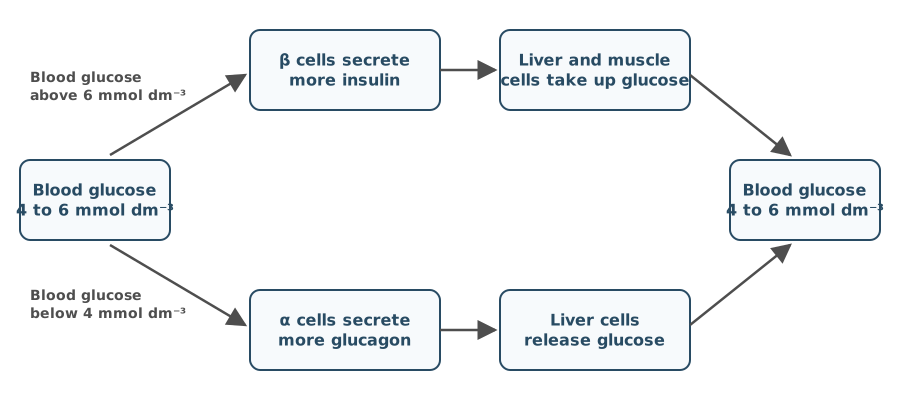
Use the information in Figure 1 to describe how negative feedback works.
(2 marks)
Hint
Negative feedback has two parts. A change is detected, and a response brings the value back. Use Figure 1 to describe both.
Mark Scheme
- A change in blood glucose is detected (by the α or β cells), or separate mechanisms control a rise and a fall (1 mark)
Explanation (not marked): For example, a rise above 6 mmol dm⁻³ is detected by the β cells, which secrete more insulin; a fall below 4 mmol dm⁻³ is detected by the α cells, which secrete more glucagon. - The response (cells taking up glucose, or the liver releasing glucose) returns blood glucose to the norm (4 to 6 mmol dm⁻³) (1 mark)
Explanation (not marked): For example, after a rise, insulin makes liver and muscle cells take up glucose, so blood glucose falls back to 4 to 6 mmol dm⁻³. After a fall, glucagon makes liver cells release glucose, so it rises back.
Also accepted / rejected
Also accepted
- “Set point” or “optimum” for norm (point 2)
- Any value from 4 to 6 mmol dm⁻³ (point 2)
Tips
- Say how the change is detected. A change in blood glucose is detected by the α or β cells
- Then say the response returns the blood glucose to the norm (4 to 6 mmol dm⁻³)
- You only need to describe one direction (an increase or a decrease)
What earns marks
- Most students gain the mark for the value returning to the norm or set point
Figure 1 shows one of the physiological systems involved in controlling blood pH.
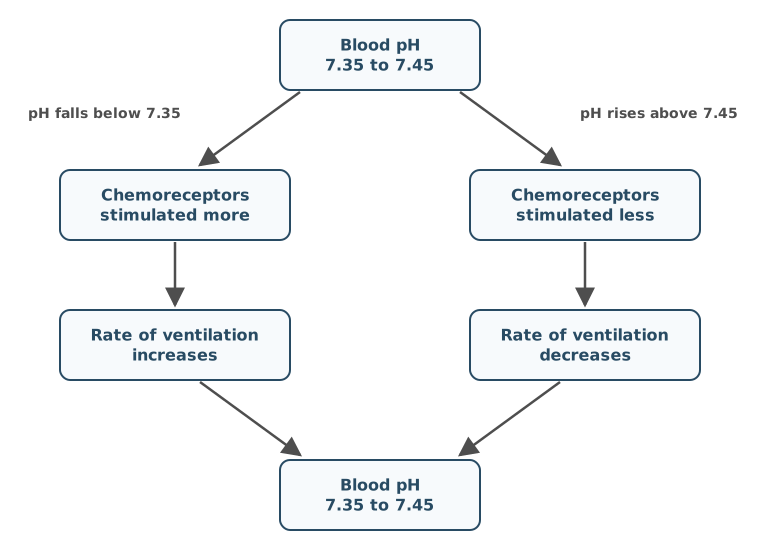
Running a 400 m race causes a change in blood pH.
Use Figure 1 to describe and explain the changes in blood pH and in the rate of ventilation.
(2 marks)
Hint
What does running do to the rate of respiration, and what does that produce? Then follow the left-hand route of Figure 1.
Mark Scheme
- More respiration produces more carbon dioxide, or anaerobic respiration produces lactate (1 mark)
Explanation (not marked): During the race, the leg muscles respire faster, so more carbon dioxide enters the blood. It forms an acid in the blood that releases H⁺ ions, lowering the pH. - The blood pH falls, so the chemoreceptors are stimulated more and the rate of ventilation increases (1 mark)
Explanation (not marked): For example, blood pH falls below 7.35, so ventilation increases; more carbon dioxide is breathed out and the pH returns to 7.35 to 7.45.
Also accepted / rejected
Also accepted
- “Lactic acid” for lactate (point 1)
- More H⁺ (more acidic), or a pH below 7.35 (point 2)
Not accepted
- Anaerobic respiration producing lactate and carbon dioxide (point 1)
Tips
- Start with respiration. More respiration produces more carbon dioxide (or anaerobic respiration produces lactate)
- In humans, anaerobic respiration produces lactate only, not lactate and carbon dioxide
- More carbon dioxide lowers the blood pH; it doesn’t increase it
- Mention both chemoreceptors and ventilation. The lower pH increases stimulation of the chemoreceptors, which increases the rate of ventilation
- Heart rate isn’t relevant here
Also accepted