What you need to know (from the AQA specification)
What you need to know (from the AQA specification)
- The use of monoclonal antibodies in:
- targeting medication to specific cell types by attaching a therapeutic drug to an antibody
- medical diagnosis.
- The use of antibodies in the ELISA test.
- Ethical issues associated with the use of vaccines and monoclonal antibodies.
Students should be able to:
- discuss ethical issues associated with the use of vaccines and monoclonal antibodies
- evaluate methodology, evidence and data relating to the use of vaccines and monoclonal antibodies.
Details of the commercial or scientific production of monoclonal antibodies are not required.
Monoclonal antibodies are identical antibodies produced from a single clone of plasma cells, so they all bind to the same specific antigen. Their specificity makes them powerful tools in medicine (targeted treatment) and diagnosis (e.g. ELISA, pregnancy tests).
Uses of Monoclonal Antibodies
Targeting Medication to Specific Cell Types
Because monoclonal antibodies bind to one specific antigen, a therapeutic drug can be attached to the antibody, which delivers the drug only to cells with that antigen.
Example: treating cancer
- Cancer cells have antigens on their surface that aren’t found on most healthy cells. These are called tumour markers
- Monoclonal antibodies are made that are complementary to the tumour marker
- An anti-cancer drug is attached to the antibody
- The antibodies are injected into the bloodstream, where they bind only to the cancer cells
- The drug enters and destroys the cancer cells, with little effect on healthy cells
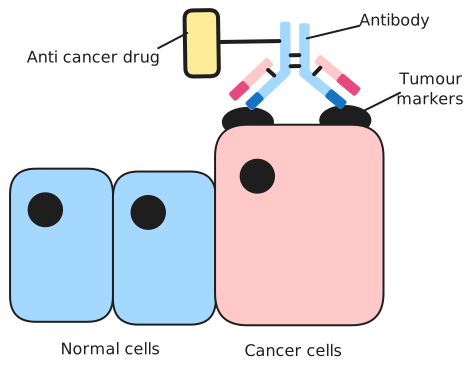
This means smaller doses of drug are needed, and there are fewer side effects, because the drug mostly reaches only cancer cells.
Medical Diagnosis
Monoclonal antibodies can be used to detect specific molecules in the body, useful for diagnosis.
Example: pregnancy tests
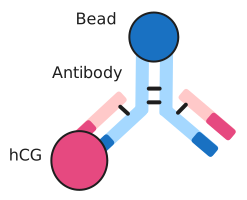
- During pregnancy, the hormone hCG (human chorionic gonadotropin) is produced and appears in urine
- The pregnancy test contains monoclonal antibodies complementary to hCG, attached to a coloured dye
- If hCG is present in the urine, it binds to the antibodies, and a coloured line appears
Note: in an ELISA test the colour comes from an enzyme reacting with its substrate, not a dye.
The ELISA Test
ELISA (Enzyme-Linked Immunosorbent Assay) is a test that uses antibodies to detect the presence (and amount) of a specific antigen or antibody in a sample.
It works by using an enzyme-linked antibody to bind the target molecule. Once bound, a substrate is added. The enzyme converts it into a coloured product, giving a visible positive result.
There are two versions:
- Direct ELISA: the enzyme-linked antibody binds the target antigen directly
- Indirect ELISA: a primary antibody binds the target first; then a secondary, enzyme-linked antibody binds the primary antibody (this is the version used in the HIV test below)
Example: testing for HIV antibodies
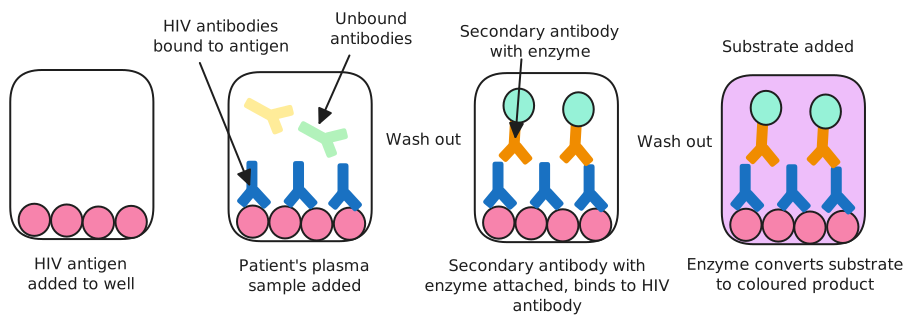
- HIV antigens are bound to the inside of a well in a plate
- The patient’s blood sample is added. Any HIV antibodies in their blood bind to the HIV antigens
- The well is washed to remove unbound antibodies
- A secondary antibody (with an enzyme attached) is added. This binds to the patient’s HIV antibodies
- The well is washed again to remove unbound secondary antibodies
- A substrate for the enzyme is added. The enzyme converts it into a coloured product
- If a colour appears, the patient has HIV antibodies
The intensity of the colour can be measured with a colorimeter to quantify how much antibody is present.
The same method can be used to detect an antigen instead (e.g. a pathogen). Antibodies are bound to the well, and the antigen in the sample binds them. Then a second, enzyme-linked antibody binds to the antigen, and the substrate is added as before.
Why are the wash steps so important?
Why are the wash steps so important?
The washing steps remove unbound antibodies. If you didn’t wash, any antibody could give a colour change, even ones that didn’t actually bind. This would give a false positive.
Ethical Issues
Answering 'evaluate the ethics' questions
Always give both sides:
- One concern (e.g. animal testing, drug-trial risks, cost / unequal access)
- One benefit (e.g. saves lives, prevents disease, effective treatment)
Monoclonal antibodies and ELISA are examined as part of cell recognition and the immune system. See how they're tested on that page →
Tips from examiner reports
What students commonly get wrong
- ELISA: the colour comes from an enzymeWatch out: when explaining the colour change in an ELISA test, say an enzyme (attached to the antibody) reacts with its substrate to make the coloured product. "A coloured dye", or the antigen-antibody complex reacting with the substrate, doesn't get the mark. 2023 P1 Q9.1
- What a control line showsWatch out: a line at the control (C) shows the sample has moved past the test line (T), so a negative result at T is real. Don't just explain why a colour appears at C. 2023 P1 Q9.2
Exam Question Practice
A few exam-style questions on this topic to try. Have a go at each one before opening the answer.
An antibody-drug conjugate (ADC) is a monoclonal antibody joined to a drug that kills cells.
One ADC used to treat breast cancer binds to an antigen on the surface of tumour cells. The ADC is then taken into the tumour cell, and the antibody is broken down inside the cell to release the drug. This process is very similar to phagocytosis.
Use your knowledge of phagocytosis to describe how the ADC enters and kills the tumour cell.
(3 marks)
Hint
How does the cell take the ADC in, and which organelle’s enzymes break the antibody down?
Mark Scheme
- The cell ingests/engulfs the antibody/ADC
OR The cell membrane surrounds the antibody/ADC (to take it inside the cell) (1 mark) - Lysosomes fuse with the vesicle/phagosome (containing the ADC) (1 mark)
- Lysozymes break down/digest the antibody/ADC to release the drug (1 mark)
Also accepted / rejected
Tips
- The cell engulfs the ADC, lysosomes fuse with the vesicle, and lysozymes break down the antibody to release the drug
- Don’t write about the acquired immune response
An antibody-drug conjugate (ADC) is a monoclonal antibody joined to a drug that kills cells.
Some of the antigens on the surface of breast tumour cells are also found on the surface of healthy cells.
Use this information to explain why treatment with an ADC often causes side effects.
(2 marks)
Hint
If healthy cells carry the same antigen, what will the ADC do to them?
Mark Scheme
- The ADC will bind to non-tumour/healthy cells (1 mark)
- Causing death/damage of non-tumour/healthy cells
OR Causing damage to other organs/systems (1 mark)
Also accepted / rejected
1. Reject reference to an active site.
Zika is a disease caused by the Zika virus.
Scientists designed a test to detect antibodies against the Zika virus in a patient’s blood sample. Figure 1 shows how the test works, and the negative and positive results.
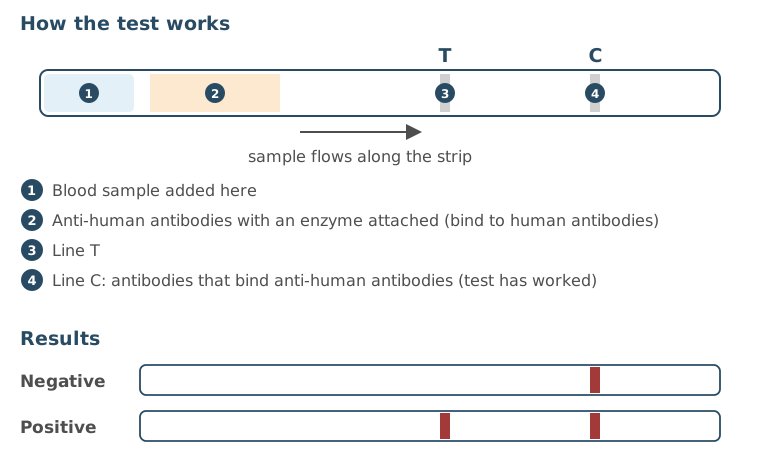
Suggest what is on the test at line T, and explain what causes the line to appear in a positive test.
(2 marks)
Hint
Read the question carefully: what is being detected, antibodies or antigens? Describe how the ELISA technique produces a visible result.
Mark Scheme
- Line T has Zika antigen (with the enzyme’s substrate) (1 mark)
- In a positive test, the enzyme on the anti-human antibody reacts with the substrate, forming enzyme-substrate complexes that give the colour (1 mark)
Also accepted / rejected
Also accepted
- “A colourless dye” for substrate (point 2)
Not accepted
- Antigen in the patient’s blood (point 1: the test detects antibodies)
Tips
- The test detects Zika antibodies in the blood, so line T holds Zika antigen (and substrate); it doesn’t detect the virus or antigen in the blood
- The line appears because the enzyme on the anti-human antibody reacts with the substrate, giving a colour change; say “enzyme”, not just a dye or beads
Scientists investigated how often skin cells divide in young and old mice.
To find which cells were replicating their DNA, the scientists used a chemical called BrdU. Cells use BrdU instead of nucleotides containing thymine during DNA replication.
Cells with BrdU in their DNA can be detected using an anti-BrdU antibody with an enzyme attached.
Use your knowledge of the ELISA test to suggest and explain how the scientists identified the cells that have BrdU in their DNA.
(3 marks)
Hint
What would you add to the cells, how would you get rid of anything that hasn’t bound, and what would you add last to show which cells contain BrdU?
Mark Scheme
- Add the antibody (anti-BrdU with enzyme attached) to the cells/DNA
OR Add the cells/DNA to the antibody (anti-BrdU with enzyme attached) (1 mark) - Wash (the cells/DNA) to remove excess/unattached antibody
OR Wash (the immobilised antibody) to remove excess/unattached cells/DNA (1 mark) - Add substrate to cause a colour change (1 mark)
Also accepted / rejected
All mark points must relate to the procedure.
Do not cancel any mark point for the use of additional antibodies.
2. Allow error carried forward for the absence of cells/DNA.
3. For substrate accept a description in the context of the enzyme.
Tips
- Describe the procedure the scientists would follow: the question asks how they identified the cells
- Keep to the one antibody named in the question; adding two or three different antibodies leads to confused answers
1. Accept endocytosis for ingest/engulf.
3. Accept hydrolytic enzyme for lysozyme.