25 of 34 spec points in this unit have notes.
- Notes
- Suggested skills activity
- Coming soon
-
Principles of Homeostasis
Spec points
Why Homeostasis MattersJump to notes →
Homeostasis in mammals involves physiological control systems that maintain the internal environment within restricted limits.
The importance of maintaining a stable core temperature and stable blood pH in relation to enzyme activity.
The importance of maintaining a stable blood glucose concentration in terms of availability of respiratory substrate and of the water potential of blood.Negative FeedbackJump to notes →
Negative feedback restores systems to their original level.
The possession of separate mechanisms involving negative feedback controls departures in different directions from the original state, giving a greater degree of control.
Students should be able to interpret information relating to examples of negative and positive feedback.
-
Nerve Impulses
Spec points
Structure of a Myelinated Motor NeuroneJump to notes →
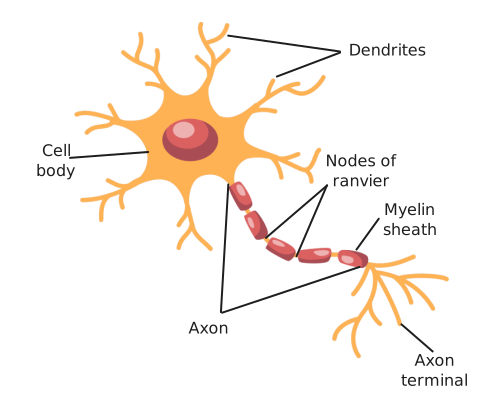
The structure of a myelinated motor neurone.The Resting PotentialJump to notes →
The establishment of a resting potential in terms of differential membrane permeability, electrochemical gradients and the movement of sodium ions and potassium ions.The Action Potential & All-or-Nothing PrincipleJump to notes →
Changes in membrane permeability lead to depolarisation and the generation of an action potential. The all-or-nothing principle.Passage of an Action PotentialJump to notes →
The passage of an action potential along non-myelinated and myelinated axons, resulting in nerve impulses.The Refractory PeriodJump to notes →
The nature and importance of the refractory period in producing discrete impulses and in limiting the frequency of impulse transmission.Factors Affecting Speed of ConductanceJump to notes →
Factors affecting the speed of conductance: myelination and saltatory conduction; axon diameter; temperature.Calculating Maximum Impulse FrequencySkillMS 0.2Jump to notes →
Students could use appropriate units when calculating the maximum frequency of impulse conduction given the refractory period of a neurone.
-
Synaptic Transmission
Spec points
Structure of a Synapse & Neuromuscular JunctionJump to notes →
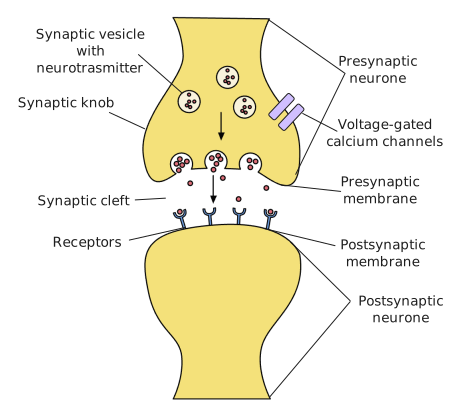
The detailed structure of a synapse and of a neuromuscular junction.Transmission Across a Cholinergic SynapseJump to notes →
The sequence of events involved in transmission across a cholinergic synapse in sufficient detail to explain:
• unidirectionality
• temporal and spatial summation
• inhibition by inhibitory synapses.Synapse vs Neuromuscular JunctionJump to notes →
A comparison of transmission across a cholinergic synapse and across a neuromuscular junction.Effects of Drugs on SynapsesJump to notes →
Students should be able to use information provided to predict and explain the effects of specific drugs on a synapse.
(Recall of the names and mode of action of individual drugs will not be required.)
-
Skeletal Muscles
Spec points
Antagonistic Muscle PairsJump to notes →
Muscles act in antagonistic pairs against an incompressible skeleton.Structure of Skeletal Muscle & the MyofibrilJump to notes →
Gross and microscopic structure of skeletal muscle. The ultrastructure of a myofibril.The Mechanism of Muscle ContractionJump to notes →
The roles of actin, myosin, calcium ions and ATP in myofibril contraction.
The roles of calcium ions and tropomyosin in the cycle of actinomyosin bridge formation. (The role of troponin is not required.)ATP & Phosphocreatine in ContractionJump to notes →
The roles of ATP and phosphocreatine in muscle contraction.Slow & Fast Skeletal Muscle FibresJump to notes →
The structure, location and general properties of slow and fast skeletal muscle fibres.Microscopy of Skeletal MuscleSkillAT dTopic page →
Students could examine prepared slides of skeletal muscle using an optical microscope.Investigating Muscle FatigueSkillAT hTopic page →
Students could investigate the effect of repeated muscular contraction on the rate of muscle fatigue in human volunteers.
-
Kidneys
Spec points
Osmoregulation & the Role of ADHJump to notes →
Osmoregulation as control of the water potential of the blood.
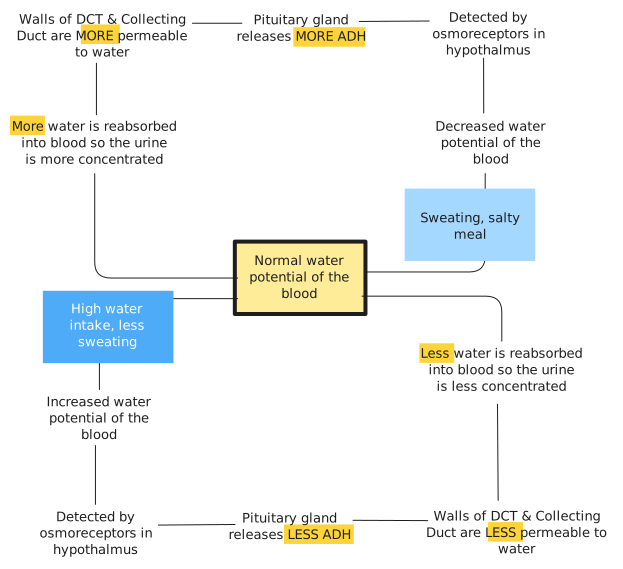
The roles of the hypothalamus, posterior pituitary and antidiuretic hormone (ADH) in osmoregulation.Structure & Role of the NephronJump to notes →
The structure of the nephron and its role in:
• the formation of glomerular filtrate
• reabsorption of glucose and water by the proximal convoluted tubule
• maintaining a gradient of sodium ions in the medulla by the loop of Henle
• reabsorption of water by the distal convoluted tubule and collecting ducts.
-
Control of Blood Glucose
Spec points
Blood Glucose & the Role of the LiverJump to notes →
The factors that influence blood glucose concentration.
The role of the liver in glycogenesis, glycogenolysis and gluconeogenesis.The Action of InsulinJump to notes →
The action of insulin by:
• attaching to receptors on the surfaces of target cells
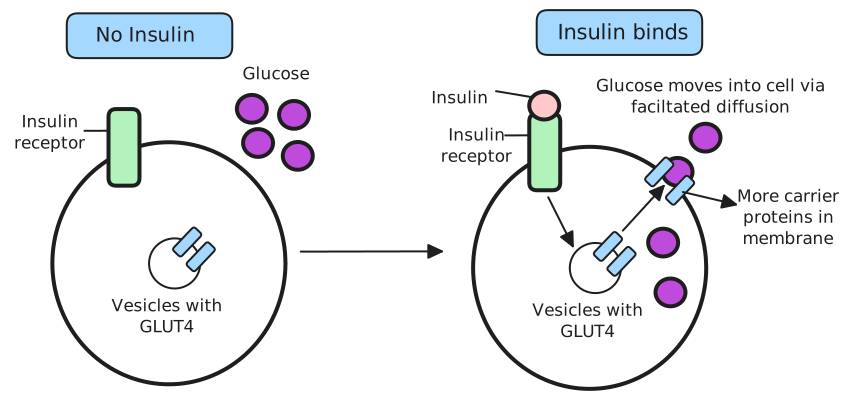
• controlling the uptake of glucose by regulating the inclusion of channel proteins in the surface membranes of target cells
• activating enzymes involved in the conversion of glucose to glycogen.The Action of GlucagonJump to notes →
The action of glucagon by:
• attaching to receptors on the surfaces of target cells
• activating enzymes involved in the conversion of glycogen to glucose
• activating enzymes involved in the conversion of glycerol and amino acids into glucose.The Role of AdrenalineJump to notes →
The role of adrenaline by:
• attaching to receptors on the surfaces of target cells
• activating enzymes involved in the conversion of glycogen to glucose.The Second Messenger ModelJump to notes →
The second messenger model of adrenaline and glucagon action, involving adenylate cyclase, cyclic AMP (cAMP) and protein kinase.Types I and II DiabetesJump to notes →
The causes of types I and II diabetes and their control by insulin and/or manipulation of the diet.
Students should be able to evaluate the positions of health advisers and the food industry in relation to the increased incidence of type II diabetes.Required Practical 11Required practicalAT bAT c
Required practical 11: Production of a dilution series of a glucose solution and use of colorimetric techniques to produce a calibration curve with which to identify the concentration of glucose in an unknown 'urine' sample.
-
S
Survival and Response
Spec points
Plant Growth Factors & IAA
Organisms increase their chance of survival by responding to changes in their environment.
In flowering plants, specific growth factors move from growing regions to other tissues, where they regulate growth in response to directional stimuli.
The effect of different concentrations of indoleacetic acid (IAA) on cell elongation in the roots and shoots of flowering plants as an explanation of gravitropism and phototropism in flowering plants.Taxes & Kineses
Taxes and kineses as simple responses that can maintain a mobile organism in a favourable environment.The Simple Reflex Arc
The protective effect of a simple reflex, exemplified by a three-neurone simple reflex. Details of spinal cord and dorsal and ventral roots are not required.Investigating IAA and Root GrowthSkillAT h
Students could design and carry out investigations into the effects of indoleacetic acid on root growth in seedlings.Required Practical 10Required practicalAT h
Required practical 10: Investigation into the effect of an environmental variable on the movement of an animal using either a choice chamber or a maze.
-
R
Receptors
Spec points
The Pacinian Corpuscle
The Pacinian corpuscle should be used as an example of a receptor to illustrate that:
• receptors respond only to specific stimuli
• stimulation of a receptor leads to the establishment of a generator potential.
The basic structure of a Pacinian corpuscle.
Deformation of stretch-mediated sodium ion channels in a Pacinian corpuscle leads to the establishment of a generator potential.Rods, Cones & the Human Retina
The human retina in sufficient detail to show how differences in sensitivity to light, sensitivity to colour and visual acuity are explained by differences in the optical pigments of rods and cones and the connections rods and cones make in the optic nerve.Investigating Skin ReceptorsSkillAT h
Students could design and carry out investigations into:
• the sensitivity of temperature receptors in human skin
• habituation of touch receptors in human skin
• resolution of touch receptors in human skin.
-
C
Control of Heart Rate
Spec points
Myogenic Stimulation: SAN, AVN & Purkyne Tissue
Myogenic stimulation of the heart and transmission of a subsequent wave of electrical activity. The roles of the sinoatrial node (SAN), atrioventricular node (AVN) and Purkyne tissue in the bundle of His.Receptors & Autonomic Control of Heart Rate
The roles and locations of chemoreceptors and pressure receptors and the roles of the autonomic nervous system and effectors in controlling heart rate.Investigating Human Pulse RateSkillAT h
Students could design and carry out an investigation into the effect of a named variable on human pulse rate.Calculating Cardiac OutputSkillMS 2.2
Students could use values of heart rate (R) and stroke volume (V) to calculate cardiac output (CO), using the formula CO = R × V