You have probably heard of fats and oils before: these are lipids. Like carbohydrates, lipids are made of carbon, hydrogen and oxygen and they can also be used to store energy, but they have other important functions too:
- Long-term energy store: oils in seeds provide energy for the seedling when it germinates, and fat stores in animals can be used to go through hibernation periods without food. Gram for gram, lipids store about twice as much energy as carbohydrates: about 37 kJ (9 kcal) per gram, compared with about 17 kJ (4 kcal).
- Cell membranes: every membrane in a cell is built from phospholipids, a type of lipid we look at here
- Insulation and protection: fat under the skin reduces heat loss, fat around organs (e.g. kidneys) cushions them from damage, and the waxy cuticle on leaves reduces water loss
There are two groups of lipid you need to know: triglycerides and phospholipids.
Are lipids polymers?
Are lipids polymers?
No. A polymer is made of many repeating monomers joined in a chain (like glucose in starch). A triglyceride is made of one glycerol and three fatty acids, which aren’t repeating units of the same monomer, so lipids aren’t polymers.
Triglycerides
What you need to know (from the AQA specification)
What you need to know (from the AQA specification)
Triglycerides and phospholipids are two groups of lipid.
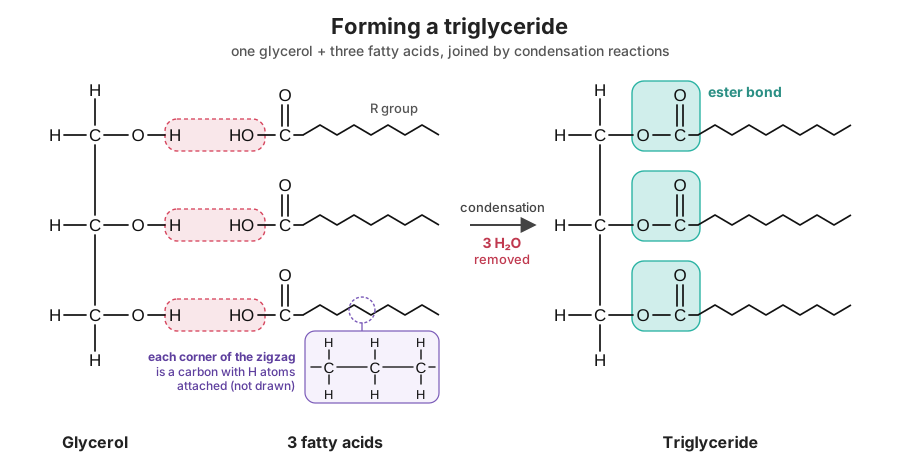
Triglycerides are formed by the condensation of one molecule of glycerol and three molecules of fatty acid.
A condensation reaction between glycerol and a fatty acid (RCOOH) forms an ester bond.
A triglyceride is made of:
- Glycerol: a small molecule with three OH groups
- Three fatty acids: each has a carboxyl group (COOH) at one end and a long hydrocarbon chain (the R group) attached. Fatty acids can be saturated or unsaturated: we look at this later
Formation of Triglycerides
Each fatty acid joins to one of glycerol’s OH groups in a condensation reaction. A molecule of water is removed and an ester bond forms. The result is a triglyceride with:
- Three ester bonds
- Three molecules of water removed when it forms
Which atoms are removed to make an ester bond? (Try it before looking at the diagram)
Which atoms are removed to make an ester bond? (Try it before looking at the diagram)
- The H from one of glycerol’s OH groups
- The OH from the fatty acid’s COOH group
Together they make one molecule of water (H₂O).
Breaking Down Triglycerides
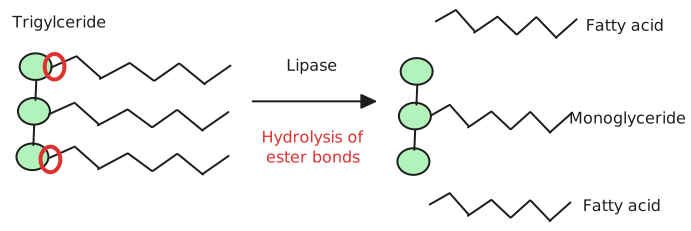
The reverse reaction, adding water to break the ester bonds, is hydrolysis. This happens when lipids are digested by lipase.
How does the structure of triglycerides relate to their properties?
The main function of triglycerides is as an energy store, e.g. fat tissue in animals and oil in seeds.
Just like with starch and glycogen, think about how their structure makes them good at storing energy.
How is the structure of triglycerides suited to being an energy store? (See if you can work it out yourself first)
How is the structure of triglycerides suited to being an energy store? (See if you can work it out yourself first)
- Lots of C–H bonds: The long fatty acid chains are full of C–H bonds, which release lots of energy when they’re respired. So a gram of fat releases about twice as much energy as a gram of carbohydrate
- Insoluble in water: they don’t affect the water potential of the cell, so water doesn’t move in by osmosis. If the store were soluble, it would lower the water potential of the cell, water would move in, and the cell could swell and burst (lysis)
Why are triglycerides insoluble in water?
Why are triglycerides insoluble in water?
The fatty acid chains are hydrophobic (non-polar), so they don’t form hydrogen bonds with water. Instead, triglycerides clump together as droplets. (This is also why the emulsion test works: the lipid forms tiny droplets in water.)
Phospholipids
What you need to know (from the AQA specification)
What you need to know (from the AQA specification)
In phospholipids, one of the fatty acids of a triglyceride is substituted by a phosphate-containing group.
A phospholipid is made of:
- Glycerol: same as in a triglyceride
- Two fatty acids (joined by ester bonds): one fewer than a triglyceride. Like in triglycerides, these can be saturated or unsaturated
- Phosphate-containing group: not in a triglyceride
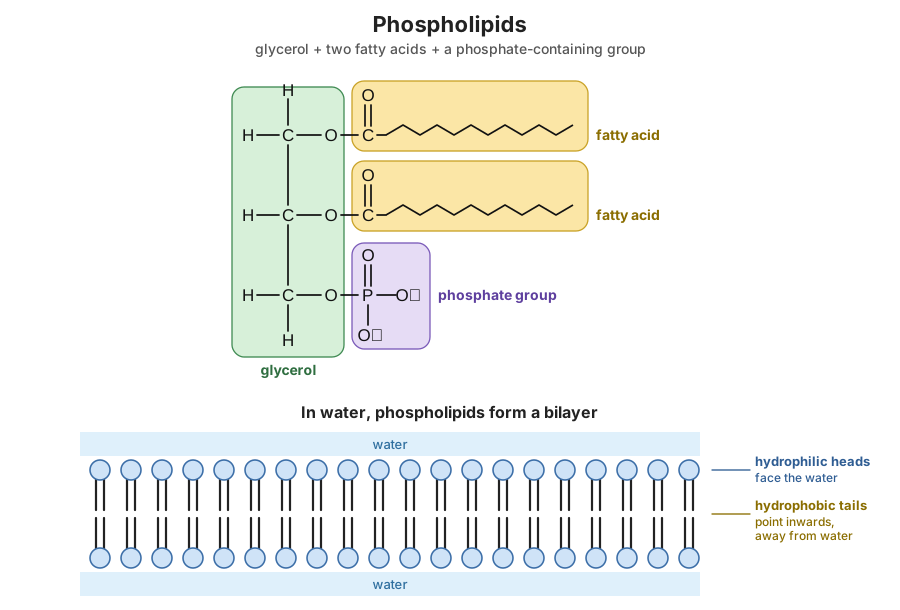
If you look at the diagram above, you can see that the two ends of the phospholipid behave very differently in water:
- The phosphate head is hydrophilic (polar): it’s attracted to water. This is because the phosphate group is negatively charged, so it’s attracted to water molecules, which are polar (see water)
- The fatty acid tails are hydrophobic (non-polar): they repel water. This is because the long hydrocarbon chains have no charge, so they can’t form hydrogen bonds with water
How does the structure of phospholipids relate to their properties?
Because phospholipids have a hydrophilic head and hydrophobic tails, in water they arrange themselves into a bilayer (also called a lipid bilayer). The heads face the water on both sides, and the tails point inwards, away from the water. This is the basis of every cell membrane.
The hydrophobic core stops water-soluble (polar) substances passing straight through, so the membrane controls what enters and leaves the cell.
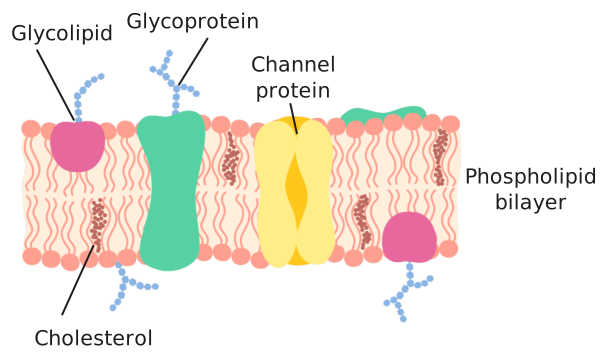
You’ll learn more about cell membranes and the other molecules in them in Unit 2.
Why do phospholipids form a bilayer in a cell membrane?
Why do phospholipids form a bilayer in a cell membrane?
- The hydrophilic heads (phosphate) are attracted to water, so they face the water on both sides of the membrane
- The hydrophobic tails (fatty acids) repel water, so they point inwards, away from the water
Comparing triglycerides and phospholipids
What you need to know (from the AQA specification)
What you need to know (from the AQA specification)
The different properties of triglycerides and phospholipids related to their different structures.
Students should be able to explain the different properties of triglycerides and phospholipids.
| Triglyceride | Phospholipid | |
|---|---|---|
| Made of | Glycerol + three fatty acids | Glycerol + two fatty acids + a phosphate-containing group |
| Bonds | Ester bonds | Ester bonds |
| Fatty acids | Saturated or unsaturated | Saturated or unsaturated |
| Elements | C, H and O | C, H, O and P |
| In water | Whole molecule hydrophobic, forms droplets | Hydrophilic head, hydrophobic tails, forms a bilayer |
| Main function | Energy store | Cell membranes |
Tip
When asked to compare and contrast, write each point as a direct comparison, e.g. “both contain glycerol and ester bonds, but a triglyceride has three fatty acids whereas a phospholipid has two fatty acids and a phosphate group”.
Saturated and Unsaturated Fatty Acids
What you need to know (from the AQA specification)
What you need to know (from the AQA specification)
The R-group of a fatty acid may be saturated or unsaturated.
Students should be able to recognise, from diagrams, saturated and unsaturated fatty acids.
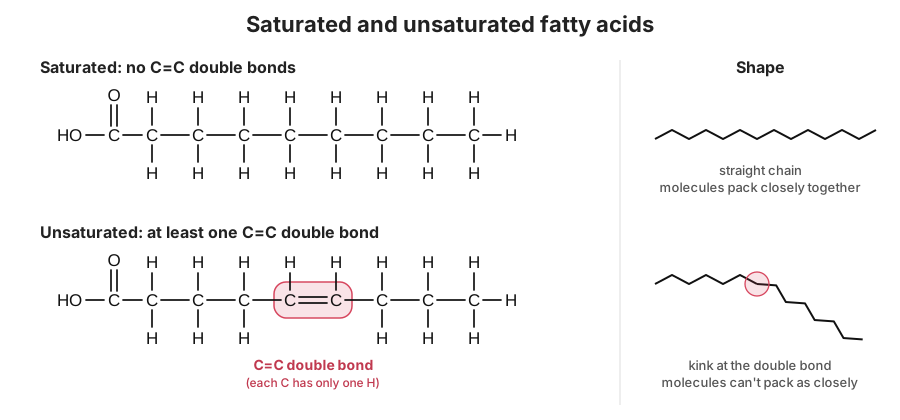
Both triglycerides (three fatty acids) and phospholipids (two fatty acids) are built with fatty acids, so let’s look at the fatty acids themselves. They differ in their R group (the hydrocarbon chain):
- Saturated: no C=C double bonds.
- Every carbon is bonded to as many hydrogen atoms as possible (it’s “saturated” with hydrogen). The chain is straight, so the molecules pack closely together.
- Unsaturated: at least one C=C double bond.
- Each double bond puts a kink in the chain, so the molecules can’t pack as closely. (One double bond is monounsaturated, more than one is polyunsaturated.)
Which do you think has a lower melting point, saturated or unsaturated fatty acids?
Which do you think has a lower melting point, saturated or unsaturated fatty acids?
Unsaturated. Because unsaturated fatty acids can’t pack closely, they have lower melting points. That’s why animal fats (mostly saturated) are solid at room temperature, while plant oils (mostly unsaturated) are liquid.
The same kinks matter in cell membranes: phospholipids with unsaturated fatty acids make the cell-surface membrane more fluid, because the kinked tails can’t pack tightly.
Emulsion Test for Lipids
What you need to know (from the AQA specification)
What you need to know (from the AQA specification)
The emulsion test for lipids.
Students could use, and interpret the results of, the emulsion test for lipids.
Below are the steps to test if a substance contains lipids
- Add ethanol to the sample and shake (any lipid dissolves in the ethanol)
- Pour the mixture into water and shake
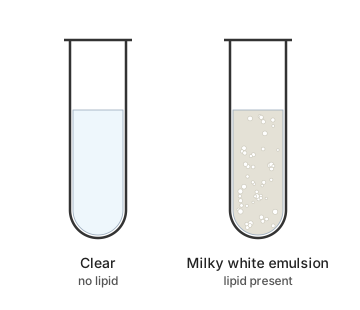
- If a lipid is present, a white (milky) emulsion forms. If not, it stays clear
Why does a milky emulsion form?
Why does a milky emulsion form?
Lipids dissolve in ethanol but not in water. When the ethanol is added to water, the lipid comes out of solution as lots of tiny droplets spread through the water. These droplets scatter light, so the mixture looks milky white.
How this topic is tested
This analysis is based on past paper data from 2017 to 2025. It is intended for interest only and is not predictive of what will appear in future papers.
- Tested in 3 of 9 years (2017–2025): 7 question parts worth 17 marks.
- 42nd most-examined topic overall by marks, 5th in Unit 1.
Marks by year
Most-tested spec points
- Triglycerides & Ester Bonds: tested in 3 parts (11 marks)
- Relating Structure to Properties: tested in 3 parts (9 marks)
- Phospholipids: tested in 1 part (5 marks)
- Saturated & Unsaturated Fatty Acids: tested in 3 parts (3 marks)
Also links to: Membrane Structure & the Fluid-Mosaic Model, Phagocytosis.
Tips from examiner reports
What students commonly get wrong
- Ester bond: name it, and know which atoms are removedWatch out: the bond between glycerol and a fatty acid is an ester bond, not glycosidic (that's between sugars). The water removed is the H from an OH group on glycerol and the OH from the COOH of the fatty acid: not an H from a C–H, and not an OH from both. 2024 P1 Q1.1
- Triglycerides: three water moleculesWatch out: one glycerol joins to three fatty acids, so three condensation reactions happen and three molecules of water are removed. Saying just "water is removed" misses the mark. 2021 P1 Q8.1
- Saturation: double bonds and hydrogen atomsWatch out: describe saturation in terms of C=C double bonds (e.g. "as the number of double bonds increases, melting point decreases"). If you talk about hydrogen, say hydrogen atoms, not hydrogen molecules. 2024 P1 Q1.3
- Bilayer: heads like water, tails don'tWatch out: the phosphate heads are hydrophilic and the fatty acid tails are hydrophobic; don't swap them. To explain the bilayer, link it to water: heads face the water on both sides, tails point away from it. If you draw it, label the heads, tails and where the water is. 2025 P1 Q1.2
- Membrane fluidity: unsaturated fatty acidsWatch out: link the cause to the effect. More unsaturated fatty acids in the phospholipids make the cell-surface membrane more fluid, because the kinks at the C=C double bonds stop the tails packing closely together, so the phospholipids can move more freely. 2024 P1 Q1.4
- Emulsion test: milky white, not cloudyWatch out: a positive emulsion test is a white (milky) emulsion. "Cloudy" isn't accepted. 2019 P1 Q10.2
Exam Question Practice
Describe how a triglyceride molecule is formed.
(3 marks)
Hint
What are the two types of molecule in a triglyceride, and how many of each? What type of reaction joins them, and what is released?
Mark Scheme
- One glycerol and three fatty acids (1 mark)
- Condensation (reactions) and removal of three molecules of water (1 mark)
- Ester bond(s) (formed) (1 mark)
Comments from mark scheme
Tips from examiner reports
Tips from the examiner report
- Include all three parts: one glycerol and three fatty acids, joined by ester bonds in condensation reactions
- Say three water molecules are removed; this was often missed
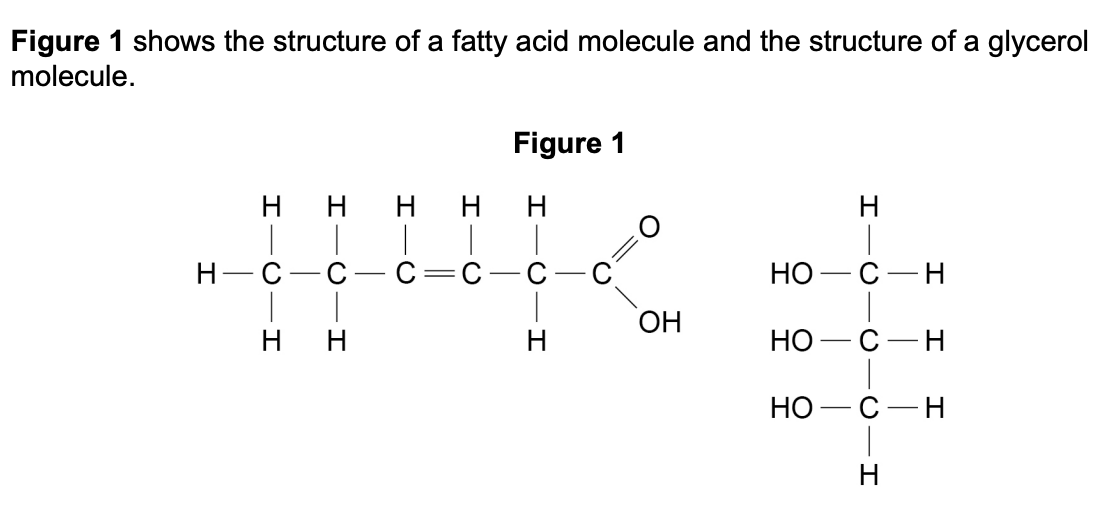
On Figure 1, draw a circle around the part of the fatty acid molecule and the part of the glycerol molecule that is removed to form a bond in a triglyceride molecule.
Name the bond formed between a fatty acid and glycerol in a triglyceride molecule.
Name the reaction involved in forming a bond between a fatty acid and glycerol in a triglyceride molecule.
Bond = ________
Reaction = ________
(3 marks)
Hint
Think about what molecule is released when bonds form between monomers. Which specific atoms from each molecule combine to form that released molecule?
Mark Scheme
- Circle(s)/shape(s) drawn around H in one of the HO groups of the glycerol and the OH group of the fatty acid (1 mark)
- Ester (bond) (1 mark)
- Condensation (reaction) (1 mark)
Comments from mark scheme
1. Accept circle(s)/shape(s) drawn around the OH group of one molecule and the H of an OH group of the other molecule
Tips from examiner reports
Tips from the examiner report
- Name the bond as an ester bond, not a glycosidic bond
- Circle the OH of the fatty acid’s carboxyl group and the H of an OH group on glycerol; together they form the water that is removed
- Don’t circle an H from a C–H group of glycerol, and don’t circle an OH on both molecules
What earned marks
- Most students knew the bond is formed by a condensation reaction
Describe and explain the arrangement of phospholipid molecules in the cell-surface membrane.
(2 marks)
Hint
Think about which part of a phospholipid is attracted to water and which part is repelled by it, and how this makes the molecules arrange themselves with water on both sides of the membrane.
Mark Scheme
- Bilayer (of phospholipids) (1 mark)
- (Because) hydrophilic heads/phosphate attracted/point to water
OR (Because) hydrophobic tails/fatty acids repel/point away from water (1 mark)
Comments from mark scheme
1. Accept a correctly labelled diagram of bilayer OR description of bilayer
2. Accept polar/charged for ‘hydrophilic’
2. Accept non-polar/not charged for ‘hydrophobic’
Tips from examiner reports
Tips from the examiner report
- Explain why a bilayer forms, not just that it is one: the phosphate heads are hydrophilic and point towards water, the fatty acid tails are hydrophobic and point away from it
- Double-check which part is which: heads hydrophilic, tails hydrophobic
- Stick to the arrangement; points about permeability or carrier proteins gain no marks
- If you draw a diagram, label it and show where the water is
What earned marks
- Identifying the phospholipid bilayer (most students got this mark)
The melting point is the temperature at which a solid changes state to be a liquid.
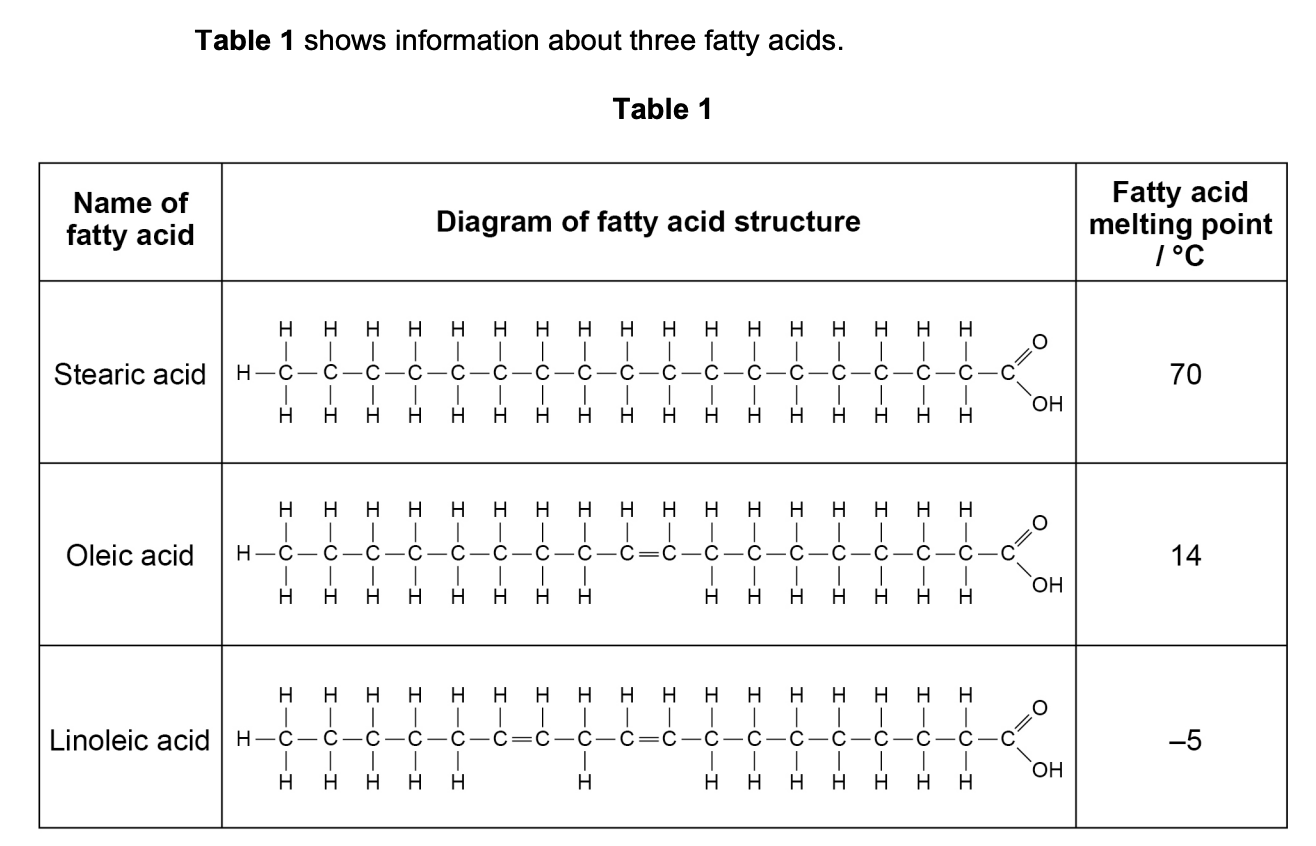
Use Table 1 to describe the relationship between fatty acid structure and fatty acid melting point.
(1 marks)
Hint
Consider how the presence of double bonds affects the shape of fatty acid chains and how they pack together.
Mark Scheme
- As (number of C) double bonds increases, melting point decreases
OR As unsaturation increases, melting point decreases
OR As saturation increases, melting point increases (1 mark)
Comments from mark scheme
Accept converse
Accept C=C for double bonds
Accept as (number of) hydrogen/H (atoms) increases, melting point increases
Tips from examiner reports
Tips from the examiner report
- Describe the link using carbon–carbon double bonds: as the number of double bonds increases, the melting point decreases
- If you mention hydrogen, refer to hydrogen atoms, not hydrogen molecules
- Read the question: it asks about melting point, not boiling point
The ratio of saturated to unsaturated fatty acids in a cell-surface membrane determines the extent of the membrane’s fluidity.
Scientists provided a cell culture of mouse phagocytes with liquid broth rich in unsaturated fatty acids.
The scientists observed:
- an increase in the proportion of phospholipids in the phagocytes containing unsaturated fatty acids
- more phagocytosis.
Suggest and explain why there was more phagocytosis.
(3 marks)
Hint
Think about what physical property of the membrane would help a cell wrap around and engulf a pathogen. How does fatty acid composition affect this property?
Mark Scheme
- More unsaturated fatty acids increases fluidity (in (cell-surface membrane) (1 mark)
- (Making cell-surface) membrane more fluid/ flexible (1 mark)
- Easy to engulf (1 mark)
Comments from mark scheme
Accept for 2 marks, more unsaturated fatty acids increases membrane fluidity
3. Accept endocytosis for engulf
3. Accept more/easier for phagosomes to form
Tips from examiner reports
Tips from the examiner report
- Say the membrane contains more unsaturated fatty acids, which makes the cell-surface membrane more fluid; don’t just repeat the question
- Refer to the cell-surface membrane, not just “the bilayer”
- Explain how a more fluid membrane makes engulfing easier, rather than describing phagosomes and lysosomes
- The fatty acids are not antigens, so don’t describe an immune response to them
Accept all marks in suitably labelled diagram OR in a balanced equation