29 of 29 spec points in this unit have notes.
- Notes
- Suggested skills activity
- Coming soon
-
DNA, Genes & Chromosomes
Spec points
3.4.1 DNA, Genes and Chromosomes
DNA in Prokaryotes & EukaryotesJump to notes →
In prokaryotic cells, DNA molecules are short, circular and not associated with proteins.
In the nucleus of eukaryotic cells, DNA molecules are very long, linear and associated with proteins, called histones. Together a DNA molecule and its associated proteins form a chromosome.
The mitochondria and chloroplasts of eukaryotic cells also contain DNA which, like the DNA of prokaryotes, is short, circular and not associated with protein.Genes & LociJump to notes →
A gene is a base sequence of DNA that codes for:
• the amino acid sequence of a polypeptide
• a functional RNA (including ribosomal RNA and tRNAs).
A gene occupies a fixed position, called a locus, on a particular DNA molecule.The Triplet CodeJump to notes →
A sequence of three DNA bases, called a triplet, codes for a specific amino acid. The genetic code is universal, non-overlapping and degenerate.Exons, Introns & Non-coding DNAJump to notes →
In eukaryotes, much of the nuclear DNA does not code for polypeptides. There are, for example, non-coding multiple repeats of base sequences between genes. Even within a gene only some sequences, called exons, code for amino acid sequences. Within the gene, these exons are separated by one or more non-coding sequences, called introns.
3.4.2 DNA and Protein Synthesis
Interpreting the Genetic CodeJump to notes →
Students should be able to:
• relate the base sequence of nucleic acids to the amino acid sequence of polypeptides, when provided with suitable data about the genetic code
• interpret data from experimental work investigating the role of nucleic acids.
Students will not be required to recall in written papers specific codons and the amino acids for which they code.
-
DNA and Protein Synthesis
Spec points
Genome & ProteomeJump to notes →
The concept of the genome as the complete set of genes in a cell and of the proteome as the full range of proteins that a cell is able to produce.mRNA & tRNA StructureJump to notes →
The structure of molecules of messenger RNA (mRNA) and of transfer RNA (tRNA).TranscriptionJump to notes →
Transcription as the production of mRNA from DNA. The role of RNA polymerase in joining mRNA nucleotides.
• In prokaryotes, transcription results directly in the production of mRNA from DNA.
• In eukaryotes, transcription results in the production of pre-mRNA; this is then spliced to form mRNA.TranslationJump to notes →
Translation as the production of polypeptides from the sequence of codons carried by mRNA. The roles of ribosomes, tRNA and ATP.
-
Genetic Diversity: Mutation and Meiosis
Spec points
Gene MutationsJump to notes →
Gene mutations involve a change in the base sequence of chromosomes. They can arise spontaneously during DNA replication and include base deletion and base substitution. Due to the degenerate nature of the genetic code, not all base substitutions cause a change in the sequence of encoded amino acids. Mutagenic agents can increase the rate of gene mutation.Chromosome Non-disjunctionJump to notes →
Mutations in the number of chromosomes can arise spontaneously by chromosome non-disjunction during meiosis.The Process of MeiosisJump to notes →
Meiosis produces daughter cells that are genetically different from each other.
The process of meiosis only in sufficient detail to show how:
• two nuclear divisions result usually in the formation of four haploid daughter cells from a single diploid parent cell
• genetically different daughter cells result from the independent segregation of homologous chromosomes
• crossing over between homologous chromosomes results in further genetic variation among daughter cells.Meiosis, Fertilisation & VariationJump to notes →
Students should be able to:
• complete diagrams showing the chromosome content of cells after the first and second meiotic division, when given the chromosome content of the parent cell
• explain the different outcome of mitosis and meiosis
• recognise where meiosis occurs when given information about an unfamiliar life cycle
• explain how random fertilisation of haploid gametes further increases genetic variation within a species.Examining Meiosis Under the MicroscopeSkillAT dTopic page →
Students could examine meiosis in prepared slides of suitable plant or animal tissue.Calculating Chromosome CombinationsSkillMS 0.5Jump to notes →
Students could:
• use the expression 2ⁿ to calculate the possible number of different combinations of chromosomes following meiosis, without crossing over
• derive a formula from this to calculate the possible number of different combinations of chromosomes following random fertilisation of two gametes,
where n is the number of homologous chromosomes pairs.
-
Genetic Diversity and Adaptation
Spec points
Genetic Diversity & Natural SelectionJump to notes →
Genetic diversity as the number of different alleles of genes in a population.
Genetic diversity is a factor enabling natural selection to occur.Principles of Natural SelectionJump to notes →
The principles of natural selection in the evolution of populations.
• Random mutation can result in new alleles of a gene.
• Many mutations are harmful but, in certain environments, the new allele of a gene might benefit its possessor, leading to increased reproductive success.
• The advantageous allele is inherited by members of the next generation.
• As a result, over many generations, the new allele increases in frequency in the population.Directional & Stabilising SelectionJump to notes →
Directional selection, exemplified by antibiotic resistance in bacteria, and stabilising selection, exemplified by human birth weights.Types of AdaptationJump to notes →
Natural selection results in species that are better adapted to their environment. These adaptations may be anatomical, physiological or behavioural.Interpreting Selection DataJump to notes →
Students should be able to:
• use unfamiliar information to explain how selection produces changes within a population of a species
• interpret data relating to the effect of selection in producing change within populations
• show understanding that adaptation and selection are major factors in evolution and contribute to the diversity of living organisms.Logarithmic Scales for Bacterial DataSkillMS 2.5Jump to notes →
Students could use a logarithmic scale when dealing with data relating to large numbers of bacteria in a culture.Required Practical 6Required practicalAT iJump to notes →
Required practical 6: Use of aseptic techniques to investigate the effect of antimicrobial substances on microbial growth.
-
Species and Taxonomy
Spec points
Species & Courtship BehaviourJump to notes →
Two organisms belong to the same species if they are able to produce fertile offspring. Courtship behaviour as a necessary precursor to successful mating. The role of courtship in species recognition.Phylogenetic ClassificationJump to notes →
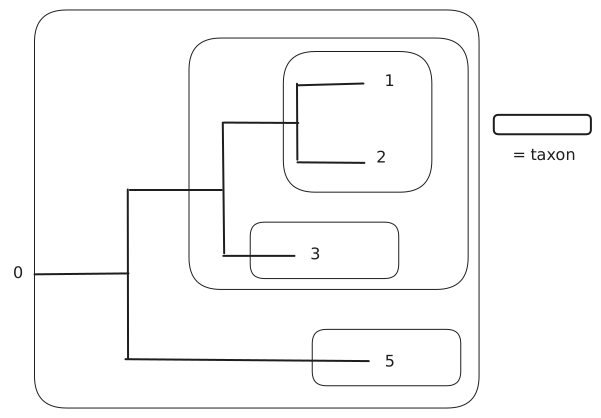
A phylogenetic classification system attempts to arrange species into groups based on their evolutionary origins and relationships. It uses a hierarchy in which smaller groups are placed within larger groups, with no overlap between groups. Each group is called a taxon (plural taxa).The Taxonomic Hierarchy & Binomial NamingJump to notes →
One hierarchy comprises the taxa: domain, kingdom, phylum, class, order, family, genus and species.
Each species is universally identified by a binomial consisting of the name of its genus and species, eg, Homo sapiens.
Recall of different taxonomic systems, such as the three domain or five kingdom systems, will not be required.Immunology & Genome Sequencing in ClassificationJump to notes →
Students should be able to appreciate that advances in immunology and genome sequencing help to clarify evolutionary relationships between organisms.
-
Biodiversity in the Community
Spec points
Biodiversity & Species RichnessJump to notes →
Biodiversity can relate to a range of habitats, from a small local habitat to the Earth.
Species richness is a measure of the number of different species in a community.Index of DiversityMS 2.3Jump to notes →
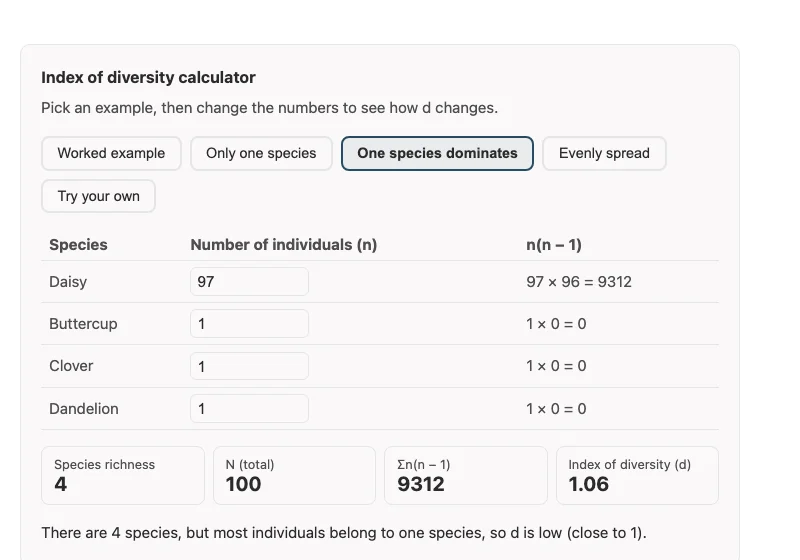
An index of diversity describes the relationship between the number of species in a community and the number of individuals in each species.
Calculation of an index of diversity (d) from the formula
d = N(N − 1) / Σn(n − 1)
where N = total number of organisms of all species
and n = total number of organisms of each species.
Students could be given data from which to calculate an index of diversity and interpret the significance of the calculated value of the index.Farming & BiodiversityJump to notes →
Farming techniques reduce biodiversity. The balance between conservation and farming.
-
Investigating Diversity
Spec points
Comparing Genetic DiversityJump to notes →
Genetic diversity within, or between species, can be made by comparing:
• the frequency of measurable or observable characteristics
• the base sequence of DNA
• the base sequence of mRNA
• the amino acid sequence of the proteins encoded by DNA and mRNA.Interpreting Sequence DataJump to notes →
Students should be able to:
• interpret data relating to similarities and differences in the base sequences of DNA and in the amino acid sequences of proteins to suggest relationships between different organisms within a species and between species
• appreciate that gene technology has caused a change in the methods of investigating genetic diversity; inferring DNA differences from measurable or observable characteristics has been replaced by direct investigation of DNA sequences.
Knowledge of gene technologies will not be tested.Quantitative Investigation of VariationJump to notes →
Quantitative investigations of variation within a species involve:
• collecting data from random samples
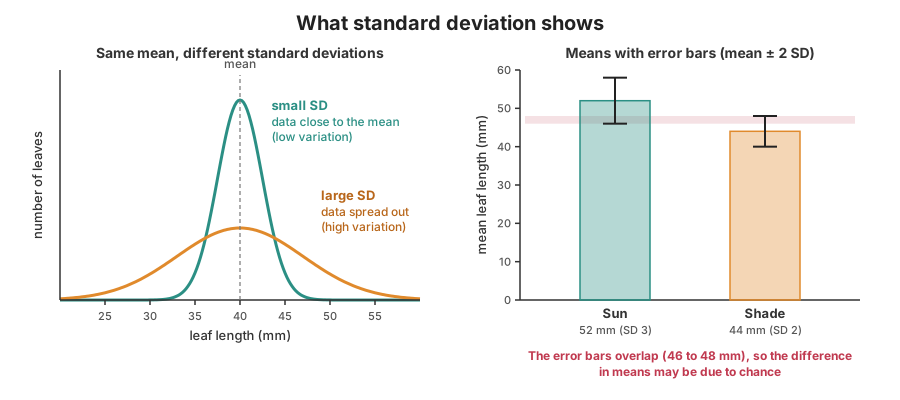
• calculating a mean value of the collected data and the standard deviation of that mean
• interpreting mean values and their standard deviations.
Students will not be required to calculate standard deviations in written papers.Random Sampling MethodsSkillAT kJump to notes →
Students could:
• design appropriate methods to ensure random sampling
• carry out random sampling within a single population
• use random samples to investigate the effect of position on the growth of leaves.Calculating Mean ValuesSkillMS 1.2Jump to notes →
Students could use standard scientific calculators to calculate the mean values of data they have collected or have been given.Calculating Standard DeviationSkillMS 1.10Jump to notes →
Students could calculate, and interpret the values of, the standard deviations of their mean values.