Dihybrid Crosses
What you need to know (from the AQA specification)
What you need to know (from the AQA specification)
The use of fully labelled genetic diagrams to interpret, or predict, the results of:
- monohybrid and dihybrid crosses involving dominant, recessive and codominant alleles
- crosses involving sex-linkage, autosomal linkage, multiple alleles and epistasis.
Students could use information to represent phenotypic ratios in monohybrid and dihybrid crosses.
A dihybrid cross looks at two genes at the same time, each on a different chromosome. Each gamete gets one allele of each gene.
Worked example: crossing two plants heterozygous for both genes
In pea plants, round seeds (R) are dominant to wrinkled (r), and yellow seeds (Y) are dominant to green (y). Two plants heterozygous for both genes are crossed (RrYy × RrYy).
Each parent can make four types of gamete: RY, Ry, rY, ry.
How to find the gametes
Gametes from parent 1 (RrYy)
Gametes from parent 2 (RrYy)
| RY | Ry | rY | ry | |
|---|---|---|---|---|
| RY | RRYYround yellow | RRYyround yellow | RrYYround yellow | RrYyround yellow |
| Ry | RRYyround yellow | RRyyround green | RrYyround yellow | Rryyround green |
| rY | RrYYround yellow | RrYyround yellow | rrYYwrinkled yellow | rrYywrinkled yellow |
| ry | RrYyround yellow | Rryyround green | rrYywrinkled yellow | rryywrinkled green |
- 9 round yellow : 3 round green : 3 wrinkled yellow : 1 wrinkled green
- Ratio: 9 : 3 : 3 : 1
Test Cross
- A test cross means crossing with a parent that is homozygous recessive for both genes (here rryy).
- That parent can only pass on recessive alleles, so the offspring’s phenotypes show which alleles were in the other parent’s gametes.
- A dihybrid test cross (RrYy × rryy) gives 1 round yellow : 1 round green : 1 wrinkled yellow : 1 wrinkled green, so all four phenotypes appear in equal numbers.
How many different gametes can a plant with the genotype RrYy make?
How many different gametes can a plant with the genotype RrYy make?
Four: RY, Ry, rY and ry. Each gamete gets one allele of the R gene and one allele of the Y gene.
This works because of independent segregation in meiosis. The two genes are on different chromosomes, and each homologous pair lines up independently, so which R allele a gamete gets doesn’t affect which Y allele it gets (see Independent segregation).
Autosomal Linkage
An autosome is any chromosome that isn’t a sex chromosome (i.e any of the 22 pairs of chromosomes in humans). Autosomal linkage is when two genes are on the same autosome, so they tend to be inherited together. Because of this, it often behaves more like a monohybrid cross (i.e as both genes are inherited together).
This changes the results of a dihybrid cross. In a test cross of AaBb × aabb:
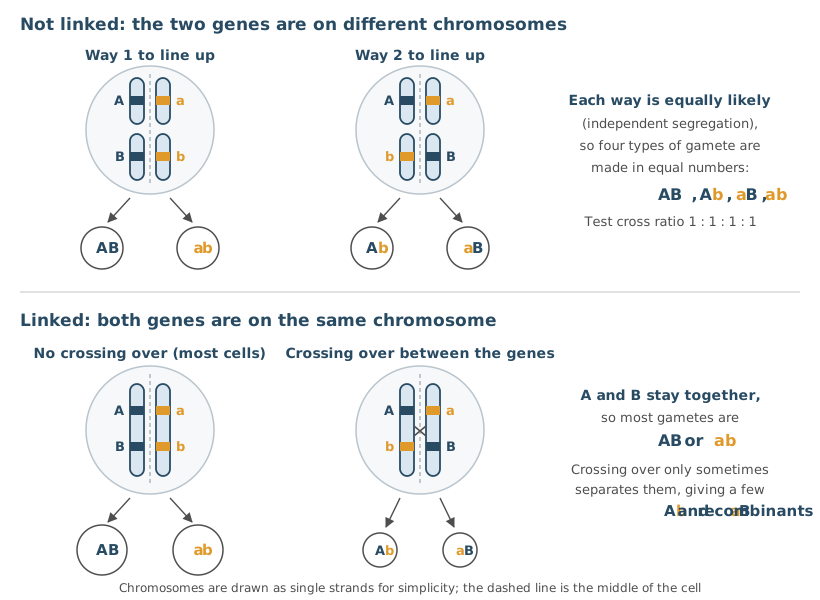
- If the genes are on different chromosomes, the two homologous pairs can line up either way in meiosis (independent segregation, shown in the top half of the diagram below), so you’d expect 1 : 1 : 1 : 1 (as per test cross example above)
- If the genes are linked (A and B on one chromosome, a and b on the other), most gametes are AB or ab. So most offspring have the same combinations as the parents (AaBb and aabb)
- The two genes are inherited together as if they were one gene, so the results look more like a monohybrid cross (close to 1 : 1 in a test cross, instead of 1 : 1 : 1 : 1)
A few offspring have new combinations (Aabb and aaBb). These are recombinants, made when crossing over in meiosis swaps alleles between the chromosomes (see image below, crossing over between genes).
A dihybrid test cross gives lots of offspring with the parental phenotypes and only a few with new combinations. What does this suggest?
A dihybrid test cross gives lots of offspring with the parental phenotypes and only a few with new combinations. What does this suggest?
The two genes are linked (on the same autosome), so the alleles are usually inherited together. The few offspring with new combinations are recombinants, produced by crossing over during meiosis.
Epistasis
Epistasis is when one gene affects the expression of another gene, often by masking it. The gene doing the masking is called the epistatic gene.
- Recessive epistasis: the epistatic gene only masks the other gene when it has two recessive alleles (e.g. cc).
- Dominant epistasis: one dominant allele of the epistatic gene is enough to mask the other gene (e.g. W).
Recessive epistasis
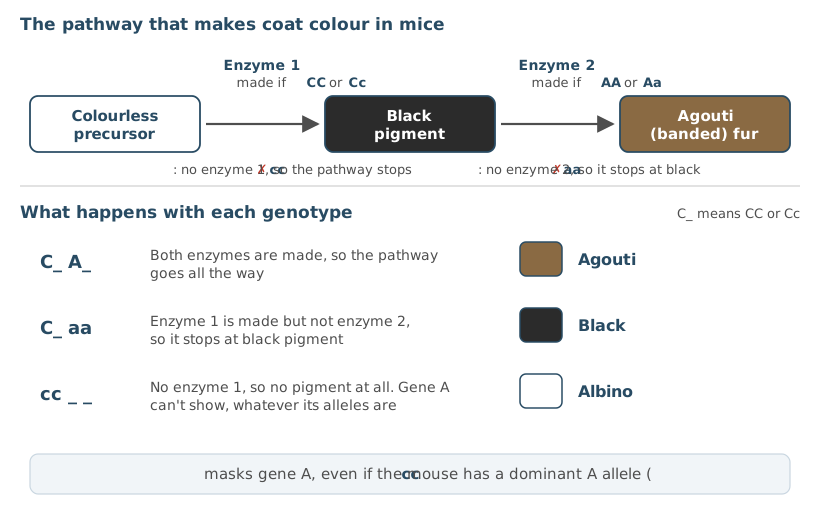
In mice, coat colour depends on two genes. Each one codes for an enzyme in the pathway that makes the coat pigment:
- Gene C codes for enzyme 1, which makes black pigment from a colourless substance. The C allele makes a working enzyme, but c doesn’t.
- Gene A codes for enzyme 2, which turns the black pigment into agouti (brown-grey) fur. A (agouti) is dominant to a (black).
Important: If the genotype is ccAa (i.e recessive epistatic gene cc), this stops enzyme 1 working (i.e can’t turn from colourless to black), but it will also mask enzyme 2 (even if the genotype is AA or Aa). The mouse will remains albino.
Two mice that are CcAa are crossed. What ratio of agouti : black : albino would you expect?
Two mice that are CcAa are crossed. What ratio of agouti : black : albino would you expect?
9 agouti : 3 black : 4 albino. Start from the usual 9 : 3 : 3 : 1:
- 9 C_A_: agouti
- 3 C_aa: black
- 3 ccA_ + 1 ccaa = 4 albino. These two groups merge because every cc mouse is albino.
Dominant epistasis
In squash, fruit colour also depends on two genes. Gene W is the epistatic gene and gene Y is the gene it masks:
- Gene W: the dominant allele W stops any colour being made, so the fruit is white.
- Gene Y: controls the colour when there is no W allele. Y (yellow) is dominant to y (green).
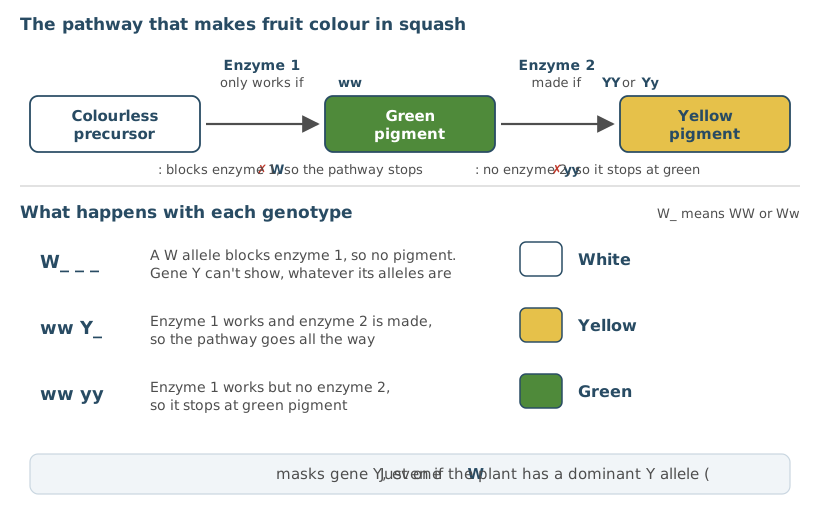
This is dominant epistasis because just one dominant allele (W) masks gene Y. However in the mice example above, the colour is lost when the mouse is cc, but here colour is lost when there is a W.
Two squash plants that are WwYy are crossed. What ratio of white : yellow : green would you expect?
Two squash plants that are WwYy are crossed. What ratio of white : yellow : green would you expect?
12 white : 3 yellow : 1 green. Start from the usual 9 : 3 : 3 : 1:
- 9 W_Y_ + 3 W_yy = 12 white. These two groups merge because every plant with a W allele is white.
- 3 wwY_: yellow
- 1 wwyy: green
Tip
If a dihybrid cross gives a ratio like 9 : 3 : 4 or 12 : 3 : 1 instead of 9 : 3 : 3 : 1, think epistasis: the ratio adds up to 16, but some groups have merged because one gene masks the other.
Which Pattern Is It?
When you’re given the results of a cross, look at the ratio and whether males and females are affected differently:
| What you see | Cross that gives it | What it suggests |
|---|---|---|
| 3 : 1 | Aa × Aa | Monohybrid, one dominant allele |
| 1 : 1 | Aa × aa | Monohybrid test cross |
| 1 : 2 : 1 | CRCW × CRCW | Monohybrid, codominance |
| 9 : 3 : 3 : 1 | AaBb × AaBb | Dihybrid, genes on different chromosomes |
| 1 : 1 : 1 : 1 | AaBb × aabb | Dihybrid test cross |
| Mostly two phenotypes (the same as the parents) in about equal numbers, plus a few of the other two | AaBb × aabb | Autosomal linkage |
| 9 : 3 : 4 or 12 : 3 : 1 | AaBb × AaBb | Epistasis |
| Different results in males and females | e.g. XHXh × XHY | Sex-linkage |
Why are the observed results of a cross rarely exactly the same as the expected ratio?
Why are the observed results of a cross rarely exactly the same as the expected ratio?
- Fertilisation is random, so the combinations of gametes vary by chance
- The sample of offspring may be small
- Genes may be linked, and crossing over produces recombinants
- Some genotypes may be lethal
- Epistasis: one gene masks another, so some phenotype groups merge
- Epigenetics: the environment can change how genes are expressed
(Mutation isn’t a good answer, because it happens far too rarely to change the ratio. Independent segregation isn’t a reason either, because it’s what produces the expected ratio in the first place.)
Exam Question Practice
One past paper question for each part of the topic. Try each one before opening the walkthrough.
In fruit flies, a gene for wing shape has a dominant allele for curly wings, R, and a recessive allele for normal wings, r. The alleles for this gene are on a different pair of chromosomes from the gene for body colour. Fruit flies that are homozygous dominant for curly wings do not survive beyond the embryo stage.
A curly-winged fly, homozygous for grey body colour was crossed with a curly-winged, black-bodied fly.
Complete the genetic diagram to show all the possible genotypes and the ratio of phenotypes expected to develop into adults from this cross.
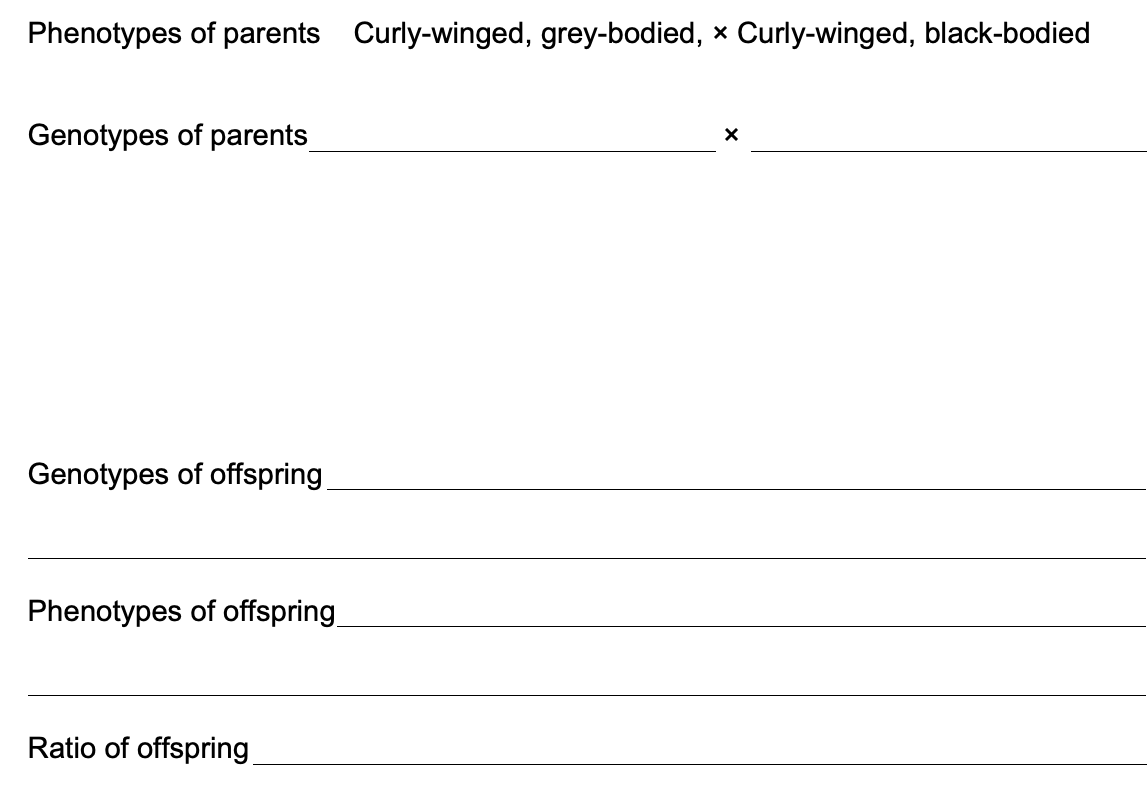
(3 marks)
Hint
Set up the dihybrid cross correctly. Remember to exclude any genotypes that don’t survive (as stated in the question) when calculating the final ratio.
Walkthrough and mark scheme
Walkthrough
Step 1: parent genotypes. Curly flies must be Rr, because RR flies die as embryos. The first fly is homozygous grey (GG); the second is black (gg). So the cross is RrGG × Rrgg.
Step 2: gametes. RrGG makes RG and rG. Rrgg makes Rg and rg.
Step 3: Punnett square.
Gametes from RrGG
Gametes from Rrgg
| RG | rG | |
|---|---|---|
| Rg | RRGgdies as an embryo | RrGgcurly, grey |
| rg | RrGgcurly, grey | rrGgnormal, grey |
Step 4: count only the flies that survive to adults. RRGg dies, leaving 2 curly grey and 1 normal grey: 2 : 1.
All the offspring are grey, because one parent can only give G. The key idea is the lethal genotype: it turns the 3 : 1 you’d expect for wings into 2 : 1.
Mark scheme
- RrGG and Rrgg (1 mark)
- RrGg, (x2), rrGg, (and RRGg) (1 mark)
- Curly(-winged), grey(-bodied) and Normal(-winged), grey(-bodied) and ratio 2 : 1 (1 mark)
Comments from mark scheme
Tips from examiner reports
Tips from the examiner report
- Read the extra condition: flies homozygous dominant for curly wings (RR) die, so leave them out of the phenotypes and ratio
- The correct ratio is 2 curly grey : 1 normal grey, not 3 : 1 or 1 : 2 : 1
- Get the parental genotypes right (RrGG and Rrgg) before drawing the cross
What earned marks
- Many gave the correct parental and offspring genotypes
In sweet pea plants, the F allele for purple flowers is dominant to the f allele for red flowers. The L allele for long pollen is dominant to the l allele for round pollen.
A scientist carried out a genetic cross between a plant with purple flowers and long pollen (heterozygous for both genes) and a plant with red flowers and round pollen.
Table 2 shows the results of this cross.
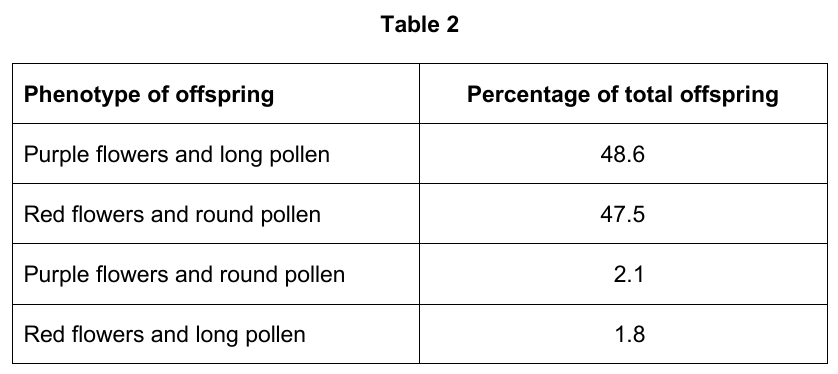
Use your knowledge of autosomal linkage to explain the results in Table 2.
Your answer should include:
- an explanation of what is meant by autosomal linkage
- a comment about the relative proportions of the different genotypes of gametes produced in this cross.
(3 marks)
Hint
If the two genes are on the same autosome, which combinations of alleles stay together in the gametes of the heterozygous parent? How could the rarer offspring arise?
Walkthrough and mark scheme
Walkthrough
Step 1: what you’d expect if the genes weren’t linked. This is a test cross (FfLl × ffll), so you’d expect 1 : 1 : 1 : 1, about 25% of each phenotype.
Step 2: what actually happened. Almost all the offspring (48.6% + 47.5%) have the parents’ combinations (purple and long, or red and round). Only about 4% have new combinations.
Step 3: explain with linkage (mark 1). The genes are linked: they are on the same autosome, with F and L on one chromosome and f and l on the other. So they’re usually inherited together.
Step 4: explain the gametes (mark 3). The heterozygous plant makes mostly FL and fl gametes, and only a few Fl and fL gametes.
Step 5: explain the few new combinations (mark 2). The few Fl and fL gametes are made by crossing over between the two genes in meiosis. The offspring they produce are recombinants.
The linkage figure above shows these gametes.
Mark scheme
- Genes are on the same chromosome/autosome (1 mark)
- Crossing over
OR Recombination (1 mark) - Fewer F l and f L (gametes)
OR More F L and f l (gametes) (1 mark)
Comments from mark scheme
1. Accept chromatid for chromosome
1. Accept alleles of different genes but not alleles unqualified
1. Accept alleles at different loci on same chromosome
2. Accept chiasma(ta) for crossing over
3. Accept if different letters used e.g. P and p for F and f
Tips from examiner reports
Tips from the examiner report
- Define autosomal linkage precisely: the two genes are on the same autosome. “Alleles” (unqualified) or “traits” on the same chromosome isn’t enough
- Comment on the gametes, not the offspring: the heterozygous parent produces mostly FL and fl gametes and only a few Fl and fL gametes
- Explain the few Fl and fL gametes by crossing over
What earned marks
- Crossing over was the most commonly credited point
In cats, males are XY and females are XX. A gene on the X chromosome controls fur colour in cats. The allele G codes for ginger fur and the allele B codes for black fur. These alleles are codominant. Heterozygous females have ginger and black patches of fur and their phenotype is described as tortoiseshell female.
The two alleles, F and f of a different gene, which is not sex-linked, interact with the gene controlling fur colour. The allele F is dominant and stops the formation of pigment in the fur, resulting in white fur. The allele f is recessive and has no effect on fur colour.
Complete the genetic diagram to show all the possible genotypes and the ratio of phenotypes expected in the offspring of this cross.
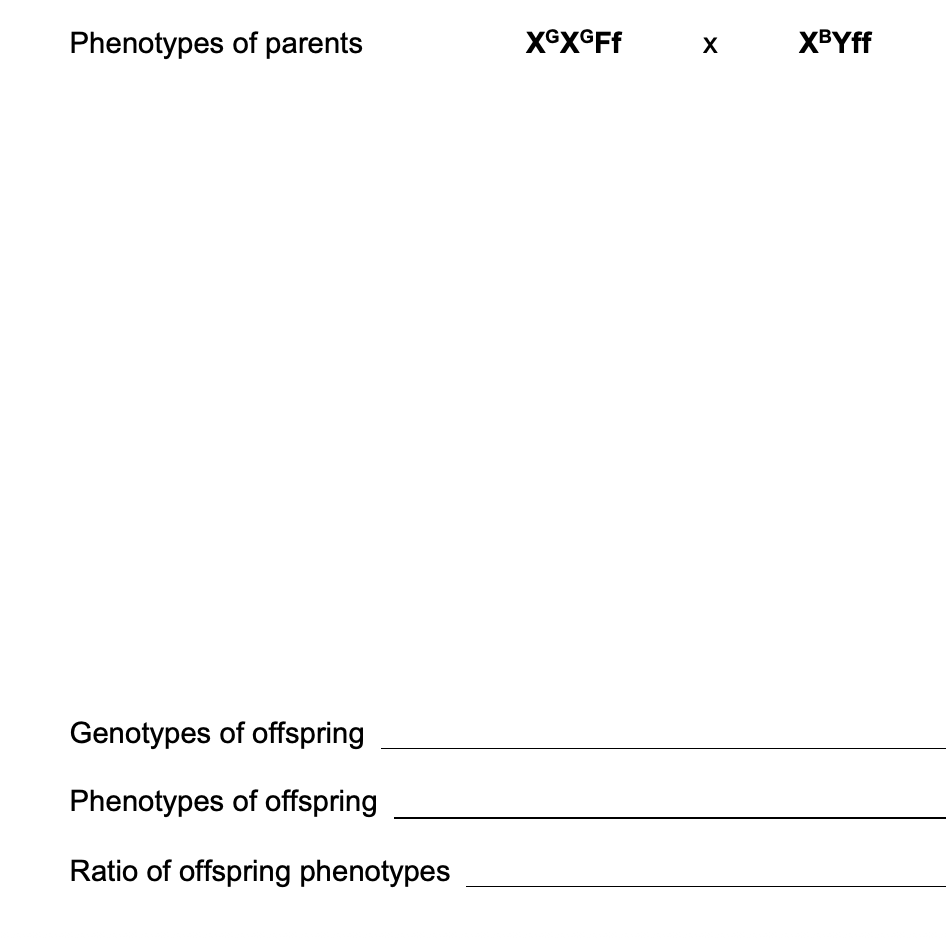
(3 marks)
Hint
Include sex in your offspring phenotypes if relevant. Don’t combine ‘male white’ and ‘female white’ - they’re different phenotypes.
Walkthrough and mark scheme
Walkthrough
Step 1: what each allele does. F is dominant epistasis: any cat with an F allele is white, whatever its colour alleles. Only ff cats show their colour. For the colour gene on the X: XGXB females are tortoiseshell, and males (one X) are either ginger or black.
Step 2: gametes. Each gamete gets one sex chromosome and one allele of the F gene:
- The female, XGXGFf, makes XGF and XGf
- The male, XBYff, makes XBf and Yf
Step 3: Punnett square.
Gametes from the female (XGXGFf)
Gametes from the male (XBYff)
| XGF | XGf | |
|---|---|---|
| XBf | XGXBFfwhite female | XGXBfftortoiseshell female |
| Yf | XGYFfwhite male | XGYffginger male |
Step 4: phenotypes and ratio. White female : tortoiseshell female : white male : ginger male = 1 : 1 : 1 : 1. Include the sex in every phenotype.
Mark scheme
- (Gametes) XGF, XGf, XBf and Yf (1 mark)
- XGXBFf, XGXBff, XGYFf and XGYff (1 mark)
- White female, Tortoiseshell female, White male, Ginger male, and ratio 1 : 1 : 1 : 1 (1 mark)
Comments from mark scheme
Allow one mark for correct dihybrid genotypes of offspring from incorrect parental gametes.
1 and 2. Accept if g and b are used throughout for G and B.
2. Accept the alleles within a genotype in any order.
1 and 2. Accept in Punnet square.
2 and 3. Accept any order of genotypes and phenotypes and accept if on incorrect answer lines.
3. Accept sequence of phenotypes does not need to mirror genotypes but must be correct.
3. Accept equivalent ratios e.g. 4:4:4:4.
3. Accept ‘Ginger and black’ for tortoiseshell and accept ‘no pigment’ for white.
Tips from examiner reports
Tips from the examiner report
- Write the gametes first: XGF and XGf from the female, XBf and Yf from the male
- Include the sex in every phenotype: white female, tortoiseshell female, white male, ginger male
- Don’t combine white males and white females: the ratio is 1 : 1 : 1 : 1, not 2 : 1 : 1
In genetic crosses, the observed phenotypic ratios obtained in the offspring are often not the same as the expected ratios.
Suggest two reasons why.
Do not refer to sex-linkage or autosomal linkage in your answer.
1 = ________
2 = ________
(2 marks)
Hint
Think about chance events when gametes fuse, genes that affect each other’s expression, and how many offspring were counted.
Walkthrough and mark scheme
Walkthrough
You can’t use linkage here, so think about chance first, then about other gene effects:
Chance:
- Small sample size: with only a few offspring, chance has a big effect on the numbers
- Random fertilisation: which gametes fuse is down to chance
Other effects on the ratio:
- Epistasis: one gene masks another, so phenotype groups merge
- Lethal genotypes: some offspring die before they’re counted
- Crossing over
- Epigenetics: the environment changes gene expression
Any two of these score. Don’t say mutation: it happens far too rarely to change a ratio.
Mark scheme
Max 2 marks
- Small sample size (1 mark)
- Crossing over (1 mark)
- Random fusion of gametes
OR Random fertilisation (1 mark) - Epistasis (1 mark)
- Lethal genotypes/alleles/genes (1 mark)
- Epigenetics (1 mark)
Comments from mark scheme
Ignore mutation and independent segregation
3. Ignore random breeding/mating
5. Ignore lethal phenotypes
Tips from examiner reports
Tips from the examiner report
- Don’t give mutation: mutations are too rare to change phenotypic ratios. Independent segregation doesn’t gain the mark either
- Say “random fertilisation” (random fusion of gametes), not “random mating”
What earned marks
- Crossing over, random fertilisation and small sample size were the most common correct answers; epistasis, epigenetics and lethal genotypes were also credited
1 and 2. Accept the alleles in any order e.g. RGrG and accept if not shown on answer lines.
Accept if different letters than shown are used for the alleles.
3. Accept ratios equivalent to 2 : 1.
Note: If no mark awarded allow one (principle) mark when parental genotypes are incorrect but correct dihybrid genotypes shown for offspring from this cross.