Inheritance lets you predict which characteristics offspring will inherit, and how likely it is to inherit them.
This topic requires you to understand and practise how to solve inheritance problems.
Practice examples
For each type of inheritance there is a Practice box. This walks you through questions and checks each answer before you move on. Each box has three practice question, so select next question to try another question.
Key Terms
What you need to know (from the AQA specification)
What you need to know (from the AQA specification)
The genotype is the genetic constitution of an organism.
The phenotype is the expression of this genetic constitution and its interaction with the environment.
There may be many alleles of a single gene.
Alleles may be dominant, recessive or codominant.
In a diploid organism, the alleles at a specific locus may be either homozygous or heterozygous.
Recap from Unit 4
Inheritance builds on Unit 4. If any of these terms are unfamiliar, go back to DNA, genes and chromosomes and Meiosis before carrying on.
-
Gene: A base sequence of DNA that codes for the amino acid sequence of a polypeptide
-
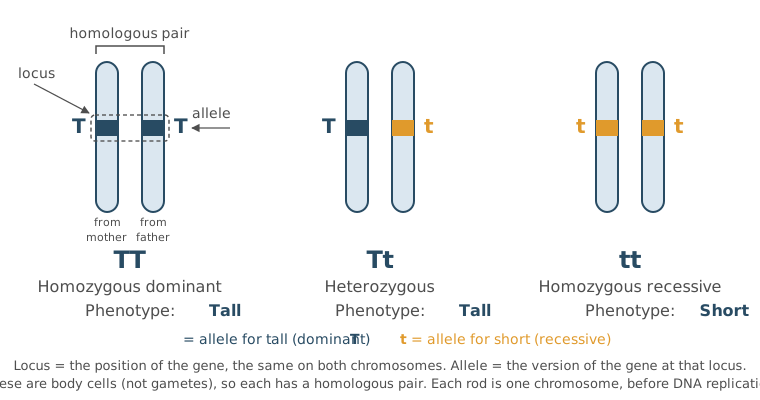
Locus: The fixed position of a gene on a chromosome (i.e. where it is on the chromosome)
-
Allele: A different version of the same gene, e.g. the gene for height in pea plants has a tall allele and a short allele. There can be many alleles of a single gene
-
Homologous chromosomes: A pair of chromosomes, one from each parent, that carry the same genes at the same loci. So you have two copies of every gene, which can be the same allele (e.g. TT) or different alleles (e.g. Tt)
-
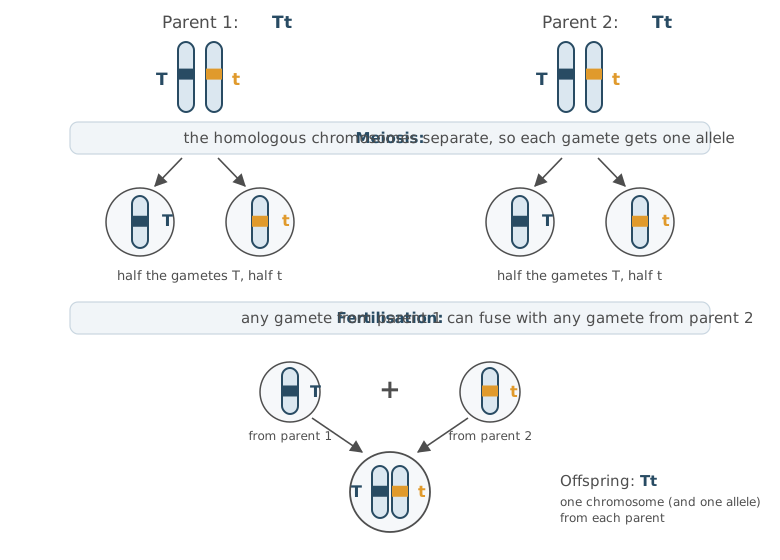
Meiosis: The cell division that happens in the testes and ovaries to make gametes. It halves the chromosome number, so each gamete gets one chromosome from each pair, and one allele of each gene.
- At fertilisation, two gametes fuse, restoring the full chromosome number. The offspring gets one chromosome of each pair from each parent, so it has two alleles of each gene.
Quick check: why does a gamete only carry one allele of each gene?
Quick check: why does a gamete only carry one allele of each gene?
Gametes are made by meiosis, which halves the chromosome number. Each gamete gets one chromosome from each homologous pair, so it only gets one of the two alleles for each gene.
New for this topic
-
The genotype is the genetic make up of an organism (the alleles it has), e.g. Tt.
-
The phenotype is the expression of the genotype and its interaction with the environment (the characteristics you can observe), e.g. tall, heavy, etc.
-
Dominant: An allele that is always expressed if it’s present (shown with a capital letter, e.g. T)
-
Recessive: An allele that is only expressed if there’s no dominant allele present (shown with a lower-case letter, e.g. t), so the recessive phenotype only shows in the homozygous form, tt
-
Codominant: Both alleles are expressed in the phenotype of a heterozygote, e.g. a flower with both red and white patches
-
Homozygous: Both alleles (at a locus) are the same (TT or tt)
-
Heterozygous: The two alleles (at a locus) are different (Tt)
How to Draw a Genetic Diagram
What you need to know (from the AQA specification)
What you need to know (from the AQA specification)
The use of fully labelled genetic diagrams to interpret, or predict, the results of:
- monohybrid and dihybrid crosses involving dominant, recessive and codominant alleles
- crosses involving sex-linkage, autosomal linkage, multiple alleles and epistasis.
Students could use information to represent phenotypic ratios in monohybrid and dihybrid crosses.
Students could show understanding of the probability associated with inheritance.
What’s actually happening in a cross?
When two organisms reproduce, their alleles go through two events:
-
Meiosis in each parent (before fertilisation). A pair of homologous chromosomes separates. Each homologous chromosome has one allele on it. This means that each gamete gets only one of these alleles. A Tt parent makes two types of gamete, T and t, in equal numbers. A TT parent makes only T gametes.
-
Fertilisation. One gamete from each parent fuses at fertilisation. Fertilisation is random, so any gamete from one parent can fuse with any gamete from the other. This is one of the sources of genetic variation you met in Unit 4 (see random fertilisation).
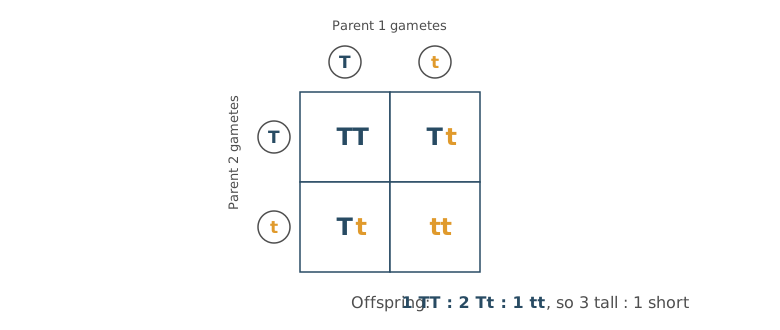
A Punnett square predicts the offspring from these two events
- The gametes each parent makes in meiosis go along the edges
- Each box shows one possible fertilisation.
- It doesn’t tell you exactly what the offspring will be: it shows the probability of each genotype (and so each phenotype). Every box is equally likely, so you can count the boxes to work out ratios and probabilities.
Steps for predicting the results of a cross
Write down all your working: it helps you work through the problem, and you can earn marks for it.
- Parent phenotypes (e.g. tall × short)
- Parent genotypes (e.g. Tt × tt)
- Gametes (each gamete gets one allele of each gene)
- Punnett square to combine the gametes
- Offspring genotypes (e.g. TT, tt)
- Offspring phenotypes (e.g. tall, short)
- Ratio of phenotypes
Monohybrid Crosses
A monohybrid cross looks at one gene, usually with two alleles (e.g. T and t).
Worked example: crossing pure-breeding parents, then their offspring
In pea plants, the allele for tall (T) is dominant to the allele for short (t).
Step 1: crossing the parents. A pure-breeding (homozygous) tall plant is crossed with a pure-breeding short plant.
- Parent phenotypes: tall × short
- Parent genotypes: TT × tt
- Gametes: T (from the TT parent) and t (from the tt parent)
Gametes from the tall parent (TT)
Gametes from the short parent (tt)
| T | T | |
|---|---|---|
| t | Tttall | Tttall |
| t | Tttall | Tttall |
- Offspring genotypes: all Tt
- Offspring phenotypes: all tall
Step 2: crossing two of the offspring. Two of the offspring (Tt) are crossed with each other.
- Parent phenotypes: tall × tall
- Parent genotypes: Tt × Tt
- Gametes: T and t from each parent
Gametes from parent 1 (Tt)
Gametes from parent 2 (Tt)
| T | t | |
|---|---|---|
| T | TTtall | Tttall |
| t | Tttall | ttshort |
- Offspring genotypes: 1 TT : 2 Tt : 1 tt
- Offspring phenotypes: 3 tall : 1 short
- Ratio: 3 : 1
The short phenotype skips a generation: the Tt plants carry the recessive allele without showing it.
A tall pea plant could be TT or Tt. How could you find out which genotype it has?
A tall pea plant could be TT or Tt. How could you find out which genotype it has?
Do a test cross: cross it with a homozygous recessive (short, tt) plant.
- If all the offspring are tall, the plant was TT
- If about half are short, the plant was Tt (Tt × tt gives 1 tall : 1 short)
Codominance
When alleles are codominant, both alleles are expressed (e.g. red and white flowers, both red and white can be expressed). This results in a third, different phenotype (e.g. pink the new phenotype).
Worked example: crossing two pink flowers
In some flowers, CR gives red flowers and CW gives white flowers. The heterozygote CRCW has pink flowers.
Crossing two pink plants (CRCW × CRCW):
Gametes from parent 1 (CRCW)
Gametes from parent 2 (CRCW)
| CR | CW | |
|---|---|---|
| CR | CRCRred | CRCWpink |
| CW | CRCWpink | CWCWwhite |
Ratio: 1 red : 2 pink : 1 white
Multiple alleles
Each individual only has 2 alleles (i.e. 2 versions of the gene), one from each parent. However, some genes will have more than two alleles. The example which is often given is the ABO blood group gene, which has three alleles:
- IA and IB are codominant
- IO is recessive to both
| Blood group (phenotype) | Possible genotypes |
|---|---|
| A | IAIA or IAIO |
| B | IBIB or IBIO |
| AB | IAIB |
| O | IOIO |
Worked example: working out the parents' genotypes
A mother with blood group A and a father with blood group B have a child with blood group O. What are the parents’ genotypes, and which blood groups could their other children have?
- Group O can only be IOIO, so the child got one IO from each parent.
- So the mother must be IAIO (not IAIA), and the father must be IBIO.
Gametes from the mother (IAIO)
Gametes from the father (IBIO)
| IA | IO | |
|---|---|---|
| IB | IAIBgroup AB | IBIOgroup B |
| IO | IAIOgroup A | IOIOgroup O |
Ratio: 1 AB : 1 B : 1 A : 1 O, so any of the four blood groups is possible (each with a probability of 1/4).
Can two parents with blood group A have a child with blood group O?
Can two parents with blood group A have a child with blood group O?
Yes, if both parents are heterozygous (IAIO). Each can pass on an IO allele, so there’s a 1 in 4 chance of a child with IOIO (group O).
Sex-linkage
Humans have 23 pairs of chromosomes (46 chromosomes in total) in nearly all of their body cells (i.e. in the nucleus, see Unit 2). The gametes (sex cells) only have 23 chromosomes after meiosis (see above).
Of these 23 pairs of chromosomes, 1 pair is the sex chromosomes. For females these are XX, and for males XY (highlighted on diagram).
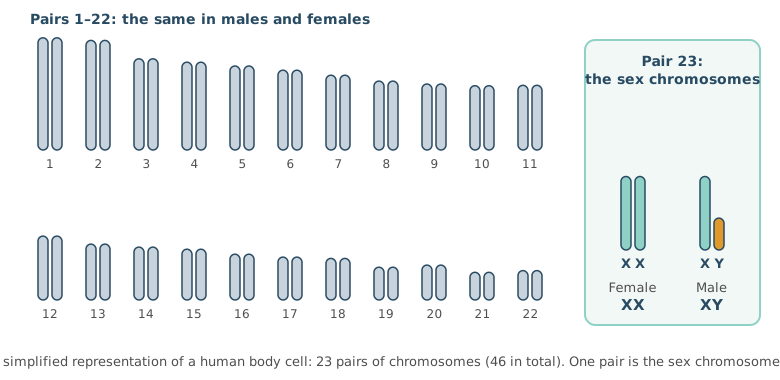
Some genes are sex-linked. This means the gene is found on a sex chromosome, usually the X chromosome.
If you look at the size of the sex chromosomes, why do you think the gene is on the X?
If you look at the size of the sex chromosomes, why do you think the gene is on the X?
The Y chromosome is much smaller than the X chromosome, so it can’t carry as many genes as the X chromosome.
As the sex-linked gene is on the X chromosome, this means that:
- Females (XX) have two copies of every sex-linked gene, one on each X chromosome.
- Males (XY) have only one copy of every sex-linked gene, on their X chromosome, and none on their Y chromosome.
Why are sex-linked diseases more common in males?
- Females
- In females, one X chromosome might carry the recessive allele for a condition (e.g. Xh, haemophilia), while the other X carries the dominant allele (XH, normal blood clotting).
In the case above, what will the female phenotype be?
In the case above, what will the female phenotype be?
She won’t have the condition. The dominant allele on her other X chromosome masks the recessive one, so she is an unaffected carrier. She only has the condition if both of her X chromosomes carry the recessive allele.
- Males
- The story in males is different. Males (XY) have only one X, and the Y chromosome has no copy of the gene. This means there isn’t any second allele (on his Y chromosome) to mask a recessive one on his X chromosome. If his one X carries the recessive allele for the condition, he has the condition.
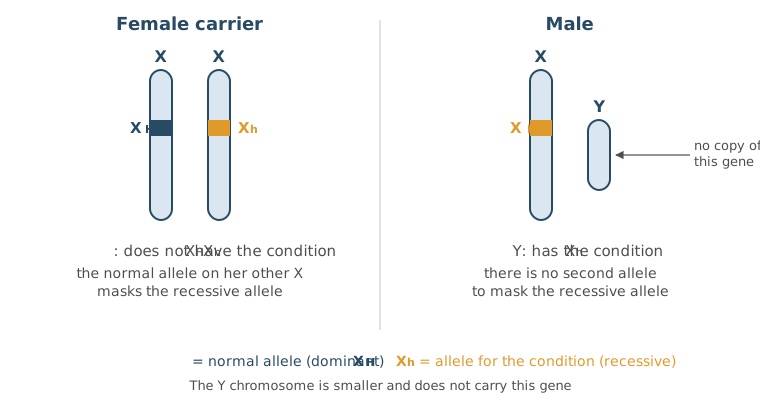
This is why X-linked recessive conditions, like haemophilia and red-green colour blindness, are much more common in males.
A male only needs to inherit the recessive allele once (on the X from his mother), but a female needs to inherit it twice (one from each parent).
Worked example: a carrier female and an unaffected male
A carrier female (XHXh) has children with an unaffected male (XHY). Xh is the allele for haemophilia.
Gametes from the father (XHY)
Gametes from the mother (XHXh)
| XH | Y | |
|---|---|---|
| XH | XHXHunaffected female | XHYunaffected male |
| Xh | XHXhcarrier female | XhYmale with haemophilia |
Ratio: 1 unaffected female : 1 carrier female : 1 unaffected male : 1 male with haemophilia
Tip
In sex-linked crosses, always include the sex in the phenotypes (e.g. “male with haemophilia”, not just “haemophilia”), as the ratios are often different for males and females. And remember the Y chromosome does carry genes, just not the one for the sex-linked characteristic.
Why can't a father pass an X-linked condition to his son?
Why can't a father pass an X-linked condition to his son?
A son always gets his Y chromosome from his father (and his X from his mother). X-linked alleles are on the X, so a father can only pass them to his daughters.
This is useful evidence when looking at a pedigree diagram. If an affected daughter has an unaffected father, the gene can’t be X-linked recessive. She would need the recessive allele on both her X chromosomes, and one of them comes from her father, so he would be affected too.
Pedigree Diagrams
A pedigree (family tree) shows how a characteristic is passed through a family. In the example below, squares are males, circles are females, and shaded symbols are affected individuals.
Useful evidence to look for:
- Two unaffected parents have an affected child: the allele must be recessive (both parents are carriers)
- Two affected parents have an unaffected child: the allele must be dominant
- An affected daughter has an unaffected father: the gene isn’t X-linked recessive (her father would have to pass her the allele on his only X, so he’d be affected)
Tip
When a question asks for evidence from a pedigree, name the specific individuals (e.g. “individuals 1 and 2 are unaffected but their child 4 is affected”), and explain it in terms of alleles (e.g. “so 1 and 2 must both be heterozygous, and 4 inherited a recessive allele from each”).
Worked example: reading a pedigree
The pedigree below shows how a condition is inherited in one family. Work out each answer yourself before you open it.
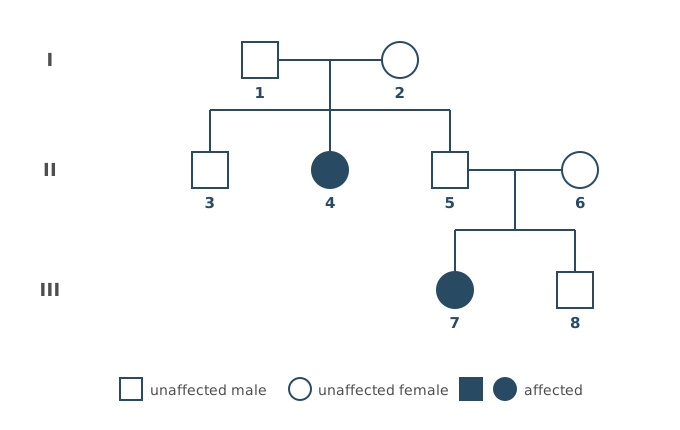
1. Is the allele for the condition dominant or recessive? Use the individuals to explain.
1. Is the allele for the condition dominant or recessive? Use the individuals to explain.
Recessive. Individuals 1 and 2 are unaffected, but their daughter 4 is affected. So 1 and 2 must each carry the allele without showing it. They are both heterozygous carriers. Individual 4 inherited one recessive allele from each of them. (5, 6 and their daughter 7 show the same thing.)
2. Could the gene be on the X chromosome (sex-linked)?
2. Could the gene be on the X chromosome (sex-linked)?
No. Female 4 is affected, so if the allele were X-linked recessive she would need two copies, one on each X. One of her X chromosomes comes from her father 1, and a male has only one X, so 1 would be affected too. He isn’t, so the gene must be on an autosome (not a sex chromosome).
3. Using A for the normal allele and a for the allele for the condition, what are the genotypes of 1, 2, 4 and 7?
3. Using A for the normal allele and a for the allele for the condition, what are the genotypes of 1, 2, 4 and 7?
- 1 and 2: Aa (unaffected carriers)
- 4 and 7: aa (affected, so homozygous recessive)
4. Individuals 5 and 6 plan another child. What is the probability that it will have the condition?
4. Individuals 5 and 6 plan another child. What is the probability that it will have the condition?
Their daughter 7 is aa, so 5 and 6 must both be carriers (Aa). Aa × Aa gives 1 AA : 2 Aa : 1 aa, so the probability of an affected child is 1/4 (25%). The next section shows how to work out probabilities like this.
Probability
Each fertilisation is a separate, random event, so a genetic cross gives you the probability of each outcome.
If you need the probability of two things happening together you can multiply the probabilities.
Worked example: the probability of an affected son
Two parents are both heterozygous (Aa) for a recessive condition that isn’t sex-linked. What’s the probability that their next child is a son with the condition?
Gametes from parent 1 (Aa)
Gametes from parent 2 (Aa)
| A | a | |
|---|---|---|
| A | AAunaffected | Aaunaffected (carrier) |
| a | Aaunaffected (carrier) | aahas the condition |
- Probability of the child having the condition (aa) = 1/4 (1 box out of 4)
- Probability of the child being a boy = 1/2
- Both have to happen, so multiply: 1/4 × 1/2 = 1/8 (12.5%)
Try it: what is the probability that their next two children both have the condition?
Try it: what is the probability that their next two children both have the condition?
Each child is a separate fertilisation, so each has a 1/4 chance, whatever happened to the one before. Both have to happen, so multiply: 1/4 × 1/4 = 1/16.
Tip
Read the question carefully: “the probability that a child is affected” and “the probability of an affected son” are different. In 2025, most students gave 25% for an affected son, forgetting to multiply by the 1/2 chance of having a boy.
How this topic is tested
This analysis is based on past paper data from 2017 to 2025. It is intended for interest only and is not predictive of what will appear in future papers.
- Tested in 9 of 9 years (2017–2025): 39 question parts worth 73 marks.
- 4th most-examined topic overall by marks, 2nd in Unit 7.
Marks by year
Most-tested spec points
- Genetic Diagrams & Crosses: tested in 26 parts (51 marks)
- Genotype & Phenotype: tested in 5 parts (7 marks)
- Alleles, Dominance & Zygosity: tested in 3 parts (5 marks)
- The Chi-Squared Test: tested in 1 part (2 marks)
- Probability in Inheritance: tested in 1 part (1 marks)
Also links to: The Hardy-Weinberg Principle.
Maths and practical skills
- Units and standard form (MS 0.2): e.g. 2025 P2 Q9.1
- Percentages, ratios and fractions (MS 0.3): e.g. 2025 P2 Q9.1
- Probability (MS 1.4): e.g. 2025 P2 Q4.3
- Using equations (MS 2.4): e.g. 2020 P2 Q6.4
Exam Question Practice
One past paper question for each part of the topic. Try each one before opening the walkthrough.
Explain what is meant by the term phenotype.
(2 marks)
Hint
A phenotype has two influences. What are they?
Walkthrough and mark scheme
Walkthrough
Phenotype has two parts, and each one is a mark:
- It’s the expression of the genotype (the alleles the organism has)
- …and its interaction with the environment
So a full answer is: “The phenotype is the expression of the organism’s genotype (its alleles) together with the effect of the environment.”
“What an organism looks like” on its own isn’t enough: always mention the genotype and the environment.
Mark scheme
- Expression/appearance/characteristic/feature/trait due to genetic constitution / genotype/allele(s) (1 mark)
- (And due to interaction with the) environment (1 mark)
Comments from mark scheme
Tips from examiner reports
Tips from the examiner report
- Include both influences: the phenotype is the expression of the genotype and its interaction with the environment
- “The appearance of a characteristic” on its own is not enough
- Don’t confuse phenotype with proteome
In fruit flies, a gene for body colour has a dominant allele for grey body, G, and a recessive allele for black body, g.
Explain how you would determine if the genotype of a grey fly is homozygous or heterozygous for body colour.
(2 marks)
Hint
To determine if a dominant phenotype is homozygous or heterozygous, what genotype should you cross it with? What offspring ratios would you expect?
Walkthrough and mark scheme
Walkthrough
Step 1: choose the cross. Cross the grey fly with a black fly. Black is recessive, so a black fly must be gg (homozygous recessive). This is a test cross: the black fly can only give g alleles, so the offspring show which alleles the grey fly passed on.
Step 2: work out both possibilities.
If the grey fly is GG, every offspring gets a G from it:
Grey fly (GG)
Black fly (gg)
| G | G | |
|---|---|---|
| g | Gggrey | Gggrey |
| g | Gggrey | Gggrey |
If the grey fly is Gg, half the offspring get its g allele:
Grey fly (Gg)
Black fly (gg)
| G | g | |
|---|---|---|
| g | Gggrey | ggblack |
| g | Gggrey | ggblack |
Step 3: conclude. If any black offspring appear, the grey fly was Gg (heterozygous). If all the offspring are grey, it was GG (homozygous).
Mark scheme
- Cross with homozygous recessive (fly)
OR Cross with a black (fly)
OR Cross with gg (fly) (1 mark) - Black offspring/flies then is heterozygous/Gg
OR Black and grey offspring/flies then is Heterozygous/Gg
OR No black offspring/flies then is homozygous/GG
OR All grey offspring/flies then is homozygous/GG (1 mark)
Comments from mark scheme
1. Accept cross with heterozygous (fly)
Alternative mark scheme, if cross not used.
Mark as pairs 3 with 4, and 5 with 6.
3. DNA base sequencing;
4. Compare base sequence with known alleles;
5. Separate alleles using electrophoresis;
6. Use gene/DNA probes to identify alleles OR Compare position/banding with known alleles OR Homozygous forms one band, heterozygous forms two bands;
Tips from examiner reports
Tips from the examiner report
- Cross the grey fly with a black (homozygous recessive) fly; crossing two grey flies doesn’t work
- Explain how the offspring show the genotype: any black offspring means heterozygous; all grey means homozygous
- “Look at the parents” or “use a Punnett square” isn’t a method
In a species of flowering plant, the T allele for tallness is dominant to the t allele for dwarfness. In the same species, two alleles CR (red) and CW (white) code for the colour of flowers. When homozygous red-flowered plants were crossed with homozygous white-flowered plants, all the offspring had pink flowers.
A dwarf, pink-flowered plant was crossed with a heterozygous tall, white-flowered plant.
Complete the genetic diagram to show all the possible genotypes and the ratio of phenotypes expected in the offspring of this cross.
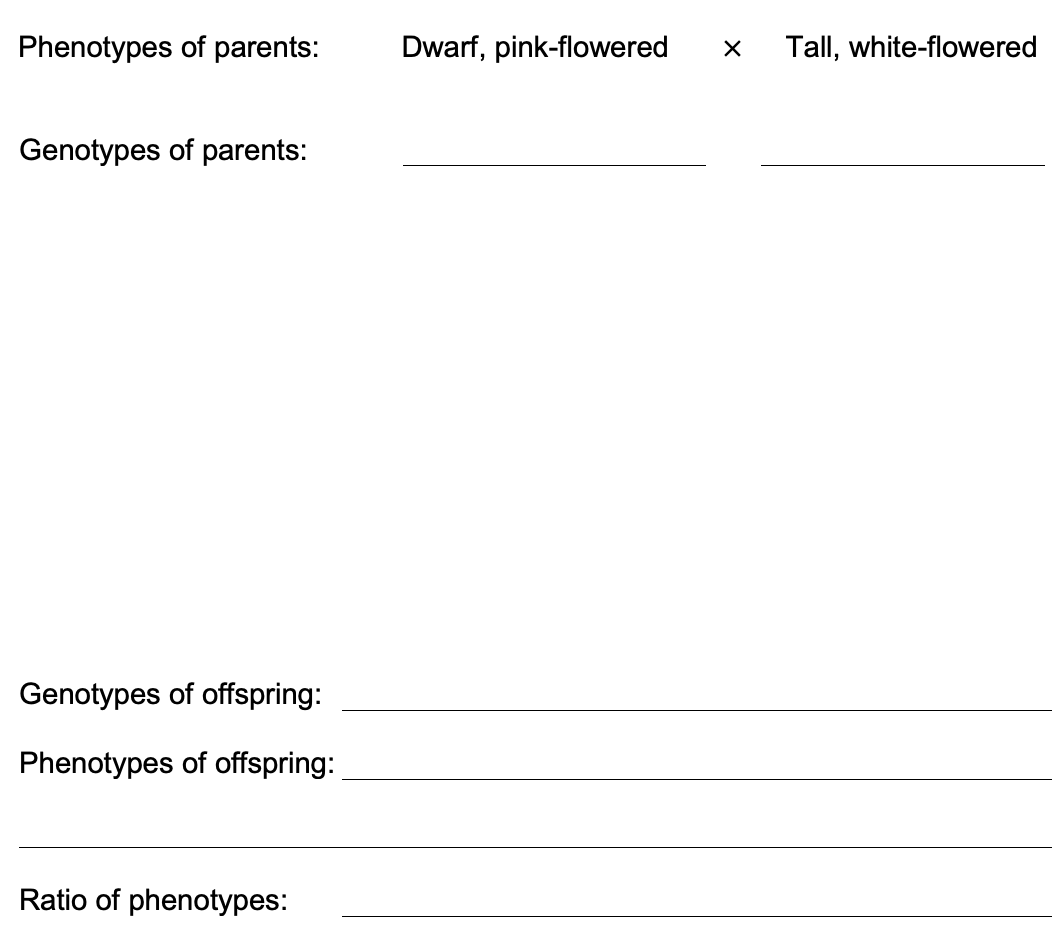
(3 marks)
Hint
Write each parent’s genotype for both genes. Which gametes can each parent make, and what combinations do they give?
Walkthrough and mark scheme
Walkthrough
Step 1: parent genotypes. Work out each gene separately:
- Dwarf is recessive, so the dwarf plant is tt. Pink is the heterozygote for the codominant alleles, so it’s CRCW. So the first parent is ttCRCW
- The tall plant is heterozygous, so Tt (not TT: read the question). White is CWCW. So the second parent is TtCWCW
Step 2: gametes. Each gamete gets one allele of each gene:
- ttCRCW makes tCR and tCW
- TtCWCW makes TCW and tCW
Step 3: Punnett square.
Gametes from ttCRCW
Gametes from TtCWCW
| tCR | tCW | |
|---|---|---|
| TCW | TtCRCWtall, pink | TtCWCWtall, white |
| tCW | ttCRCWdwarf, pink | ttCWCWdwarf, white |
Step 4: phenotypes and ratio. Tall pink : tall white : dwarf pink : dwarf white = 1 : 1 : 1 : 1.
Mark scheme
- ttCRCW and TtCWCW (1 mark)
- TtCRCW, TtCWCW, ttCRCW and ttCWCW (1 mark)
- Tall pink, tall white, dwarf pink, dwarf white, and ratio 1 : 1 : 1 : 1 (1 mark)
Comments from mark scheme
2 and 3. Accept: any order of genotypes and phenotypes and ignore if on incorrect answer lines.
3. Accept: sequence of phenotypes does not need to mirror genotypes but must be correct.
3. Accept equivalent ratios e.g. 4:4:4:4.
Allow equivalent of mark points 2 and 3 for cross using homozygous tall parent i.e. TTCWCW.
Allow one mark for correct dihybrid genotypes of offspring from incorrect parental genotypes.
Tips from examiner reports
Tips from the examiner report
- Read the parents carefully: the tall parent is heterozygous (Tt), not homozygous
- Check your ratio matches your own offspring: this cross gives 1 : 1 : 1 : 1, not 9 : 3 : 3 : 1
- Make sure each offspring phenotype matches its genotype
In fruit flies, males are XY and females are XX. A cross between a grey-bodied male fly and a black-bodied female fly produced some black-bodied females.
Explain how this shows that the gene for body colour is not sex-linked.
(1 marks)
Hint
If the gene is on the X chromosome, what allele(s) would the male parent have? What would this mean for female offspring?
Walkthrough and mark scheme
Walkthrough
The trick: imagine the gene is on the X chromosome, and show that the results couldn’t happen.
If it were sex-linked:
- The grey male would be XGY. He has only one X, and it carries the grey allele
- The black female would be XgXg
- Every daughter gets her father’s X, so every daughter would get XG
Grey male (XGY)
Black female (XgXg)
| XG | Y | |
|---|---|---|
| Xg | XGXggrey female | XgYblack male |
| Xg | XGXggrey female | XgYblack male |
So all the daughters would be grey, and none would be black. But the cross produced black females, so the gene can’t be on the X chromosome.
Mark scheme
- (If sex-linked) grey/male fly would only have / pass on grey/dominant allele
OR (If sex-linked) females would receive the grey/ dominant allele
OR (If sex-linked) grey/male fly would not have / pass on black/recessive allele
OR (If sex-linked) female (offspring) would be grey
OR (If sex-linked) no female (offspring) would be black
OR (If sex-linked) male (parent) could not have been heterozygous
OR (If sex-linked) only black male (parent) could produce a black bodied female (1 mark)
Comments from mark scheme
Accept G for dominant allele and g for recessive allele.
Tips from examiner reports
Tips from the examiner report
- Explain what would happen if the gene were sex-linked: the grey male passes his X (with the grey allele) to all his daughters, so no daughters would be black
- It’s the daughters that would all be grey, not all the offspring
- Sex-linked genes are on the X chromosome, not the Y
What earned marks
- Stating that no female offspring would be black
In humans, the ABO blood groups and Rhesus blood groups are under genetic control. The inheritance of the ABO blood groups is controlled by three alleles of a single gene, IA, IB and IO. The alleles IA and IB are codominant, and the allele IO is recessive to IA and recessive to IB.
There are four ABO phenotypes, A, B, AB and O.
The gene for the Rhesus blood groups has two alleles. The allele for Rhesus positive, R, is dominant to the allele for Rhesus negative, r.
The genes for the ABO and Rhesus blood groups are not sex-linked and are not on the same chromosome.
Figure 3 shows the phenotypes in a family tree for the ABO and Rhesus blood groups.
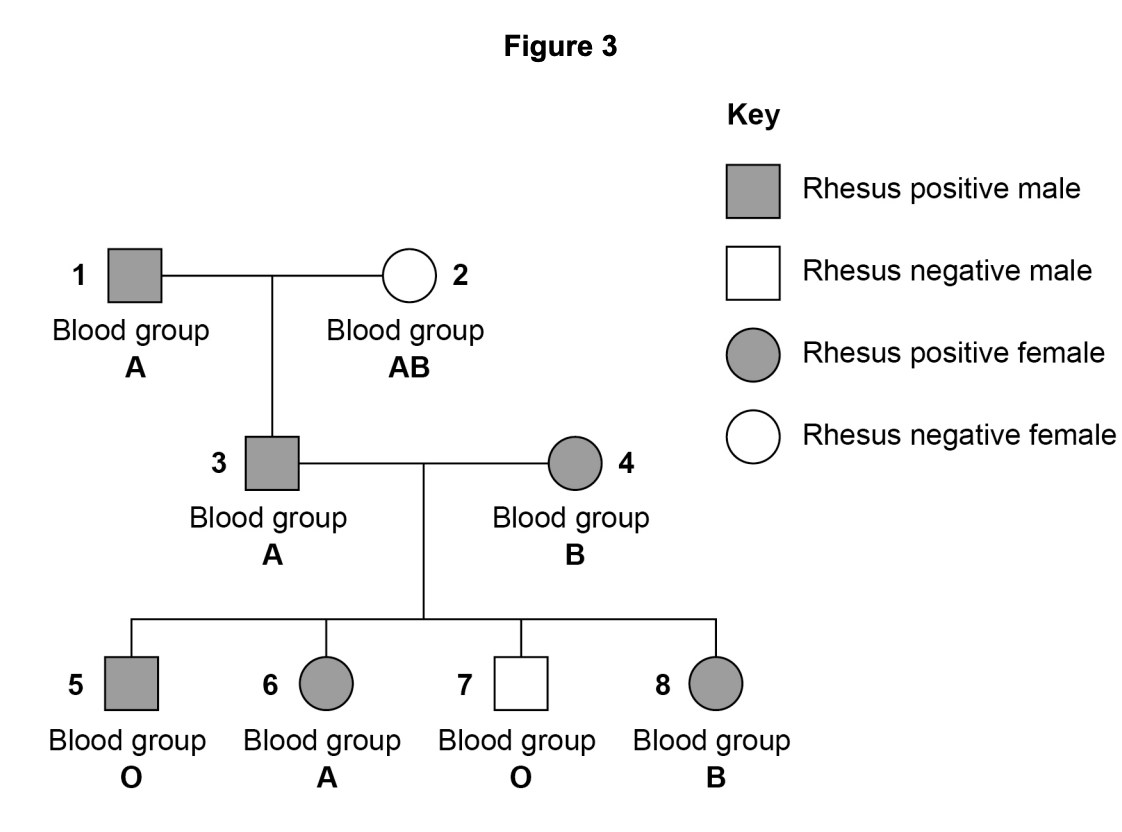
Explain one piece of evidence from Figure 3 that the allele for Rhesus positive is dominant.
(2 marks)
Hint
Find two Rhesus positive parents with a Rhesus negative child. What must both parents carry?
Walkthrough and mark scheme
Walkthrough
Step 1: find two parents with the same phenotype whose child is different. Individuals 3 and 4 are both Rhesus positive (shaded), but their son 7 is Rhesus negative (not shaded).
Step 2: explain it with alleles. 7 must have got an allele for Rhesus negative from each parent. So 3 and 4 both carry the Rhesus negative allele without showing it: it must be recessive, and both 3 and 4 are heterozygous (Rr).
Step 3 (another way to say it): if Rhesus positive were recessive, 3 and 4 would both be rr, and all their children would be Rhesus positive.
Always name the individuals you are using, then explain in terms of alleles.
Mark scheme
- Rhesus positive parents produce 7/Rhesus negative child
OR 3 and 4 produce 7/Rhesus negative child
OR Two Rhesus positive produce 7/Rhesus negative child (1 mark) - Both Rhesus positive/3 and 4 have recessive allele
OR Both Rhesus positive/3 and 4 are heterozygous/carriers
OR If Rhesus positive was recessive, all children (of 3 and 4) would be Rhesus positive / have recessive (phenotype) (1 mark)
Comments from mark scheme
1. Reject if incorrect evidence and correct evidence provided.
1.Accept Rhesus positive parents produce Rhesus positive and Rhesus negative child.
2. Reject if incorrect explanation and correct explanation provided.
1 and 2. Accept ‘affected’ for Rhesus positive and ‘unaffected’ for Rhesus negative.
Tips from examiner reports
Tips from the examiner report
- Use individuals 3 and 4: two Rhesus positive parents have a Rhesus negative child (7)
- So both 3 and 4 must carry the recessive allele (both heterozygous), not just one of them
- Read the diagram carefully: 3 and 4 are partners, not children of 1 and 2 together
Haemophilia C is an autosomal recessive condition.
Two parents are both heterozygous for the haemophilia C allele.
Calculate the probability of these parents producing a son who has haemophilia C.
Probability = ________
(1 marks)
Hint
Work out the chance of a child having haemophilia C from the cross, then the chance of that child being a son. Multiply the two.
Walkthrough and mark scheme
Walkthrough
Step 1: the condition. It’s autosomal, so being male or female doesn’t change the alleles. Both parents are heterozygous:
Gametes from parent 1 (Hh)
Gametes from parent 2 (Hh)
| H | h | |
|---|---|---|
| H | HHunaffected | Hhunaffected |
| h | Hhunaffected | hhhaemophilia C |
Probability of a child with haemophilia C (hh) = 1/4
Step 2: the sex. Probability of the child being a son = 1/2
Step 3: both must happen, so multiply: 1/4 × 1/2 = 1/8 (0.125 or 12.5%)
The most common wrong answer was 25%: that’s the chance of any child having the condition, not of a son having it.
Mark scheme
- 0.125 / 12.5% / 1/8 (1 mark)
Comments from mark scheme
Reject 1 : 8 or 8 : 1
Accept 1 in 8
Reject 12.5 without %
Tips from examiner reports
Tips from the examiner report
- Include the chance of having a son: 1/4 (affected) × 1/2 (son) = 1/8. 0.25 was the most common wrong answer
- Give a probability as a fraction, decimal or percentage (1/8, 0.125 or 12.5%), not a ratio such as 1 : 8, and include the % sign
1. Accept: named characteristic
1. Accept: homozygous/heterozygous/genes/DNA for ‘genotype’
1. Ignore: chromosomes