Structure of Xylem
What you need to know (based on the AQA specification)
What you need to know (based on the AQA specification)
Xylem as the tissue that transports water in the stem and leaves of plants.
Xylem is a transport tissue in plants responsible for transporting water and dissolved mineral ions from the roots to the leaves.
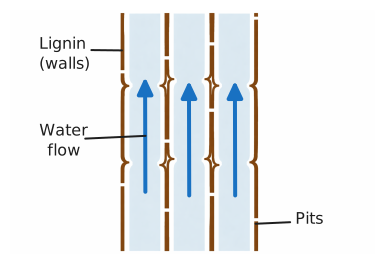
Key structural features of xylem vessels
- Dead cells with no cytoplasm, nucleus or organelles. This creates a hollow lumen, allowing water to flow through without obstruction
- Lignified walls — cell walls reinforced with lignin, a waterproof and tough substance. Lignin provides structural support and prevents the vessel from collapsing under tension
- No end walls — adjacent xylem cells form long continuous tubes so water can continuously move upwards
- Pits — gaps in the lignified walls allow lateral movement of water between vessels and surrounding cells; if a vessel is blocked or damaged, water can still move up the plant via adjacent vessels
How does water enter the xylem?
Water is absorbed by root hair cells from the soil by osmosis (soil water has a higher water potential than root hair cells).
Cohesion-Tension Theory
What you need to know (based on the AQA specification)
What you need to know (based on the AQA specification)
The cohesion-tension theory of water transport in the xylem.
How does the cohesion-tension theory work?
- Transpiration
- Water evaporates from the surfaces of mesophyll cells and diffuses out of the leaf through the stomata
- This creates a low water potential in the mesophyll cells.
- Tension
- As water leaves the mesophyll cells, it creates a pulling force (tension/negative pressure) on the water in the xylem vessels.
- Water is pulled up the xylem in a continuous column.
- Cohesion
- Water molecules are attracted to each other by hydrogen bonds (this is called cohesion). When water is pulled from the top of the xylem, it pulls the whole column of water upwards.
- Adhesion
- Water molecules can form hydrogen bonds with other molecules (e.g. xylem vessel walls).
- This allows water to be pulled up the continuous column in the xylem, and prevents the water column from breaking.
- Water uptake by roots
- Water enters through root hair cells and moves into xylem tissue in the root
What is the difference between cohesion and adhesion?
What is the difference between cohesion and adhesion?
- Cohesion is the attraction between water molecules (due to hydrogen bonds between water molecules)
- Adhesion is the attraction between water molecules and the walls of the xylem vessel
Both help to maintain a continuous column of water in the xylem.
Transpiration
Transpiration is the loss of water vapour from the leaves of a plant, mainly through the stomata. It is a consequence of gas exchange.
Factors affecting transpiration rate:
- Light intensity
- High light intensity increases the rate of transpiration
- Stomata open in light for photosynthesis (to let in carbon dioxide)
- Temperature
- Higher temperature increases the rate of transpiration
- It increases the kinetic energy of water molecules, so they evaporate from the cells at a faster rate
- Humidity
- Higher humidity decreases the rate of transpiration
- Higher humidity means the water potential of the surrounding air is higher (less negative), so the water potential gradient between the leaf and the air is reduced, slowing the diffusion of water vapour out of the leaf
- Wind (air movement)
- Higher air movement increases the rate of transpiration
- High air movement removes water vapour from around the leaf surface, maintaining a steep water potential gradient
Tip
For air movement and humidity, think in terms of the water potential gradient between inside the leaf and outside the leaf. A steeper gradient means a faster rate of transpiration.
Why do stomata open in light?
Why do stomata open in light?
Stomata open in light to allow carbon dioxide to enter the leaf for photosynthesis. Water enters by osmosis, making the guard cells turgid and opening the stomatal pore.
Potometer Experiment
A potometer is used to measure the rate of water uptake by a plant, which can be used as an estimate of the rate of transpiration.
Why does the potometer measure water uptake and not transpiration directly?
Why does the potometer measure water uptake and not transpiration directly?
Not all water taken up by a plant is lost through transpiration; some is used in photosynthesis and other metabolic reactions. However, since transpiration accounts for the vast majority of water uptake (~99%), water uptake is a good estimate of transpiration rate.
How does a potometer work?
- A leafy shoot is cut under water (to prevent air entering the xylem)
- The shoot is sealed into the potometer apparatus with an airtight seal
- An air bubble is introduced into the capillary tube
- As the plant transpires, it takes up water, and the air bubble moves along the capillary tube
- The distance the bubble moves over a set time is measured to calculate the rate of water uptake (e.g. ml per minute)
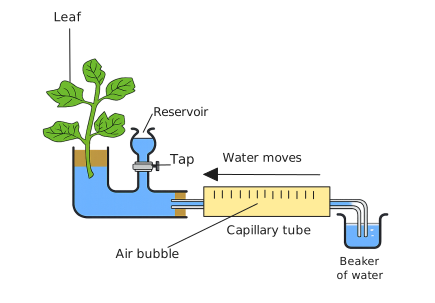
Using a potometer to investigate factors affecting transpiration
The potometer can be used to test the effect of different environmental conditions on transpiration rate:
- Wind — use a fan at different speeds or distances
- Temperature — place in water baths at different temperatures
- Light intensity — use a lamp at different distances
- Humidity — enclose in plastic bags with wet/dry cotton wool
Tip
When using a potometer, it is important to keep all other variables constant (controlled variables) when testing the effect of one factor. The reservoir tap can be used to reset the air bubble between readings.
Exam Questions
Lignin is a polymer found in the walls of xylem vessels in plants. Lignin keeps the xylem vessel open as a continuous tube.
Explain the importance of the xylem being kept open as a continuous tube.
(3 marks)Hint
This is about water transport in xylem. How does water form a continuous column? What creates the pulling force?
Mark Scheme
- (Allows) unbroken water column OR (So) no barrier to (water) movement (1 mark)
- Cohesion from hydrogen bonds between (all) water molecules OR Cohesion from (polar) attraction between (all) water molecules (1 mark)
- Evaporation/transpiration creates tension (in the column) OR Water moving from xylem (into cells) creates tension OR (Pulling up) water creates tension (in xylem) (1 mark)
Tips from examiner reports
- Water moves up xylem by cohesion-tension: transpiration creates tension, water molecules cohere via hydrogen bonds forming a continuous column
- Don’t confuse transpiration in xylem with translocation in phloem
- Don’t mention “source and sink”; that relates to translocation of sugars
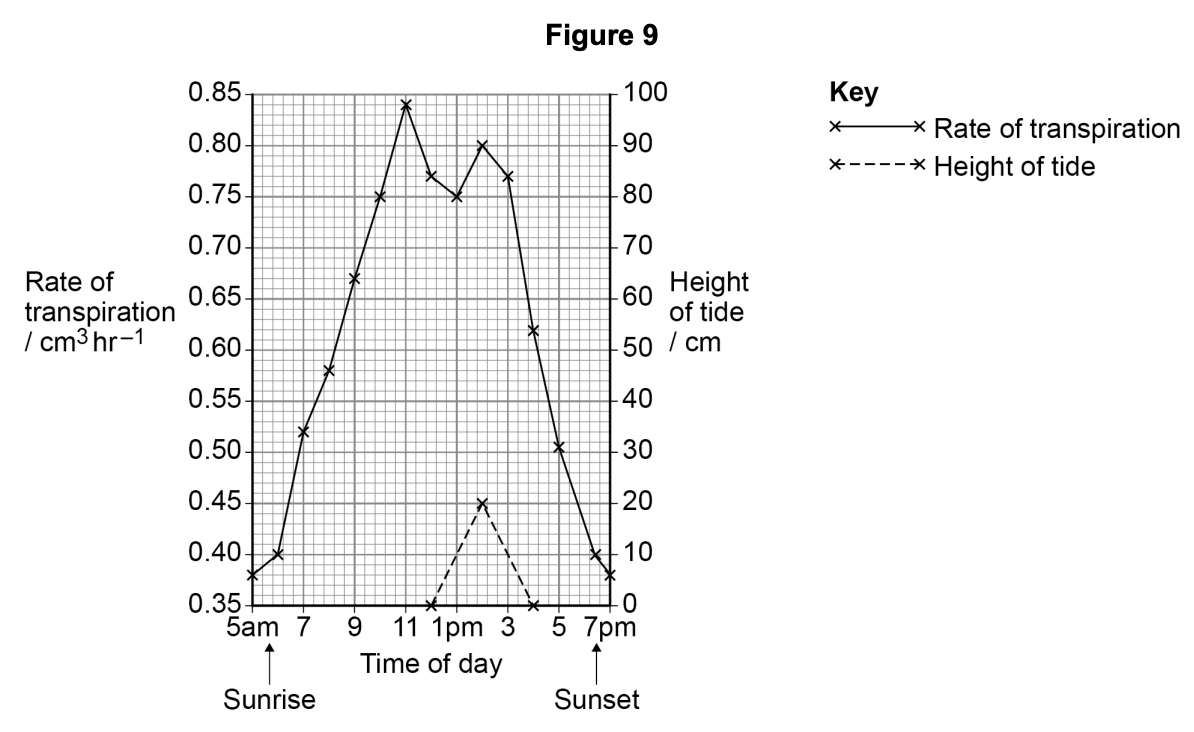
Mangrove trees grow near the sea. Sea water surrounds the lower parts of the trees at high tide. Scientists investigated the rate of transpiration in a mangrove tree. Figure 9 shows the scientists’ results.
Explain the rate of transpiration between 5 am and midday shown in Figure 9.
Hint
Explain the biological reason behind the data pattern; don’t just describe the trend. Think about what changes between 5 am and midday (temperature, light, stomata).
Mark Scheme
- (Rate of) transpiration/evaporation increases due to increased temperature OR increased light intensity OR decreased humidity OR increased wind/air movement (1 mark)
- (So) increased kinetic energy (causing more water loss) OR increased water potential gradient (so more water lost) OR increased (water) diffusion gradient (so more water lost) (1 mark)
- Stomata open (at sunrise/after 5 am) allowing gas exchange OR allowing carbon dioxide to enter (1 mark)
- (Some) stomata close at midday/after 11 am (reducing transpiration) (1 mark)
Comments from mark scheme
- Ignore reference to tide
- For points 1 and 2: reject tide affecting transpiration/water potential/humidity
- For points 1 and 2: correct link needed between the factor affecting transpiration and the explanation
- For point 4: accept “at 11 am” as the time when stomata close
Tips from examiner reports
- Explain the biological reason behind the data pattern; don’t just describe the trend
- Be precise: say “increased light intensity” or “increased temperature” rather than “the sun”
- Stomata open for gas exchange, and water loss is a consequence, not the other way around
- Changes in photosynthesis rate don’t directly explain changes in transpiration rate
Comments from mark scheme