Mutations in the genes involved in regulating the cell cycle can lead to uncontrolled cell division, which leads to the formation of tumours and cancers.
Benign vs Malignant
What you need to know (based on the AQA specification)
What you need to know (based on the AQA specification)
The main characteristics of benign and malignant tumours.
It’s important to note that not all tumours are malignant (cancerous), some are benign which are non cancerous.
The table below outlines the main differences between benign and malignant tumours
| Feature | Benign tumours | Malignant tumours |
|---|---|---|
| Growth rate | Usually slow | Often rapid and uncontrolled |
| Cell differentiation | Cells are well differentiated (similar to normal cells) | Cells are poorly differentiated or undifferentiated |
| Metastasis | Do not spread to other parts of the body | Can spread via blood or lymph (metastasis) |
| Effect on body | Usually localised effects | Can affect multiple organs (systemic) |
| Recurrence after removal | Unlikely to return if fully removed | Likely to recur after treatment |
| Encapsulated (fibrous tissue) | Often enclosed in a capsule/fibrous tissue to help separate abnormal growth from rest of body | Not encapsulated, so can spread to other parts of body |
Tumour Suppressor Genes
What you need to know (based on the AQA specification)
What you need to know (based on the AQA specification)
- The role of the following in the development of tumours:
- tumour suppressor genes and oncogenes
- abnormal methylation of tumour suppressor genes and oncogenes
Normal (not mutated)
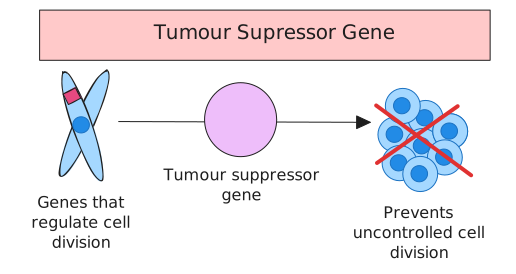
- Tumour suppressor genes normally regulate the cell cycle to prevent uncontrolled cell division.
- If DNA damage is severe, they can trigger apoptosis (programmed cell death).
Hypermethylation
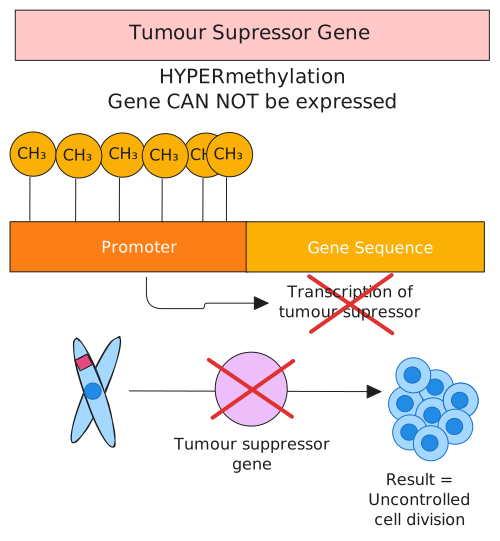
- Hypermethylation of tumour suppressor gene at promoter region, leads to inactivation of the tumour suppressor gene.
- As a result, the tumour suppressor protein is not produced and cell division is no longer properly controlled, increasing the risk of tumour formation.
- E.g. BRCA1 is a tumour suppressor gene and hypermethylation of its promoter is associated with the development of some breast cancers
Oncogenes
Normal (not mutated)
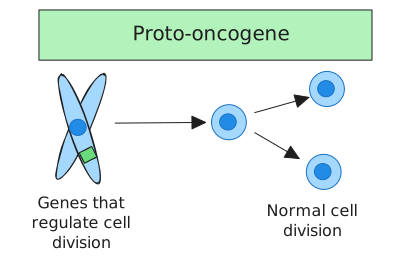
- Proto-oncogenes normally stimulate controlled cell division by producing proteins that promote progression through the cell cycle.
Hypomethylation
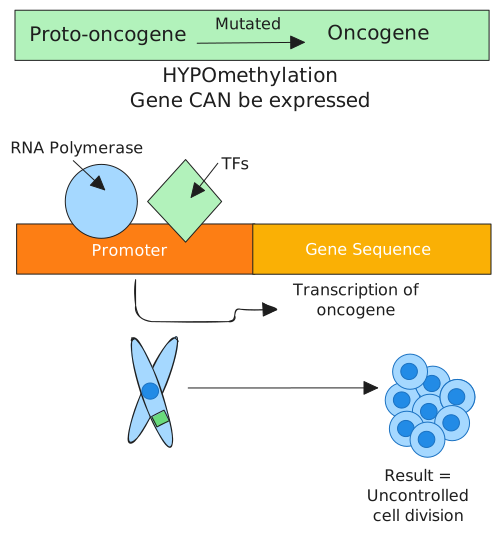
- If a proto-oncogene becomes mutated, it becomes an oncogene that is permanently active.
- Mutated proto-oncogene = Oncogene
- This leads to uncontrolled cell division and tumour formation.
- In some cancers, hypomethylation can increase expression of growth-promoting genes, contributing to oncogene overactivity.
- E.g HER2 (associated with some breast cancers) and RAS (associated with bladder and other cancers).
Oestrogen & Breast Cancer
What you need to know (based on the AQA specification)
What you need to know (based on the AQA specification)
- The role of the following in the development of tumours:
- increased oestrogen concentrations in the development of some breast cancers.
After menopause, ovaries stop producing oestrogen, but fat tissue (adipose) creates oestrogen. This increases the overall levels of oestrogen in the body.
- High levels of oestrogen will increase binding to the oestrogen receptor, a transcription factor.
- This elevates the transcription of genes coding for proteins involved in cell division, leading to increased cell proliferation in breast tissue.
- Read more about the mechanism Oestrogen Receptor (TF)
Exam Question Practice
BRCA1 and BRCA2 are human genes that code for tumour suppressor proteins.
Mutations in BRCA1 and BRCA2 can cause cancer. Explain how.
(3 marks)Hint
Think about how a mutation affects the protein, and what tumour suppressor proteins normally do.
Mark Scheme
- A mutation in BRCA1/BRCA2 changes the DNA base sequence, altering the codons in the gene (1 mark)
- This changes the amino acid sequence (primary structure) of the tumour suppressor protein, altering its tertiary structure and making it non-functional (1 mark)
- Without a functional tumour suppressor protein to regulate the cell cycle, cells undergo rapid, uncontrolled division, forming a tumour (1 mark)
The KRAS gene codes for a protein called K-Ras. The protein relays signals from outside a cell to a cell’s nucleus, stimulating cell division. An alteration in the KRAS gene produces an oncogene which can cause a tumour to develop.
Suggest and explain how an alteration in the KRAS gene can cause a tumour to develop.
(3 marks)Hint
Think about what happens if a protein that stimulates cell division is altered or overproduced.
Mark Scheme
- A mutation in the KRAS gene changes the DNA base sequence (1 mark)
- This produces an altered K-Ras signalling protein, or causes more K-Ras protein to be produced — both permanently stimulate cell division signals (1 mark)
- The nucleus receives constant growth signals, leading to rapid, uncontrolled cell division and tumour formation (1 mark)
Blood tests can be used to test for cancers. Men with prostate cancer have a high concentration of prostate-specific antigen (PSA) in their blood. Urinary infections and a naturally enlarged prostate can also increase concentrations of PSA.
However, the results of blood tests may not be conclusive when testing for prostate cancer. Explain why.
(2 marks)Hint
Think about what else (other than cancer) can cause high PSA levels.
Mark Scheme
- High PSA levels are not exclusively caused by prostate cancer — the test can give a false positive result (1 mark)
- Elevated PSA can also result from a urinary infection or a naturally enlarged prostate, neither of which is cancer (1 mark)