What are stem cells?
- Stem cells are undifferentiated (unspecialised) cells, which are capable of continuously dividing into new stem cells or new specialised cells.
- The types of specialised cells the stem cells can divide into depends on the cell’s ability to differentiate (stem cells’ potency)
Types of stem cells
What you need to know (based on the AQA specification)
What you need to know (based on the AQA specification)
- Totipotent cells can divide and produce any type of body cell.
- Totipotent cells occur only for a limited time in early mammalian embryos.
- Pluripotent cells are found in embryos; multipotent and unipotent cells are found in mature mammals and can divide to form a limited number of different cell types.
- Pluripotent stem cells can divide in unlimited numbers and can be used in treating human disorders.
- Unipotent cells, exemplified by the formation of cardiomyocytes .
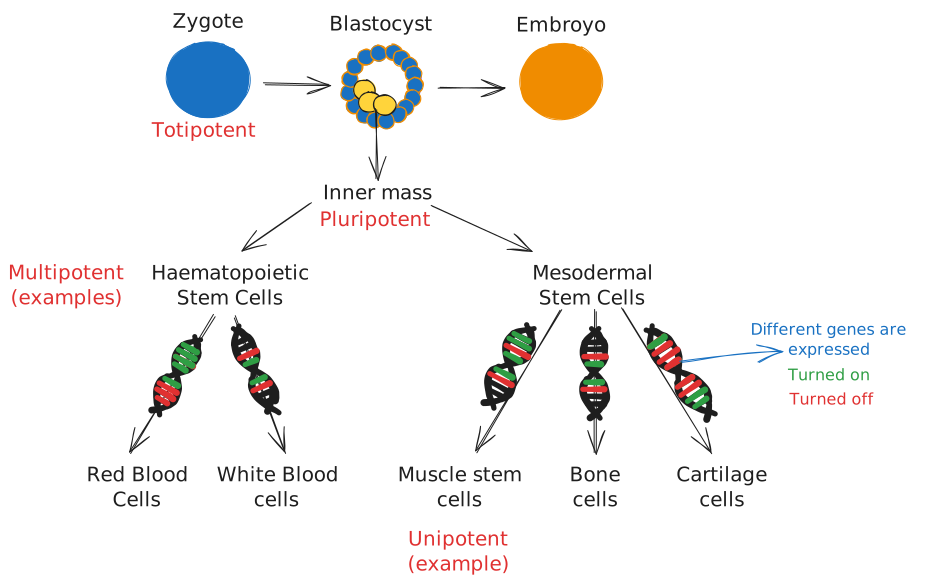
- Totipotent cells (all types of body cell)
- Totipotent cells are formed from a zygote and only exist for a brief period of time (approximately 4 days in humans).
- They have the ability to differentiate into all types of cells (including embryonic & placenta cells)
- Pluripotent (all types excluding the embryonic & placenta tissue)
- Pluripotent stem cells are found in embryos after 4 days - they are the inner mass of the blastocyst cell (see on diagram)
- They have the ability to differentiate into any type of body cell, but not embryonic and placenta tissue
- Adult stem cells, include:
- Multipotent
- Can develop into a limited number of specialised cells
- e.g Haematopoietic Stem Cells, can differentiate into different blood cell types
- Unipotent
- Can only divide into one type of cell
- e.g. Muscle stem cells make muscle fibres
- e.g Epidermal (skin) stem cells make skin cells
- Multipotent
Stem cells & differentiation
- Stem cells contain the same genes, but during development not all genes are expressed (i.e. not all are transcribed and translated).
- Differentiation occurs because specific genes are switched on or off.
- Signals (external or internal), such as chemical signals from neighbouring cells, trigger changes in gene expression.
- Gene expression can be controlled by:
- Transcription (DNA → mRNA)
- Genes required by the cell are transcribed, while genes that are not needed are not transcribed (repressed)
- Controlled by Transcription Factors, Epigenetics
- Translation (mRNA → protein)
- Prevention of translation of certain mRNA molecules
- The proteins produced determine the cell’s structure and function
- Transcription (DNA → mRNA)
- As cells become more specialised, these changes in gene expression become increasingly difficult to reverse.
Induced Pluripotent Stem Cells
What you need to know (based on the AQA specification)
What you need to know (based on the AQA specification)
Induced pluripotent stem cells (iPS cells) can be produced from adult somatic cells using appropriate protein transcription factors.
- iPSCs are created by reprogramming specialised adult cells back to pluripotent state
- iPSCs
- Have the ability to self-renew
- Can differentiate into any body cell type
- Function similarly to embryonic stem cells, but without the ethical concerns since embryos are not destroyed as part of this process
- Made from patient’s own cells (genetically identical) so reduce the risk of immune rejection
Brief outline of the process below:
- Start with a specialised adult cell
- Blood cells are commonly used for this
- Introduce genes that code for pluripotency transcription factors
- These will need to be delivered by a vector e.g plasmids, mRNA
- Transcription Factors
- Reprogramming occurs
- Transcription factors switch on genes associated with pluripotency and switch off genes for differentiation
- Cell loses its specialised identity - it becomes pluripotent
Stem Cells to Treat Diseases
What you need to know (based on the AQA specification)
What you need to know (based on the AQA specification)
Evaluate the use of stem cells in treating human disorders.
Given the properties of pluripotent cells, ability to self renew and differentiate into any body cell (excluding embryonic / placenta), there are many potential uses for these in treatments.
| Stem cell | Advantages | Disadvantages |
|---|---|---|
| Embryonic | Pluripotent – can form any body cell Rapid division → large numbers of cells | Ethical issues (embryo destruction) Not patient-specific → immune rejection risk Risk of tumour formation |
| Induced pluripotent (iPSC) | Pluripotent No ethical issues Patient-specific → reduced rejection Used for disease models & drug testing | Possible genetic/epigenetic changes Tumour risk Expensive & complex Long-term safety unknown |
| Adult (somatic) | No ethical issues Often patient-specific Already used clinically | Multipotent or unipotent Limited cell types Difficult to isolate & culture |
Why do adult stem cells have a much lower tumour risk?
Why do adult stem cells have a much lower tumour risk?
Embryonic and induced pluripotent stem cells have a higher risk of tumour formation because they are undifferentiated and can divide rapidly. Adult stem cells have limited potency, so they divide more slowly and are more tightly regulated.
AO3 evaluation question tips
- Consider both the pros and cons of the statement
- Interrogate the methodology (e.g. Is the experiment long enough? Was it done on humans or only mice?)
- Interrogate the data (e.g. Is it significant? Was a statistical test used? Is the sample size large enough?)
Exam Question Practice
Myelodysplastic syndromes (MDS) are a group of malignant cancers. In MDS, the bone marrow does not produce healthy blood cells.
Haematopoietic stem cell transplantation (HSCT) is one treatment for MDS. In HSCT, the patient receives stem cells from the bone marrow of a person who does not have MDS. Before the treatment starts, the patient’s faulty bone marrow is destroyed.
For some patients, HSCT is an effective treatment for MDS. Explain how.
(3 marks)Hint
Think about what the new stem cells produce, and why this is a long-term solution.
Mark Scheme
- The transplanted haematopoietic stem cells differentiate to produce healthy blood cells (1 mark)
- Because the faulty bone marrow was destroyed first, there are no MDS/cancerous cells left to produce defective blood cells (1 mark)
- The transplanted stem cells continuously divide (self-renew), providing a long-term supply of healthy blood cells (1 mark)
Haematopoietic stem cell transplantation (HSCT) is a long-term treatment for SCD. In HSCT, the patient receives stem cells from the bone marrow of a person who does not have SCD. The donor is often the patient’s brother or sister. Before the treatment starts, the patient’s faulty bone marrow cells have to be destroyed.
Use this information to explain how HSCT is an effective long-term treatment for SCD.
(3 marks)Hint
Think about what the new cells produce, and why using a sibling donor is mentioned.
Mark Scheme
- The transplanted stem cells differentiate to produce healthy red blood cells with normal haemoglobin (1 mark)
- The patient’s faulty bone marrow was destroyed beforehand, so no sickle-shaped red blood cells are produced (1 mark)
- The stem cells continuously divide (self-renew) for a long-term supply; using a sibling donor also reduces the risk of immune rejection (1 mark)
A new long-term treatment for SCD involves the use of gene therapy. Figure 2 shows some of the stages involved in this treatment in a child with SCD.
Some scientists have concluded that this method of gene therapy will be a more effective long-term treatment for SCD than HSCT. Use all the information provided to evaluate this conclusion.
(3 marks)Hint
Evaluate = points FOR and AGAINST. Think about what gene therapy avoids, and what risks it introduces.
Mark Scheme
For gene therapy (max 2 marks from points 1–3):
- The patient’s bone marrow does not need to be destroyed beforehand (1 mark)
- No donor is required — the patient’s own stem cells are used (1 mark)
- Because the patient’s own cells are used, there is less/no risk of immune rejection (1 mark)
Against gene therapy:
- The patient’s own stem cells remain in place and will still produce some sickle-shaped red blood cells (1 mark)
- The viral vector used to deliver the gene could trigger an immune response or cause side effects; also, long-term safety is unknown as it is a new treatment (1 mark)