What is a mutation?
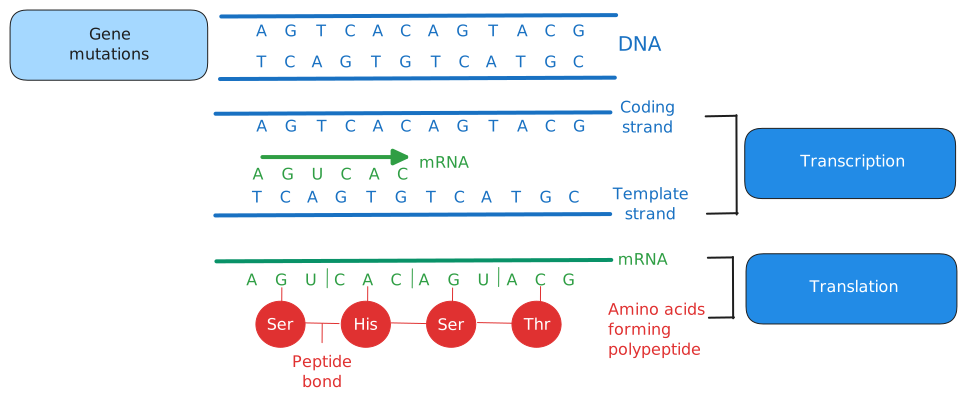
- Mutations involve a change in the base sequence of the DNA
- They can arise spontaneously during DNA replication, or they can be caused by mutagenic agents
- Due to the degenerate nature of the genetic code, not all base substitutions cause a change in the sequence of encoded amino acids.
- This means that there are multiple codons which can all code for the same amino acid, so if there is a single base change mutation it might still code for the same amino acid
- E.g UCU, UCC, UCA, and UCG all code for the amino acid Serine
- If the mutation is in the intron (outside the coding region), it also won’t cause a change to the encoded protein.
Types of Gene Mutation
What you need to know (based on the AQA specification)
What you need to know (based on the AQA specification)
Gene mutations might arise during DNA replication. They include addition, deletion, substitution, inversion, duplication and translocation of bases.
The below animations go through the different types of mutations you need to be aware of, breaking it down by:
- DNA sequence change
- Resulting mRNA change (transcribed from DNA template strand)
- Amino acid change (translated from mRNA)
Addition
- Inserting an additional nucleotide into the DNA code
- This causes a frameshift mutation, shifting the entire sequence to the right
- Note: If we inserted 3 nucleotides (or multiples of 3) it wouldn’t cause frameshift mutation, but would still produce a different polypeptide chain
Addition mutation shown in the animation
Original sequence
| Codon 1 | Codon 2 | Codon 3 | |
|---|---|---|---|
| DNA template (3’→5’) | A T A | G C A | T G A |
| mRNA (5’→3’) | U A U | C G U | A C U |
| Amino acid | Tyr | Arg | Thr |
After addition: Insert G after “AT”
| Codon 1 | Codon 2 | Codon 3 | |
|---|---|---|---|
| DNA template (3’→5’) | A T G | A G C | A T G |
| mRNA (5’→3’) | U A C | U C G | U A C |
| Amino acid | Tyr | Ser | Tyr |
The inserted base shifts the reading frame right, changing all downstream amino acids.
Deletion
- Deletion works in a similar way to addition; it deletes a nucleotide from the base sequence
- This causes a frameshift mutation, shifting the entire sequence to the left
Deletion mutation shown in the animation
Original sequence
| Codon 1 | Codon 2 | Codon 3 | |
|---|---|---|---|
| DNA template (3’→5’) | A T A | G C A | T G A |
| mRNA (5’→3’) | U A U | C G U | A C U |
| Amino acid | Tyr | Arg | Thr |
After deletion: Remove the 3rd base (A)
| Codon 1 | Codon 2 | Codon 3 | |
|---|---|---|---|
| DNA template (3’→5’) | A T A | G C A | T G A |
| mRNA (5’→3’) | U A C | G U A | C U … |
| Amino acid | Tyr | Val | … |
The deleted base shifts the reading frame left, changing all downstream amino acids.
Substitution
- When a DNA nucleotide base is replaced for another (e.g C is replaced by A)
- This could cause the following effects:
- Missense mutation: Change in the encoded amino acid
- This would cause a change in the polypeptide chain (protein)
- Nonsense mutation: Creation of STOP codon, which prematurely stops translation
- Silent mutation: No change to amino acid encoded as the genetic code is degenerate
- Even though the codon has changed, different codons can code for the same amino acid
- Missense mutation: Change in the encoded amino acid
Substitution mutations shown in the animation
Original sequence
| Codon 1 | Codon 2 | Codon 3 | |
|---|---|---|---|
| DNA template (3’→5’) | A T A | G C A | T G A |
| mRNA (5’→3’) | U A U | C G U | A C U |
| Amino acid | Tyr | Arg | Thr |
Silent substitution (A → G in codon 1)
| Codon 1 | Codon 2 | Codon 3 | |
|---|---|---|---|
| DNA template (3’→5’) | A T G | G C A | T G A |
| mRNA (5’→3’) | U A C | C G U | A C U |
| Amino acid | Tyr | Arg | Thr |
Codon changes (UAU → UAC), but still codes for Tyr. No effect on protein.
Missense substitution (G → T in codon 2)
| Codon 1 | Codon 2 | Codon 3 | |
|---|---|---|---|
| DNA template (3’→5’) | A T A | T C A | T G A |
| mRNA (5’→3’) | U A U | A G U | A C U |
| Amino acid | Tyr | Ser | Thr |
Codon changes (CGU → AGU), so Arg → Ser. Different amino acid in protein.
Nonsense substitution (A → T in codon 1)
| Codon 1 | Codon 2 | Codon 3 | |
|---|---|---|---|
| DNA template (3’→5’) | A T T | G C A | T G A |
| mRNA (5’→3’) | U A A | C G U | A C U |
| Amino acid | STOP | — | — |
Creates a stop codon (UAA). Translation ends early, producing a truncated protein.
Duplication of bases
- One or more bases are repeated.
- This causes a frameshift mutation, shifting the entire sequence to the right.
Duplication mutation shown in the animation
Original sequence
| Codon 1 | Codon 2 | Codon 3 | |
|---|---|---|---|
| DNA template (3’→5’) | A T A | G C A | T G A |
| mRNA (5’→3’) | U A U | C G U | A C U |
| Amino acid | Tyr | Arg | Thr |
After duplication: 3rd base (A) is duplicated
| Codon 1 | Codon 2 | Codon 3 | |
|---|---|---|---|
| DNA template (3’→5’) | A T A A | G C A | T G A |
| mRNA (5’→3’) | U A U U | C G U | A C U |
| Amino acid | Leu | Ala | … |
The duplicated base shifts the reading frame right, changing all downstream amino acids.
Inversion of bases
- Occurs when a segment of DNA breaks off from a chromosome, flips 180 degrees, and reinserts itself in the reverse order, changing the sequence of genetic bases.
- In this example (in animation) it causes a missense mutation where the encoded amino acid changes.
Inversion mutation shown in the animation
Original sequence
| Codon 1 | Codon 2 | Codon 3 | |
|---|---|---|---|
| DNA template (3’→5’) | A T A | G C A | T G A |
| mRNA (5’→3’) | U A U | C G U | A C U |
| Amino acid | Tyr | Arg | Thr |
After inversion: Codon 2 (GCA) is flipped to ACG
| Codon 1 | Codon 2 | Codon 3 | |
|---|---|---|---|
| DNA template (3’→5’) | A T A | A C G | T G A |
| mRNA (5’→3’) | U A U | U G C | A C U |
| Amino acid | Tyr | Cys | Thr |
The segment is reversed (GCA → ACG), changing the codon and resulting amino acid.
Translocation of bases
- Occurs when a segment of DNA breaks off from one chromosome, and reinserts itself in a new chromosome.
- These can have a significant effect on gene expression, resulting in different phenotypes.
- Animation below shows how translocation works - you don’t need to be aware of the difference between reciprocal and non reciprocal translocation, these are just for illustrative purposes.
Effects of Gene Mutations
What you need to know (based on the AQA specification)
What you need to know (based on the AQA specification)
Gene mutations occur spontaneously. The mutation rate is increased by mutagenic agents. Mutations can result in a different amino acid sequence in the encoded polypeptide. - Some gene mutations change only one triplet code. Due to the degenerate nature of the genetic code, not all such mutations result in a change to the encoded amino acid. - Some gene mutations change the nature of all base triplets
Above, we have seen different types of mutations and how they can have an effect on encoded amino acid. The table below summarises these
| Mutation type | Frameshift? | Effect |
|---|---|---|
| Missense (substitution) | No | One base is substituted → different amino acid encoded |
| Silent (substitution) | No | One base is substituted, amino acid stays the same (degenerate code) |
| Nonsense (substitution) | No | One base is substituted, creates a stop codon → early termination |
| Insertion | Yes* | Base(s) added, reading frame shifts right → downstream amino acids change |
| Deletion | Yes* | Base(s) removed, reading frame shifts left → downstream amino acids change |
| Duplication | Yes* | Base(s) repeated, reading frame shifts right → downstream amino acids change |
| Inversion | No | Amino acids may change within the inverted segment |
| Translocation | No | Gene disruption, altered gene expression, changes in phenotype |
*Note: If we inserted 3 nucleotides (or multiples of 3) it wouldn’t cause frameshift mutation, but would still produce a different polypeptide chain
Tip
Understand how the mutation works, and then what effect this could have on the encoded amino acid sequence
Causes of Gene Mutations
Mutations happen spontaneously and as a result of errors in DNA replication. The rate of mutations can be increased through mutagenic agents.
Mutagenic agents examples
- High energy ionising radiation
- UV light
- Gamma rays
- X-rays
- Chemicals
- Alkylating Agents (e.g mustard gas), add alkyl groups to DNA bases
- Benzene - found in tobacco smoke inactivates tumour suppressor gene
- Biological
- Viruses: HPV virus, Hepatitis B/C
- Bacteria: Helicobacter pylori
Are mutations always harmful?
Are mutations always harmful?
- Mutations can be harmful to the cells, causing proteins that don’t function as expected, and cause cancer.
- An important distinction is that mutagenic agents don’t necessarily cause cancer, they cause mutations which may or may not cause cancer. Carcinogens are agents known to cause cancer.
- Sometimes mutations can be beneficial
- They can produce genetic diversity for natural selection and speciation
Exam Questions
There are different types of gene mutation.
Select the box next to the statement which incorrectly describes the effect of the mutation in an exon of a gene.
Hint
Think about whether each mutation adds, removes, or rearranges bases.
Leigh syndrome (LS) is a rare, recessive, inherited condition.
LS is caused by a mutation in any one of more than 75 different genes coding for proteins involved in oxidative phosphorylation.
In 80% of people with LS, these mutations occur in nuclear DNA. In 20% of people with LS, these mutations occur in mitochondrial DNA (mtDNA).
15% of the nuclear DNA mutations that cause LS occur in the SURF1 gene. A mutated SURF1 gene codes for a shorter polypeptide than a non-mutated SURF1 gene.
Name one type of SURF1 gene mutation and explain how this mutation could lead to production of a shorter polypeptide.
(2 marks)Hint
Think about two ways a polypeptide could be shorter - missing codons, or early termination.
Mark Scheme
Mark as pairs: 1 and 2 OR 3 and 4
- Deletion or translocation — both involve the loss of genetic material from the coding sequence (1 mark)
- A deletion removes nucleotides, so entire codon(s) may be lost, meaning the corresponding amino acid(s) are missing from the polypeptide — producing a shorter chain (1 mark)
OR
- Substitution, inversion, addition, duplication, deletion or translocation — any of these can alter the base sequence (1 mark)
- If the change creates a premature stop codon, translation ends early, producing a shorter (truncated) polypeptide (1 mark)
Sickle cell disease (SCD) is a group of inherited disorders. People with SCD have sickle-shaped red blood cells. A single base substitution mutation can cause one type of SCD. This mutation causes a change in the structure of the beta polypeptide chains in haemoglobin.
Explain how a single base substitution causes a change in the structure of this polypeptide.
Do not include details of transcription and translation in your answer.
(3 marks)Hint
Think about how a change in primary structure affects the bonds that form tertiary structure.
Mark Scheme
- The base substitution changes the mRNA codon, so a different amino acid is incorporated — this alters the primary structure (amino acid sequence) of the polypeptide (1 mark)
- Different amino acids interact differently, changing the hydrogen bonds, ionic bonds or disulfide bonds that form within the polypeptide chain (1 mark)
- Because different bonds form in different places, the tertiary structure (3D folded shape) of the polypeptide is altered (1 mark)