Structure of Neurone
What you need to know (based on the AQA specification)
What you need to know (based on the AQA specification)
The structure of a myelinated motor neurone.
Neurones are specialised cells responsible for transmitting electrical and chemical signals throughout the body. Signals travel along neurones as action potentials (electrical) and between neurones via neurotransmitters at synapses (chemical). This allows us to do everything from walking to reading this page!
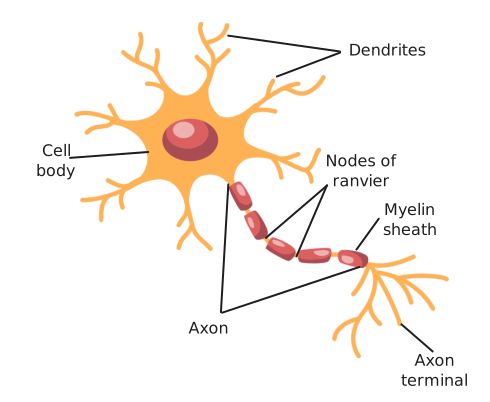
Key Structures in Neurone
- Dendrites — thin branching extensions that receive impulses from other neurones or receptors.
- Cell body — contains the nucleus and most of the cell’s organelles.
- Axon — a long, thin fibre that carries the nerve impulse (action potential) away from the cell body.
- Schwann cells — wrap around the axon to form the myelin sheath, providing electrical insulation.
- Nodes of Ranvier — gaps between Schwann cells where the axon membrane is exposed. This is where depolarisation occurs.
- Axon terminal — branched endings that form synapses with the next neurone (or an effector). They release neurotransmitters to pass the signal on.
There are 3 types of neurone:
- Sensory neurones — carry impulses from receptors to the central nervous system.
- Relay neurones — receive impulses from sensory neurones and transmit them to other relay neurones or to motor neurones.
- Motor neurones — transmit impulses from the central nervous system to effectors.
Resting Potential
What you need to know (based on the AQA specification)
What you need to know (based on the AQA specification)
The establishment of a resting potential in terms of differential membrane permeability, electrochemical gradients and the movement of sodium ions and potassium ions.
A nerve impulse is a self-propagating wave of electrical activity that travels along the axon membrane — “self-propagating” because each depolarised region triggers depolarisation of the next, so once started, the impulse continues. A neurone is either at its resting potential (not transmitting an impulse) or generating an action potential (transmitting an impulse).
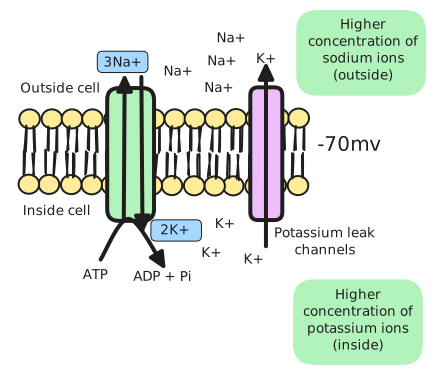
A neurone’s resting potential is −70mV. The outside of the cell is more positively charged compared to the inside — we say the membrane is polarised at rest. There is a higher concentration of sodium ions outside the cell and a higher concentration of potassium ions inside the cell.
How is this maintained?
- Sodium-potassium pumps actively transport 3 Na⁺ ions out of the cell and 2 K⁺ ions in (this requires ATP).
- The membrane is much more permeable to K⁺ than to Na⁺ — potassium ion channels allow K⁺ to diffuse back out, but relatively few Na⁺ ions can diffuse back in.
Explain how the resting potential is maintained across the axon membrane (3 marks)
Explain how the resting potential is maintained across the axon membrane (3 marks)
- There is a higher concentration of sodium ions outside and a higher concentration of potassium ions inside.
- Sodium ions are actively transported out and potassium ions are actively transported in (3 Na⁺ out, 2 K⁺ in) by the sodium-potassium pump, which requires ATP.
- The membrane is more permeable to potassium ions, allowing potassium to diffuse back out of the cell.
Tip
ATP is required for the sodium-potassium pump (active transport). If there is no ATP (e.g. due to a respiratory inhibitor), the resting membrane potential can’t be maintained.
Extra Detail — Types of Ion Channel
Extra Detail — Types of Ion Channel
There are different types of ion channel in the neurone membrane. Understanding the difference helps make sense of the action potential stages:
- Leak channels — always open. The membrane has many more K⁺ leak channels than Na⁺ leak channels, which is why it is much more permeable to potassium at rest.
- Ligand-gated channels — open when a specific molecule (e.g. a neurotransmitter) binds to them. These are the Na⁺ channels that open during the stimulus phase.
- Voltage-gated channels — open in response to a change in membrane potential. These are the Na⁺ and K⁺ channels responsible for depolarisation and repolarisation.
Action Potential
What you need to know (based on the AQA specification)
What you need to know (based on the AQA specification)
Changes in membrane permeability lead to depolarisation and the generation of an action potential. The all-or-nothing principle.
When a neurone is stimulated (e.g. pressure on a skin receptor, or neurotransmitter arriving at a synapse), sodium ion channels in the cell membrane open. If the stimulus is large enough, it causes a change in the potential difference across the membrane — this is the start of an action potential.
There are 5 stages to understand:
- Stimulus
- Depolarisation
- Repolarisation
- Hyperpolarisation
- Return to resting potential**
Stimulus
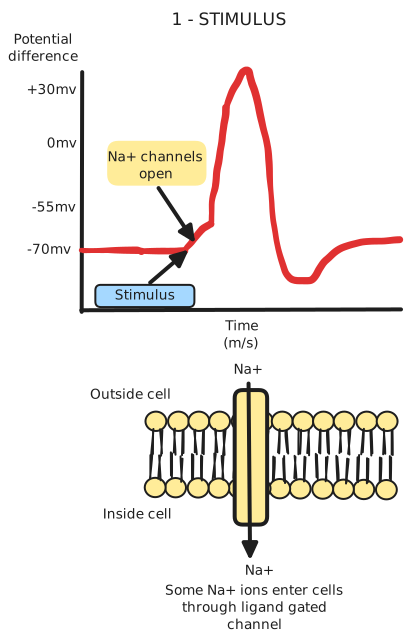
- A stimulus excites the neurone cell membrane.
- Na⁺ (sodium ion) channels open (these aren’t the voltage-gated channels yet, these are ligand-gated channels).
- The membrane becomes more permeable to sodium, so Na⁺ ions diffuse into the neurone down their electrochemical gradient.
- The inside of the neurone becomes more positive.
Depolarisation
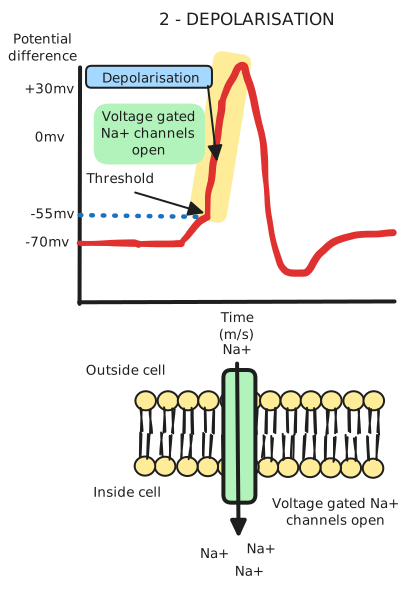
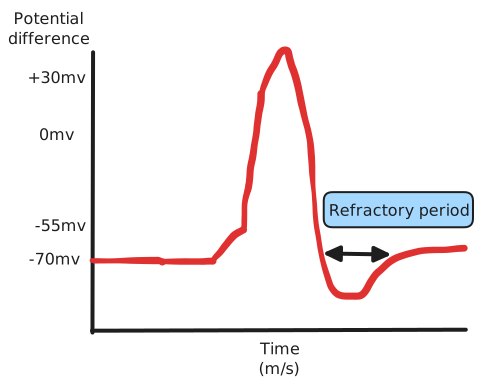
- If the potential difference reaches the threshold (−55mV), voltage-gated sodium ion channels open.
- More Na⁺ ions flood into the neurone.
- This is positive feedback — the influx of Na⁺ causes more depolarisation, which opens more voltage-gated Na⁺ channels, which causes even more depolarisation.
- The potential difference rapidly rises to around +30mV.
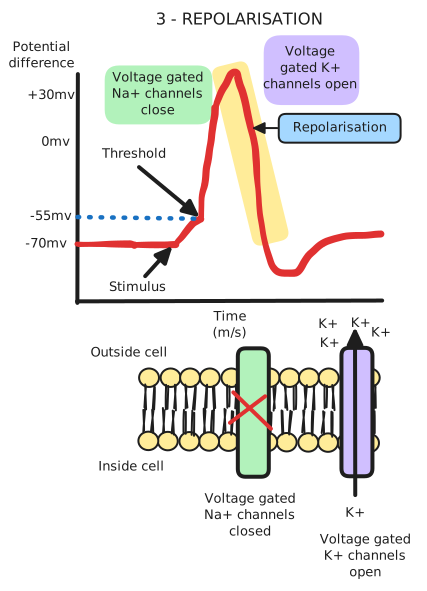
Repolarisation
- At around +30mV, the voltage-gated Na⁺ channels close.
- Voltage-gated K⁺ channels open.
- The membrane is now more permeable to potassium ions — K⁺ diffuses out of the neurone down its electrochemical gradient (both the K⁺ concentration gradient and the electrical gradient inside drive K⁺ out).
- This brings the membrane potential back down towards the resting potential.
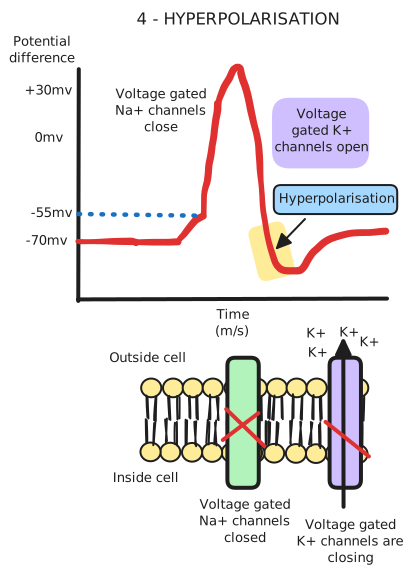
Hyperpolarisation
- The K⁺ channels are slow to close, so there’s a slight “overshoot” — too many potassium ions diffuse out of the neurone.
- The potential difference temporarily becomes more negative than the resting potential.
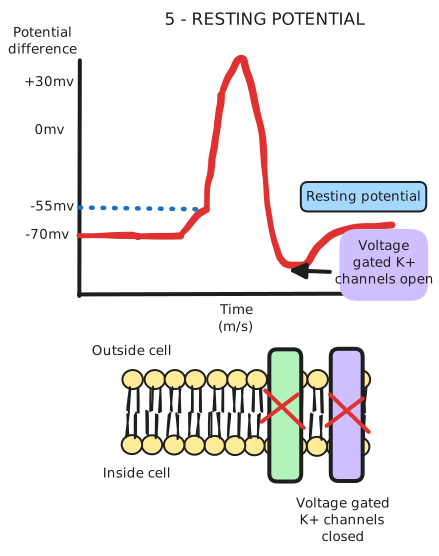
Return to resting potential
- The ion channels reset.
- The sodium-potassium pump restores the original ion concentrations (3 Na⁺ out, 2 K⁺ in), and the resting potential of −70mV is re-established.
- The neurone is ready to be stimulated again.
Refractory Period
What you need to know (based on the AQA specification)
What you need to know (based on the AQA specification)
The nature and importance of the refractory period in producing discrete impulses and in limiting the frequency of impulse transmission.
- The refractory period is a recovery phase following an action potential where the membrane cannot be immediately restimulated
- The voltage-gated Na⁺ channels cannot reopen immediately — this creates a time delay between one action potential and the next.
Extra Detail - Absolute vs Relative Refractory Periods
Extra Detail - Absolute vs Relative Refractory Periods
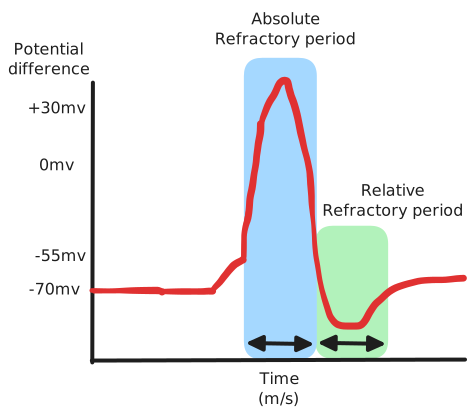
The refractory period can be split into two phases:
- Absolute refractory period — no action potential can be generated, no matter how strong the stimulus. The voltage-gated Na⁺ channels are inactivated so cannot reopen.
- Relative refractory period — an action potential can be generated, but only if the stimulus is stronger than normal. Some voltage-gated Na⁺ channels have returned to their resting state, but not all — so a stronger stimulus is needed to open enough channels to reach threshold.
Why is the refractory period important?
- Discrete impulses — ensures each action potential is a separate event and prevents continuous depolarisation.
- Limits frequency — the refractory period sets a maximum rate at which action potentials can fire, because the next one can’t start until the ion channels have reset.
- Unidirectional transmission — the region of membrane just behind the action potential is still in its refractory period, so the impulse can only travel forwards. Think of it like a Mexican wave — you can’t stand up again until you’ve sat back down.
Wave of depolarisation
- An action potential doesn’t just happen in one spot — it moves along the axon as a wave of depolarisation.
- The influx of Na⁺ creates local currents that spread through the axoplasm (cytoplasm inside the axon) to adjacent regions of membrane.
- These local currents depolarise the next region of membrane, opening its sodium ion channels — and so the action potential propagates forward.
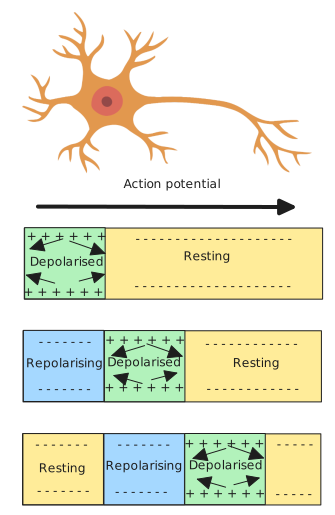
Why does the action potential only move in one direction? (As shown by the image)
Why does the action potential only move in one direction? (As shown by the image)
The region behind the depolarised area is in its refractory period. This means the voltage-gated Na⁺ channels are inactivated and cannot reopen immediately. So even if the action potential spreads backwards, it cannot trigger another action potential.
All-or-nothing principle
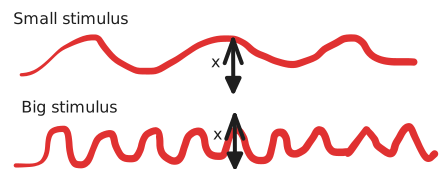
- Once the threshold is reached, an action potential will always fire at the same voltage — no matter how big the stimulus.
- If the threshold isn’t reached, no action potential fires. There is no “partial” action potential.
- So how does the body distinguish a gentle touch from a hard push? A bigger stimulus doesn’t produce a bigger action potential — instead, it causes action potentials to fire more frequently.
Myelinated vs Non-myelinated Conduction
What you need to know (based on the AQA specification)
What you need to know (based on the AQA specification)
The passage of an action potential along non-myelinated and myelinated axons, resulting in nerve impulses.
Myelinated neurones
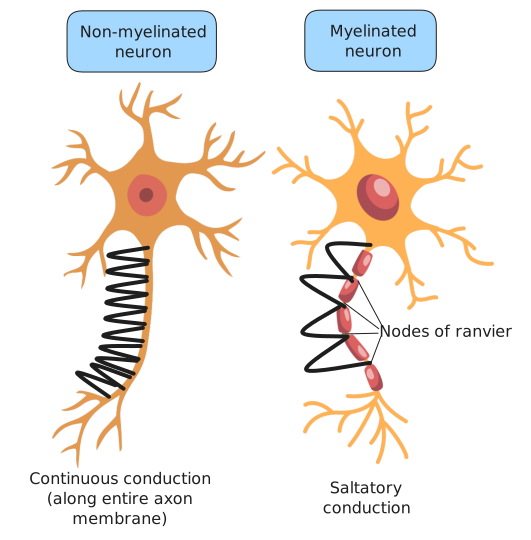
In myelinated neurones, the myelin sheath acts as an electrical insulator. The myelin sheath greatly reduces ion permeability, so depolarisation only occurs at the Nodes of Ranvier.
Local currents flow through the cytoplasm from one node to the next, so the action potential appears to “jump” from node to node. This is called saltatory conduction — and it’s much faster because the impulse skips over the insulated sections rather than depolarising every bit of membrane.
Non-myelinated neurones
In a non-myelinated neurone, there is no myelin to skip over. The impulse must depolarise the entire length of the axon membrane, section by section — which is significantly slower.
Factors affecting speed of conduction
What you need to know (based on the AQA specification)
What you need to know (based on the AQA specification)
Factors affecting the speed of conductance: myelination and saltatory conduction; axon diameter; temperature.
1. Myelination — myelin insulates the axon, so depolarisation only occurs at the Nodes of Ranvier. The impulse jumps from node to node (saltatory conduction) rather than depolarising every section of membrane, which is much faster.
2. Axon diameter — a larger diameter means less resistance to the flow of ions through the cytoplasm, so local currents spread faster and depolarisation of the next section happens more quickly.
3. Temperature — higher temperature increases the kinetic energy of ions and the rate of diffusion, so conduction speeds up. However, above around 40°C, the proteins involved (ion channels, Na⁺/K⁺ pump) begin to denature, and conduction breaks down.