Required practical 7
Use of chromatography to investigate the pigments isolated from leaves of different plants, eg, leaves from shade-tolerant and shade-intolerant plants or leaves of different colours.
Overview
Plants contain different types of photosynthetic pigments (e.g chlorophyll)
Why would it be advantageous for a plant to have different pigments in the leaf?
Why would it be advantageous for a plant to have different pigments in the leaf?
So they can absorb more different wavelengths for photosynthesis.
Chromatography can be used to separate and then compare these photosynthetic pigments present in leaves from different plants (e.g. shade-tolerant vs shade-intolerant plants). Note there are different types of chromatography, e.g thin layer, paper, but they all apply similar principles.
General Principles
-
Solvent (mobile phase)
- This is the liquid moving up the paper
- It carries the pigments with it
- If a pigment dissolves easily in the solvent (higher solubility) it will travel further
-
The paper (stationary phase)
- This stays still
- Pigments can stick to the paper
- If a pigment is attracted more strongly to the paper, it moves more slowly (higher affinity)
Method
- Grind leaf tissue with solvent (e.g. propanone) to extract pigments.
- Draw a pencil baseline near the bottom of chromatography paper
- Use pipette to apply pigment extract to the pencil line (known as point of origin)
- Place paper in solvent (propanone/acetone) ensuring the pigment spot is above the solvent (i.e the solvent is below the pencil line)
- Allow solvent to rise until near the top
- When the solvent has nearly reached the top, remove the paper from the solvent and mark in pencil the point (solvent front)
Why would you grind the leaf tissue with a solvent?
Why would you grind the leaf tissue with a solvent?
- This helps to break down cell walls of leaf cell and specifically chloroplast membrane so we can analyse the chlorophyll pigments
- It enables the pigment to dissolve in the solvent (solvent can dissolve lipids, e.g cell and chloroplast membranes)
Why would you not draw the line in pen?
Why would you not draw the line in pen?
This will ensure that the pigment and ink in the pen don’t mix
Tip for method
Ask ‘why’ do we perform each of these steps, it will help you understand and remember the method better
Calculating Rf value
Used to identify and compare pigments.
$$ R_f = \frac{\text{distance moved by pigment from baseline}}{\text{distance moved by solvent front from baseline}} $$
- Each pigment has a characteristic Rf value in a given solvent.
- Rf values depend on the solvent used, so comparisons must use the same solvent.
- Rf values can be compared between different plants to identify differences in pigment composition.
Example Rf Calculation
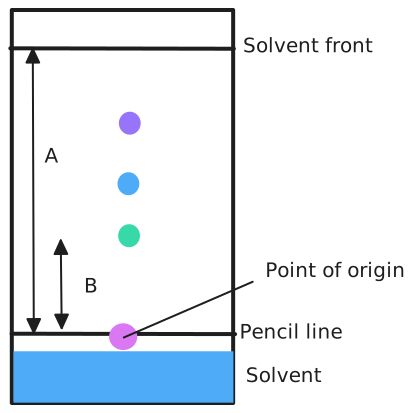
From the chromatogram:
-
A = distance travelled by the solvent front from the pencil line
-
B = distance travelled by the pigment spot from the pencil line
-
Distance travelled by solvent front (A) = 8.0 cm
-
Distance travelled by pigment spot (B) = 3.2 cm
$$ R_f = \frac{B}{A} $$
$$ R_f = \frac{3.2}{8.0} = 0.40 $$
- The pigment has an Rf value of 0.40 in this solvent.
- This value can be compared with:
- known pigment Rf values
- pigments from other plants (using the same solvent)
Exam Questions
A student used chromatography to separate the different photosynthetic pigments in a chlorophyll solution. She had the following materials:
- Chromatography paper
- A ruler and pencil
- Suitable glassware
- A solvent (solvent A)
- 2 cm³ of the chlorophyll solution
Describe how she could use these materials to separate the photosynthetic pigments by chromatography.
(4 marks)Hint
Think about the steps in order: how do you prepare the paper, apply the sample, run the chromatography, and know when to stop?
Mark Scheme
- Draw a pencil line/origin near the bottom of the chromatography paper using a ruler — pencil is used so the line does not dissolve in the solvent (1 mark)
- Use a pipette/dropper to apply the chlorophyll solution to the pencil line/origin (1 mark)
- Place the paper in the solvent so the solvent level is below the pencil line — this prevents the pigment from dissolving directly into the solvent (1 mark)
- Remove the paper before the solvent reaches the top (or mark the solvent front in pencil when it is near the top) — this records the distance the solvent has travelled for Rf calculation (1 mark)
Tips from examiner reports
- Students often forget to mention the line must be drawn in pencil not pen — pen ink would dissolve in the solvent and interfere with results.
- “Below the line” is key — if the solvent covers the origin, the pigments dissolve into the solvent rather than travelling up the paper.
- A common mistake is saying “so the ink doesn’t run” — be specific: it’s so the line doesn’t dissolve in the solvent and interfere with the chromatogram.
A student separated photosynthetic pigments using chromatography. The solvent front moved 9.2 cm from the origin. One pigment spot moved 3.68 cm from the origin.
Calculate the Rf value of this pigment.
(2 marks)Hint
Remember the Rf formula — it’s a ratio of two distances, both measured from the same starting point.
Mark Scheme
- Rf = distance moved by pigment ÷ distance moved by solvent front (1 mark)
- Rf = 3.68 ÷ 9.2 = 0.4 (1 mark)